

The pancreatitis flare: pain relief, anti-nausea, and feeding through it
Alastair Greenway
BVM&S MRCVS
A pet with a painful pancreas and no appetite raises one practical question, whether you're in the waiting room while they're admitted on a drip or back home watching a slow recovery: what now?
Here's the part that catches most owners out: no single drug switches pancreatitis off. Treatment of an acute flare is supportive and symptomatic, buying the pancreas time to settle while keeping your pet comfortable, hydrated and fed (Forman et al., 2021; Lim et al., 2024; Walton, 2020). This article walks through that care, and the biggest shift in how we give it: we no longer starve the pancreas. For what pancreatitis actually is, and the guilt about a fatty meal, start with pancreatitis explained. And if your pet is vomiting, painful and off their food right now, our Vomiting and Diarrhoea Triage helps you judge how urgent this is.
Four pillars to get through a flare
Treatment rests on four pillars. The first three are done in hospital; the fourth is where home care picks up.
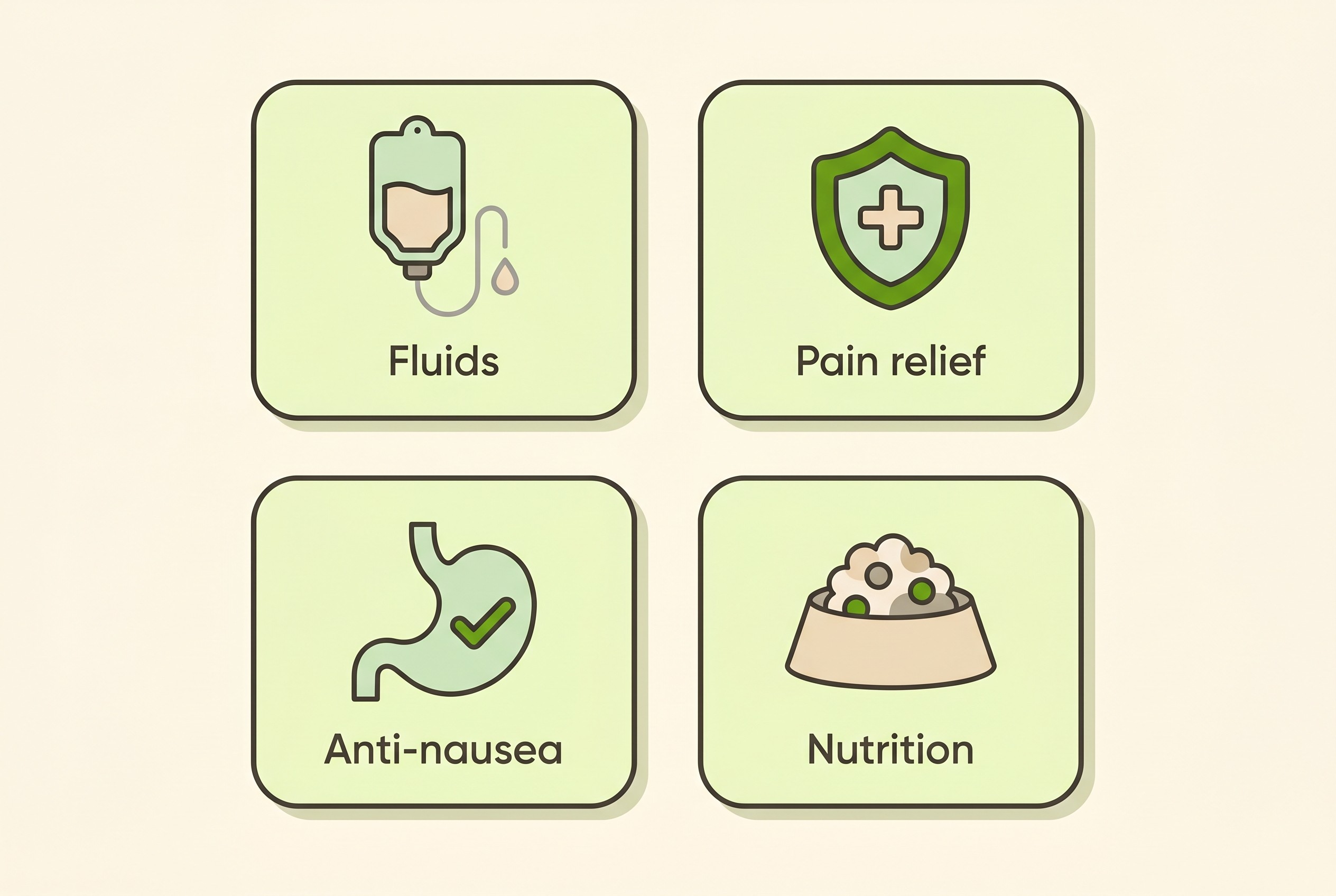
Fluids are the foundation. Intravenous crystalloid fluids, a balanced salt solution such as lactated Ringer's, correct the dehydration from vomiting and not drinking, replace ongoing losses, and support blood flow to the inflamed pancreas (Forman et al., 2021; Lim et al., 2024; Walton, 2020). For anything more than a mild case it is the single most important thing we do, adjusted to your pet's losses rather than set and forgotten (Lim et al., 2024).
The other three are pain relief, because pancreatitis genuinely hurts (Cridge et al., 2021; Forman et al., 2021); anti-nausea medication, which makes early feeding possible; and nutrition, which has changed most.
Feed, don't starve
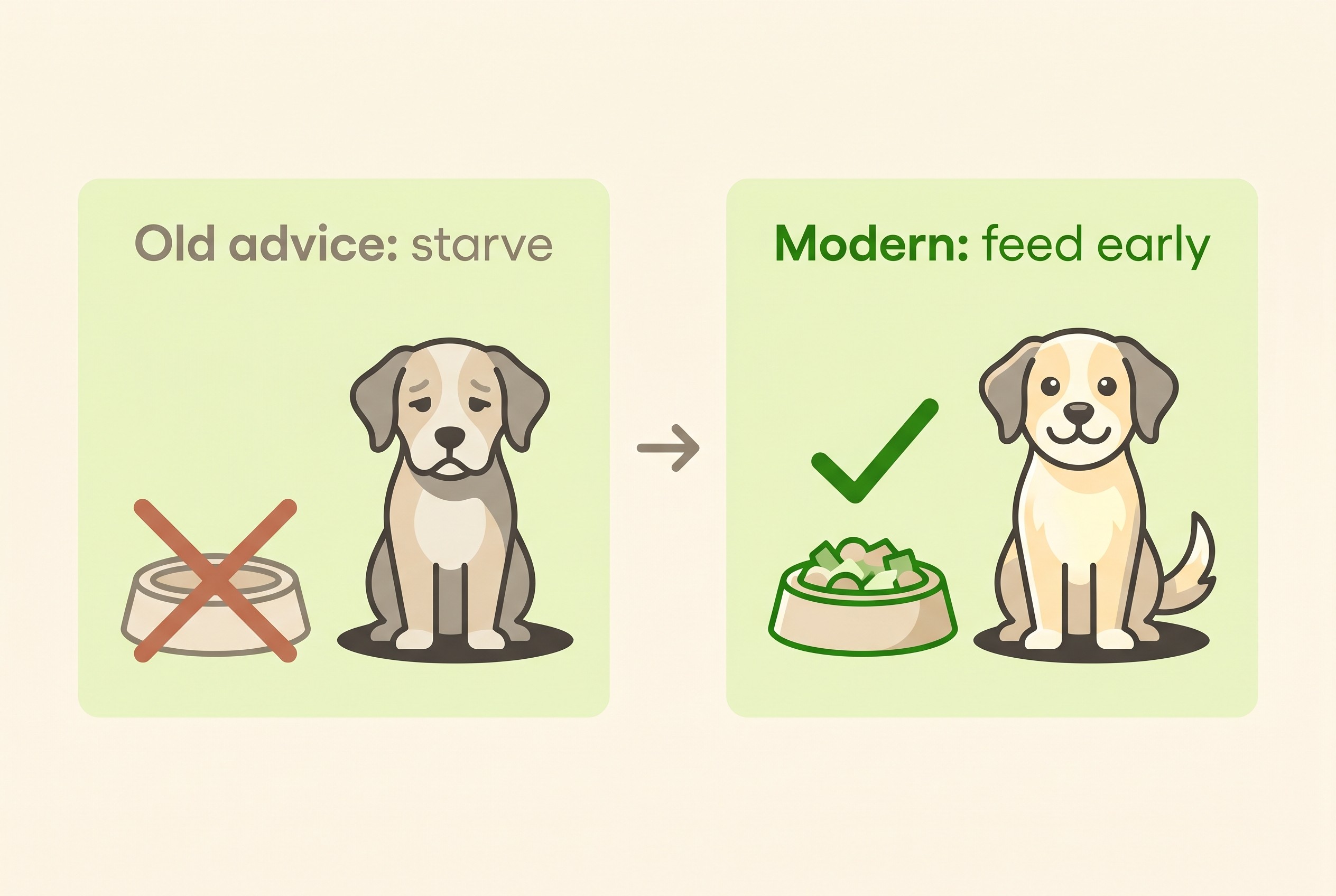
For a long time the standard advice was to rest the pancreas by withholding food, sometimes for days, on the logic that eating stimulates it and would pour fuel on the fire. It is the most repeated piece of old advice about this disease, and it is wrong (Jensen & Chan, 2014; Mansfield et al., 2011; Forman et al., 2021).
The reason is that the gut lining depends on nutrients arriving in the gut itself to stay healthy. Starve an animal for days and the intestinal barrier deteriorates, letting gut bacteria and their toxins leak across the weakened wall while immunity is dampened (Jensen & Chan, 2014; Lim et al., 2024). Prolonged gut rest does not soothe a sick pet; it quietly makes them sicker, so the goal has flipped to feeding early.
The evidence in pets backs this up. In a pilot of ten dogs with severe acute pancreatitis, those fed early through a tube had fewer episodes of vomiting and regurgitation than dogs fed intravenously; it showed early feeding is tolerated, not that it saves more lives (Mansfield et al., 2011). A larger retrospective study of thirty-four dogs found feeding within forty-eight hours of admission gave a faster return to voluntary eating and significantly less gut upset (26% of early-fed dogs against 60% of those fed later), though it did not shorten the hospital stay (Harris et al., 2017). In cats the message is firmer still: the feline consensus is explicit that withholding food is actively harmful, because a cat that stops eating is at real risk of fatty liver, so waiting to see whether they will eat is exactly the wrong instinct (Forman et al., 2021).
So how is feeding actually achieved? The first aim is to tempt voluntary eating. If that fails, the modern approach is assisted feeding through a narrow tube passed up the nose: well tolerated, and far kinder than syringe force-feeding, which worsens food aversion and risks food going into the lungs (Harris et al., 2017; Jensen & Chan, 2014; Walton, 2020). Please hear a feeding tube as good care, not a failure. The food is usually a highly digestible, low-fat one in dogs; what to feed long-term lives in low-fat feeding for a pancreas.
One caveat is worth keeping in mind. Early feeding is now standard of care and makes good mechanistic sense, but the canine evidence is still modest and partly borrowed from human medicine. It is the best-supported approach, not one settled by a large trial (Jensen & Chan, 2014; Lim et al., 2024).
Pain relief, taken seriously
Pancreatitis hurts, and the pain is easy to miss. Some dogs are stoic, and cats go quiet, hunched and off their food rather than crying out, so an absence of obvious distress is not an absence of pain (Cridge et al., 2021; Forman et al., 2021; Lim et al., 2024). The classic sign in a dog is the "praying" posture, chest down and bottom up to ease a sore belly, but many show nothing more than not wanting to eat. Good practice now gives pain relief on suspicion rather than waiting for proof, treating a pet that will not eat as one that may be hurting rather than stubborn.
The mainstay is opioids. A strong opioid such as methadone, or fentanyl as an infusion, covers moderate to severe pain, while buprenorphine suits gentler discomfort and is a practical choice in cats (Forman et al., 2021; Lim et al., 2024). For pain that is hard to settle, your vet can add low-dose ketamine or lidocaine infusions to reduce the opioid needed (Lim et al., 2024; Walton, 2020).
One specific warning, because it prevents harm at home: the everyday anti-inflammatory painkillers, the NSAIDs such as meloxicam, are deliberately avoided in a flare, because these dehydrated pets are at real risk of kidney injury and stomach ulceration from them (Lim et al., 2024; Marks et al., 2018; Walton, 2020). Please do not give human anti-inflammatories or leftover tablets at home.
Anti-nausea, and the truth about acid drugs
The usual first choice for nausea and vomiting is maropitant, sold as Cerenia. It blocks the main vomiting pathway, is licensed for vomiting in dogs and cats, and is the most widely used anti-sickness drug here (Forman et al., 2021; Lim et al., 2024). There is also early, experimental evidence it may relieve visceral pain and dampen inflammation beyond stopping vomiting (Boscan et al., 2011; Tsukamoto et al., 2018): a plausible bonus, not a substitute for real pain relief. If it is not enough alone, metoclopramide, which also helps the stomach empty, or ondansetron can be added (Forman et al., 2021; Walton, 2020).
Stomach-acid drugs, the proton-pump inhibitors such as omeprazole and the older H2 blockers, along with the gut-coating drug sucralfate, were once routine in pancreatitis, and should not be. The consensus review of these gut protectants found no evidence for acid suppression unless there is actual ulceration or bleeding, such as vomiting blood or black, tarry stool, in which case omeprazole is preferred over an H2 blocker (Marks et al., 2018). For the same reason, antibiotics are not routine in an uncomplicated flare, which is mostly a sterile inflammation; the wider stewardship story sits in antibiotics for diarrhoea.
Tempting a nauseous pet to eat at home
Once home, the appetite is often the last thing to recover, and this is where you come in. The appetite stimulant with the best evidence is mirtazapine, which doubles as an anti-sickness drug. For cats there is a transdermal ointment, rubbed onto the inner ear and licensed in the UK and beyond, that produced significant weight gain in a placebo-controlled trial of cats losing weight (Poole et al., 2019; Quimby et al., 2020); it is also used off-licence as tablets in dogs, and is the obvious thing to ask your vet about (Forman et al., 2021). Another option, capromorelin, mimics the hunger hormone but is licensed only in the United States, so UK and EU owners can get it by case-by-case import alone (Forman et al., 2021).
Beyond medication, a few gentle things help. Offer small, frequent meals of the prescribed low-fat food, warmed slightly to release the smell, and hand-feed in a calm, quiet spot. Resist the urge to reach for rich or fatty tempters: a high-fat mouthful is close to the worst thing you can offer a recovering pancreas (pancreatitis explained has the why). And do not force it: persistent refusal to eat is a reason to go back to your vet, not to keep coaxing (Forman et al., 2021; Lim et al., 2024).
Recovery is easier to judge when you track it. Logging appetite, how often your pet is sick, and stool quality with the Faecal Score Tracker turns a vague "a bit better, I think" into a trend you and your vet can both see: a pet eating more each day, brightening and being sick less is heading the right way, while one that stalls needs another look. What to record is covered in describing symptoms to your vet.
When a flare is becoming an emergency
All of the above assumes a pet stable enough to treat. Some flares tip into a genuine emergency, and a handful of warning signs mean you should not wait: collapse, pale or grey gums, a severely painful or swollen belly, vomiting that will not stop, vomiting blood or black tarry stool, and rapid deterioration (Forman et al., 2021; Lim et al., 2024). The severe end of acute pancreatitis carries a real risk to life, which is why prompt veterinary care beats anything attempted at home (Fabrès et al., 2019). Most mild cases settle well, but know the line: the full red-flag list lives in digestive emergencies, and the Vomiting and Diarrhoea Triage is built for that decision.
There is a hopeful direction of travel. A newer hospital drug, fuzapladib (sold as Panoquell-CA1), is the first medicine aimed at the inflammation itself rather than just supporting the pet through it. It is conditionally approved in the United States and approved in Japan, but not licensed in the UK or EU, and even where used it sits alongside supportive care, not instead of it (Lim et al., 2024). For now the four pillars remain the heart of it, and with them most pets come out the other side. Your part at home, feeding little and often and knowing when to pick up the phone, is a real reason why.
References
- Boscan, P., Monnet, E., Mama, K., Twedt, D. C., Congdon, J., & Steffey, E. P. (2011). Effect of maropitant, a neurokinin-1 receptor antagonist, on anesthetic requirements during noxious visceral stimulation of the ovary in dogs. American Journal of Veterinary Research, 72(12), 1576-1579.
- Cridge, H., Twedt, D. C., Marolf, A. J., Sharkey, L. C., & Steiner, J. M. (2021). Advances in the diagnosis of acute pancreatitis in dogs. Journal of Veterinary Internal Medicine, 35(6), 2572-2587.
- Fabrès, V., Dossin, O., Reif, C., et al. (2019). Development and validation of a novel clinical scoring system for short-term prediction of death in dogs with acute pancreatitis (the CAPS score). Journal of Veterinary Internal Medicine, 33(2), 499-507.
- Forman, M. A., Steiner, J. M., Armstrong, P. J., et al. (2021). ACVIM consensus statement on pancreatitis in cats. Journal of Veterinary Internal Medicine, 35(2), 703-723.
- Harris, J. P., Parnell, N. K., Griffith, E. H., & Saker, K. E. (2017). Retrospective evaluation of the impact of early enteral nutrition on clinical outcomes in dogs with pancreatitis: 34 cases (2010-2013). Journal of Veterinary Emergency and Critical Care, 27(4), 425-433.
- Jensen, K. B., & Chan, D. L. (2014). Nutritional management of acute pancreatitis in dogs and cats. Journal of Veterinary Emergency and Critical Care, 24(3), 240-250.
- Lim, S. Y., Cridge, H., Twedt, D. C., Ohta, H., Nuruki, T., & Steiner, J. M. (2024). Management of acute-onset pancreatitis in dogs: a narrative review. Journal of the American Veterinary Medical Association, 262(9), 1231-1240.
- Mansfield, C. S., James, F. E., Steiner, J. M., Suchodolski, J. S., Robertson, I. D., & Hosgood, G. (2011). A pilot study to assess tolerability of early enteral nutrition via esophagostomy tube feeding in dogs with severe acute pancreatitis. Journal of Veterinary Internal Medicine, 25(3), 419-425.
- Marks, S. L., Kook, P. H., Papich, M. G., Tolbert, M. K., & Willard, M. D. (2018). ACVIM consensus statement: support for rational administration of gastrointestinal protectants to dogs and cats. Journal of Veterinary Internal Medicine, 32(6), 1823-1840.
- Poole, D., Quimby, J. M., Hu, T., Labelle, D., & Buhles, W. (2019). A double-blind, placebo-controlled, randomized study to evaluate the weight gain drug, mirtazapine transdermal ointment, in cats with unintended weight loss. Journal of Veterinary Pharmacology and Therapeutics, 42(2), 179-188.
- Quimby, J. M., Benson, K. K., Summers, S. C., Saffire, A., Herndon, A. K., Bai, S., & Gustafson, D. L. (2020). Assessment of compounded transdermal mirtazapine as an appetite stimulant in cats with chronic kidney disease. Journal of Feline Medicine and Surgery, 22(4), 376-383.
- Tsukamoto, A., Ohgoda, M., Haruki, N., Hori, M., & Inomata, T. (2018). The anti-inflammatory action of maropitant in a mouse model of acute pancreatitis. Journal of Veterinary Medical Science, 80(3), 492-498.
- Walton, S. A. (2020, February 17). Treatment of acute pancreatitis in dogs. Today's Veterinary Practice.
Keep track of how your pet is doing
The owners who cope best are the ones who notice changes early. A simple health log shows you what is working, and what is not, before the next vet visit.
Start tracking, freeYou're not doing this alone
Compare treatment journeys and talk to owners managing digestive health. Free to join.
Join PetsLikeMine