


Does my pet need antibiotics for diarrhoea? (Usually not)
Alastair Greenway
BVM&S MRCVS
For most pets with a bout of diarrhoea, the evidence-based answer to the antibiotic question is no. Reaching for antibiotics is more likely to do harm than good, and if you have come here hoping I will tell you otherwise, I am going to gently disappoint you.
This is a position the profession itself has had to change its mind on. For decades a great many vets, me included earlier in my career, reached almost automatically for metronidazole when a dog turned up with a loose tummy. It felt like doing something, and we now know it usually was not. The research of the last few years has been clear enough to flip the formal guidelines, even though most public, brand and home-remedy advice online has not caught up. So this is the version your vet would want you to read: why antibiotics rarely help, the few times they do, and what is worth doing instead.
Most diarrhoea settles on its own
The great majority of acute diarrhoea is self-limiting: mild to moderate, usually dietary or a passing infection, and it settles within a few days whether or not you treat it, as the gut clears the irritant and the lining repairs (Langlois et al., 2020; Jessen et al., 2024; Scahill et al., 2024).
So the first and far more useful question is not "which drug" but "is my pet well enough to get better with supportive care, or showing something that needs a vet today". Our Vomiting and Diarrhoea Triage walks you through the questions I would ask on the phone. The genuine red flags that mean go now rather than wait, the bloody, collapsing, swollen-belly or suspected-poison patterns, are owned by digestive emergencies, and if any of those fit your pet that is the article you need, not this one. What I want to settle here is the antibiotic question for the well, uncomplicated pet, which is the large majority.
What the trials actually found
When researchers have tested antibiotics against placebo in uncomplicated acute diarrhoea, they have repeatedly failed to find a benefit worth having. The most authoritative answer comes from a systematic review and meta-analysis pooling the trials, which found high-certainty evidence that antimicrobial treatment had no clinically relevant effect on any outcome in dogs with mild or moderate diarrhoea (Scahill et al., 2024). High certainty means the next study is unlikely to overturn it. On the strength of that, the European guideline now strongly recommends against antibiotics in both mild and moderate disease (Jessen et al., 2024), and the WSAVA's owner-facing guidance agrees: high certainty that antimicrobials are not needed for mild and moderate canine acute diarrhoea (WSAVA/ENOVAT, 2024).
It is worth being scrupulously fair about the one trial that did show a difference, because a good myth-buster does not bury inconvenient evidence. In a randomised, double-blinded, placebo-controlled study of 31 dogs, diarrhoea resolved a little faster on metronidazole than on placebo, about 2.1 days versus 3.6 on average (Langlois et al., 2020). But the authors' own conclusion is telling: every dog recovered regardless of treatment, and they wrote that metronidazole use "should be carefully considered" because their result did not rule out other treatments being as good or better (Langlois et al., 2020). So the fair synthesis is a roughly day-and-a-half average head start, in one small trial in which everyone got better anyway, set against real costs and against newer work pointing the other way.
That newer work matters. A randomised controlled trial in dogs with non-infectious acute colitis compared an easily-digestible diet, the same diet plus metronidazole, and a fibre-enhanced diet, and found dietary management resolved the signs as fast or faster, with the metronidazole group actually the slowest to come right (Rudinsky et al., 2022). For that common large-bowel pattern, the diet treated the problem better, and more safely, than the antibiotic.
When antibiotics genuinely are the right call
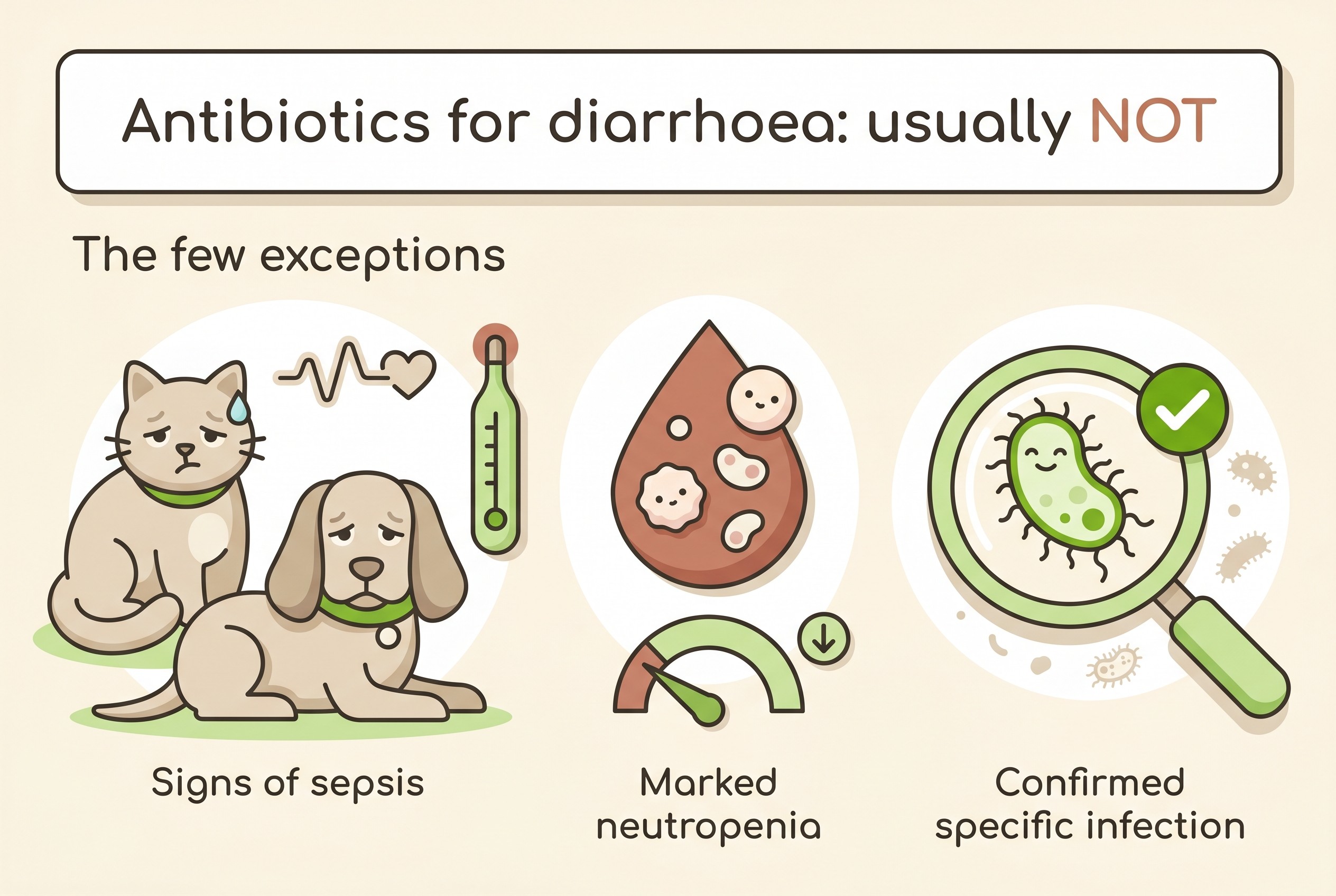
Which brings me to the most important word in the title: "usually". Usually not is not the same as never, and I do not want any owner of a genuinely sick pet to read this and refuse treatment their animal needs. Antibiotics are warranted when there are signs of sepsis or systemic infection, when bloods show marked changes such as a severe neutrophilia, a neutropenia or a degenerative left shift, when there is mucosal sloughing with impending sepsis, and in specific, confirmed infections where treatment is genuinely indicated (Jessen et al., 2024; WSAVA/ENOVAT, 2024). The thread tying these together is that the antibiotic is for a pet who is systemically unwell, not for the diarrhoea itself. The European guideline reflects this exactly: a strong steer against antibiotics in mild and moderate disease, but a conditional suggestion they may be appropriate in severe disease (Jessen et al., 2024).
This even extends to the dramatic cases. In dogs with acute haemorrhagic diarrhoea, the sudden, bloody, almost jam-like kind, who were not septic, antibiotics did not improve survival, shorten hospital stays or reduce the severity of illness compared with placebo (Unterer et al., 2011). The syndrome is largely toxin-mediated and self-limiting with good fluid support, so antibiotics are reserved for the ones who tip into sepsis. Recognising that kind of emergency belongs to digestive emergencies; the unwell, septic, collapsing patient is the genuine exception, and needs a vet whatever any article says.
What actually helps instead
If antibiotics are not the answer for the everyday case, what is? Reassuringly mundane things: hydration, a little time, and getting the food right. The modern approach favours feeding early and lightly rather than the old 24-hour fast, and for that common colitis pattern diet beat metronidazole outright (Rudinsky et al., 2022). The full how-to of safe home care is owned by tummy upset home care.
Probiotics are the other thing owners reach for, and I will be straight rather than hopeful: the same meta-analysis also looked at nutraceutical and probiotic products and found no clinically significant effect on shortening diarrhoea (Scahill et al., 2024). A specific, evidenced strain may help a little and is very unlikely to harm, but it is not a cure.
What genuinely helps is watching the trend. Logging your pet's stool in our Faecal Score Tracker turns "he seems a bit better" into a line you can see improving, which is the usual story on supportive care alone, and hands your vet real data if a visit becomes necessary. How to score and photograph stool belongs to describing symptoms to your vet.
A quick word on chronic cases
Everything above is about acute diarrhoea. Long-standing or recurrent diarrhoea is a different conversation: a small subset of chronic enteropathy historically responded to antibiotics such as tylosin or metronidazole, but even there the profession has moved towards diet-led, microbiome-sparing management, and any such use is a monitored decision made during a work-up, not a day-one reach for a pill (Jessen et al., 2024). That framework is owned by chronic enteropathy treatment.
Talking it through with your vet
If your vet does not prescribe antibiotics, the most useful thing to ask is not "why won't you give antibiotics" but "is my pet well enough to recover with supportive care, and what should I watch for". And if your vet does want to prescribe one, it is entirely fair to ask what specifically they are worried about: a good vet will gladly explain the sepsis risk, the blood result or the confirmed infection that puts your pet in the exception group rather than the rule. Good medicine here is a shared, informed decision, not a tug-of-war, and a vet practising careful antimicrobial stewardship is looking after both your pet and the wider resistance problem that touches animal and human health (BSAVA/SAMSoc, 2023).
So, most pets get better on their own with hydration, sensible feeding and a little time, and the cases that genuinely need an antibiotic are the unwell ones your vet will recognise. Keep an eye on the trend, know your red flags, and you are doing right by your pet.
References
- BSAVA/SAMSoc. (2023). PROTECT ME: guide to responsible use of antibacterials (antimicrobial stewardship toolkit and poster). British Small Animal Veterinary Association and the Small Animal Medicine Society.
- Jessen, L. R., Werner, M., Singleton, D., Prior, C., Foroutan, F., Ferran, A. A., ... Scahill, K. (2024). European Network for Optimization of Veterinary Antimicrobial Therapy (ENOVAT) guidelines for antimicrobial use in canine acute diarrhoea. The Veterinary Journal, 307, 106208.
- Langlois, D. K., Koenigshof, A. M., & Mani, R. (2020). Metronidazole treatment of acute diarrhea in dogs: A randomized double blinded placebo-controlled clinical trial. Journal of Veterinary Internal Medicine, 34(1), 98-104.
- Pilla, R., Gaschen, F. P., Barr, J. W., Olson, E., Honneffer, J., Guard, B. C., ... Suchodolski, J. S. (2020). Effects of metronidazole on the fecal microbiome and metabolome in healthy dogs. Journal of Veterinary Internal Medicine, 34(5), 1853-1866.
- Rudinsky, A. J., Parker, V. J., Winston, J., Cooper, E., Mathie, T., Howard, J. P., ... Gilor, C. (2022). Randomized controlled trial demonstrates nutritional management is superior to metronidazole for treatment of acute colitis in dogs. Journal of the American Veterinary Medical Association, 260(S3), S23-S32.
- Scahill, K., Jessen, L. R., Prior, C., Singleton, D., Foroutan, F., Ferran, A. A., ... Werner, M. (2024). Efficacy of antimicrobial and nutraceutical treatment for canine acute diarrhoea: A systematic review and meta-analysis for European Network for Optimization of Antimicrobial Therapy (ENOVAT) guidelines. The Veterinary Journal, 303, 106054.
- Unterer, S., Strohmeyer, K., Kruse, B. D., Sauter-Louis, C., & Hartmann, K. (2011). Treatment of aseptic dogs with hemorrhagic gastroenteritis with amoxicillin/clavulanic acid: A prospective blinded study. Journal of Veterinary Internal Medicine, 25(5), 973-979.
- Werner, M., Suchodolski, J. S., Straubinger, R. K., Wolf, G., Steiner, J. M., Lidbury, J. A., ... Unterer, S. (2020). Effect of amoxicillin-clavulanic acid on clinical scores, intestinal microbiome, and amoxicillin-resistant Escherichia coli in dogs with uncomplicated acute diarrhea. Journal of Veterinary Internal Medicine, 34(3), 1166-1176.
- WSAVA/ENOVAT. (2024). Five steps of canine acute diarrhea treatment (owner and clinician guidance). World Small Animal Veterinary Association.
Keep track of how your pet is doing
The owners who cope best are the ones who notice changes early. A simple health log shows you what is working, and what is not, before the next vet visit.
Start tracking, freeYou're not doing this alone
Compare treatment journeys and talk to owners managing digestive health. Free to join.
Join PetsLikeMine