


How to describe it to your vet (and what to photograph)
Alastair Greenway
BVM&S MRCVS
There is a sentence I hear more often than almost any other, and it is the one that helps me least. "He's had a bad tummy." I never blame the owner for it, because by the time you are across the table from me the detail has usually gone fuzzy: how many times, whether the blood was bright red or more like tar, whether it followed a meal or came up overnight. Most people, quite reasonably, cannot say. That is a real problem, because vomiting and diarrhoea are signs, not diagnoses, and the way a vet narrows a long list of causes is by the pattern: the timing, the frequency, what it looks like, its relationship to food, and a handful of localising features (Hall, Williams & Kathrani, 2020). You are the only person who sees that pattern at home, and this guide is about turning you into a precise reporter of it.
It will not tell you what your observations mean, or which of them is an emergency. That interpretation, and the acute-versus-chronic split, lives in what is causing it, and the red flags in the emergency guide. My job here is narrower, and it is to help you record what you see.
Memory fades, and that is only human
Owner recall of tummy episodes fades, and that is not a failing, it is simply human. In the Dogslife cohort, which followed a large group of Labradors over years, episodes that did not prompt a vet visit were logged after a median of around 40 days, against about 16 days for episodes that did; and most episodes never reached a vet at all, with only around 37% of diarrhoea and 28% of vomiting reports leading to a consultation (Pugh et al., 2017). The longer the gap, the fuzzier the detail.
The fix is simple and kind to yourself: record it as it happens, not from memory at the appointment. A note made in the moment ("third soft stool today, bit of mucus, otherwise bright") beats a reconstruction a week later. This is the whole reason the Faecal Score Tracker exists: not a medical chart, just somewhere to jot down what you would otherwise forget.
Faecal scoring, done properly
The single most useful thing you can learn is to score your pet's stool against a chart, because it replaces a vague word ("loose", "soft", "not right") with a number that means the same thing to you and your vet. The widely used one is a 7-point scale. On the Nestlé Purina chart it runs from 1, very hard and dry, in separate pellets, through the firm, segmented, easy-to-lift stool at 2, the moist but still log-shaped stool around 3 and 4, to 7, watery with no texture at all (Nestlé Purina PetCare). The same scale, with the same anchors, is used for dogs and cats.
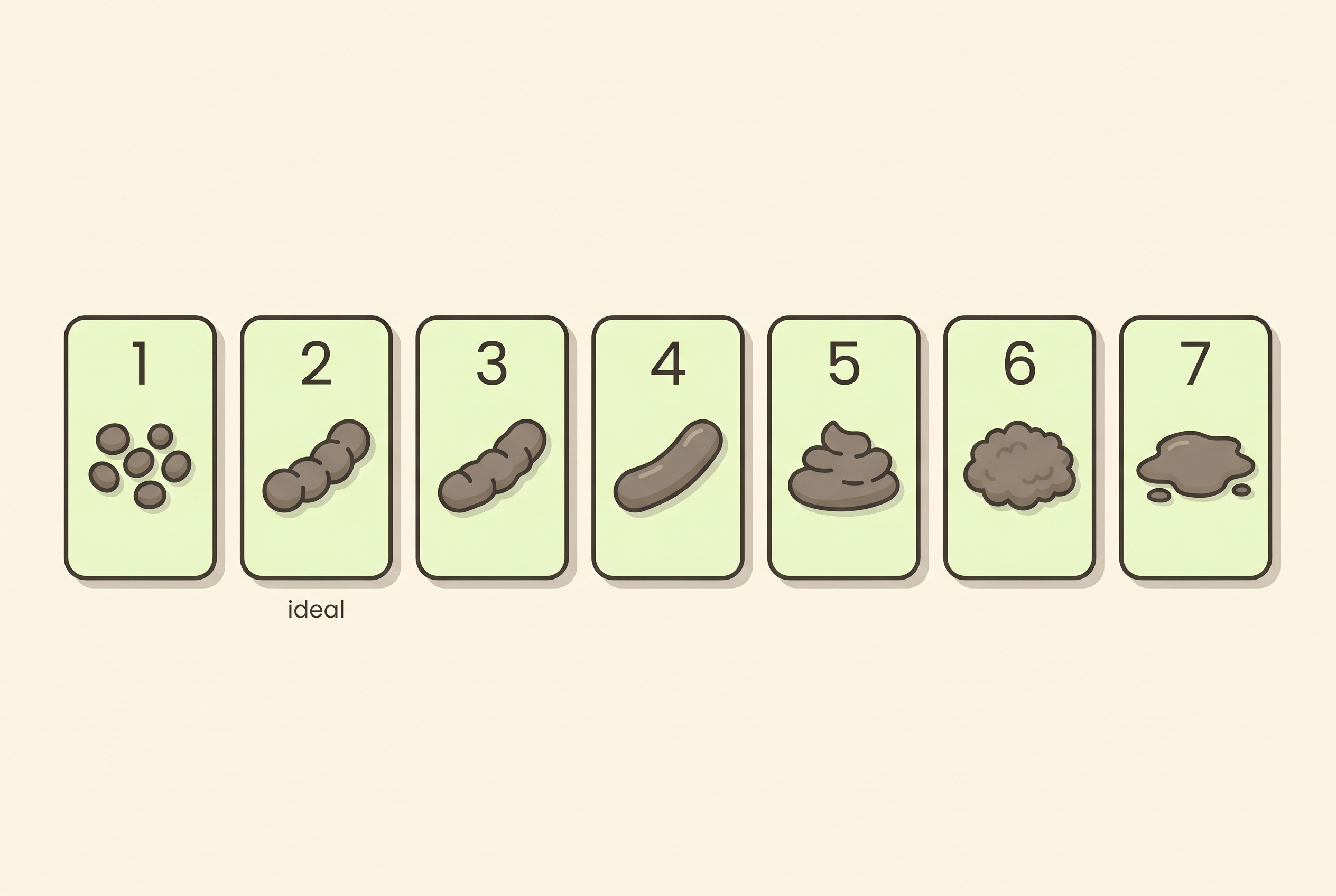
What you are aiming for in a healthy pet is the firm but not hard, segmented stool you can lift cleanly off the ground in one piece. On the Purina chart that ideal is named explicitly as a score of 2 (Nestlé Purina PetCare). Plenty of blogs loosely call "3" or "the middle" normal, and a healthy stool does sit around a 2 to 3, but I would follow the official chart rather than the internet.
The exact number matters less than you might think, because there is more than one chart and they are not numbered identically: the other common one is the WALTHAM faeces scoring system, on which the ideal is also a 2 (Moxham, 2001), and a separate Royal Canin chart uses half-point increments. Score a 3 on one and a 2.5 on another and you have learned about the charts, not your pet. So pick one, ideally the one your tracker or vet uses, and stick with it. The effort is worth it because faecal scoring is the standard yardstick in gut research: studies track the score falling over days or weeks rather than relying on "seems a bit better" (Cavett et al., 2021). Score at home and you are using the same measure your vet and the published trials use.
A photo closes the gap
I want to be straight about one nuance, because the brand "poop chart" pages never are. Scoring is reliable between experienced people but only fair between a vet and a member of the public who has not done it before: in the key reliability study, vet-to-vet agreement was reasonable (kappa around 0.40 to 0.77 on the Purina scale) but fell between a vet and a lay scorer (around 0.38), improving with practice (Cavett et al., 2021). The message is emphatically not "you'll get it wrong". It is that scoring takes a little practice, and the simplest way to remove the guesswork is to also take a photo.
This is where the slightly grim bit earns its place, because the evidence is good. A 2025 validation study found that faecal scoring from photographs agreed very closely with scoring fresh stool in person, without meaningful bias, so a clear photo is a legitimate stand-in for the vet seeing it themselves (Chauvel et al., 2025). That study was done in puppies, so I would extend it sensibly to adult dogs and cats rather than claim it is separately proven in each.
Beyond the number: what else to jot down
The score is the backbone, but a few extra observations help your vet localise the problem. You are recording these, not interpreting them, so keep each to a quick line and leave the meaning to me.
Blood, and which kind. The colour points to where the bleeding is. Fresh, bright-red blood in or on the stool tends to come from the lower bowel, and with mucus and straining suggests a large-bowel problem; dark, tarry, almost black stool is digested blood from higher up, in the stomach or small intestine (Vessieres & Walker, 2016; Hall, Williams & Kathrani, 2020). One caveat worth knowing: that black, tarry stool only appears once a fair amount of upper-gut bleeding has occurred (Veterian Key), so "no black stool" does not rule bleeding out. Report the colour accurately and leave the call to your vet.
The shape of the diarrhoea. Small-bowel diarrhoea tends to be a larger volume only slightly more often, sometimes with weight loss; large-bowel diarrhoea tends to be small amounts, very frequently, with urgency, straining and mucus (Vessieres & Walker, 2016; Hall, Williams & Kathrani, 2020). Think "a lot, a few times" versus "a little, often, with straining": that alone often tells your vet which half of the bowel to look at.
Frequency and timing. How many episodes a day, whether it is getting better or worse, and whether it follows meals or happens overnight on an empty stomach. Record it accurately, but resist drawing the conclusion yourself, because timing is easy to over-interpret (Armstrong, 2013).
Vomiting: count and contents. How many times, and what came up: recently eaten food, yellow bile, frothy white fluid, blood. And one line that matters: whether it came up effortlessly or with retching, and whether your pet tried unproductively to bring something up (Armstrong, 2013). Effortless bringing-up and true vomiting are different problems, explained in vomiting versus regurgitation, so just tell your vet which one you saw.
Appetite, thirst, energy and weight. Persistent weight loss, a marked increase in drinking, or unusual lethargy can turn "a tummy upset" into something that needs a proper look, so record them. Thirst with weight loss in particular can point beyond the gut, but that is for the funnel article to weigh.
Getting a useful photograph
For stool, photograph it where it lands or on a neutral, plain background, a sheet of white or grey paper or a clean paving slab, anything that lets the true colour read through. Add something for scale, a date (most phones do this automatically), good light and a sharp, close shot, and note your score alongside so your vet can confirm it (Chauvel et al., 2025).
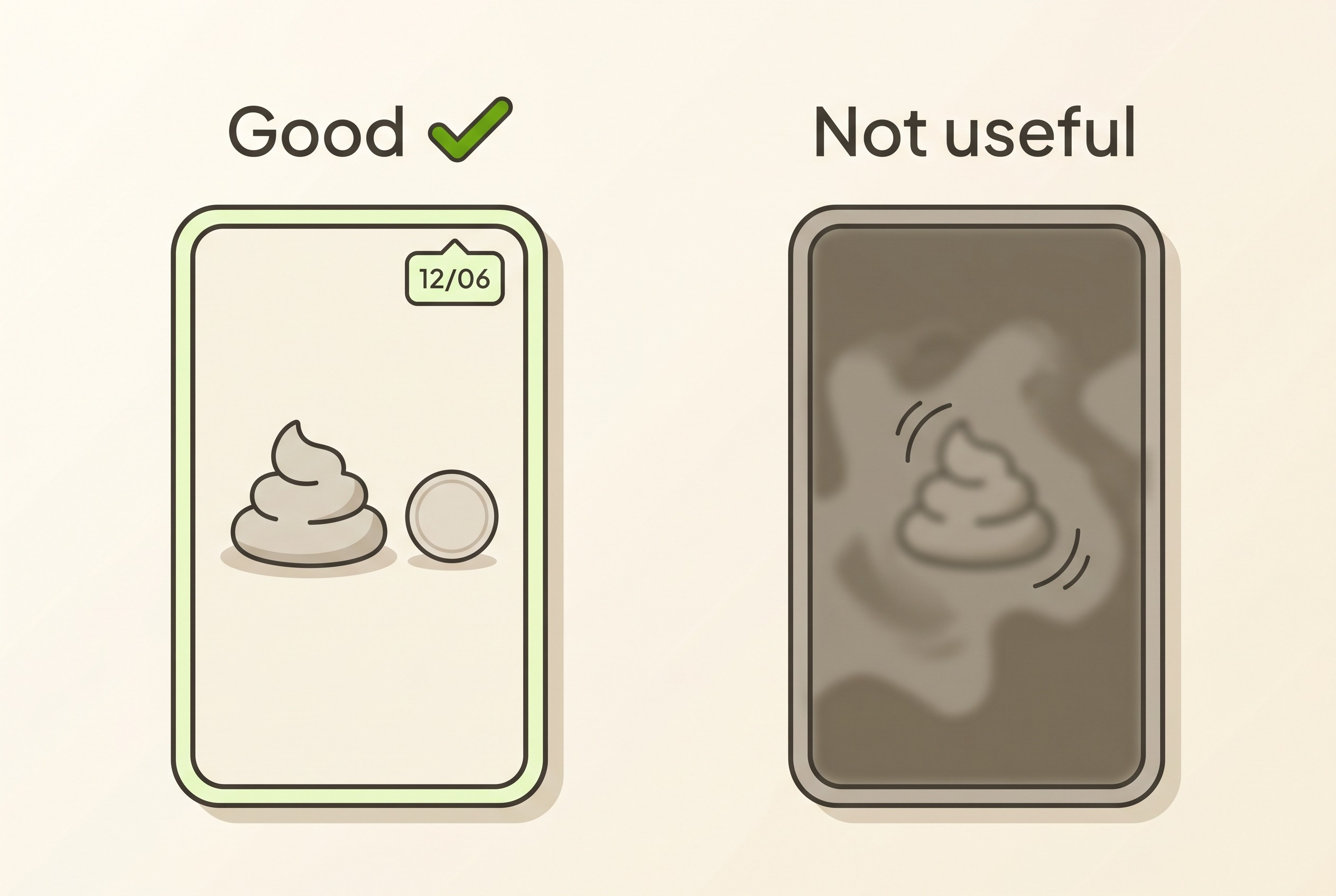
Cats are a practical special case, because litter coats and clumps the stool, hiding its consistency and colour. Check the tray promptly rather than once a day, and where you can, photograph before the litter clings; a temporarily lined tray makes a one-off sample readable. For vomit, photograph it only if it is safe: never handle anything you think could be a swallowed object or a toxin, because that is a get-in-the-car emergency (see the emergency guide), not a photo opportunity. Otherwise the same rules apply, plus the volume and contents. Better still, a short video of the episode itself beats a photo of the aftermath, because footage settles what is hard to put into words, particularly that effortless-versus-retching question (Armstrong, 2013). You already photograph your pet constantly; this is just one slightly unglamorous shot, done well.
Make it a habit
A score, a photo and a one-line note, logged each time, quietly becomes something a vague memory never can: a trend you and your vet can both see, the direct antidote to the recall decay (Pugh et al., 2017). That is what the Faecal Score Tracker is for: read this, then log it. If you are not yet sure whether today is even a vet day, the Vomiting & Diarrhoea Triage will help you decide, alongside what is causing it.
The same habit pays off later. If your pet ever needs a food trial for a suspected food-responsive gut problem, you judge whether the new diet is working by the faecal score falling over a couple of weeks, not by impression. The mechanics belong to the diet-trial guide and its Diet-Trial Companion, but today's scoring is what makes that decision readable. So the next time something is off, reach for your phone before the moment fades: a number, a clear picture, a line about what you saw. That is the difference between "he's had a bad tummy" and a record your vet can actually act on.
References
- Armstrong, P. J. (2013). GI intervention: approach to diagnosis and therapy of the vomiting patient. Today's Veterinary Practice, March/April 2013.
- Cavett, C. L., Tonero, M., Marks, S. L., Winston, J. A., Gilor, C., & Rudinsky, A. J. (2021). Consistency of faecal scoring using two canine faecal scoring systems. Journal of Small Animal Practice, 62(3), 167-173.
- Chauvel, C., Bendahmane, I., Vellard, E., Lyazrhi, F., Meynadier, A., Mila, H., & Grellet, A. (2025). Validation of photographic faecal scoring in puppies. Preventive Veterinary Medicine, 246, 106729.
- Hall, E. J., Williams, D. A., & Kathrani, A. (Eds.). (2020). BSAVA Manual of Canine and Feline Gastroenterology (3rd ed.). Gloucester: British Small Animal Veterinary Association.
- Moxham, G. (2001). Waltham faeces scoring system: a tool for veterinarians and pet owners. How does your pet rate? Waltham Focus, 11(2), 24-25.
- Nestlé Purina PetCare. Faecal Scoring Chart (Purina PRO PLAN). Société des Produits Nestlé S.A.
- Pugh, C. A., Bronsvoort, B. M. deC., Handel, I. G., Querry, D., Rose, E., Summers, K. M., & Clements, D. N. (2017). Incidence rates and risk factor analyses for owner reported vomiting and diarrhoea in Labrador Retrievers: findings from the Dogslife cohort. Preventive Veterinary Medicine, 140, 19-29.
- Vessieres, F., & Walker, D. (2016). Managing chronic gastrointestinal signs in cats and dogs, part 2. Veterinary Times (CPD), 27 June 2016.
- Veterian Key. Introduction to haematochezia and melaena.
Keep track of how your pet is doing
The owners who cope best are the ones who notice changes early. A simple health log shows you what is working, and what is not, before the next vet visit.
Start tracking, freeYou're not doing this alone
Compare treatment journeys and talk to owners managing digestive health. Free to join.
Join PetsLikeMine