


The diet trial, done properly: the first and best treatment
Alastair Greenway
BVM&S MRCVS
A dog who has had loose, unpredictable, grumbling guts for weeks or months arrives in my consulting room with an owner braced for the worst: steroids, a camera and biopsies, or a bag of something expensive and a shrug. So it surprises a lot of people when the very first thing I suggest is a change of food.
It surprises them more when I explain that this is not a stalling tactic or a cheap first guess. In chronic enteropathy, a careful diet trial does two jobs at once: it is the first-line treatment, and it is the test. Getting it right is the difference between an answer and another wasted fortnight. This article is about doing it properly.
Why we reach for food first now
For years, the reflex with a chronically upset gut was to investigate hard and medicate early. The modern position has moved firmly the other way. The 2026 ACVIM consensus on chronic inflammatory enteropathy in dogs, the most authoritative current statement, makes the dietary treatment trial the preferred first-choice recommendation ahead of invasive testing, precisely because so many dogs turn out to be food-responsive (Heilmann et al., 2026). The diet trial is not what you do before the real medicine. For a large share of dogs, it is the real medicine.
That share is genuinely large. The consensus puts the food-responsive proportion anywhere from 38 to 89 percent across the studies it reviewed, with most series clustering around half to two-thirds (Heilmann et al., 2026). Wherever your dog sits in that range, food-responsive enteropathy is the biggest treatment-response group there is, and the one most often controlled on diet alone for the long term (Heilmann et al., 2026; Allenspach et al., 2007). That is the hopeful headline: the most common form of this frustrating disease is also the most treatable.
The reason the trial doubles as a test is that we classify chronic enteropathy by how it responds: food-responsive first, then antibiotic-responsive, then immunosuppressant-responsive (Allenspach et al., 2007; Dandrieux, 2016). A clear response to diet is the diagnosis of the food-responsive form. The full framework, and why "IBD" is really the minority of cases, belongs to what chronic enteropathy actually is; where the trial sits in the wider work-up is covered in getting to a diagnosis. Here, I want to focus on the doing.
Choosing the diet, and why the supermarket version usually fails
There are two main strategies. The first is a hydrolysed-protein diet. Hydrolysis breaks the protein into fragments so small that the immune system no longer recognises them as a target. The consensus reports remission in roughly 64 to 89 percent of dogs on a hydrolysed diet (Heilmann et al., 2026). A landmark randomised field trial backs this up: a hydrolysed diet was highly effective for long-term control of canine chronic small-bowel disease, with dogs kept on it significantly more likely to stay well at recheck than dogs on an ordinary highly digestible food (Mandigers et al., 2010).
The second is a true novel-protein, or limited-antigen, diet: a single protein and carbohydrate the pet has never eaten before, so there is nothing for an established sensitivity to react to. Novel-protein diets show a favourable response in around 56 percent of cases (Heilmann et al., 2026). Neither approach wins automatically. Hydrolysis is not perfect either, and somewhere around 20 to 50 percent of sensitised patients can still react to a hydrolysed version of a protein they are allergic to, so ideally even a hydrolysed diet is built around a protein the pet has not met (Schmid & Galloni, 2023). The right choice depends on your pet's diet history, what they will actually eat, the cost, and whether they also need a low-fat formulation. This is a conversation to have, not a verdict to look up.
What I will be firm about is the food you should not reach for. The "sensitive", "hypoallergenic" and "limited-ingredient" bags on the supermarket shelf are usually not strict enough, because the label cannot be taken at face value. When researchers have analysed commercial elimination-type diets, they keep finding proteins that are not declared on the packet: one microarray study detected undeclared animal species in 77 percent of the novel-protein diets and 67 percent of the hydrolysed diets it tested (Ricci et al., 2018). A food that secretly contains a protein your pet reacts to cannot give you a clean answer. That same study turned up the odd contaminated veterinary product too, so the point is not that any bag marked "vet" is flawless: it is to run the trial on a properly quality-controlled therapeutic diet chosen on veterinary advice, not on a marketing word.
Rules that make or break the trial
This is the part nobody warns owners about clearly enough, and the part that most often sinks a trial that should have worked. The food only tells you the truth if it is the only thing going in. When a trial "fails", the dog is usually not unresponsive at all. The problem is contamination from outside the bowl.
So the rules are simple to say, harder to live:
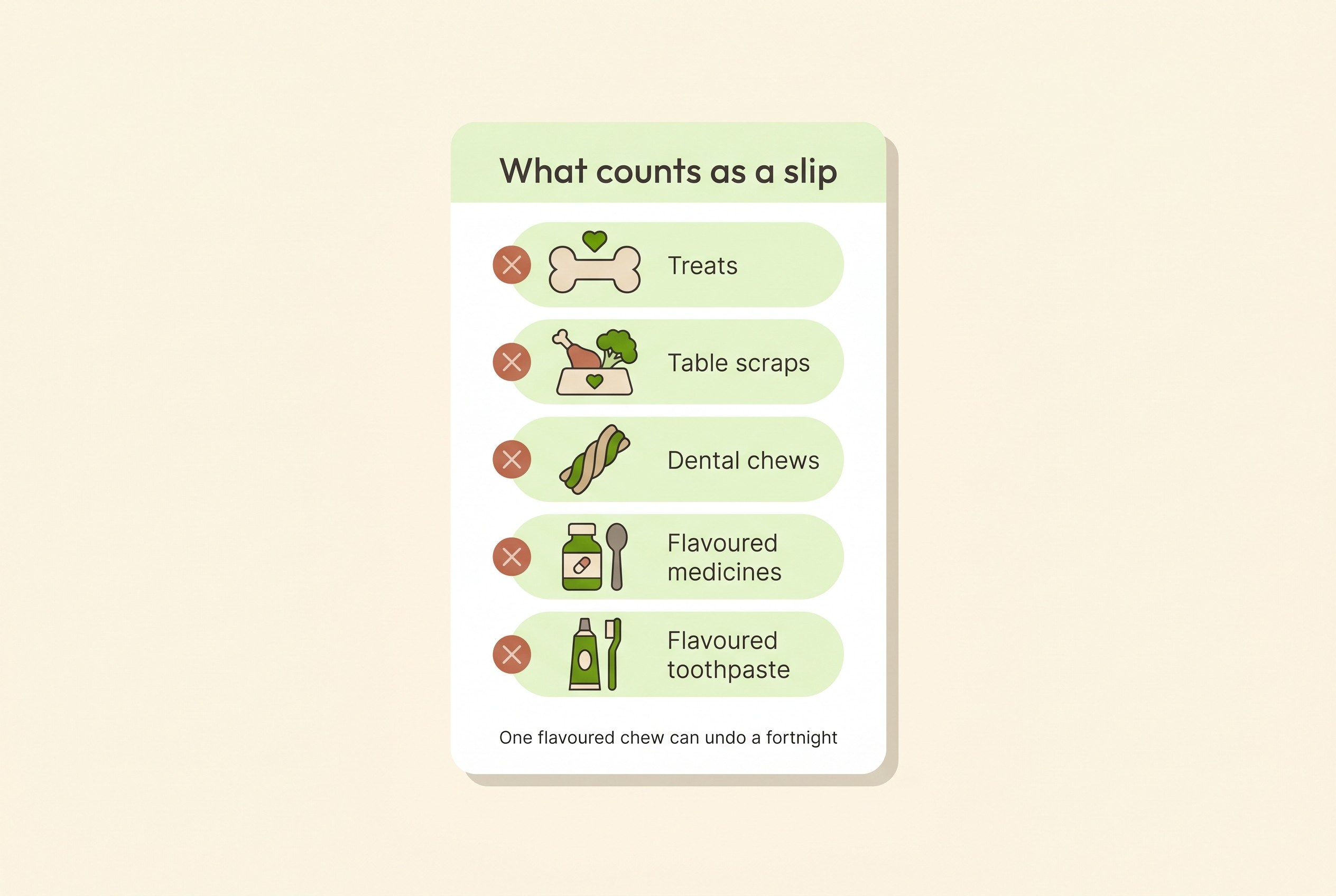
- One diet, fed exclusively. No treats, no table scraps, no dental chews, no flavoured or meaty supplements, no flavoured toothpaste (Schmid & Galloni, 2023). All of those carry proteins that can quietly break the trial. If you want to give something extra, use plain pieces of the trial diet itself, and keep any treats under about five percent of calories.
- Mind the medicines. Many worm and flea treatments and a lot of palatable tablets are meat-flavoured. Talk to your vet about anything regular your pet takes, so a tasty pill does not quietly undo a fortnight.
- The whole household, all in. Children, partners, the doting neighbour, and any other pet who shares a food bowl all have to follow the rule. One person slipping a crust under the table is enough to muddy the result.
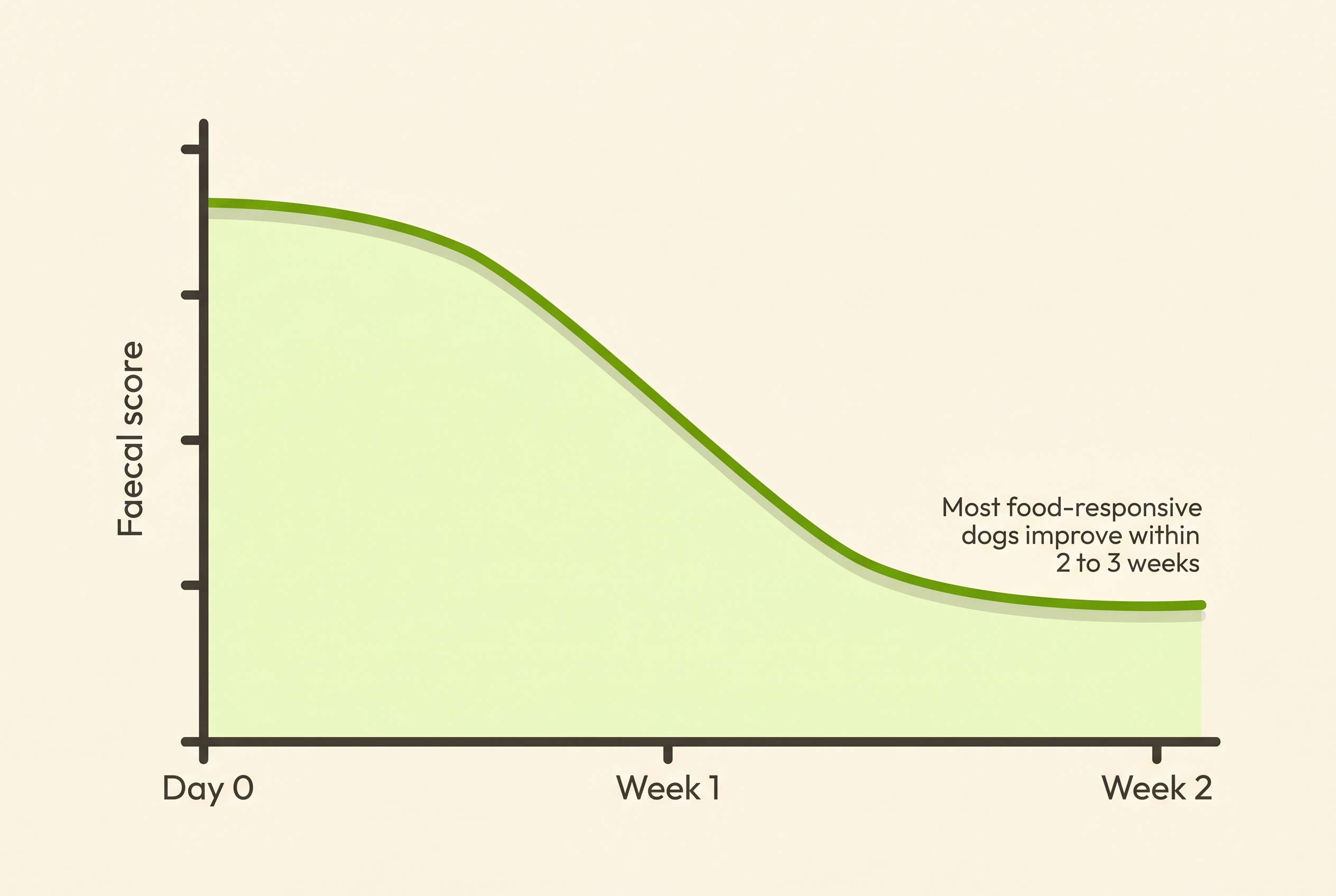
The timeline is the encouraging part. For the gut, a clear response is usually visible within two to three weeks, with most food-responsive dogs improving inside 10 to 14 days (Heilmann et al., 2026). That is far quicker than the equivalent trial for itchy skin, which needs around eight weeks to catch most responders (Olivry, Mueller & Prélaud, 2015). The gut answers fast. If your pet is clearly better by the two-week mark, that points strongly to food-responsive disease. If nothing has shifted on a strictly run trial after two to three weeks, that is not failure either: it is useful information that tells you and your vet where to look next.
Judge it by data, not by vibes
When I ask owners two weeks in whether things are better, the answer is often "I think so?" Memory is a poor instrument for this: the gut has good and bad days anyway, and it is hard to tell a real trend from a lucky run by feel alone. So judge the trial on numbers you actually wrote down.
The signs to track are concrete: the faecal score trending toward normal, fewer episodes of diarrhoea and vomiting, a steady or climbing weight, and a brighter coat and energy. This is where the home tools earn their place. Log the start date, the diet, every slip and the daily signs in the Diet-Trial Companion, so the whole household is genuinely running the same trial and your vet can see at a glance what happened. Alongside it, the Faecal Score Tracker lets you watch the score fall over the fortnight, which is the difference between judging by data and judging by vibes. The 1 to 7 scoring chart, and how to photograph and describe what you are seeing, belongs to describing symptoms to your vet.
One important caveat on patience. A single diet that does not work does not rule out food-responsiveness. The consensus advises being willing to run at least three trials with different diets, for instance a hydrolysed diet and then a novel-protein one, before concluding a dog is not food-responsive (Heilmann et al., 2026). The commonest and costliest mistake is to abandon food after one disappointing fortnight and jump to steroids (Schmid & Galloni, 2023).
What a yes, or a no, actually means
A clear response means food-responsive chronic enteropathy, the best-outcome group of the lot. Many of these dogs are controlled on diet alone for the long term and never need steroids at all (Heilmann et al., 2026; Mandigers et al., 2010; Allenspach et al., 2007). This is precisely why the old line that "IBD means lifelong steroids" is out of date: because most dogs respond to food first, the majority never reach the immunosuppression part of the ladder (Heilmann et al., 2026; Dandrieux, 2016).
Once the gut is steady, the diet usually stays. After about 12 weeks of good control some dogs can be moved off the strict diet, with anywhere from 31 to 79 percent holding their remission, but many do best simply staying on the food that works (Heilmann et al., 2026). Finding and keeping that food, with B12, fibre and a sensible flare plan, is the territory of living with chronic enteropathy.
If a properly run trial across more than one diet brings no improvement at all, that is the cue to step up, not to despair. It simply moves your dog into the part of the framework where we consider antibiotics and immunomodulation, and that ladder, including where steroids genuinely fit, is set out plainly in when diet is not enough. Even then, reaching reflexively for antibiotics is no longer the right move: a randomised trial in acute colitis found diet alone resolved signs faster than diet plus metronidazole (Rudinsky et al., 2022). The full case lives in antibiotics for diarrhoea.
A few boundaries before you start. Most of the trial evidence above comes from dogs; cats deserve their own approach, with nuances covered in chronic enteropathy in cats. And if your pet's signs turn acute mid-trial, with repeated vomiting, blood, a painful or swollen belly, or real lethargy or collapse, stop reading this as a slow puzzle and treat it as urgent: triage it first with the Vomiting & Diarrhoea Triage and the digestive emergencies guide. A food trial for an itchy skin problem is a separate exercise with its own rules and a much longer clock, covered in food allergies explained; this article owns only the gut side.
So if your vet has suggested a diet trial, give it a fair run. Pick the diet together, clear the kitchen of everything else, get the whole household signed up, start the Companion on day one, and hold the line for two to three weeks. Then let the falling faecal score, not your memory, tell you the answer.
References
- Heilmann RM, Jergens AE, Kathrani A, Allenspach K, Salavati Schmitz S, Priestnall SL, Dandrieux JRS, O'Connor AM. ACVIM-endorsed statement: consensus statement and systematic review on guidelines for the diagnosis and treatment of chronic inflammatory enteropathy in dogs. J Vet Intern Med. 2026;40(1):aalaf017.
- Allenspach K, Wieland B, Gröne A, Gaschen F. Chronic enteropathies in dogs: evaluation of risk factors for negative outcome. J Vet Intern Med. 2007;21(4):700-708.
- Mandigers PJJ, Biourge V, van den Ingh TSGAM, Ankringa N, German AJ. A randomized, open-label, positively-controlled field trial of a hydrolyzed protein diet in dogs with chronic small bowel enteropathy. J Vet Intern Med. 2010;24(6):1350-1357.
- Dandrieux JRS. Inflammatory bowel disease versus chronic enteropathy in dogs: are they one and the same? J Small Anim Pract. 2016;57(11):589-599.
- Schmid SM, Galloni AM. Diet Trials for Chronic Enteropathy. Today's Veterinary Practice (updated October 2023)
- Ricci R, Conficoni D, Morelli G, Losasso C, Alberghini L, Giaccone V, Ricci A, Andrighetto I. Undeclared animal species in dry and wet novel and hydrolyzed protein diets for dogs and cats detected by microarray analysis. BMC Vet Res. 2018;14:209.
- Raditic DM, Remillard RL, Tater KC. ELISA testing for common food antigens in four dry dog foods used in dietary elimination trials. J Anim Physiol Anim Nutr (Berl). 2011;95(1):90-97.
- Olivry T, Mueller RS. Critically appraised topic on adverse food reactions of companion animals (5): discrepancies between ingredients and labeling in commercial pet foods. BMC Vet Res. 2018;14:24.
- Olivry T, Mueller RS, Prélaud P. Critically appraised topic on adverse food reactions of companion animals (1): duration of elimination diets. BMC Vet Res. 2015;11:225.
- Rudinsky AJ, Parker VJ, Winston J, et al. Randomized controlled trial demonstrates nutritional management is superior to metronidazole for treatment of acute colitis in dogs. J Am Vet Med Assoc. 2022;260(S3):S23-S32.
Keep track of how your pet is doing
The owners who cope best are the ones who notice changes early. A simple health log shows you what is working, and what is not, before the next vet visit.
Start tracking, freeYou're not doing this alone
Compare treatment journeys and talk to owners managing digestive health. Free to join.
Join PetsLikeMine