

Chronic enteropathy: the modern way to think about "IBD"
Alastair Greenway
BVM&S MRCVS
Weeks of unpredictable guts, loose stools that come and go, the odd vomit, a coat that has lost its shine, perhaps a little weight slipping off. Somewhere along the way a word may have been mentioned that lands like a stone: IBD. Inflammatory bowel disease. It sounds chronic and serious, and if you have done any reading you will have met the gloomy story that goes with it, the one about lifelong steroids and a pet who is never quite well again.
I want to take that stone out of your hand, because the story has changed, and changed for the better. The condition your vet is circling is now usually called chronic enteropathy, and the modern understanding of it is far more hopeful than the old "IBD" label suggests. Most affected dogs do well, and a large proportion never need steroids at all. This article covers what chronic enteropathy actually is, why we talk about it differently now, and why the road ahead is more reassuring than that frightening acronym implies.
What we mean by chronic enteropathy
Chronic enteropathy, or CE, simply means persistent or recurring gut signs, typically lasting or coming and going for more than about three weeks, once the other causes have been ruled out (Dandrieux, 2016; Jergens & Heilmann, 2022). That last part matters. CE is not one disease with one cause. It is a clinical syndrome, an umbrella, and it is reached by exclusion: your vet works through and rules out parasites, infection, exocrine pancreatic insufficiency and disease of other organs before settling on it (Dandrieux, 2016; Jergens & Heilmann, 2022). How that elimination is done, and why a biopsy is not always step one, is its own conversation, set out in getting the diagnosis.
So why the change of name? "Inflammatory bowel disease" was borrowed from human medicine, where it means specific, biopsy-confirmed, immune-driven conditions. The disease in our pets behaves and responds quite differently, and the word IBD carries an unhelpful implication: that this is always an immune-mediated illness needing lifelong immune suppression (Dandrieux, 2016; Dupouy-Manescau et al., 2024). Most affected dogs do not have that. So the profession now uses "chronic enteropathy", or "chronic inflammatory enteropathy", as the broader umbrella term, and reserves "IBD" for the small, confirmed, immune-driven subset (Jergens & Heilmann, 2022; Dupouy-Manescau et al., 2024). The label changed because the understanding did.
Grouped by what works, not by the biopsy
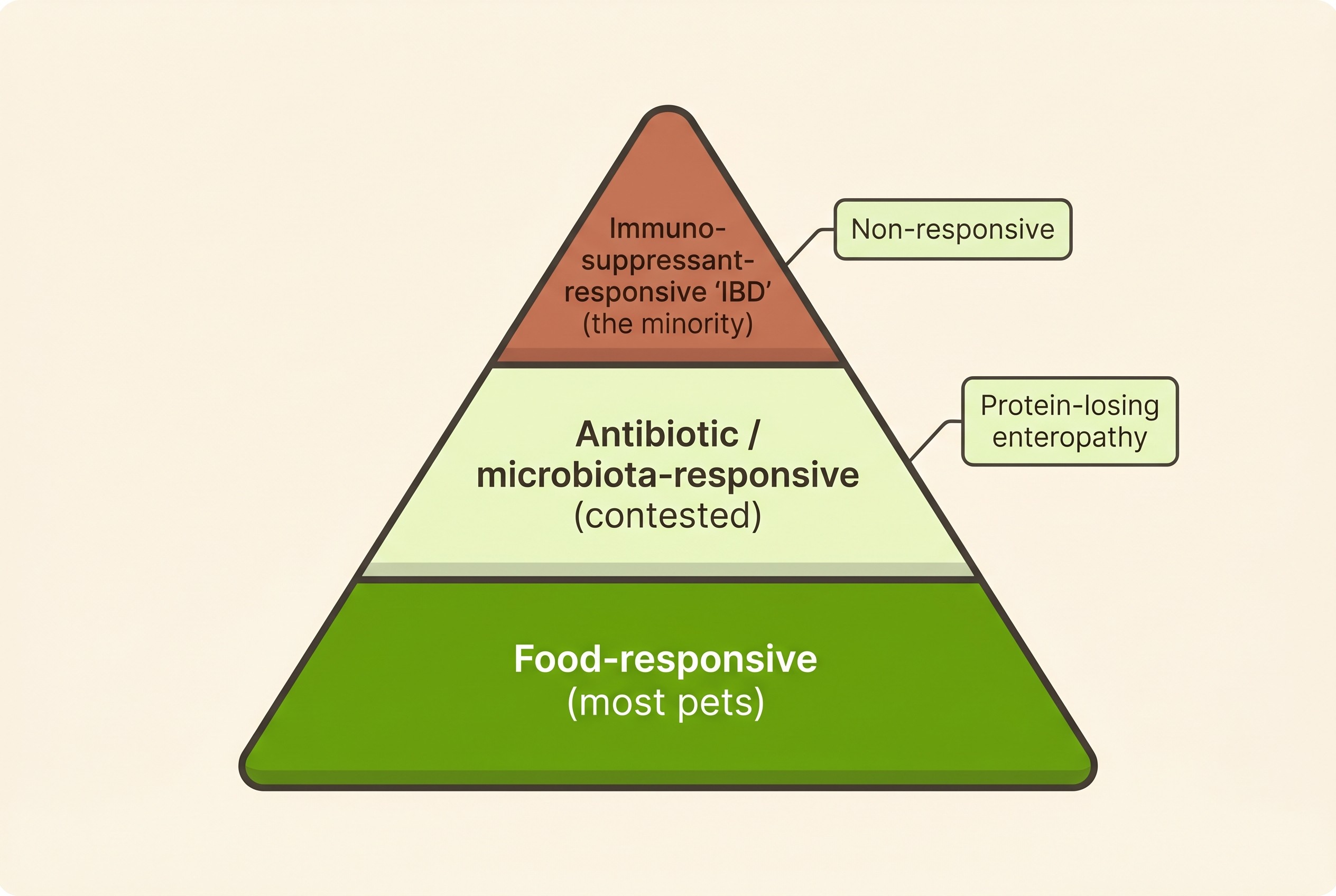
This is the idea that turns the whole thing on its head. We do not file these cases by the words on a biopsy report. We classify them by what the patient responds to, worked through in a sensible order (Dandrieux, 2016; Jergens & Heilmann, 2022). There are broadly four groups, plus one more serious presentation that sits across them.
Food-responsive enteropathy comes first, because it is by far the largest group. These pets get better on a change of diet alone, often without any other medicine at all, and they tend to be younger, with milder signs than the rest (Jergens & Heilmann, 2022).
Antibiotic-responsive enteropathy was historically the next group, but it has become genuinely contested, and I will come back to why in a moment.
Immunosuppressant-responsive enteropathy is the group that needs medicines to calm an over-active immune response, and this, confirmed on biopsy, is the subset most accurately called idiopathic IBD (Jergens & Heilmann, 2022; Dandrieux, 2016).
Non-responsive enteropathy is the frustrating minority that does not settle adequately on any of the above, and it carries the most guarded outlook of the four (Dupouy-Manescau et al., 2024).
Across all of these sits protein-losing enteropathy, the more serious presentation in which the gut leaks protein and the blood albumin falls. It can occur in any group and carries a guarded outlook, which is why those cases need closer, often specialist care (Allenspach et al., 2007; Jergens & Heilmann, 2022). I will keep that to a flag here, because the treatment of the tougher end belongs to when diet is not enough.
Why this matters so much to you
Look at the base of that pyramid, because it holds the most reassuring fact in this whole subject. Food-responsive enteropathy is the biggest group: roughly half to two-thirds of dogs with chronic enteropathy respond to a diet change alone (Jergens & Heilmann, 2022; Dupouy-Manescau et al., 2024), a figure the MSD Veterinary Manual puts at over half of patients (MSD Veterinary Manual). A single Japanese cohort landed in the same place, with 18 of 32 dogs, 56 percent, turning out to be food-responsive (Kawano et al., 2016). The true proportion may be higher still, because some pets first labelled non-responders go on to respond to a further dietary trial (Dupouy-Manescau et al., 2024).
The practical pay-off follows directly. Because that group is the largest and tends to respond quickly, the logical first step for most pets is a carefully run diet trial, not steroids and not a camera (Allenspach et al., 2007; Jergens & Heilmann, 2022). This is precisely why the old "IBD equals lifelong steroids" story is out of date: most dogs never reach the immune-suppressing part of the ladder, which is reserved for the minority (Jergens & Heilmann, 2022; Dandrieux, 2016). The scary word still applies to a small group, but only after the simpler, kinder options have been tried first.
A diet trial does two jobs at once, treatment and test, and getting it right is the difference between an answer and a wasted fortnight. The mechanics, which diet, how strict, how long, sit in their own guide, the diet trial done properly, and you can run it alongside the Diet-Trial Companion. The point to take from here is simply the why: food first, because the odds are genuinely with you.
A quick word on that contested antibiotic group, because it deserves one. The very existence of "antibiotic-responsive enteropathy" is now debated, and the most recent classification proposes renaming it "microbiota-related modulation-responsive enteropathy" (Dupouy-Manescau et al., 2024). The reasoning is sound: antibiotics such as metronidazole and tylosin cause long-lasting disruption of the gut's bacterial community, most pets that seem to respond relapse once the drug stops, and there are real antimicrobial-resistance costs, so the reflexive antibiotic trial is falling out of favour (Jergens & Heilmann, 2022; Dupouy-Manescau et al., 2024). The full case for why antibiotics are no longer a sensible first move lives in antibiotics for diarrhoea.
Signs to watch for
The signs are often unglamorous and easy to live alongside for too long: chronic or recurring vomiting, diarrhoea, gradual weight loss, a dull coat, a variable appetite, and sometimes simply a pet who is intermittently "off" without ever being acutely ill (Dandrieux, 2016; Jergens & Heilmann, 2022). None of it is dramatic, which is part of the problem, because it is the kind of grumbling that gets written off as a sensitive stomach for months.
One distinction is worth holding in your head, because where in the gut the problem lies tends to change the pattern of signs and helps your vet localise it (Hall & German). Small-bowel disease shows up as weight loss, larger-volume stools, only a mild increase in how often they go, and sometimes dark, tarry stool if there is bleeding higher up, often with vomiting. Large-bowel disease looks different: straining, mucus, fresh red blood, frequent small puddles, and usually no weight loss (Hall & German).
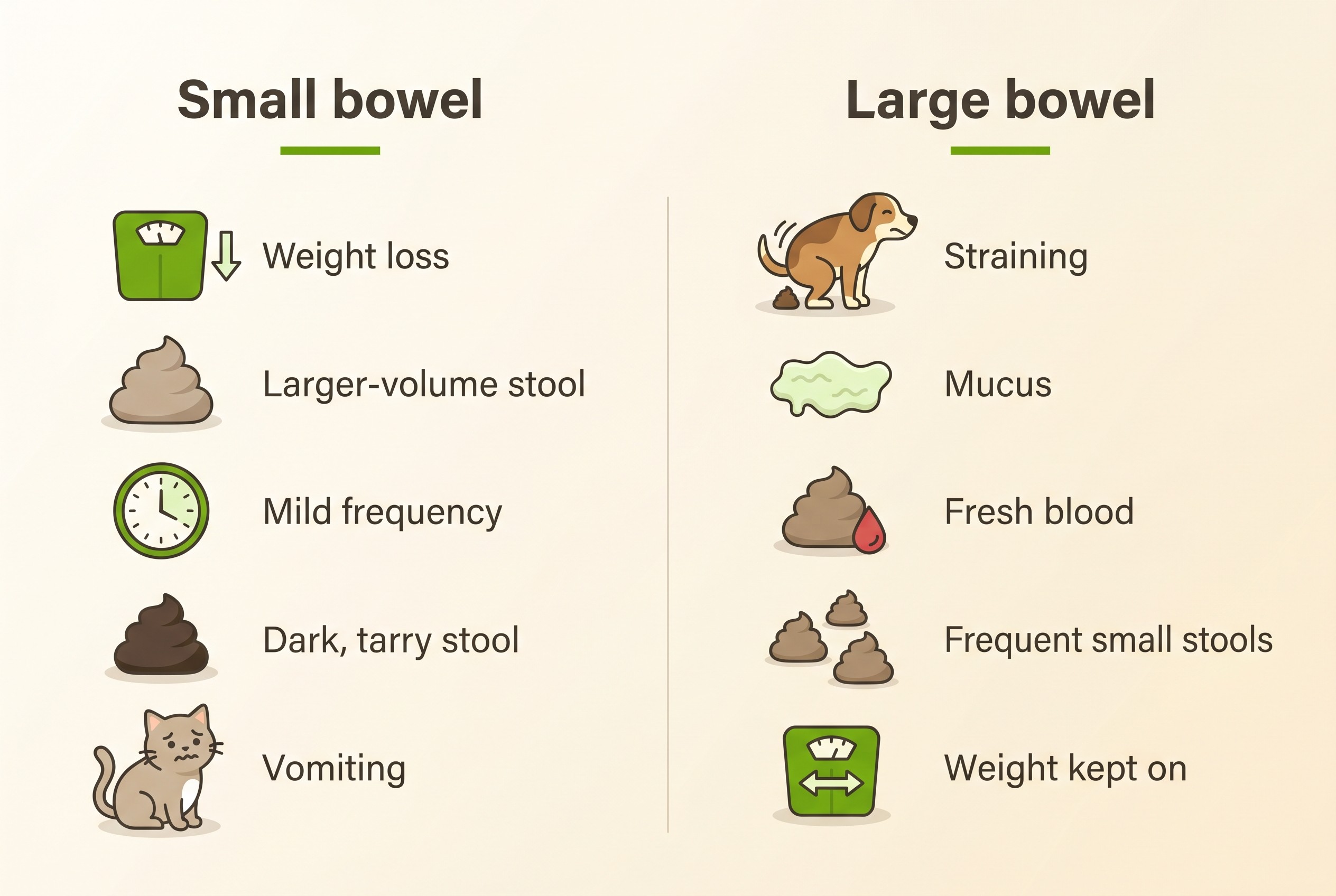
Use that only for orientation. The work of describing and recording what you are seeing, including the 1 to 7 faecal scoring chart and what to photograph, belongs to describing symptoms to your vet and pairs with the Faecal Score Tracker. I cannot stress that tool enough here: in chronic enteropathy the response is read off the stool over days and weeks, not off memory. Logging the faecal score is how you and your vet see whether a diet is working, and how you catch a flare creeping back before it becomes a crisis.
The road ahead, told straight
I will not oversell this, because you would know if I did. Chronic enteropathy is usually well controlled, but it is often not "cured". Most pets do well, many on diet alone, but it tends to be a long-term condition you manage, with the occasional flare, rather than a one-off illness that resolves and is forgotten (Allenspach et al., 2007; Jergens & Heilmann, 2022). Held next to the "lifelong steroids" fear, that is still reassuring: managed and comfortable is a very different life from medicated into submission.
The treatment order is logical, not a gamble, and it is worth understanding why, so you are not tempted to push for a biopsy or steroids on day one. Diet comes first, and we escalate only if needed, with each step doubling as a test of where your pet sits on that pyramid (Dandrieux, 2016; Jergens & Heilmann, 2022). The escalation itself, where steroids such as prednisolone, gut-targeted budesonide and other immune-modulating medicines genuinely fit, is handled frankly in when diet is not enough.
Two markers signal a tougher course without meaning doom: a low blood albumin (the protein-losing form) and a low cobalamin, vitamin B12, are both recognised pointers to a more difficult road (Allenspach et al., 2007). The protein-losing end belongs to the treatment guide, and the B12 story, why deficiency is common and what to do about it, belongs to living with chronic enteropathy. I flag them only so the words are not a shock if your vet uses them.
One last boundary, because cats are not small dogs here, and the figures above come from studies in dogs. In cats the picture blurs into a worrying-sounding but often very treatable cousin, low-grade alimentary lymphoma, and telling the two apart can change the approach (Marsilio et al., 2023). If you have a cat, the feline-specific version of all this is over in feline chronic enteropathy. And if the signs ever turn genuinely acute or severe, repeated vomiting, blood, a painful belly, real lethargy, that is a different conversation altogether, and the place to start is digestive emergencies.
If you arrived here through the vomiting and diarrhoea guide and have worked out that your pet's signs are the chronic, grumbling kind, you are in the right section. The next sensible step is to understand how the diagnosis is reached, so the tests your vet suggests make sense rather than feeling like a fishing trip: getting the diagnosis. Hold on to the headline while you read it. The most common form of this frustrating condition is also the most treatable, and for a great many pets the answer turns out to be a bowl of the right food.
References
- Dandrieux JRS. Inflammatory bowel disease versus chronic enteropathy in dogs: are they one and the same? Journal of Small Animal Practice. 2016;57(11):589–599.
- Jergens AE, Heilmann RM. Canine chronic enteropathy — current state-of-the-art and emerging concepts. Frontiers in Veterinary Science. 2022;9:923013.
- Dupouy-Manescau N, Méric T, Sénécat O, Drut A, Valentin S, Leal RO, Hernandez J. Updating the classification of chronic inflammatory enteropathies in dogs. Animals (Basel). 2024;14(5):681.
- Allenspach K, Wieland B, Gröne A, Gaschen F. Chronic enteropathies in dogs: evaluation of risk factors for negative outcome. Journal of Veterinary Internal Medicine. 2007;21(4):700–708. )21[700:CEIDEO]2.0.CO;2.
- Kawano K, Shimakura H, Nagata N, et al. Prevalence of food-responsive enteropathy among dogs with chronic enteropathy in Japan. Journal of Veterinary Medical Science. 2016;78(8):1377–1380.
- Chronic enteropathies in small animals. MSD Veterinary Manual (Merck Veterinary Manual), current online edition.
- Hall EJ, German AJ. Diseases of the small intestine. (And the diagnostic approach to chronic GI disease and small-bowel vs large-bowel localisation.) In: BSAVA Manual of Canine and Feline Gastroenterology, 2nd/3rd ed. (Hall, Williams & Kathrani, eds), BSAVA; and Ettinger & Feldman, Textbook of Veterinary Internal Medicine.
Keep track of how your pet is doing
The owners who cope best are the ones who notice changes early. A simple health log shows you what is working, and what is not, before the next vet visit.
Start tracking, freeYou're not doing this alone
Compare treatment journeys and talk to owners managing digestive health. Free to join.
Join PetsLikeMine