

Feline chronic enteropathy and the small-cell lymphoma question
Alastair Greenway
BVM&S MRCVS
Chronic vomiting in a cat is not normal, and it is not "just hairballs". That sentence surprises a lot of owners, so it is worth saying plainly. The occasional bring-up of fur can be normal, but when it becomes a pattern, or comes with quiet weight loss, it is usually a symptom of bowel disease rather than a quirk of the species. Cats are genuinely not small dogs here.
This is the feline corner of the chronic enteropathy section. For what chronic enteropathy actually is, and the modern way vets think about it, start with chronic enteropathy explained. My aim here is narrower: how the disease looks in a cat, and a calm walk through the blurred line between inflammation and low-grade lymphoma, which frightens people more than it should.
How it shows up in a cat
The canine version often announces itself with obvious diarrhoea. The feline version is quieter, which is exactly why it gets missed. Weight loss is the commonest and most overlooked sign, creeping on so gradually that nobody notices until the cat is picked up and feels lighter than it should. Vomiting is often intermittent and put down to hairballs or "a sensitive tummy", and diarrhoea may be mild or absent. The typical patient is middle-aged or older (Marsilio et al., 2023; Freiche et al., 2021b).
How rarely these signs are benign is striking. In a series of 100 cats with chronic vomiting, small-bowel diarrhoea and/or weight loss plus a thickened small intestine on ultrasound, 99 of the 100 had genuine bowel disease on biopsy; the two dominant diagnoses were chronic inflammation of the bowel and intestinal lymphoma, in roughly equal numbers. Even two cats that had hairballs removed at surgery had underlying bowel disease too: frequent hairball-type vomiting is often the symptom, not the explanation (Norsworthy et al., 2013).

Chronic enteropathy is defined in cats as in dogs: gut signs grumbling on for at least three weeks or so, once the vet has ruled out causes outside the gut, such as an overactive thyroid or kidney disease in an older cat (Marsilio et al., 2023). The general framework, that we classify these cats by how they respond to treatment rather than by the word on a biopsy report, belongs to chronic enteropathy explained.
Diet matters in cats too. A meaningful subgroup are food-sensitive and settle on a properly run elimination diet: in the key study, 16 of 55 cats, around 29%, were food-responsive (Guilford et al., 2001). You will see this rounded up to "about half" in places, but the accurate figure is nearer a third. Because of it, a diet trial is often one of the earliest steps; how it is run, and how long to give it, lives in the chronic enteropathy diet trial, with the Diet-Trial Companion to run and read it.
Because a cat's signs are so subtle, tracking them is more than busywork. Logging vomiting episodes, appetite, weight and the look of the stool turns a vague impression into a trend your vet can use, and is the cleanest way to see whether treatment is working. The Faecal Score Tracker is built for this, and how to describe and photograph signs is covered in describing symptoms to your vet.
More than just the gut
Owners are sometimes surprised that the work-up looks wider than a "tummy problem" seems to warrant, and there is an anatomical reason: in the cat, the pancreatic duct and the bile duct share a common opening into the gut, so inflammation tends to involve more than one organ at once. Vets call concurrent inflammation of the intestine, pancreas and biliary tract "triaditis". In a post-mortem and biopsy series, more than one organ was inflamed in 57% of cats, with full triaditis in around 17% overall and roughly 30% of symptomatic cats (Fragkou et al., 2016).
So if your vet wants to look beyond the bowel, that is sound feline medicine, not over-testing. Concurrent pancreatitis in particular is common, and has its own write-up in pancreatitis explained; the liver side of triaditis is a separate subject I will not wade into here.
Inflammation or lymphoma?
This is the part that brings people to this page at two in the morning. When a cat is worked up for chronic gut disease, the word "lymphoma" sometimes appears, and it lands hard. I want to be straight about why the line is genuinely blurred, and equally straight about why the low-grade type is usually a manageable situation with a long survival rather than a verdict.
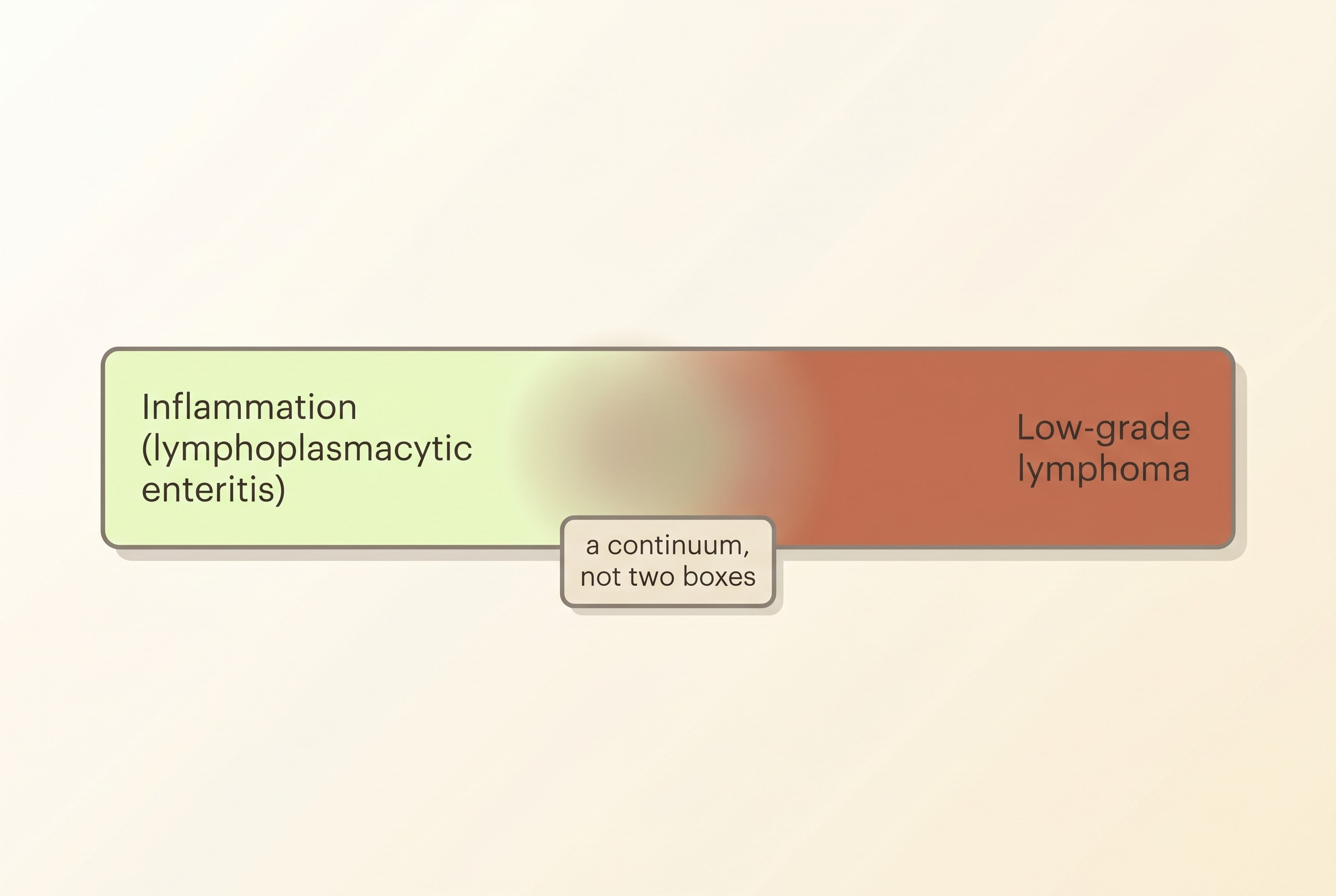
The starting point is that inflammation and low-grade lymphoma sit on a continuum, not in two tidy boxes. The 2023 international consensus statement treats lymphoplasmacytic enteritis, the inflammatory end, and low-grade intestinal T-cell lymphoma, the cancerous end, as "a continuum rather than 2 separate disease entities": they frequently coexist, many lymphoma cats have a prior history of inflammation, and concurrent inflammation is present in up to 60% of low-grade lymphoma cases (Marsilio et al., 2023). These two ends are biologically close, which is precisely why telling them apart is hard. The difficulty is in the disease, not in your vet.
Nothing on the outside reliably separates them. There are "currently no known pathognomonic signalment or clinical findings that can reliably distinguish" inflammation from low-grade lymphoma in cats (Marsilio et al., 2023). The lymphoma cats do tend to be older and to have had signs for longer, with a little more polyphagia and small-bowel diarrhoea, but the overlap is large, no single feature is decisive, and some cats with low-grade lymphoma have minimal signs or none (Freiche et al., 2021b; Marsilio et al., 2023).
Ultrasound cannot make the call either. No imaging "reliably differentiates" the two, and tissue is needed (Marsilio et al., 2023). Thickening of the muscle layer of the small bowel is the commonest abnormality, and the wall measurements in inflammation and in low-grade lymphoma are not significantly different (Jergens, 2012). Some findings raise suspicion (a rounded, enlarged gut lymph node was seen in 85% of lymphoma cats against 6% of inflammatory ones, and fluid in the abdomen in 45% against 14%), but the appearance of the two overlaps enough that these are clues prompting a closer look, not a diagnosis, and meaningful disease can be present even when the scan looks normal (Freiche et al., 2021b; Griffin, 2019; Marsilio et al., 2023).
Biopsy is the gold standard, and even biopsy can be a close call. Tissue is "the current gold standard" for telling the two apart, but sample quality and orientation matter enormously, pathologists do not always agree, and "even with adequate sample numbers and quality and optimal processing, it can be difficult to arrive at a precise diagnosis" (Marsilio et al., 2023). Extra tests help: immunohistochemistry, which stains for cell types such as T cells, and clonality testing (PARR), which looks at whether one cell line has taken over. Neither settles it alone, because "clonality is not equivalent with malignancy and clonality has been well described in reactive lesions" (Marsilio et al., 2023). The fair summary is that no single test reliably separates the two; the diagnosis comes from "integrating all available clinical and diagnostic data", combining histopathology, immunohistochemistry and molecular criteria (Freiche et al., 2021a).
Getting to a diagnosis
Your vet will work through this in a logical order rather than reaching for a biopsy on day one, and the staged reasoning is owned by chronic enteropathy diagnosis. Two feline-specific points are worth knowing.
Cobalamin, vitamin B12, is checked early and it matters. Low B12 is common in feline chronic enteropathy and more frequent in lymphoma than in inflammation (57% against 19% in one series), because B12 is absorbed at the far end of the small bowel, which lymphoma often involves; a normal result does not rule disease out (Freiche et al., 2021b; Marsilio et al., 2023). The good news for anyone dreading a course of injections is that, in cats, oral B12 now works just as well as the jab (Toresson et al., 2017; Chang et al., 2024). The practical how-to lives in living with chronic enteropathy.
If a biopsy is needed, it can be taken by endoscopy or by surgery, and neither is automatically better in sample quality (Marsilio et al., 2023). Because the changes that matter sit in the surface lining of the gut, good endoscopic samples can be diagnostic without full-thickness surgery, so which route suits your cat is a conversation for your vet (Marsilio et al., 2023).
If it is low-grade lymphoma
This is the part I most want you to take away, because the word does more damage than the disease often does. Low-grade alimentary lymphoma (also called small-cell or lymphocytic lymphoma) is the indolent type that overlaps with inflammation, and it is very treatable. The usual treatment is a tablet chemotherapy, chlorambucil, given alongside prednisolone, and it is well tolerated at home. In the most-cited series, 13 of 17 cats, around 76%, went into complete remission, with a median remission of nearly 19 months; cats in complete remission lived a median of around 19 months against about 4 months for those who did not respond, and the authors judged the outlook "good to excellent" (Lingard et al., 2009). Other work on the same drugs reports median survivals of roughly two years or more (Stein et al., 2010). For many cats, then, a low-grade lymphoma diagnosis is a chronic disease measured in years, not a death sentence.
The one distinction I will not let slip is low-grade against high-grade. Those encouraging figures belong to the low-grade, small-cell type. High-grade (large-cell) alimentary lymphoma is a different, aggressive disease: it comes on over days to weeks, often forms a mass, needs multi-drug chemotherapy, and carries a much poorer outlook (Lingard et al., 2009). The two are not the same beast, so if you are unsure, ask your vet directly which one your cat has.
At the inflammatory end, many cats are managed comfortably on diet and B12, with prednisolone added if the inflammation needs damping down. Reassuringly, cats tend to tolerate steroids better than dogs, and budesonide is an option too. The general step-up, and where steroids and other immune-modulating drugs fit, belongs to chronic enteropathy treatment.
One practical aside: in cats, "being sick" can mean true vomiting or passive bringing-up, which point in different directions (vomiting vs regurgitation untangles it), and if your cat is acutely off colour rather than slowly grumbling, the Vomiting & Diarrhoea Triage helps you judge whether to watch or to ring the vet.
So the message is not "wait and see", and it is certainly not "panic". It is "get it looked at properly, and early", precisely because the answer is so often something we can treat. A diagnosis here is a starting point, not a verdict. Keep an eye on the trend, write down what you see, and act on it sooner rather than later: that is the single most useful thing you can do for a cat whose signs are so easy to dismiss.
References
- Chang, C.-H., Lidbury, J. A., Suchodolski, J. S., & Steiner, J. M. (2024). Effect of oral or subcutaneous administration of cyanocobalamin in hypocobalaminemic cats with chronic gastrointestinal disease or exocrine pancreatic insufficiency. Journal of Veterinary Internal Medicine, 38(5), 2464-2479.
- Fragkou, F. C., Adamama-Moraitou, K. K., Poutahidis, T., Prassinos, N. N., Kritsepi-Konstantinou, M., Xenoulis, P. G., et al. (2016). Prevalence and clinicopathological features of triaditis in a prospective case series of symptomatic and asymptomatic cats. Journal of Veterinary Internal Medicine, 30(4), 1031-1045.
- Freiche, V., Fages, J., Paulin, M. V., Bruneau, J., Couronné, L., German, A. J., Penninck, D., & Hermine, O. (2021b). Clinical, laboratory and ultrasonographic findings differentiating low-grade intestinal T-cell lymphoma from lymphoplasmacytic enteritis in cats. Journal of Veterinary Internal Medicine, 35(6), 2685-2696.
- Freiche, V., Paulin, M. V., Cordonnier, N., Couronné, L., Lacroux, C., Hermine, O., et al. (2021a). Histopathologic, phenotypic, and molecular criteria to discriminate low-grade intestinal T-cell lymphoma in cats from lymphoplasmacytic enteritis. Journal of Veterinary Internal Medicine, 35(6), 2673-2684.
- Griffin, S. (2019). Feline abdominal ultrasonography: what's normal? what's abnormal? The diseased gastrointestinal tract. Journal of Feline Medicine and Surgery, 21(11), 1047-1060.
- Guilford, W. G., Jones, B. R., Markwell, P. J., Arthur, D. G., Collett, M. G., & Harte, J. G. (2001). Food sensitivity in cats with chronic idiopathic gastrointestinal problems. Journal of Veterinary Internal Medicine, 15(1), 7-13.
- Jergens, A. E. (2012). Feline idiopathic inflammatory bowel disease: what we know and what remains to be unraveled. Journal of Feline Medicine and Surgery, 14(7), 445-458.
- Lingard, A. E., Briscoe, K., Beatty, J. A., Moore, A. S., Crowley, A. M., Krockenberger, M., Churcher, R. K., Canfield, P. J., & Barrs, V. R. (2009). Low-grade alimentary lymphoma: clinicopathological findings and response to treatment in 17 cases. Journal of Feline Medicine and Surgery, 11(8), 692-700.
- Marsilio, S., Freiche, V., Johnson, E., Leo, C., Langerak, A. W., Peters, I., & Ackermann, M. R. (2023). ACVIM consensus statement guidelines on diagnosing and distinguishing low-grade neoplastic from inflammatory lymphocytic chronic enteropathies in cats. Journal of Veterinary Internal Medicine, 37(3), 794-816.
- Norsworthy, G. D., Estep, J. S., Kiupel, M., Olson, J. C., & Gassler, L. N. (2013). Diagnosis of chronic small bowel disease in cats: 100 cases (2008-2012). Journal of the American Veterinary Medical Association, 243(10), 1455-1461.
- Stein, T. J., Pellin, M., Steinberg, H., & Chun, R. (2010). Treatment of feline gastrointestinal small-cell lymphoma with chlorambucil and glucocorticoids. Journal of the American Animal Hospital Association, 46(6), 413-417.
- Toresson, L., Steiner, J. M., Olmedal, G., Larsen, M., Suchodolski, J. S., & Spillmann, T. (2017). Oral cobalamin supplementation in cats with hypocobalaminaemia: a retrospective study. Journal of Feline Medicine and Surgery, 19(12), 1302-1306.
Keep track of how your pet is doing
The owners who cope best are the ones who notice changes early. A simple health log shows you what is working, and what is not, before the next vet visit.
Start tracking, freeYou're not doing this alone
Compare treatment journeys and talk to owners managing digestive health. Free to join.
Join PetsLikeMine