

When can you treat a tummy upset at home, and when must you call the vet?
Alastair Greenway
BVM&S MRCVS
A dog raids the bin, or a cat brings up its breakfast and then a bit of grass, and the next few hours go on watching for the next puddle and wondering whether this is a wait-and-see or a get-in-the-car. Most of the time, in an otherwise well pet, it really is the former. A single bout of vomiting, or a day of soft stool, in an animal that is still bright, still drinking and still itself, will very often settle on its own with a little sensible help. The trouble is that the advice you find online is a strange mix of folklore and worry: starve them for a day, give chicken and rice, dose them with this supplement or that. Some of it is harmless, some out of date, and a little of it dangerous, because it tempts you to wait when you should not. This is the up-to-date version: how to help a mild upset safely, and the signs that mean the watching stops.
One line sits above all of it. Home care is only ever for the mild, well pet. It must never be used to buy time for an emergency, because the few upsets that are dangerous are dangerous precisely because they do not wait.
Who this is genuinely for
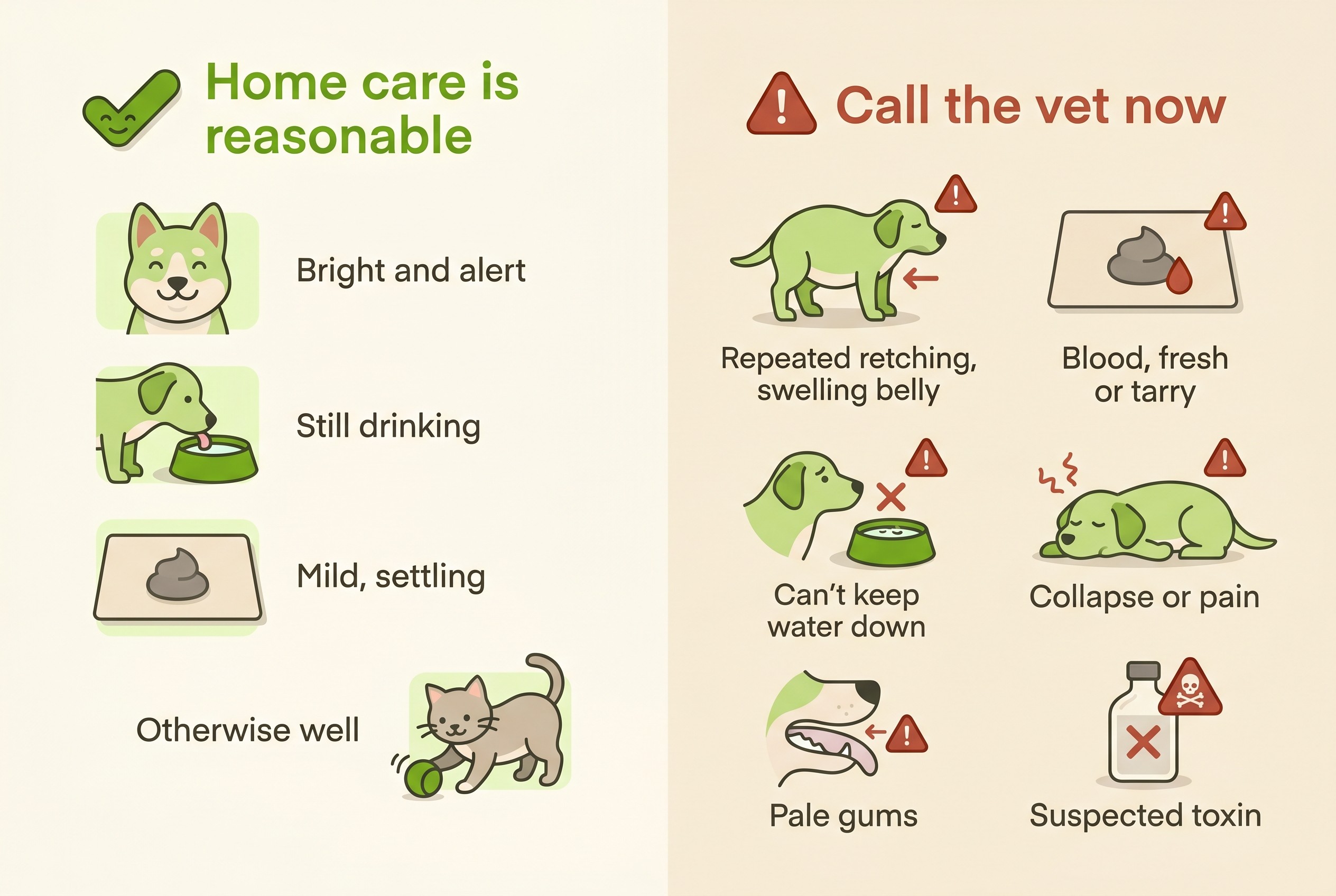
Picture two pets. The first is bright, alert and interested in you, gums a healthy moist pink, with a couple of episodes of vomiting or some soft-to-loose stool, but still drinking and otherwise behaving normally. That pet is a reasonable candidate for a short spell of careful home care. The second is flat, withdrawn, off its water, or has something in the picture that worries you. That pet is not, and no home remedy changes that.
You cannot tell the cause of an upset by looking at it. Vomiting and diarrhoea are symptoms, not diagnoses, and the list of things that produce them is long; that whole picture, and the difference between an acute and a recurring problem, is laid out in vomiting and diarrhoea explained. What home care turns on is not the cause but the state of the animal in front of you.
And some pictures are emergencies from the outset: repeated unproductive retching with a swelling belly, a suspected swallowed object, a collapsed or painful pet, blood, or a known toxin. These are not home-care situations at all, and they are set out properly in digestive emergencies. I will not re-list them here: if any of that rings true, go to that one first. If you are unsure which camp your pet falls into, our Vomiting and Diarrhoea Triage walks you through the same questions a vet would ask on the phone, and is the right first stop before you settle in to watch.
Why starving them is the wrong move
Start with the most repeated piece of tummy-upset folklore there is. For years the standard advice was to withhold food for 24 hours to "rest the gut". For the routine mild case, that is now out of date.
The gut lining is not like a muscle that benefits from rest. The cells lining the intestine draw much of their fuel directly from the food passing over them, and when you take that food away they begin to suffer. The clearest demonstration came from dogs with severe parvovirus: feeding early through a tube, rather than holding food back, gave better gut-barrier integrity (measured as reduced intestinal permeability), a faster return to normal demeanour, appetite and stool, and significant weight gain (Mohr et al., 2003). That was a severe model, so I cite it as proof of principle, not proof it applies identically to a dog that ate something off the pavement. But it helped move the whole profession in one direction, and current veterinary nutrition guidance now favours getting easily-digested food back in early rather than starving the gut (Lenox, 2021; Witzel Rollins, 2018).
So the modern approach is not a fast at all. It is feed sooner, feed light. Offer small, frequent meals, something like three to six small portions across the day, of an easily-digested, fat-controlled, low-fibre food, with free access to water throughout (Lenox, 2021; Witzel Rollins, 2018). Small meals mean less stretch on the stomach and a shorter burst of acid each time, which a queasy gut tolerates far better than one big bowl (Witzel Rollins, 2018). There is a real nuance here: a pet that is actively vomiting should not be force-fed, and a short voluntary pause while the heaving settles is sensible. As things improve over two or three days, mix the normal diet back in gradually rather than switching in one go, so the gut is not asked to cope with an abrupt change on top of everything else. The aim throughout is gentle nutrition back in early.
Cats deserve a word of their own. A cat that stops eating is a more pressing problem than a dog that does, because going without food can tip a cat into hepatic lipidosis, a serious fatty change in the liver that follows a spell of not eating (Cornell Feline Health Center). So never deliberately starve a cat, and if one simply will not eat, that is a reason to ring the vet sooner rather than wait it out.
Chicken and rice, probiotics and pumpkin: what they really do
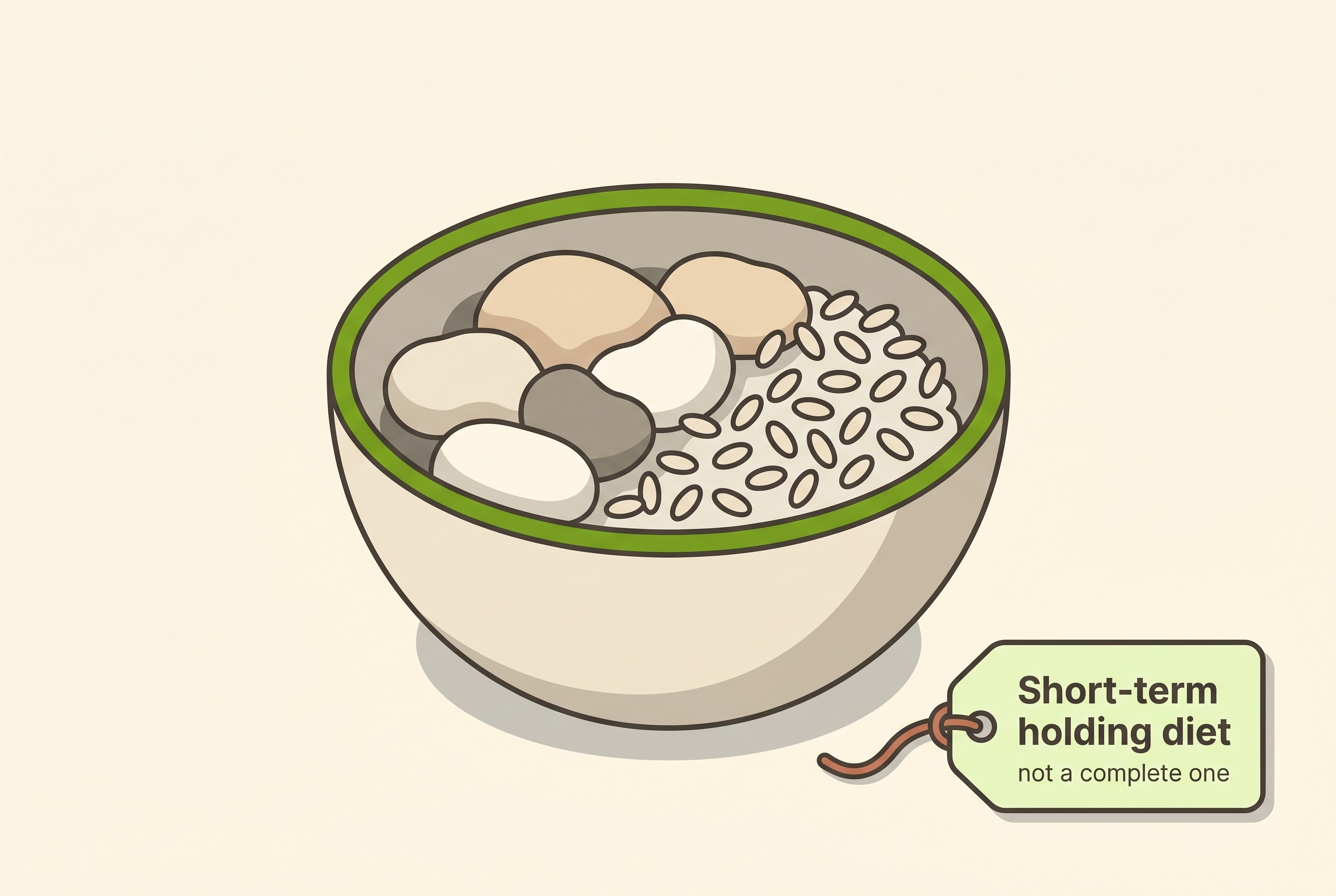
The other great myth is that chicken and rice fixes a tummy upset. It does not fix anything. What boiled skinless chicken with white rice (or a similar plain meal) actually is, is a gentle, easily-digested holding food that broadly fits the highly-digestible, low-fat, low-fibre principle for a few days while the gut settles (Lenox, 2021). That is a useful thing to be, but it is not a treatment, and it is not a complete and balanced diet: it is short on essential nutrients and unsuitable beyond a few days (Lenox, 2021). Where you can get one, a commercial veterinary highly-digestible or gastrointestinal diet is the better-evidenced choice, because it is formulated to be both gentle and nutritionally complete (Lenox, 2021). I will describe these by type rather than steer you to a brand. Chicken and rice, in short, is a fine short-term crutch, not a cure.
Probiotics get asked about constantly, so let me be straight. The evidence that they help acute diarrhoea in dogs is weak. A systematic review found the relevant trials were mostly small and at moderate-to-high risk of bias, and concluded that the data "point toward a very limited and possibly clinically unimportant effect" for treating acute gastrointestinal upset (Jensen & Bjørnvad, 2019). Some products, including certain multi-strain or Enterococcus faecium-containing ones, may shorten an upset modestly. They are very unlikely to do harm, and reaching for a probiotic is a far better instinct than reaching for an antibiotic. So the fair framing is: it may help a little, it will not hurt, and do not expect a cure. A spoon of plain pumpkin or another soluble-fibre source sits in the same low-risk, modest-benefit category: it can help firm a loose stool in some pets, but it is not magic, and more is not better.
While we are on what to reach for, antibiotics deserve one sentence. Most acute diarrhoea needs no antibiotic at all, and metronidazole, long given reflexively, is now actively discouraged for the uncomplicated case (Langlois et al., 2020). I will not re-argue the evidence, because it is set out in full in does my pet need antibiotics for diarrhoea?. The current European guidance is blunt about it: for mild and moderate acute diarrhoea there is high-certainty evidence that antibiotics are not needed, and supportive care is what helps (Jessen et al., 2024). If your pet does need to be seen, your vet is more likely to reach for an anti-sickness medicine such as maropitant (Cerenia), licensed to prevent and treat vomiting in dogs alongside supportive care, than for an antibiotic (NOAH Compendium).
The hard limits, and the pets you do not watch
Everything above is only safe inside these limits.
On time: if mild signs are not clearly improving within roughly 24 to 48 hours, or get worse at any point, stop watching and call the vet. Home care is a short bridge, not a fortnight-long plan. Any red flag overrides that clock instantly. Repeated unproductive retching with a swelling belly, blood (fresh, or dark and tarry), an inability to keep water down, collapse or marked lethargy, a painful belly, pale gums, or a suspected toxin or swallowed object all mean stop now and ring, and they take you straight to digestive emergencies. Hydration is the quiet thing to watch hardest: persistent vomiting that stops a pet drinking, or signs of dehydration such as tacky gums, sunken-looking eyes, lethargy, or skin that is slow to spring back when gently lifted at the scruff, mean this is no longer a home case.
Some pets should not be watched at home in the same way, because they deteriorate too quickly for wait-and-see to be safe. Puppies and kittens have small glycogen reserves and a small blood volume, so they dehydrate and drop their blood sugar alarmingly fast (Lee & Cohn, 2015). The same lower threshold applies to the very old, the pregnant, the diabetic, and small or toy-breed dogs. For these patients, an upset that would be reasonable to watch for a day in a robust adult is a reason to ring the vet straight away.
Watch it as a trend, not a guess
The real test of whether home care is working is whether things are genuinely improving, and "he seems a bit brighter" is hard to judge across an anxious 48 hours. So write it down. Logging a faecal score, along with the frequency and contents, in our Faecal Score Tracker turns a vague impression into a visible line you can read, and if the upset does end up needing a visit, it hands your vet real data instead of a worried estimate. The how-to of scoring and photographing stool sits in describing symptoms to your vet, so I will point you there rather than teach the chart twice.
If this turns out to be a one-off, the tracker simply confirms the improving trend and you both relax. If it keeps happening, or never quite settles, that is a different conversation, and the place to take it is back to vomiting and diarrhoea explained, which sets out how recurrent or persistent signs get worked up. Either way, you have the two things that keep a tummy upset safe at home: a clear sense of when watching is reasonable, and an even clearer sense of the moment it stops being so.
References
- Cornell Feline Health Center. Hepatic lipidosis. Cornell University College of Veterinary Medicine.
- Jensen, A. P., & Bjørnvad, C. R. (2019). Clinical effect of probiotics in prevention or treatment of gastrointestinal disease in dogs: A systematic review. Journal of Veterinary Internal Medicine, 33(5), 1849-1864.
- Jessen, L. R., Scahill, K., Singleton, D. A., et al. (2024). European Network for Optimization of Veterinary Antimicrobial Therapy (ENOVAT) guidelines for antimicrobial use in canine acute diarrhoea. The Veterinary Journal. ENOVAT/WSAVA.
- Langlois, D. K., Koenigshof, A. M., & Mani, R. (2020). Metronidazole treatment of acute diarrhea in dogs: A randomized double-blinded placebo-controlled clinical trial. Journal of Veterinary Internal Medicine, 34(1), 98-104.
- Lee, J. A., & Cohn, L. A. (2015). Canine pediatrics: The vomiting puppy. Today's Veterinary Practice, September/October 2015.
- Lenox, C. E. (2021). Nutritional management for dogs and cats with gastrointestinal diseases. Veterinary Clinics of North America: Small Animal Practice, 51(3), 669-684.
- Mohr, A. J., Leisewitz, A. L., Jacobson, L. S., Steiner, J. M., Ruaux, C. G., & Williams, D. A. (2003). Effect of early enteral nutrition on intestinal permeability, intestinal protein loss, and outcome in dogs with severe parvoviral enteritis. Journal of Veterinary Internal Medicine, 17(6), 791-798.
- NOAH Compendium. Cerenia tablets for dogs: Summary of product characteristics. National Office of Animal Health (GB).
- Witzel Rollins, A. (2018). Nutritional management for gastrointestinal disease in dogs and cats. Today's Veterinary Practice, January/February 2018.
Keep track of how your pet is doing
The owners who cope best are the ones who notice changes early. A simple health log shows you what is working, and what is not, before the next vet visit.
Start tracking, freeYou're not doing this alone
Compare treatment journeys and talk to owners managing digestive health. Free to join.
Join PetsLikeMine