

Chronic, grumbling pancreatitis: spotting the slow burn
Alastair Greenway
BVM&S MRCVS
Some of the hardest cases I see are not the dramatic ones. They are the pets whose owners say some version of "I can't quite put my finger on it, he's just not himself." A dog who goes off his food for a day or two every few weeks, licks his lips and seems tucked-up after a meal, then rallies as if nothing happened. A cat who is quietly picking at her dinner and slowly losing condition. Nothing screams "emergency", and yet that off-and-on grumbling, the sense that something is smouldering under the surface, is real. One of the things it can be is a low-grade, long-running pancreatitis.
That word tends to conjure a sudden crisis: a violently sick dog with a painful belly, rushed in after raiding the bin. That picture is real, but it is only one end of a spectrum (Watson, 2015). The other end is quieter, far more common than it is ever diagnosed. For the foundations, what the pancreas does, why "it was just one fatty meal" is rarely the whole story and why diagnosis is fuzzy, pancreatitis explained is the place to start. Here, the slow burn.
"Chronic" means long-running, not worse
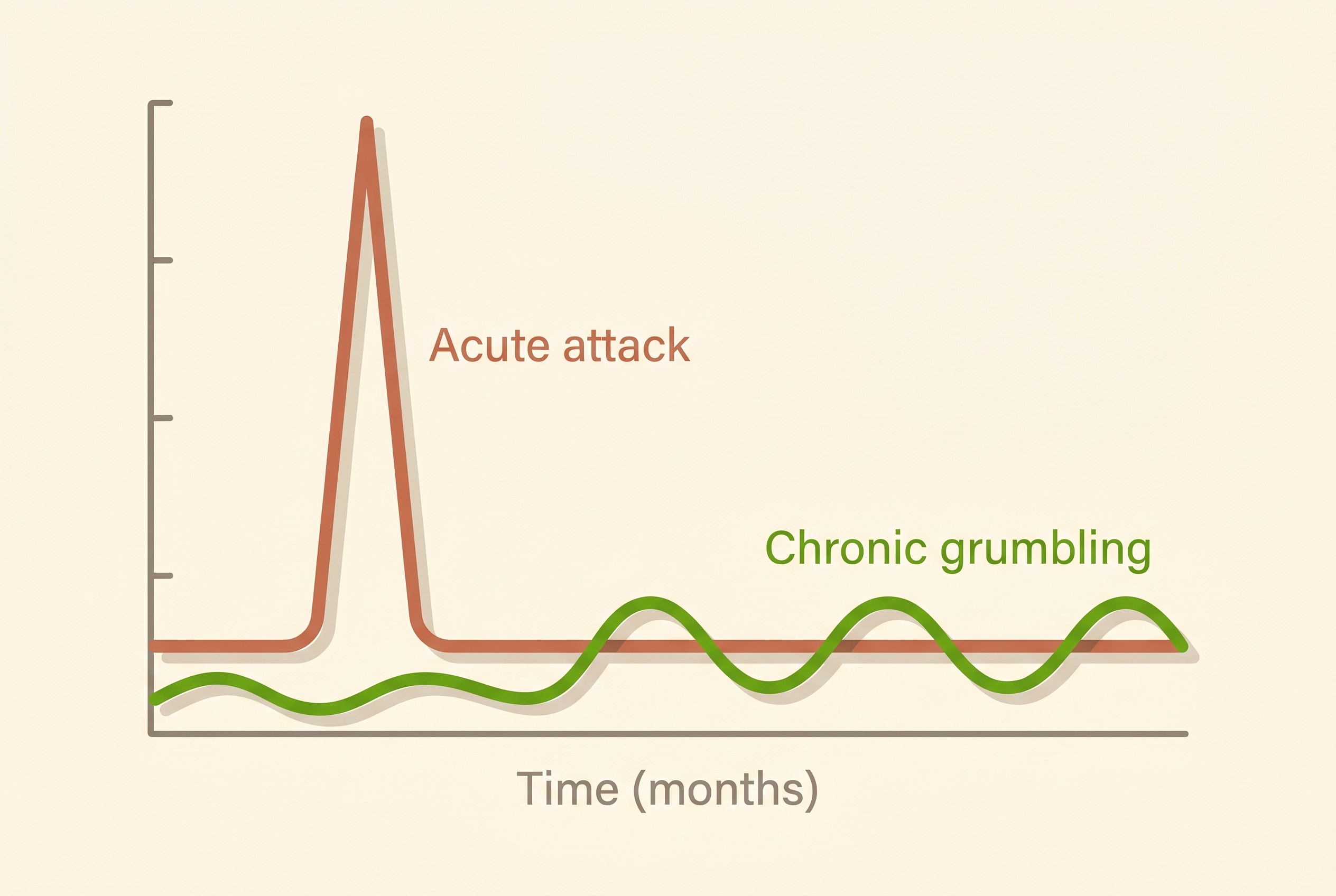
First, what "chronic" actually means, because it frightens people more than it should. Pancreatitis sits on a spectrum from a sudden, painful acute attack to a low-grade, recurrent, smouldering form that waxes and wanes for months or years (Watson, 2015). The line between the two is drawn under a microscope, not in the consulting room: chronic pancreatitis is defined by irreversible changes in the gland, scarring (fibrosis), shrinkage of the working tissue (acinar atrophy) and a particular pattern of inflammatory cells, whereas an acute attack, however severe, can in principle resolve completely and leave the gland intact (Watson, 2015; MSD Veterinary Manual). So when your vet says "chronic", they mean long-running and grumbling. They do not mean "worse".
It is striking how common this quiet form is. In a UK study that examined the pancreas of 200 ordinary first-opinion dogs after death, chronic pancreatitis turned up in around 34% of them, most of which had never been diagnosed in life, and over half of the affected glands were moderate to marked in severity (Watson et al., 2007). Other histopathology work, looking specifically at where inflammation sits within the gland, found suggestive chronic changes in an unexpectedly large share of dogs too, and noted that the lesions are often patchy rather than spread evenly, which is part of why they slip past us (Newman et al., 2004). A great many dogs, in other words, carry a grumbling pancreas that never declares itself as a textbook attack.
What owners are actually looking at
So what does the slow burn look like before anyone has said the word pancreatitis? In dogs, it is a "grumbly", intermittently off dog: waxing and waning low energy, a variable or picky appetite, gradual weight loss, intermittent vomiting, and bouts of low-grade upset with discomfort high up in the belly, lip-licking or nausea after meals (Watson, 2015; Barker, Vet Times). Tellingly, the episodes tend to settle on their own, which is exactly why they get written off as "a sensitive tummy" or "he must have eaten something." In one detailed series of affected dogs, every single one had recurring episodes rather than one obvious attack, the commonest signs being lethargy, weight loss, a poor appetite, upper abdominal pain, diarrhoea and intermittent vomiting (Coddou et al., 2024).
Cats are even more understated, and they hide it so well they deserve their own paragraph. The typical chronically affected cat is simply "off colour": lethargic, picking at food or refusing it, a little dehydrated, slowly losing weight, with vomiting and obvious belly pain far less reliable as clues than they are in dogs (Forman et al., 2021; De Cock et al., 2007). Many cats are effectively subclinical until something tips them over. The figures are sobering. When researchers examined the whole pancreas in 115 cats after death, regardless of what they died of, pancreatitis was present in 67% overall and in 45% of cats that had seemed perfectly normal in life, with the chronic form dominating (De Cock et al., 2007). So chronic vomiting or a quietly fading appetite in a cat is never "just hairballs" or "just old age", and a smouldering pancreas is one of the things worth looking for.
Why it slips past us, and where tracking earns its place
Here is the frustrating heart of it. The first problem is that the signs are non-specific and intermittent: by the time you get an "off" pet into the consulting room it has often rallied, and a single snapshot rarely captures a pattern that only shows itself over weeks (Barker, Vet Times; Watson, 2015). The second is harder to hear: the tests are imperfect for the low-grade form. The blood test we lean on, a pancreas-specific lipase (Spec cPL in dogs), is far less sensitive in mild, chronic disease than in a florid acute attack. When checked against what the tissue actually showed, that test picked up only around a fifth of histologically mild cases, against roughly three-quarters of moderate to severe ones (Cridge et al., 2021). In day-to-day chronic cases, clinical summaries put it starkly: only about a quarter have a raised lipase, and only just over half an abnormal ultrasound (Barker, Vet Times). These tests are not useless, but a single normal lipase or a clean scan does not rule out a grumbling pancreas, partly because there is no perfect gold-standard test to measure them against and partly because patchy disease is easy to miss on a scan (Cridge et al., 2021). The full "limits of diagnosis" discussion belongs to pancreatitis explained; that one fact is what makes the next bit matter.
Because no single visit or test is decisive, the most useful thing you can do is document the pattern over time: appetite dips, vomits, stool quality, and whether the weight is quietly drifting down. Logged consistently, those scattered "off days" stop being a string of unconnected shrugs and become a trend line a vet can act on. This is exactly what our Faecal Score Tracker is built for, turning a smouldering, recurrent problem into something visible rather than a vague "he was a bit off last month." It is the difference between a hunch and evidence, and it often does more to crack a grumbling-pancreas case than any one blood test.
Where it can lead, told straight
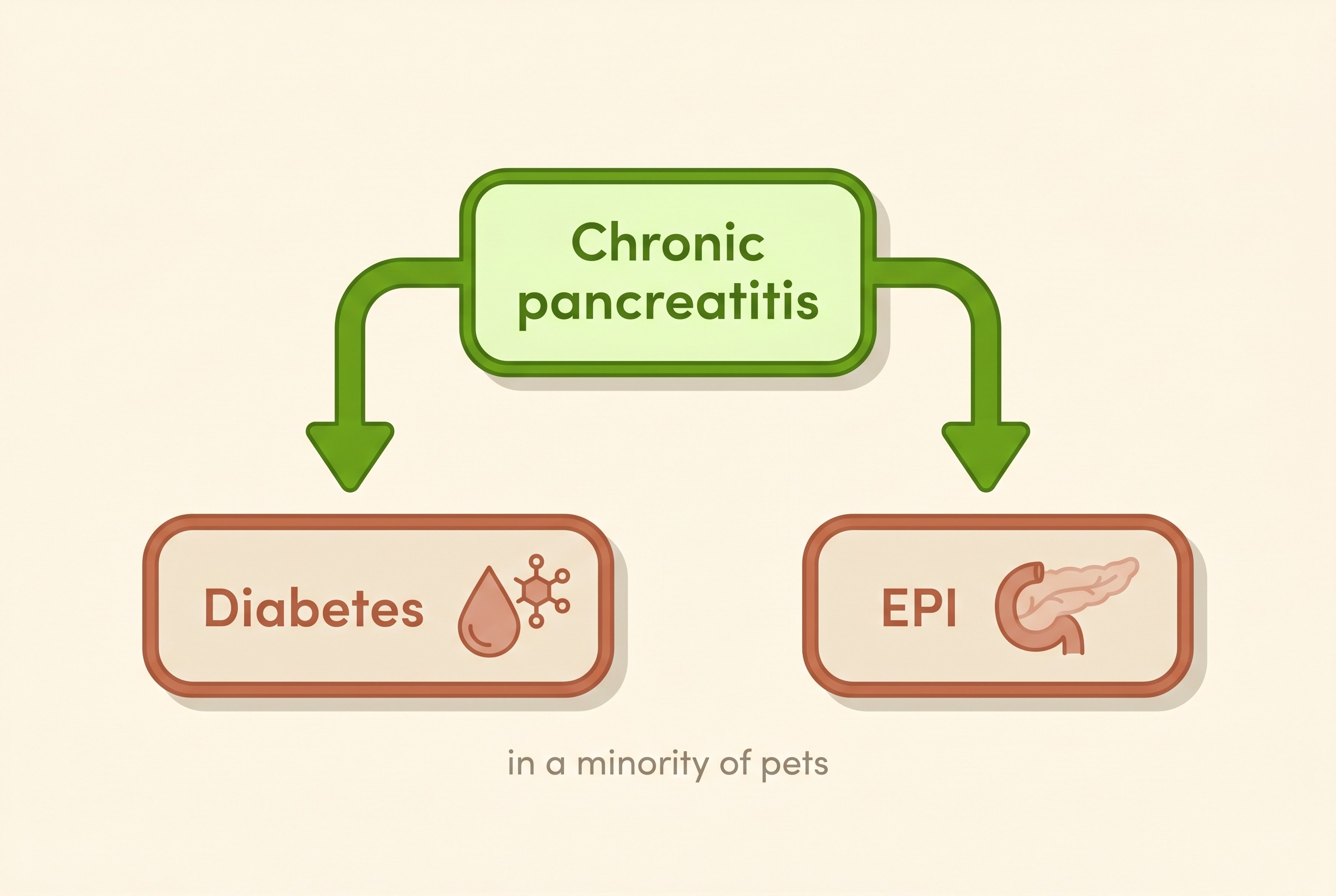
The long view is real, but it is not a sentence. Over years, ongoing inflammation gradually and irreversibly destroys both kinds of working tissue in the pancreas, the insulin-producing (endocrine) cells and the enzyme-producing (exocrine) cells, so if enough of the gland is lost a minority of pets develop diabetes mellitus, or exocrine pancreatic insufficiency (EPI, where the pet cannot digest food properly), or occasionally both (Watson, 2015; MSD Veterinary Manual). The key word is minority. In that detailed series of 104 affected dogs, EPI developed in about 11% and diabetes in about 7%, with just one dog developing both (Coddou et al., 2024). The great majority went on to neither, so keeping half an eye out is sensible foresight rather than paranoia.
In practice that means knowing the signs to mention to your vet. For EPI it is new weight loss despite a good or even ravenous appetite, often with large, pale, greasy stools; chronic pancreatitis is itself an under-recognised cause of EPI in dogs, capable of burning the gland out to that endpoint (Watson, 2003). In cats it is the dominant route, feline EPI being recognised as usually secondary to chronic pancreatitis rather than to the gland simply failing to develop (Xenoulis et al., 2016; MSD Veterinary Manual). For diabetes it is increased thirst, urination and weight loss, and a pet with both conditions can be harder to keep stable, because a flaring pancreas unsettles the blood sugar (Cridge et al., 2022). EPI's recognition and management are owned by EPI explained, and diabetes lives in the Endocrine and Hormones space; your job here is just to flag the new signs early so the right test gets run.
Managing the slow burn: same pillars, longer game
Managing the grumbling form rests on the same three pillars as any pancreatitis: a low-fat diet to ease the demand on the gland, controlling flares promptly, and ongoing monitoring (Barker, Vet Times; Watson, 2015). The difference is that this is a long game of keeping things steady, not a single course of treatment, and the specifics each have a proper home. What "low-fat" really means, the thresholds, the treats and the scavenge-proofing, is owned by feeding for a pancreas. What to do when a grumble flares into a genuine attack, the fluids, the pain relief, the anti-nausea medication (maropitant, marketed as Cerenia) and the modern shift to feeding through it rather than starving the gland, belongs to the pancreatitis flare.
What I will say plainly is something the marketing tends to gloss over: there is no licensed cure for chronic pancreatitis, and for the ordinary case no established routine role for steroids. The evidence on corticosteroids is genuinely thin and unsettled; the work that does exist looks at acute and acute-on-chronic flares rather than the everyday grumble, and even there it is suggestive at best and stops short of recommending routine use, with the authors calling for proper controlled trials (Bjørnkjær-Nielsen and Bjørnvad, 2021). So the old line that a grumbling pancreas means lifelong steroids is out of date for most pets (the one real exception is below); management stays largely dietary and supportive (Barker, Vet Times). Tracking earns its keep here too, catching a flare while it is still small. The moment one tips over, a pet suddenly vomiting repeatedly, very flat, or guarding a painful belly, our Vomiting and Diarrhoea Triage helps you decide whether to watch, book, or go now, with digestive emergencies for the red flags that mean do not wait.
Two breeds worth flagging
A couple of breeds change the picture enough to be worth flagging. Miniature schnauzers are the classic risk, linked to a tendency to high blood fats (idiopathic hypertriglyceridaemia) that predisposes them to recurrent and chronic disease; schnauzers with markedly raised triglycerides are several times more likely to show blood results consistent with pancreatitis (Xenoulis et al., 2010), and the detail is anchored in pancreatitis explained.
The standout, though, is the English cocker spaniel, because in this breed chronic pancreatitis appears to be a genuinely different disease. Rather than slow wear and tear, it looks immune-mediated: the inflammation is centred on the ducts, with dense aggregates of (mostly T-cell) lymphocytes and progressive scarring around the ducts and veins (Watson et al., 2011). It is often part of a wider immune syndrome too. In the 104-dog series, 72% had disease beyond the pancreas, including dry eye, suspected or confirmed kidney inflammation, anal sac problems and skin allergy (Coddou et al., 2024), and the condition shares histological features, including a particular antibody-producing cell type, with a recognised human immune disorder called IgG4-related disease (Coddou et al., 2020). The practical significance: in a cocker spaniel, a grumbling pancreas may be one face of a broader immune problem, so it is worth your vet checking the eyes, kidneys and elsewhere, and, unlike most chronic pancreatitis, this form has a logical rationale for responding to immunosuppressive treatment (Watson et al., 2011; Coddou et al., 2020). One myth to retire while we are here: there is no male bias in this breed, the affected dogs splitting almost evenly between the sexes at a median age of around nine years (Coddou et al., 2024). Cavaliers, collies and boxers crop up more often at post-mortem too, but the cocker is the one to know (Watson et al., 2007).
If your pet is one of the quietly-off ones, the most useful thing you can do this week costs nothing: start writing the pattern down in the Faecal Score Tracker and take it to your vet with the simple question, "could this be a grumbling pancreas?" Most pets with the slow-burn form are managed well over the long haul once someone has joined the dots, and a diagnosis is the start of a plan, not the end of the road. From there, feeding for a pancreas does most of the day-to-day heavy lifting, and EPI explained is the door to knock on if weight loss on a hungry pet ever appears.
References
- Barker, E. Pancreatitis in canines: acutely painful or chronically frustrating? Veterinary Times.
- Bjørnkjær-Nielsen, K. A., & Bjørnvad, C. R. (2021). Corticosteroid treatment for acute/acute-on-chronic experimental and naturally occurring pancreatitis in several species: a scoping review to inform possible use in dogs. Acta Veterinaria Scandinavica, 63, 28.
- Coddou, M. F., Constantino-Casas, F., Scase, T., Day, M. J., Blacklaws, B., & Watson, P. J. (2020). Chronic inflammatory disease in the pancreas, kidney and salivary glands of English cocker spaniels and dogs of other breeds shows similar histological features to human IgG4-related disease. Journal of Comparative Pathology, 177, 18-33.
- Coddou, M. F., Blacklaws, B., & Watson, P. J. (2024). Clinical manifestations of chronic pancreatitis in English cocker spaniels. Journal of Veterinary Internal Medicine, 38(4), 2129-2137.
- Cridge, H., Twedt, D. C., Marolf, A. J., Sharkey, L. C., & Steiner, J. M. (2021). Advances in the diagnosis of acute pancreatitis in dogs. Journal of Veterinary Internal Medicine, 35(6), 2572-2587.
- Cridge, H., Lim, S. Y., Algül, H., & Steiner, J. M. (2022). New insights into the etiology, risk factors, and pathogenesis of pancreatitis in dogs. Journal of Veterinary Internal Medicine, 36(3), 847-864.
- De Cock, H. E. V., Forman, M. A., Farver, T. B., & Marks, S. L. (2007). Prevalence and histopathologic characteristics of pancreatitis in cats. Veterinary Pathology, 44(1), 39-49.
- Forman, M. A., Steiner, J. M., Armstrong, P. J., et al. (2021). ACVIM consensus statement on pancreatitis in cats. Journal of Veterinary Internal Medicine, 35(2), 703-723.
- MSD Veterinary Manual. Pancreatitis in dogs and cats (the exocrine pancreas).
- Newman, S., Steiner, J., Woosley, K., Barton, L., Ruaux, C., & Williams, D. (2004). Localization of pancreatic inflammation and necrosis in dogs. Journal of Veterinary Internal Medicine, 18(4), 488-493.
- Watson, P. J. (2003). Exocrine pancreatic insufficiency as an end stage of pancreatitis in four dogs. Journal of Small Animal Practice, 44(7), 306-312.
- Watson, P. (2015). Pancreatitis in dogs and cats: definitions and pathophysiology. Journal of Small Animal Practice, 56(1), 3-12.
- Watson, P. J., Roulois, A. J. A., Scase, T., Johnston, P. E. J., Thompson, H., & Herrtage, M. E. (2007). Prevalence and breed distribution of chronic pancreatitis at post-mortem examination in first-opinion dogs. Journal of Small Animal Practice, 48(11), 609-618.
- Watson, P. J., Roulois, A., Scase, T., Holloway, A., & Herrtage, M. E. (2011). Characterization of chronic pancreatitis in English cocker spaniels. Journal of Veterinary Internal Medicine, 25(4), 797-804.
- Xenoulis, P. G., Suchodolski, J. S., Ruaux, C. G., & Steiner, J. M. (2010). Association between serum triglyceride and canine pancreatic lipase immunoreactivity concentrations in miniature schnauzers. Journal of the American Animal Hospital Association, 46(4), 229-234.
- Xenoulis, P. G., Zoran, D. L., Fosgate, G. T., Suchodolski, J. S., & Steiner, J. M. (2016). Feline exocrine pancreatic insufficiency: a retrospective study of 150 cases. Journal of Veterinary Internal Medicine, 30(6), 1790-1797.
Keep track of how your pet is doing
The owners who cope best are the ones who notice changes early. A simple health log shows you what is working, and what is not, before the next vet visit.
Start tracking, freeYou're not doing this alone
Compare treatment journeys and talk to owners managing digestive health. Free to join.
Join PetsLikeMine