

EPI: Ravenous, Thin, and Passing Greasy Stools, the Diagnosis Vets Miss
Alastair Greenway
BVM&S MRCVS
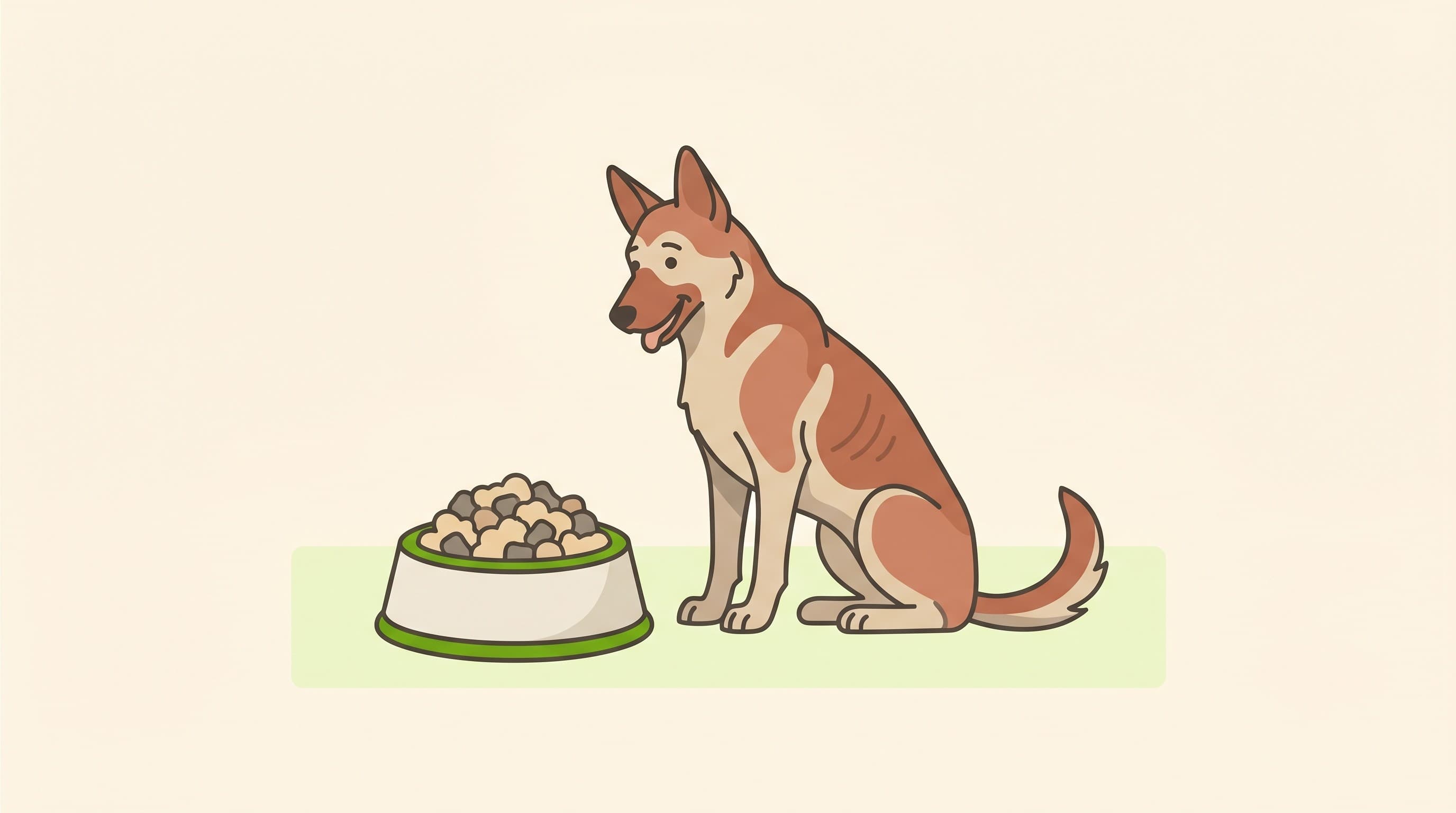
A few times a year an owner comes in with the same story. Their dog is hungry. Not just keen at mealtimes, but desperately, relentlessly hungry: bolting its food, raiding the bin, eating things in the garden it shouldn't, and somehow getting thinner all the while. They've changed the food three times and wormed it twice, and someone has told them it has "a sensitive stomach". Underneath runs a quiet thread of guilt, the sense that they're somehow failing their own dog.
The most likely explanation isn't your cooking, your worming or your love, but a real, well-understood disease called exocrine pancreatic insufficiency, or EPI: easy to miss, dramatic to live with, but diagnosed by a single cheap blood test, and most pets do very well once it's found.
Starving on a full bowl
The pancreas does two quite separate jobs. One part, the endocrine pancreas, makes insulin (the failure of which is diabetes, a different disease that belongs in another space). The other, the exocrine pancreas, makes the digestive enzymes that break food down so the body can absorb it. EPI is the failure of that second part: too little enzyme reaches the intestine, food passes through largely undigested, and the nutrients simply wash out the other end (Westermarck & Wiberg, 2012; MSD Veterinary Manual).
The whole tragedy of EPI is that the pet effectively starves on a full bowl. This isn't a "sensitive tummy" or a behaviour problem but maldigestion, and the ravenous appetite that makes owners feel they must be doing something wrong is simply the body asking, quite reasonably, for the calories it cannot reach (MSD Veterinary Manual).
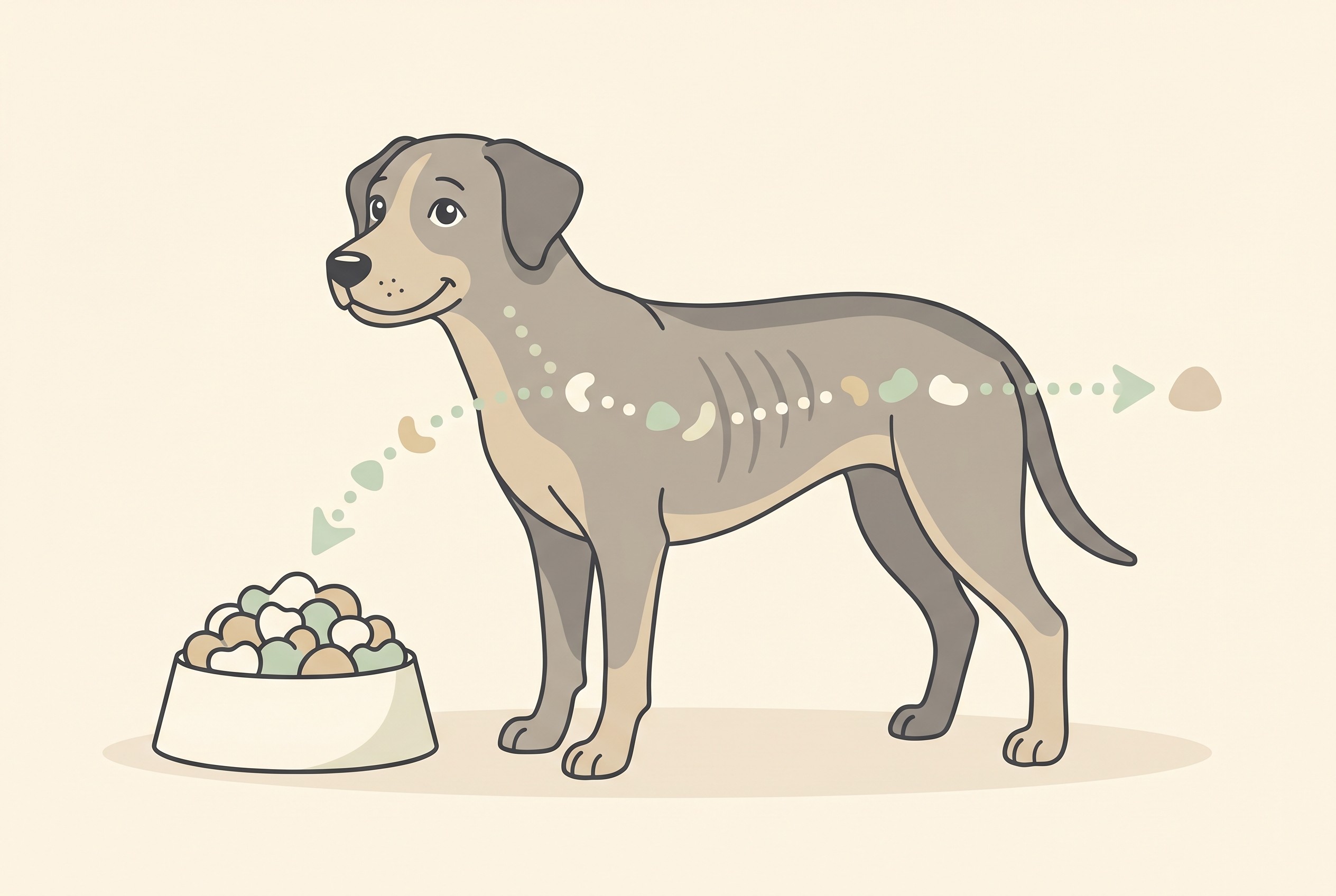
One feature explains why EPI seems to arrive out of nowhere. The pancreas has an enormous reserve, and more than 90% of its enzyme-producing acinar cells have to be lost before any signs appear at all (MSD Veterinary Manual; Wiberg, Nurmi & Westermarck, 1999). So the disease has usually been developing silently for a long time before it crosses a threshold and the signs seem to switch on overnight. The suddenness is an illusion; the decline was happening all along, just out of sight.
Spotting the pattern
Spotting the pattern is the whole game. The classic combination is a ravenous appetite and steady weight loss, together with large, pale, soft, greasy, foul-smelling faeces (MSD Veterinary Manual; Westermarck & Wiberg, 2012). That voluminous stool has a name, steatorrhoea: undigested fat passing straight through, often putty-coloured and far bulkier than you would expect.
Around that core sit the supporting players: a poor, scurfy coat, larger and more frequent bowel movements, a rumbling gut, a lot of wind, and often scavenging or eating faeces as the body chases calories any way it can. Early on, though, the dog is otherwise bright and active, which is exactly why the disease gets brushed aside. Not every case reads straight from the textbook either: some dogs aren't dramatically greedy, and in those the weight loss is the loudest sign. In cats the picture is quieter still, with weight loss, an unkempt greasy coat and soft faeces (Xenoulis et al., 2016; Cridge, 2025). Reassuringly, the test settles it regardless, so you don't have to be certain to ask the question.
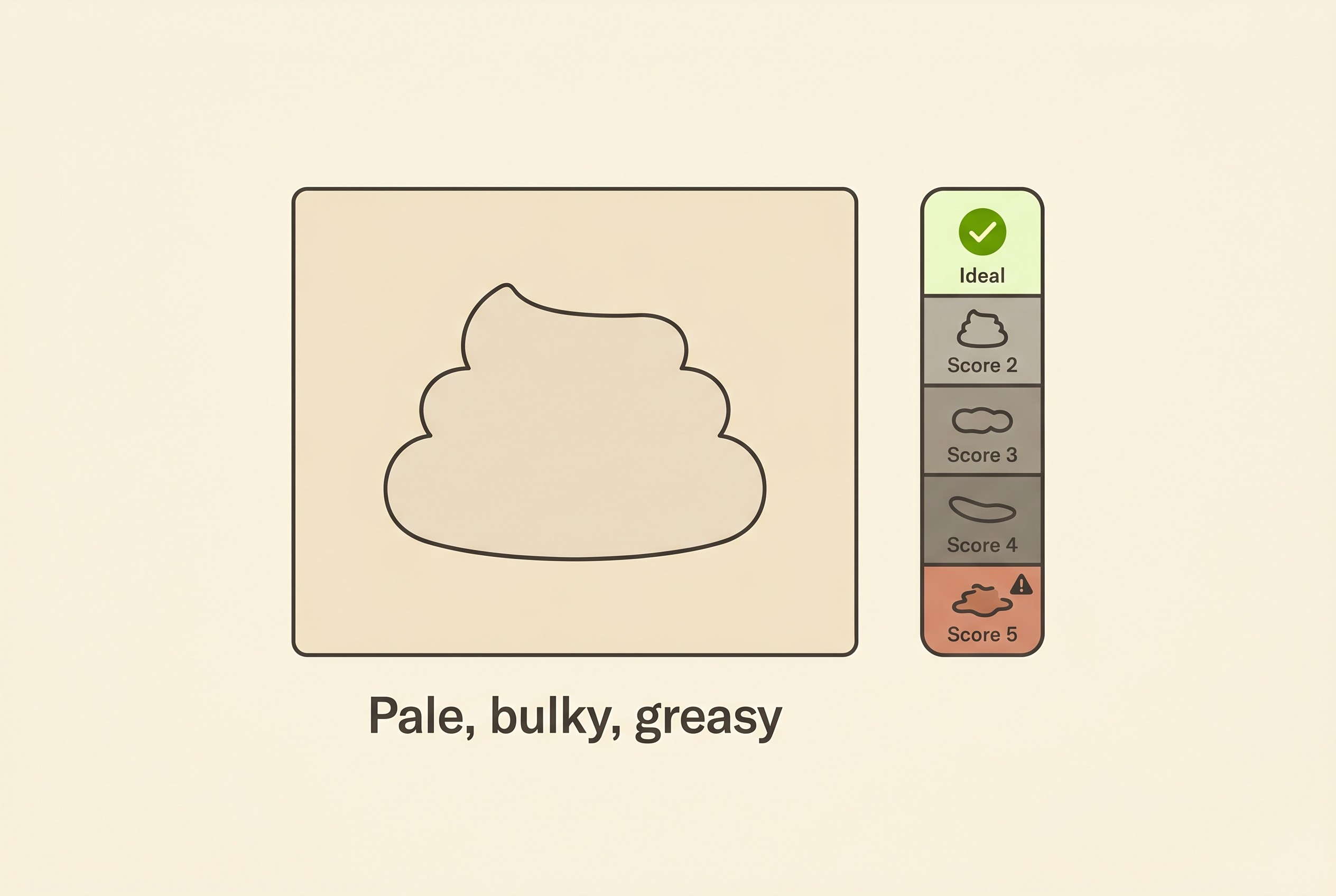
If you're watching the stools change, the Faecal Score Tracker is the place to log them. Noting that bulky, pale, greasy character over a week or two gives your vet a far clearer story than memory, and becomes your baseline for measuring recovery once treatment starts.
Why it gets missed for months
None of this is a swipe at vets. Every one of EPI's signs points, at first glance, somewhere more common. Weight loss with a big appetite and loose stools could be parasites or a poor diet, so it's reasonable to worm the dog and trial a different food before reaching for a specialist blood test. In cats especially the signs are subtle and nonspecific, and "it is easy to miss a diagnosis" is the assessment even from specialists (Cridge, 2025). Add the silent reserve we met earlier, and months can pass, with several food changes and a good deal of self-blame, before the right test is run.
Which pets, and what's behind it
In dogs, the face of EPI is the young to middle-aged German Shepherd. The breed is so strongly overrepresented that it's the first thing any vet thinks of, though it's far from the only one affected: rough collies, Eurasiers, English setters, Cavalier King Charles spaniels and Chow Chows all crop up in the current literature (MSD Veterinary Manual; Cridge, 2025). In these young dogs the cause is usually pancreatic acinar atrophy, in which an immune-mediated process destroys the enzyme-producing tissue. It's hereditary in the German Shepherd, though the inheritance is complex rather than a single gene, with an association to the dog's immune-gene region (the DLA) now documented (Tsai et al., 2013).
In dogs of other breeds, and in cats, the story is usually different: the acinar tissue has been gradually burnt out by long-running chronic pancreatitis (Westermarck & Wiberg, 2012; Xenoulis et al., 2016). So EPI in an older crossbreed or a cat is often the tail end of a grumbling inflammatory problem, which has its own guide in chronic grumbling pancreatitis. Feline EPI is genuinely uncommon, and its quiet presentation is exactly why it's so easily missed (Xenoulis et al., 2016; Cridge, 2025).
The test that settles it
EPI is diagnosed by a single fasted blood test called serum TLI, trypsin-like immunoreactivity, which measures an enzyme a healthy pancreas leaks into the blood. In EPI there's too little tissue left to leak, so the level falls strikingly low, and a markedly low TLI with the right signs is diagnostic, full stop (Williams & Batt, 1983; Wiberg, Nurmi & Westermarck, 1999). The assay is species-specific: cTLI for dogs, fTLI for cats.
The standard cut-offs are at or below about 5.5 µg/L in dogs and 8.0 µg/L in cats, although every laboratory states its own range, so it's the pattern and the lab's interpretation that matter rather than a memorised number (MSD Veterinary Manual; Xenoulis et al., 2016). A value clearly below 2.5 µg/L with typical signs is unequivocal, but anything in the borderline band up to about 5.0 to 5.5 µg/L is best handled by repeating the fasted test a few weeks later rather than committing on one result (Wiberg, Nurmi & Westermarck, 1999). The sample should ideally be fasted, though the post-meal rise is small and rarely changes the interpretation, so a non-fasted result is far better than no test at all (Cridge, 2025). Usefully, the level isn't affected by enzyme supplements, which are of pig origin and invisible to the assay, so it can still be run after a food or enzyme trial has begun (Cridge, 2025).
You may also be offered a faecal elastase test. It has its place as a screen, but it isn't the verdict: sensitive yet poorly specific, throwing up false positives in around a quarter of dogs that turn out to have a normal TLI, so a low elastase must always be confirmed by TLI (Steiner et al., 2010; MSD Veterinary Manual). The old faecal-fat and proteolytic-activity tests are unreliable and have largely been retired. TLI also tells EPI apart from chronic enteropathy, a different cause of weight loss and diarrhoea that can look very similar (the two are distinguished in diagnosing chronic enteropathy). One more thing belongs in the same blood draw: cobalamin (vitamin B12), and ideally folate, because of what comes next.
B12, and the hopeful turn
A last piece of physiology matters here. In dogs and cats, unlike in people, most of the carrier protein needed to absorb vitamin B12 from the gut is made by the pancreas itself, so when it fails, B12 absorption fails with it (MSD Veterinary Manual; Cridge, 2025). Deficiency is therefore very common in EPI, affecting around two-thirds of affected dogs and roughly three-quarters of cats, and it's no side issue: severe deficiency is linked to shorter survival in canine EPI, which is precisely why it's worth measuring and correcting from the outset (Soetart et al., 2019; Xenoulis et al., 2016; Batchelor et al., 2007). The old assumption that B12 always has to be injected is out of date too: oral cobalamin normalises low levels just as well, including in EPI dogs specifically (Chang et al., 2022; Toresson et al., 2016). The dosing detail belongs with the management guides, so I'll hand that to living with chronic enteropathy.
This leaves you in a far better place than the last few months may have felt. EPI is managed, not cured, but the outlook once it's found and treated is genuinely good: in a large study, dogs that came through the initial treatment period had a median survival of around 1,919 days, more than five years, with the best results in those reaching clinical remission (Batchelor et al., 2007). I'll be straight that it isn't effortless for everyone, and roughly one in five dogs were lost in that first year, one more reason to find it early and correct B12 promptly (Batchelor et al., 2007). The cornerstones are simple, pancreatic enzyme replacement (pancrelipase) with every meal, cobalamin, and a highly digestible diet, but getting the routine and dose right is its own craft, covered in managing EPI for life. And if the weight still won't come once treatment is under way, there are common, fixable reasons, set out in why the weight still will not come.
One safety note before then. EPI itself is a slow, chronic problem, not an emergency, but a thin pet has little in reserve, so if yours suddenly stops eating, vomits repeatedly, becomes painful in the belly or collapses, treat that as urgent: ring your vet, use the Vomiting and Diarrhoea Triage if you are unsure, and see the digestive red flags for the signs that cannot wait.
So if you recognise your dog or cat in the picture above, the hungry, thinning, greasy-stooled pet everyone has been treating for a sensitive stomach, the single most powerful step is to ask your vet for a fasted TLI. Keep logging the stools on the Faecal Score Tracker meanwhile, because once treatment starts, watching them firm up and the weight return is how you'll know, week by week, that you finally have the right answer.
References
- Batchelor, D. J., Noble, P.-J. M., Taylor, R. H., Cripps, P. J., & German, A. J. (2007). Prognostic factors in canine exocrine pancreatic insufficiency: prolonged survival is likely if clinical remission is achieved. Journal of Veterinary Internal Medicine, 21(1), 54-60.
- Chang, C.-H., Lidbury, J. A., Suchodolski, J. S., & Steiner, J. M. (2022). Effect of oral or injectable supplementation with cobalamin in dogs with hypocobalaminemia caused by chronic enteropathy or exocrine pancreatic insufficiency. Journal of Veterinary Internal Medicine, 36(5), 1607-1621.
- Cridge, H. (2025). Canine and feline exocrine pancreatic insufficiency. Today's Veterinary Practice, July/August 2025.
- MSD Veterinary Manual. Exocrine pancreatic insufficiency in dogs and cats (current online edition; H. Cridge, reviewer).
- Soetart, N., Rochel, D., Drut, A., & Jaillardon, L. (2019). Serum cobalamin and folate as prognostic factors in canine exocrine pancreatic insufficiency: an observational cohort study of 299 dogs. The Veterinary Journal, 243, 15-20.
- Steiner, J. M., Rehfeld, J. F., & Pantchev, N. (2010). Evaluation of fecal elastase and serum cholecystokinin in dogs with a false positive fecal elastase test. Journal of Veterinary Internal Medicine, 24(3), 643-646.
- Toresson, L., Steiner, J. M., Suchodolski, J. S., & Spillmann, T. (2016). Oral cobalamin supplementation in dogs with chronic enteropathies and hypocobalaminemia. Journal of Veterinary Internal Medicine, 30(1), 101-107.
- Tsai, K. L., Starr-Moss, A. N., Venkataraman, G. M., et al. (2013). Alleles of the major histocompatibility complex play a role in the pathogenesis of pancreatic acinar atrophy in dogs. Immunogenetics, 65(7), 501-509.
- Westermarck, E., & Wiberg, M. E. (2012). Exocrine pancreatic insufficiency in the dog: historical background, diagnosis, and treatment. Topics in Companion Animal Medicine, 27(3), 96-103.
- Wiberg, M. E., Nurmi, A.-K., & Westermarck, E. (1999). Serum trypsinlike immunoreactivity measurement for the diagnosis of subclinical exocrine pancreatic insufficiency. Journal of Veterinary Internal Medicine, 13(5), 426-432.
- Williams, D. A., & Batt, R. M. (1983). Diagnosis of canine exocrine pancreatic insufficiency by the assay of serum trypsin-like immunoreactivity. Journal of Small Animal Practice, 24(9), 583-588.
- Xenoulis, P. G., Zoran, D. L., Fosgate, G. T., Suchodolski, J. S., & Steiner, J. M. (2016). Feline exocrine pancreatic insufficiency: a retrospective study of 150 cases. Journal of Veterinary Internal Medicine, 30(6), 1790-1797.
Keep track of how your pet is doing
The owners who cope best are the ones who notice changes early. A simple health log shows you what is working, and what is not, before the next vet visit.
Start tracking, freeYou're not doing this alone
Compare treatment journeys and talk to owners managing digestive health. Free to join.
Join PetsLikeMine