

Worms and giardia: when a parasite is behind the diarrhoea
Alastair Greenway
BVM&S MRCVS
When a pet has loose stools, "have you wormed them?" is one of the first things people say, and there's a kernel of truth in it. A parasite genuinely can be behind the diarrhoea, especially in a young animal or one recently somewhere busy. Two surprising things are also true, though. A positive giardia test in a bright, well pet often needs no treatment at all (ESCCAP Giardia Fact Sheet). And a wormer isn't the answer to every loose stool: reaching for one again and again, in a pet whose diarrhoea keeps coming back, is one of the commonest ways a real diagnosis gets missed.
This piece is about parasites as a cause of the diarrhoea in front of you now, not the routine worming schedule (a preventive-care topic; your vet will set the right interval). It also assumes you know where parasites sit on the wider map of causes: the acute-versus-chronic split and the full differential belong to vomiting and diarrhoea explained.
When a parasite is the likely culprit
Parasites concentrate in the young, the crowded and the recently exposed: puppies and kittens carry the heaviest burdens, and so do rescues, pets from breeders, and animals coming out of kennels or catteries. Giardia in particular "occurs commonly in densely populated environments such as kennels, pet shops and animal shelters" (ESCCAP Giardia Fact Sheet), and contact with faecally contaminated ground or standing water adds to the risk. The age skew is striking: one large survey found giardia in roughly 18% of dogs under a year old against under 4% of adult dogs (18.2% versus 3.8%), with a similar, smaller gap in cats (Kurnosova et al., 2024). So a soft stool in an eight-week-old puppy fresh from a litter is a different proposition from the same stool in a settled, middle-aged house cat. The story around the pet matters as much as the stool itself.
A quick field guide to the worms
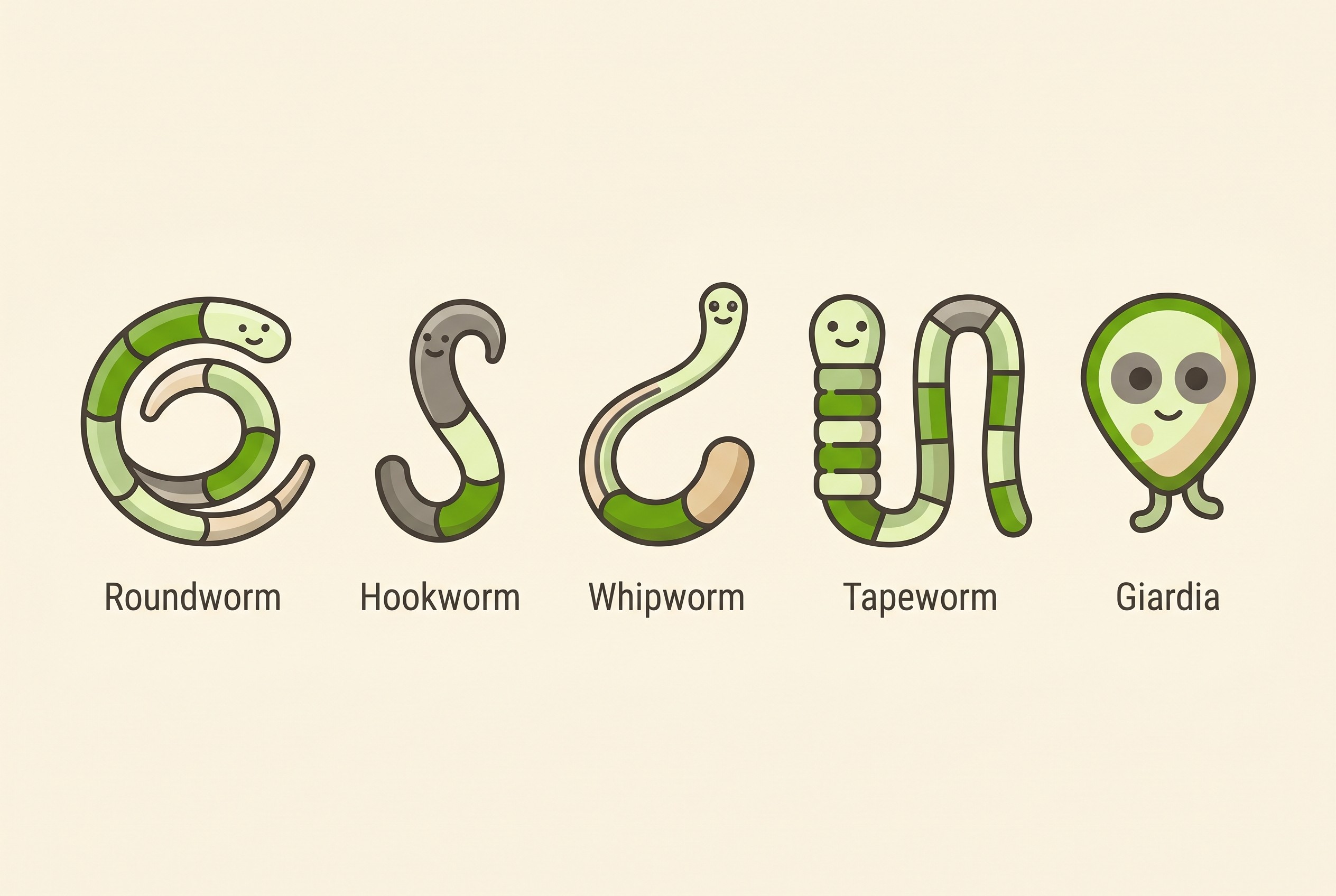
A handful of worms can cause diarrhoea, and it helps to know the patterns.
Roundworms (Toxocara canis, Toxocara cati and Toxascaris leonina) are the classic puppy and kitten worm: heavy burdens cause the pot-bellied look, poor growth, a dull coat, diarrhoea and sometimes vomiting, occasionally with spaghetti-like adult worms passed in the faeces or brought up, particularly in pups (WCVM, 2024). The reason almost every pup needs worming is the route in: Toxocara canis larvae cross to the foetuses late in pregnancy and pass in the milk through early lactation, so most pups are infected from birth, which is also why fenbendazole is licensed for treating the pregnant bitch to cut this prenatal and milk-borne transfer (WCVM, 2024; Panacur SPC, 2026).
Hookworms (Ancylostoma and Uncinaria species) are blood-feeders, so the picture is darker, literally: tarry diarrhoea, pale gums and anaemia, and in young pups Ancylostoma caninum can bleed a puppy to death (CAPC Hookworms, 2024). One emerging caveat: multi-anthelmintic-drug-resistant Ancylostoma caninum is now confirmed in the United States, so a hookworm that won't clear may be genuinely resistant rather than under-treated (CAPC Hookworms, 2024).
Whipworm (Trichuris vulpis) is a large-intestine worm of dogs, rare in cats. It causes large-bowel diarrhoea with fresh blood, mucus, straining and weight loss, and in heavy infections can throw the electrolytes into a "pseudo-Addisonian" picture (low sodium, high potassium) that mimics genuine Addison's disease (Venco et al., 2011; TroCCAP Whipworm, 2024). It's awkward to find too: the pre-patent period is long (around 10 to 12 weeks) and egg output intermittent, so a single faecal test often misses it (TroCCAP Whipworm, 2024).
Tapeworms (chiefly Dipylidium caninum, the flea tapeworm) are the ones owners actually see: rice-grain or cucumber-seed segments around the back end or in the bedding, often with scooting. And here's the surprise. Tapeworms are usually not a cause of diarrhoea. Disease from adult Dipylidium "is considered rare" and most infections cause no signs, and where diarrhoea does appear it's hard to blame the tapeworm because other parasites are usually present too (CAPC Dipylidium, 2024). What matters practically is that Dipylidium means fleas (so flea control is part of the cure) and the worm is cleared with praziquantel. And if the main sign is scooting, the cause is far more often the anal glands, which have their own anal gland problems guide.
In the very young there's one more parasite to hold in mind: coccidia (Cystoisospora), single-celled gut parasites that are a frequent cause of watery diarrhoea in puppies and kittens and are treated not with an ordinary wormer but with a coccidiocidal drug such as toltrazuril (TroCCAP Coccidia, 2024). It's worth a faecal test rather than an assumption, because the treatment is different from a routine wormer.
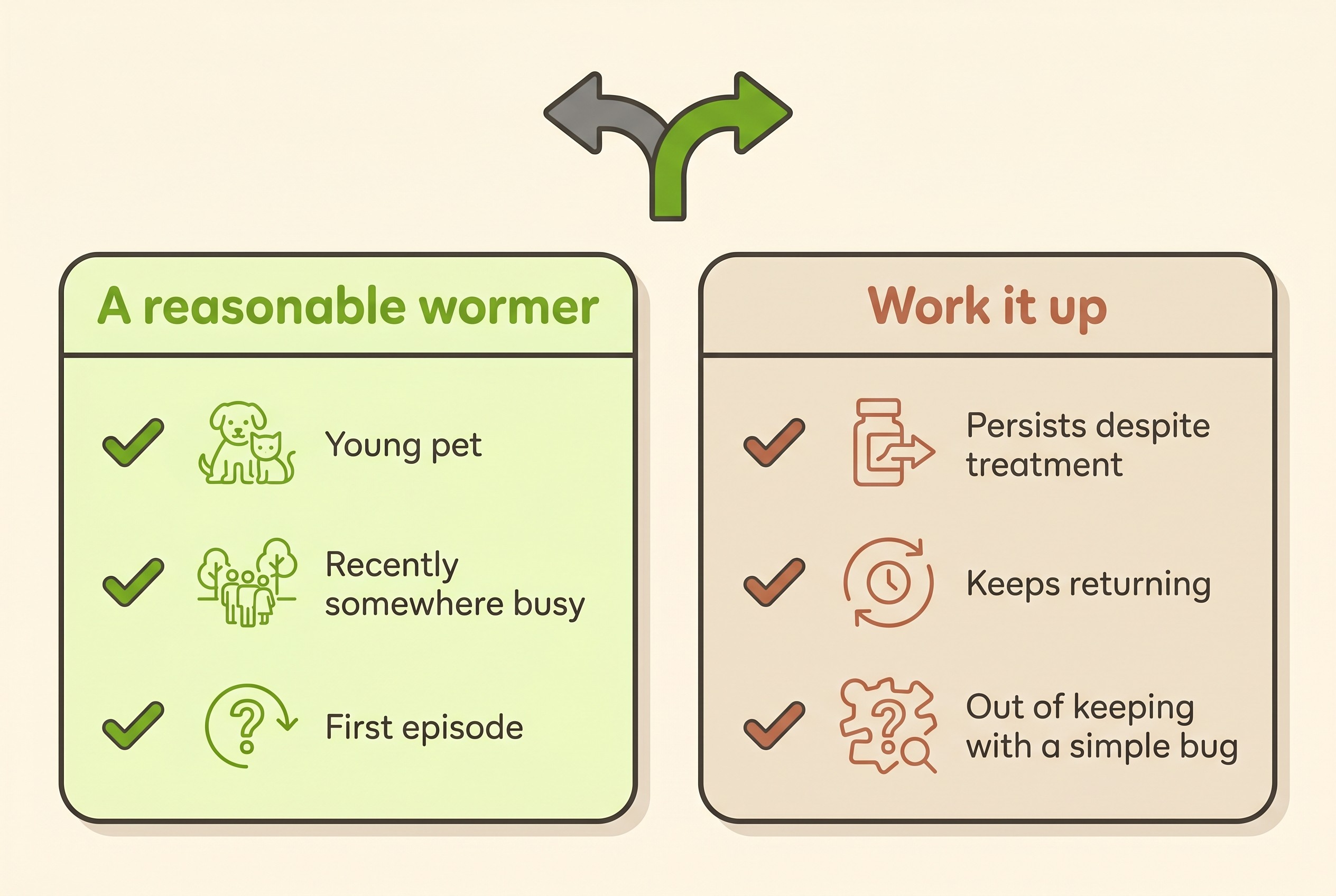
The least expected takeaway is the most useful: a wormer is a reasonable, cheap opening move, but not a cure-all. Faecal examination is integral to evaluating any pet with persistent diarrhoea, and a single negative result doesn't rule a parasite out (BSAVA Manual, 2019).
Giardia: common, frustrating, and widely misunderstood
Giardia deserves the most space, because it's common and because so much written about it is wrong. Giardia duodenalis is a single-celled protozoan parasite of the small intestine, not a worm. It sheds cysts in the faeces that are infectious the moment they're passed, and only a few are needed to infect, which is why it spreads so readily in busy environments (ESCCAP Giardia Fact Sheet).
The most important fact comes first: most infections are completely silent. "The majority of infected dogs and cats do not present clinical signs" (ESCCAP Giardia Fact Sheet). When it does cause illness, it produces a soft, sometimes greasy or mucoid, often pungent and intermittent diarrhoea, occasionally with weight loss from poor absorption, and usually without frank blood (ESCCAP Giardia Fact Sheet). The prognosis is generally good; the very young, elderly, debilitated and immunocompromised are more likely to come unstuck (ESCCAP Giardia Fact Sheet).
That silent majority leads to the most counter-intuitive rule, one content-mill pages routinely get wrong: a positive giardia test in a healthy pet with no signs usually needs no treatment. ESCCAP couldn't be plainer: "When a healthy animal without clinical signs has tested positive for Giardia, therapy is not advised. This is generally considered a transient, insignificant finding" (ESCCAP Giardia Fact Sheet). We treat the pet with the diarrhoea, not the laboratory result.
Why it's so easily missed. Giardia sheds its cysts on and off, so a single faecal sample is often falsely negative. Diagnosis uses, in rough order of usefulness, a zinc-sulphate flotation (ordinary sugar solutions collapse the fragile cysts, so zinc sulphate is preferred for giardia), a direct smear of very fresh faeces for the swimming trophozoites, a faecal antigen ELISA (the practical in-clinic test, more sensitive than a smear), and PCR at a reference laboratory, which can also tell whether the strain is one of the potentially human-infective ones (CAPC Giardia, 2024; ESCCAP Giardia Fact Sheet). Because shedding is intermittent, examining three samples over consecutive days or across a week to ten days is how you rule a parasite confidently in or out (BSAVA Manual, 2019). This is where logging the stool helps: recording it on the Faecal Score Tracker before the appointment lets your vet see the real pattern and choose the right test. If you're unsure a visit is even needed yet, the Vomiting & Diarrhoea Triage helps you judge.
Interpreting the test against the pet. Positive results "should be interpreted in relation to clinical presentation as many clinically healthy dogs and cats will test positive but do not require treatment" (ESCCAP Giardia Fact Sheet). And a trap worth flagging: antigen and PCR tests can stay positive for weeks after a successful cure, so a still-positive result isn't a reliable sign of failure or reinfection (Kaufmann et al., 2022; CAPC Giardia, 2024). If a re-test is done at all, it should be no sooner than a few days after treatment ends, and a clear positive at two to four weeks is more likely reinfection than failure (ESCCAP Giardia Fact Sheet).
Treating giardia: what actually works
In the UK the licensed first-line treatment for canine giardia is fenbendazole at 50 mg/kg once daily for three consecutive days (Panacur SPC, 2026). ESCCAP adds a refinement from practice: the licensed three-day course is "often not sufficient", and a five-day course, while off-licence, is frequently more effective (ESCCAP Giardia Fact Sheet). Febantel, a prodrug the body converts to fenbendazole, works against giardia too but is only sold as part of combination wormers, so a dog given it for giardia also receives the other ingredients without need (ESCCAP Giardia Fact Sheet).
Metronidazole is second line, for confirmed refractory cases, and it's the very antibiotic the rest of this space is wary of. ESCCAP recommends fenbendazole or febantel first precisely because "neurological side effects from metronidazole can occur, especially in small cats and kittens" (ESCCAP Giardia Fact Sheet). The broader argument about whether antibiotics belong anywhere near a loose stool, and the cost to the gut microbiome, is owned by antibiotics for diarrhoea.
Now the part most pages skip. Treatment often doesn't fully clear giardia, and that's mostly reinfection rather than the drug failing. In one French study, fenbendazole at 50 mg/kg for five days completely eliminated the parasite in only 4 of 23 naturally infected dogs (Kaufmann et al., 2022). Yet when dogs were followed at home for fifty days, both fenbendazole and metronidazole reached full efficacy after a second course, only for two dogs in each group to shed cysts again by day 50; the authors concluded that "treatment alone is not sufficient for controlling Giardia infection" (Ciuca et al., 2021). The reason is simple: cysts cling to the coat and contaminate the environment, so the pet keeps re-dosing itself.
That makes decontamination as important as the tablet, and it's genuinely doable. Wash the perineum and hindquarters with a chlorhexidine shampoo to lift cysts off the hair, ideally on the last day of treatment; pick up and bin faeces every day; and clean hard surfaces with steam or an appropriate disinfectant, washing bedding at 60°C or hotter (ESCCAP Giardia Fact Sheet; CAPC Giardia, 2024). A diet rich in highly digestible protein and lower in carbohydrate may help signs settle in some cases, because excess carbohydrate can feed less helpful gut bacteria, but it's decided pet by pet rather than as a fixed rule (ESCCAP Giardia Fact Sheet).
The endpoint that matters, then, is the diarrhoea stopping, not a clean repeat test. This is the second natural use of the Faecal Score Tracker: logging the stool through and after treatment tells you whether your pet has actually got better, which is the result that counts.
Catching giardia from your pet: weighing the real risk
Giardia has a scary reputation as something you can catch from your pet, and getting this in proportion is a real trust-builder. From pets, the risk is low. ESCCAP is explicit that "the risk of transmission from dogs and cats to humans is considered to be very low", because dogs and cats mostly carry their own host-adapted strains rarely found in people (ESCCAP Giardia Fact Sheet). Most human giardiasis comes from other people or from water, not the family dog. Sensible hygiene, hand-washing and prompt faeces disposal, is the proportionate response, not alarm.
The worms carry the bigger public-health message. Toxocara larvae cause human toxocariasis, with young children most at risk through swallowing eggs from contaminated soil; US survey data put antibody prevalence at around 5% in 2011 to 2014, down from around 14% a generation earlier (Liu et al., 2018). Hookworm larvae are the commonest cause of cutaneous larva migrans in people (CAPC Hookworms, 2024). So the proportionate advice (pick up faeces promptly, wash hands, worm the young) is anchored mainly to the worms, especially Toxocara, not to giardia.
When it is not just parasites
There's a clear line where worming stops being the answer. In a young pet, or after likely exposure, an empirical broad-spectrum wormer alongside or before a faecal test is reasonable and cheap. But when the signs are chronic, recurrent, or out of keeping with a straightforward parasite, the move is a proper faecal work-up (ideally a zinc-sulphate flotation plus an antigen test, across several samples) rather than another dose. And when the diarrhoea persists despite appropriate treatment, you stop re-worming and start investigating: ESCCAP advises that if signs continue once giardia is no longer detectable, you should look for other protozoa, chronic inflammatory bowel disease, or food reactions (ESCCAP Giardia Fact Sheet).
Recurrent giardia in particular is often a flag for a second problem. A case-control study of 82 dogs found that a concurrent food-responsive chronic enteropathy was a strong, independent risk factor for giardia coming back (around fifteen times the odds), and the authors recommended investigating concurrent chronic inflammatory enteropathy whenever symptomatic giardia recurs (Mourou et al., 2026). In other words, a giardia case that won't settle may have a diagnosis hiding behind it. That's the most important hand-off here: the "stop re-worming, work it up" path leads to chronic enteropathy diagnosis, where the proper investigation (including the food trial behind so many of these cases) is laid out. One last boundary: a collapsed pet, profuse bleeding, or a young unvaccinated puppy crashing with bloody diarrhoea is an emergency, not a worming decision, and belongs with digestive emergencies and a same-day call.
So if your pet's diarrhoea has just started and they're young or recently somewhere busy, a sensible wormer and a chat with your vet is a fair first step. Treat the pet that's actually ill, clean and bathe as thoroughly as you medicate, and judge success by the stool settling rather than by a test that lingers positive. And if it keeps coming back, resist the urge to reach for one more tablet: that's the moment to work it up properly, with the pattern you've logged in hand.
References
- BSAVA. (2019). BSAVA Manual of Canine and Feline Gastroenterology (3rd ed.; Hall, E. J., Williams, D. A., & Kathrani, A., Eds.). British Small Animal Veterinary Association.
- CAPC (Companion Animal Parasite Council). (2024). Giardia.
- CAPC (Companion Animal Parasite Council). (2024). Hookworms.
- CAPC (Companion Animal Parasite Council). (2024). Dipylidium caninum.
- Ciuca, L., Pepe, P., Bosco, A., Caccio, S. M., Maurelli, M. P., Sannella, A. R., Vismarra, A., Cringoli, G., Kramer, L., Rinaldi, L., & Genchi, M. (2021). Effectiveness of fenbendazole and metronidazole against Giardia infection in dogs monitored for 50 days in home conditions. Frontiers in Veterinary Science, 8, 626424.
- ESCCAP (European Scientific Counsel Companion Animal Parasites). Giardia infection in dogs and cats (Fact Sheet, English, v4).
- Kaufmann, H., Zenner, L., Benabed, S., Poirel, M. T., & Bourgoin, G. (2022). Lack of efficacy of fenbendazole against Giardia duodenalis in a naturally infected population of dogs in France. Parasite, 29, 49.
- Kurnosova, O. P., Panova, O. A., & Arisov, M. V. (2024). Prevalence of Giardia duodenalis in dogs and cats: age-related predisposition, symptomatic, and asymptomatic cyst shedding. Veterinary World, 17(2), 379-383.
- Liu, E. W., Chastain, H. M., Shin, S. H., Wiegand, R. E., Kruszon-Moran, D., Handali, S., & Jones, J. L. (2018). Seroprevalence of antibodies to Toxocara species in the United States and associated risk factors, 2011-2014. Clinical Infectious Diseases, 66(2), 206-212.
- Mourou, K., Gonin, P. O., Cervone, M., Zenner, L., & Hugonnard, M. (2026). Risk factors for recurrence of Giardia duodenalis infection in dogs: a case-control study. Journal of Small Animal Practice, 67(1), 77-85.
- Panacur. (2026). Panacur Granules 222 mg/g, UK Summary of Product Characteristics (Fenbendazole; AN 02709/2025). Veterinary Medicines Directorate.
- TroCCAP (Tropical Council for Companion Animal Parasites). (2024). Coccidia (canine).
- TroCCAP (Tropical Council for Companion Animal Parasites). (2024). Whipworm (Trichuris vulpis).
- Venco, L., Valenti, V., Genchi, M., & Grandi, G. (2011). A dog with pseudo-Addison disease associated with Trichuris vulpis infection. Journal of Parasitology Research, 2011, 682039.
- WCVM (Western College of Veterinary Medicine, University of Saskatchewan). (2024). Learn about parasites: Toxocara canis.
Keep track of how your pet is doing
The owners who cope best are the ones who notice changes early. A simple health log shows you what is working, and what is not, before the next vet visit.
Start tracking, freeYou're not doing this alone
Compare treatment journeys and talk to owners managing digestive health. Free to join.
Join PetsLikeMine