

Scooting, licking and that smell: anal gland problems explained
Alastair Greenway
BVM&S MRCVS
Few things make an owner pull a face quite like the anal sacs. The dog drags its bottom across your nice rug, there is a sudden eye-watering fishy smell, and a worried message arrives asking whether the glands need "doing again". It is one of the most-searched problems owners bring us, and one of the most misunderstood, wrapped in well-meaning but slightly wrong folklore.
Carry one idea through everything below: scooting is a sign to investigate, not an automatic verdict that the glands need emptying. Most of the time it is the anal sacs, but not always, and that distinction matters more than it sounds.
Anal sacs, in plain terms
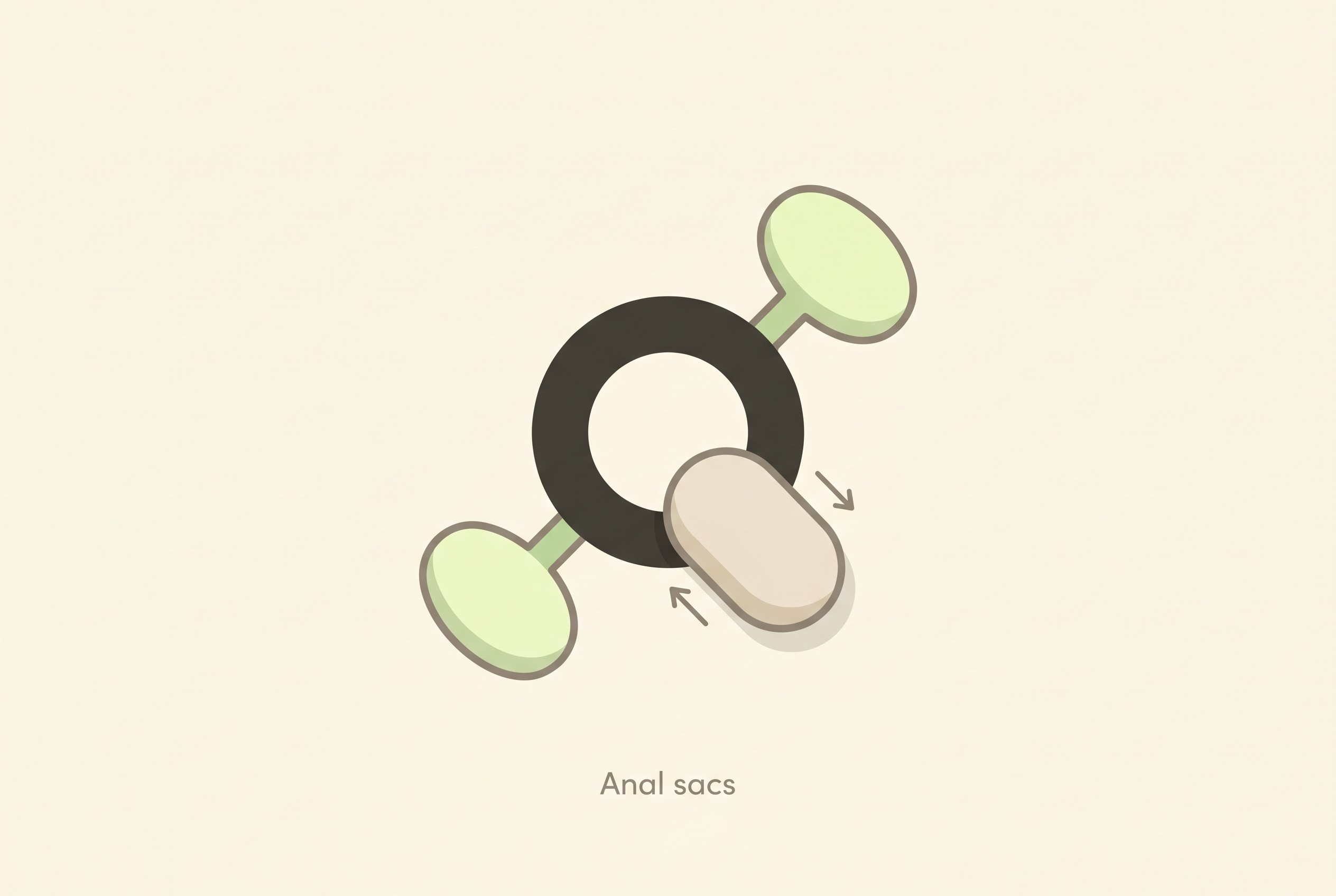
Your dog has a pair of small pouches sitting either side of the anus, at roughly the four-o'clock and eight-o'clock positions, each draining through a single short duct to an opening at the edge of the anal sphincter. They are lined by apocrine and sebaceous glands that produce a pungent, oily, brownish fluid (Rutherford & Lee, 2015; Lundberg & Koch, 2025). They play no part in digestion at all: they are scent reservoirs, a chemical calling card, which is why dogs are so interested in each other's rear ends and why a frightened dog can release the lot in one startled, deeply unpleasant burst (Lundberg & Koch, 2025). Humans do not have them, which is part of why owners find them so mysterious.
Here is the part that should change how you think about them. In a normal dog, the sacs empty themselves: every time your dog passes a firm, well-formed motion, that stool presses on the sacs and squeezes them out (Lundberg & Koch, 2025; Rutherford & Lee, 2015). A healthy dog quietly empties its own sacs several times a week and neither of you needs to think about it. Hold onto that, because it is the key to the biggest myth further down.
What you'll actually notice at home
The classic picture is hard to miss once you know it. Scooting, the bottom-dragging shuffle along the floor, is the one everyone recognises. Alongside it you often see excessive licking or biting at the rear and tail base, a strong fishy or metallic smell, a dog who seems uncomfortable sitting or clamps the tail down, and sometimes soreness or straining passing a motion (Rutherford & Lee, 2015; MSD/Merck Veterinary Manual).
Cats get anal sac trouble too, but far less often than dogs (Corbee et al., 2021). The signs are subtler, often just over-grooming under the tail, a sore-looking bottom or a vague reluctance, and a constipated or arthritic cat that strains can have a sac problem tangled up in the picture. It is uncommon, but a scooting cat still earns a proper look rather than a guess.
From mildly full to abscess
Anal sac disease (we will come to the "tumour" caveat shortly) is best understood as a continuum rather than three tidy boxes (Lundberg & Koch, 2025; Corbee et al., 2021). At the mildest, commonest end is impaction: the sacs overfill, the fluid thickens, and they stop emptying properly. The dog is uncomfortable and may scoot, but is otherwise well, and impaction was the largest single category of canine cases in one cross-sectional study (Corbee et al., 2021). Next along is sacculitis, where the lining inflames, with or without infection, and the contents can turn yellow, green, bloody or frankly purulent. The dog is more uncomfortable and often licking hard. At the far end is an abscess: infected material builds under pressure and can burst through the skin beside the anus, leaving a painful, draining wound (Rutherford & Lee, 2015; MSD/Merck Veterinary Manual). An abscess genuinely hurts and the dog may be a bit flat with it, so that end wants a same-day or next-day vet appointment. (If your pet is ever collapsed or in obvious distress, that is a different conversation, covered in digestive emergencies.)
Diagnosis is quick and hands-on: the vet feels the sacs through the wall of the rectum, expresses and inspects the contents, and checks the surrounding skin for fleas, tapeworm and allergy (Rutherford & Lee, 2015). Most of it is then managed simply: in a large UK study of dogs with anal sac disorders, only about 12% needed pain relief, around 20% were given antimicrobials, a dietary change was advised in roughly 8%, and surgery in under 1% (O'Neill et al., 2021). Put plainly, not every inflamed sac needs antibiotics, and the reflexive reach for them is something the profession is rightly rowing back on, as the antibiotics article explains.
How common, and which dogs
The best UK figure comes from a large primary-care study (VetCompass): a one-year prevalence of around 4.4% in dogs, so roughly one dog in twenty-three seen in a year (O'Neill et al., 2021). Smaller breeds are over-represented, and in the UK data the Cavalier King Charles Spaniel topped the list at almost three times the crossbred rate, alongside the King Charles Spaniel, Cockapoo, Shih-tzu, Bichon Frise and Cocker Spaniel; larger working types such as Labradors and German Shepherds were at lower risk (O'Neill et al., 2021; Corbee et al., 2021). Older dogs are more prone, and the risk climbs with age (O'Neill et al., 2021), which matters for a reason I will come back to.
What tips a dog into trouble
Several things push a dog towards trouble. A soft, poorly-formed or low-bulk stool is a frequently-cited contributor, since it is a firm, bulky motion that empties the sacs; both chronic diarrhoea and constipation can disturb that (Halnan, 1976; Corbee et al., 2021; Lundberg & Koch, 2025). Stool quality is central enough to be worth tracking: logging your dog's faeces over a few weeks with the Faecal Score Tracker lets you and your vet see whether you are achieving a firmer, bulkier motion, and whether the scooting flares on the softer days. How to score and describe stool is owned by the describing symptoms guide.
Carrying extra weight is associated with it too, plausibly because perineal fat and reduced muscle tone get in the way of emptying (Corbee et al., 2021; MSD/Merck Veterinary Manual). But the most important driver of the dog who keeps getting sacculitis is allergic skin disease: atopic dermatitis is the commonest comorbidity in affected dogs, allergic dogs are significantly more likely to suffer repeat episodes (around 47% against 34% in one recent series), and atopic dogs show altered (dysbiotic) bacteria and raised inflammatory markers within the sacs themselves, which gives a real mechanism (Hvitman-Graflund et al., 2023; Lundberg & Koch, 2025). If your dog's itchy bottom is part of a wider allergic picture, the allergy is best worked up in the food allergies guide in our Allergies & Skin space, not here. And some dogs are simply built awkwardly, with narrow ducts or thick secretions, and there is not always a fault to fix (Rutherford & Lee, 2015).
Two myths worth correcting
The fibre question, told straight. The reasoning behind feeding for bulkier stool is sound: more fibre means a firmer, larger motion that presses on the sacs and helps them empty (Salichs et al., 2025; Halnan, 1976). There is now one decent piece of evidence: a randomised, controlled trial of an oral chew containing fibre and a probiotic found a markedly lower impaction-recurrence rate in treated dogs (about 19% by day 90) than in untreated controls (about 61.5%; Salichs et al., 2025). Encouraging, but I will not oversell a single small study of one product, because the wider evidence is inconsistent: an old study tied all-meat-and-bone diets to anal sac trouble, yet a more recent series found poor stool quality in only about a fifth of affected dogs, so it is "not a consistent finding" (Lundberg & Koch, 2025). The realistic take: a firmer, bulkier stool, usually via a vet-recommended higher-fibre or therapeutic diet and sometimes a fibre supplement, is a sensible, low-risk first thing to try, but it is no guaranteed cure and no substitute for treating an underlying allergy or weight problem. It is not a licence for raw or DIY all-meat regimes, which point the wrong way.
The routine-expression myth, which is the big one. Healthy sacs empty themselves during a normal firm motion (Lundberg & Koch, 2025), so routinely squeezing normal, asymptomatic glands "just in case", at every groom, is not a preventive health measure. At best it is unnecessary; at worst, repeatedly or forcefully emptying sacs that did not need it can irritate the lining and, over time, scar the duct. This is veterinary consensus grounded in how the sacs work rather than a single landmark trial, but it is consistent: express when there are signs, or when your vet advises it for a known anal-gland-prone dog, not as a standing ritual. That is not a criticism of any owner or groomer told otherwise; it is simply how the understanding has shifted.
When scooting is not "just the glands"
Here is where the opening point earns its keep. Scooting is a symptom with a short differential, and a couple of the alternatives genuinely matter.
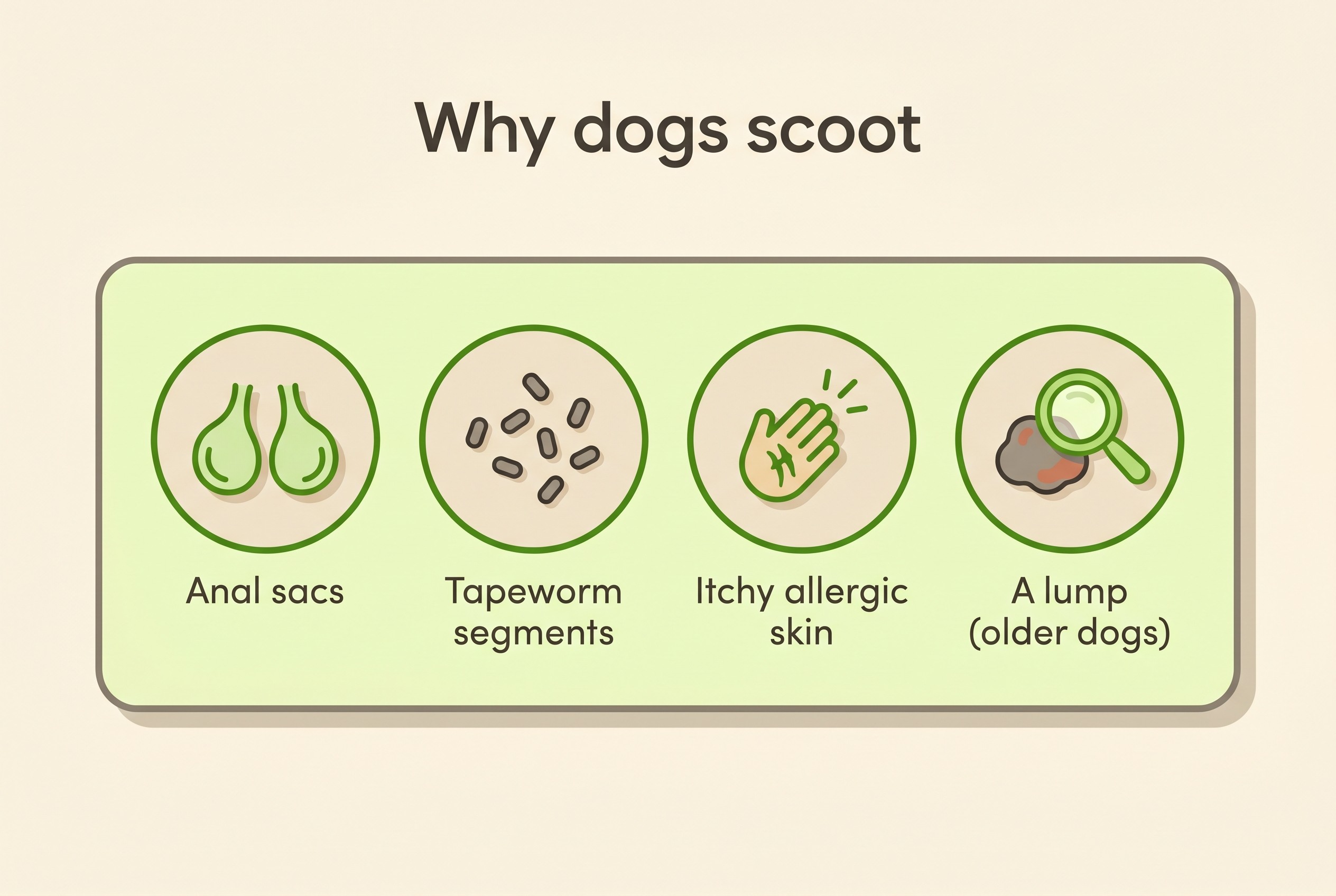
Tapeworm segments around the anus itch and prompt scooting; that belongs to the worms and giardia guide. Itchy, allergic skin affecting the perineum does the same, which loops back to the allergy point above. And the one you must not miss, especially in an older dog, is a mass. Apocrine gland anal sac adenocarcinoma is uncommon but aggressive, typically turning up in dogs around nine to eleven years old, and it can present as nothing more dramatic than scooting, a swelling or a lump felt on a rectal examination; about a quarter of cases also push the blood calcium up, causing extra thirst and weeing (American College of Veterinary Surgeons). I raise it not to frighten you, because it is uncommon, but because it is exactly why an older dog with new scooting, a lump near the bottom, or one who suddenly "always needs the glands done" deserves a proper rectal exam rather than a quick squeeze and home again. Not every anal-gland problem is a simple gland problem, and the only way to know is to look. Reassuringly, most dogs who are looked at turn out to have a single, simply-treated episode and never look back (Hvitman-Graflund et al., 2023).
For the dog this keeps happening to, repeated emptying is not the answer; chasing down the underlying driver, and weighing up surgery for the worst cases, is owned by the recurrent anal sac trouble guide. If you are on your third trip this year, that is the page to read next. And if a flare ever comes with a dog who is also off-colour or off their food, the vomiting and diarrhoea triage is a quick way to gauge how urgently they need seeing.
References
- American College of Veterinary Surgeons. Anal sac tumors in dogs.
- Corbee, R. J., Woldring, H. H., van den Eijnde, L. M., & Wouters, E. G. H. (2021). A cross-sectional study on canine and feline anal sac disease. Animals, 12(1), 95.
- Halnan, C. R. E. (1976). Therapy of anal sacculitis in the dog. Journal of Small Animal Practice, 17(10), 685-691.
- Hvitman-Graflund, K., Sparks, T., & Varjonen, K. (2023). A retrospective study of treatment, outcome, recurrence and concurrent diseases in 190 dogs with anal sacculitis. Veterinary Dermatology, 34(6), 576-585.
- Lundberg, A., & Koch, S. N. (2025). Canine anal sacculitis: a brief review with a focus on the recent literature. Today's Veterinary Practice, Sep/Oct 2025.
- MSD/Merck Veterinary Manual. Anal sac disease in dogs and cats.
- O'Neill, D. G., Hendricks, A., Phillips, J. A., Brodbelt, D. C., Church, D. B., & Loeffler, A. (2021). Non-neoplastic anal sac disorders in UK dogs: epidemiology and management aspects of a research-neglected syndrome. Veterinary Record, 188(2), e203.
- Rutherford, L., & Lee, K. (2015). Anal sac disease in dogs. In Practice, 37(9), 435-444.
- Salichs, M., Beasley, S., & Homedes, J. (2025). Efficacy of an oral chew containing fibre and Bacillus velezensis C-3102 in the management of anal sac impaction in dogs. Veterinary Dermatology, 36(1), 74-82.
Keep track of how your pet is doing
The owners who cope best are the ones who notice changes early. A simple health log shows you what is working, and what is not, before the next vet visit.
Start tracking, freeYou're not doing this alone
Compare treatment journeys and talk to owners managing digestive health. Free to join.
Join PetsLikeMine