

What To Watch at Home: The Signs That Tell You How Control Is Going
Alastair Greenway
BVM&S MRCVS
In the early weeks, owners ask me a version of the same anxious question: "How do I know if it's working?" Behind it sits the assumption that the answer lives in a meter, that without a row of glucose numbers they're flying blind. The truth is more reassuring: the best monitoring tool you have is already in the room, your own eyes and the ordinary daily knowledge you have of your pet.
That isn't a soft thing to say; the guidelines now put it in black and white. The current consensus opens its monitoring section with a blunt headline, "Monitor the cat, not just the numbers," and states that "the presence or absence of clinical signs is often a more useful marker of clinical DM control than any glycemic data obtained" (Bugbee et al., 2026). The cross-species and feline guidelines agree: read glucose data "in light of clinical signs" and weight, react to trends not single values, and prioritise the signs in any monitoring strategy (Behrend et al., 2018; Taylor et al., 2025). Nor is this new: in a study of 53 diabetic dogs, the authors concluded that "reliance on history, physical examination findings, and changes in body weight are effective for initially assessing control of glycaemia in insulin-treated diabetic dogs" (Briggs et al., 2000).
So your everyday observations aren't a poor substitute for data; they are data. One caveat, though: a diabetic dog can look clinically excellent and still run higher than ideal, and in a recent study even dogs scored as clinically optimal spent roughly half the day above the target glucose range (Del Baldo et al., 2025). So home signs and the vet's glucose data work as a pair, each catching what the other misses. Here is the daily watch-list: what good control looks like, what slipping looks like, and the handful that mean ring the vet now.
Six things to watch every day
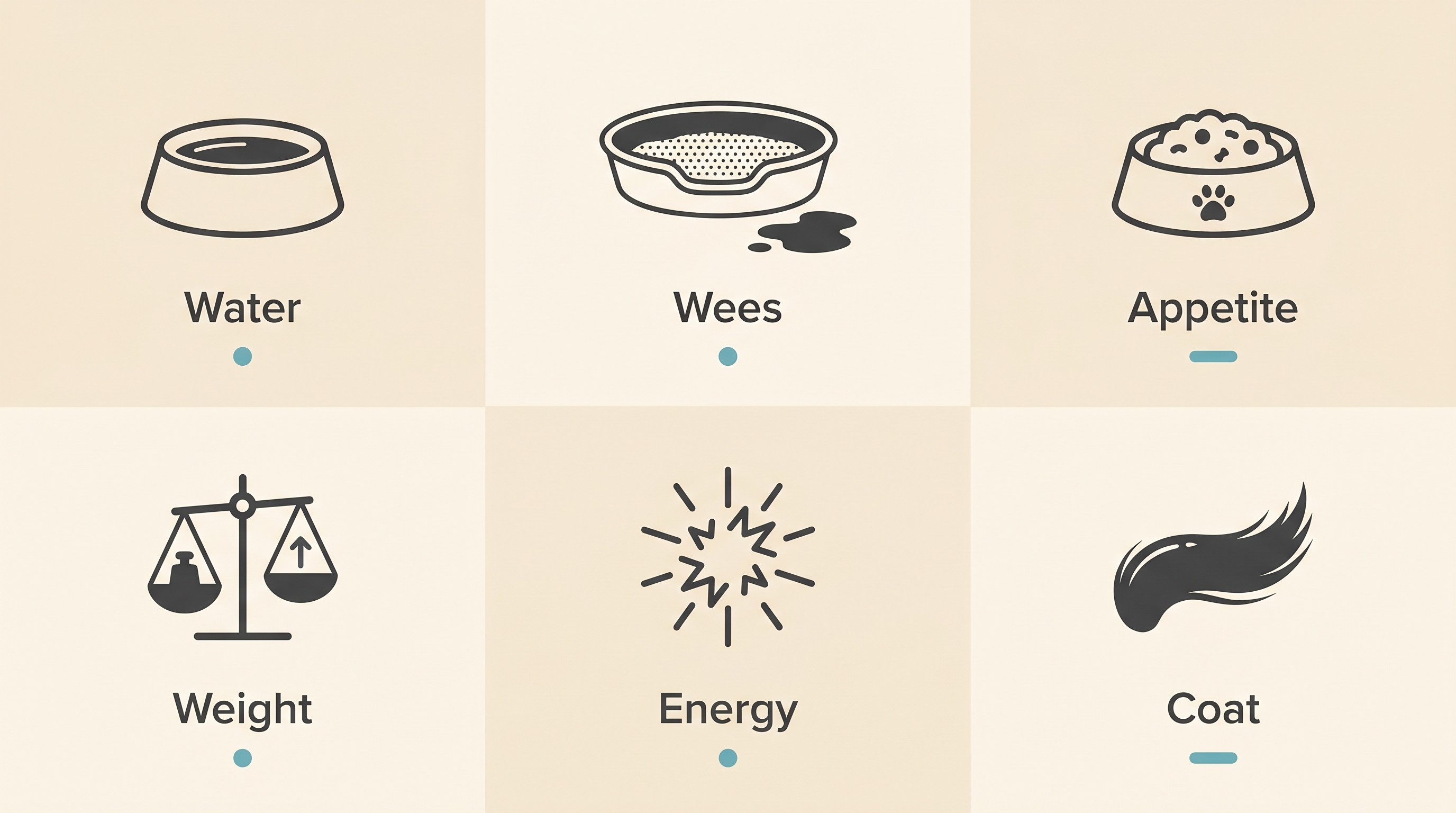
Water
If you watch one thing, watch the drinking. Thirst is the sign owners notice first at diagnosis, and it stays one of the most practical markers of control: "in cats, one of the parameters reported to be a useful and practical indicator of clinical DM control is the amount of water consumed over 24 hr" (Bugbee et al., 2026).
Unlike most signs, this one you can measure. The classic threshold for excessive thirst is a water intake above 100 ml per kilogram of bodyweight per day, used across dogs and cats (Schmid, 2023); a normal dog usually drinks well under that, with UK owner guidance putting the everyday range at roughly 20 to 70 ml/kg/day (Polzin, Veterian Key; vetspecialists.co.uk). The method is simple: measure what goes into the bowl and what's left at day's end, ideally over two or three consecutive days for a baseline, then watch the trend (Schmid, 2023).
Two wrinkles. Cats drink far less than dogs and a firm cut-off has never been established, so any feline number is a rule of thumb; fountains, multi-pet households and outdoor puddles make a cat's intake hard to pin down, which is why in cats you lean more on weight, appetite and energy (Polzin, Veterian Key; Schmid, 2023; Bugbee et al., 2026). And wet food carries a lot of water, so a diet change shifts what's in the bowl without anything being wrong (Schmid, 2023). Read the trend, not one thirsty afternoon.
Wees
Thirst and urination travel together: more drinking means bigger, more frequent wees, the odd accident in a clean dog, heavier litter clumps in a cat. You don't measure this one; you watch it move with the water.
Appetite
Untreated diabetes classically makes a pet ravenous while it loses weight, so a settling appetite is good news. Watch it against the feeding plan you've been given (feeding a diabetic pet). A pet that suddenly goes off its food is more urgent: in a diabetic on insulin, a lost appetite is never just fussiness, and it's in the red flags below.
Weight
Body weight is the most objective home sign you have, and I'd push you to weigh rather than eyeball. With good regulation, "weight gain or cessation of unintentional weight loss are positive indicators," whereas ongoing loss is a warning, and the guideline asks us to "monitor body weight (using the same scale for consistency) at least once or twice monthly" because "monitoring of body weight is crucial to effective DM monitoring" (Bugbee et al., 2026).
A kitchen or baby scale works for a small pet; a larger dog can use the practice's waiting-room scales monthly. If an overweight pet is being deliberately slimmed, a healthy rate of loss is about 0.5 to 2% of bodyweight per week (Bugbee et al., 2026). Steady or recovering weight reassures; unexplained loss in a previously stable diabetic earns a recheck. Weight as a destabiliser of control, and slimming as a lever, are taken on in weight, dental and the other things that wreck control.
Energy and coat
A well-controlled diabetic is bright and active. Lethargy tracks poorer control, and so does the coat, where "an unkempt hair coat may be noted," especially in cats, who stop grooming when they feel rough (Bugbee et al., 2026).
Good control versus slipping
Hold all six together and a picture emerges. The guideline puts the good news neatly: "with good regulation, PU, PD, and PP will drastically improve" (Bugbee et al., 2026), so the thirst, the weeing and the big appetite all settle toward normal. The rule the watch-list builds toward is the next line: "when the patient has no clinical signs and the body weight is steady or increasing, DM is likely well controlled" (Bugbee et al., 2026).
Slipping is that picture in reverse, each sign drifting the wrong way. The key discipline is to read these as a pattern over days and weeks, not one odd day: a single salty meal or off-colour morning is noise, but a trend is signal. And be aware that "gradual progression of PU, PD, or weight loss may be initially subtle and go unnoticed" (Bugbee et al., 2026). Slow change is exactly what memory smooths over.
What you do with a genuine pattern of slipping signs is report it, not act on it: never adjust the insulin dose yourself off returning signs or a single reading. Recurring signs despite faithfully given insulin are a trigger to investigate with your vet, who works through a structured list of causes, from a degraded insulin vial to a concurrent illness fighting the insulin (Bugbee et al., 2026). The dose is the vet's call, covered in insulin dose titration.
Keep a daily log
Memory is a poor logbook for a disease that changes by inches, so the guideline tells clinicians to "encourage clients to keep a daily log documenting their pet's appetite, thirst, urinary habits, feeding, and insulin dose administered, which can be brought in for review during each in-clinic recheck examination" (Bugbee et al., 2026).
This isn't busywork. There's a validated instrument behind it: the Diabetic Clinical Score, a simple, standardised way of scoring exactly these signs, weight, appetite, thirst and urination, developed by Professor Stijn Niessen at the Royal Veterinary College, evaluated in both diabetic dogs and cats and correlating with objective clinical measures (Niessen et al., 2017). It exists because owners tend to misremember signs ("she seems about the same"), and there's even an owner-facing app that logs them alongside any sugar values and shares the record with the vet (CVS / Veterinary Practice, 2024).
This is the job our Glucose Companion does: it holds your daily sign log beside any glucose or sensor data, ready to export as a clean trend your vet can read at the recheck. It is the daily log the guideline asks for, made effortless.
Red flags: ring now or today
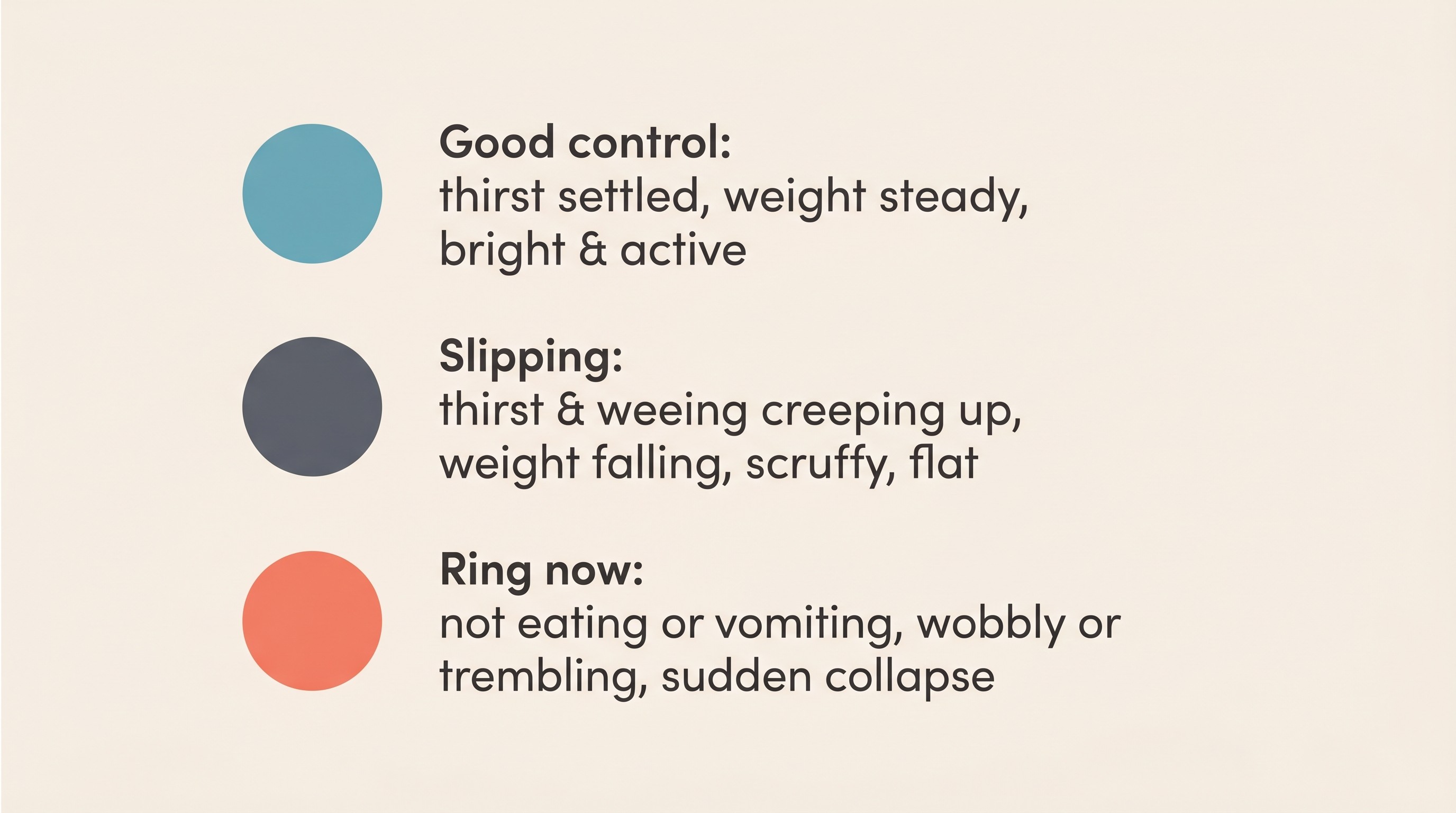
Most of this is calm, patient pattern-watching. But a short list of signs jumps the queue, and these mean contact the vet, not wait and see.
Not eating, or vomiting. In a diabetic on insulin this can't wait, for two reasons. First, it's the classic "do I still give the dose?" trap: insulin going in without food can tip a pet into a dangerous low, so never dose blind. Contact your vet about reducing or skipping it, since "the cat needs veterinary evaluation if the client notes any decrease in appetite or if the cat is not feeling well in general" (Bugbee et al., 2026). Second, persistent vomiting with lethargy can be the opening of diabetic ketoacidosis, a true emergency (Bugbee et al., 2026). The sick-day protocol is in travel and sick-day rules, the emergency itself in diabetic ketoacidosis.
Hypo signs. A wobbly, weak, dull, trembling pet may be hypoglycaemic, the killer emergency every diabetic owner must be ready for. The guideline's client sign-list runs "lethargy, sleepiness, strange behaviors, abnormal gait, weakness, tremors, and seizures" (Bugbee et al., 2026). If you suspect it, rub sugar, honey or glucose gel onto the gums (never pour liquid into a pet that can't swallow), get to the vet now, and never re-dose insulin into a suspected low. The full rescue is in hypos: the emergency to be ready for.
A sudden surge in thirst and weeing after a settled spell, rapid weight loss, or a pet that's generally flat and "not right." Any of these means book a recheck soon: control has likely slipped, or something concurrent like an infection or a dental problem is fighting the insulin (Bugbee et al., 2026; Behrend et al., 2018). You don't need to work out why; that's what the visit is for. And in a dog, sudden cloudy eyes or bumping into furniture can mean fast-developing diabetic cataracts.
One species note to close. In a cat, signs vanishing entirely, especially if it starts having lows, can be a hopeful sign of remission, something dogs don't get. Tell your vet rather than simply stopping insulin (more in feline diabetic remission). While the watch-list is much the same in both, dog and cat diabetes remain two different diseases under one word.
Where this leads
A logged, trended picture of your pet's signs and weight is exactly what your vet weighs at each recheck, alongside the glucose data, turning the next conversation from "she seems about the same, I think" into a clear trend you can both read. The vet side lives in fructosamine and the vet rechecks, the numbers in reading a glucose curve, and the case that a bright, comfortable pet at a steady weight beats chasing a perfect number in what good control really looks like.
So start tonight. Measure the water bowl, note the weight, and open the Glucose Companion to log it. You're not waiting helplessly for the next blood test; you're already doing the monitoring that matters most.
References
- Behrend, E., Holford, A., Lathan, P., Rucinsky, R., & Schulman, R. (2018). 2018 AAHA Diabetes Management Guidelines for Dogs and Cats. Journal of the American Animal Hospital Association, 54(1), 1-21.
- Briggs, C. E., Nelson, R. W., Feldman, E. C., Elliott, D. A., & Neal, L. A. (2000). Reliability of history and physical examination findings for assessing control of glycemia in dogs with diabetes mellitus: 53 cases (1995-1998). Journal of the American Veterinary Medical Association, 217(1), 48-53.
- Bugbee, A., Rucinsky, R., Alvarez, E., Cook, A., Lathan, P., & Panning, C. (2026). 2026 AAHA Diabetes Management Guidelines for Cats. Journal of the American Animal Hospital Association, 62(3), 65-93.
- CVS / Veterinary Practice. (2024). New CVS clinical improvement project aims to increase use of Diabetic Clinical Score. Veterinary Practice.
- Del Baldo, F., Tardo, A. M., Gilor, C., Mott, J., Da Vela, C., Pergolese, V., & Fracassi, F. (2025). FreeStyle Libre-derived metrics in assessing glycemic control in diabetic dogs. Journal of Veterinary Internal Medicine, 39(4), e70151.
- Niessen, S. J. M., et al. (2017). The Diabetic Clinical Score (DCS): evaluation of a simple standardised quantification tool to allow rapid description of clinical signs in diabetic dogs. Journal of Veterinary Internal Medicine (ECVIM-CA research communications).
- Polzin, D. J. (n.d.). Polyuria and Polydipsia (textbook chapter, reproduced on Veterian Key).
- Schmid, S. M. (2023). A stepwise diagnostic approach to polyuria and polydipsia in companion animals. Today's Veterinary Practice.
- Taylor, S., Cannon, M., Church, D., Fleeman, L., Fracassi, F., Gilor, C., Mott, J., & Niessen, S. (2025). 2025 iCatCare consensus guidelines on the diagnosis and management of diabetes mellitus in cats. Journal of Feline Medicine and Surgery, 27(11).
- Veterinary Specialists. (n.d.). Polydipsia in dogs and cats (increased drinking): fact sheet.
Keep track of how your pet is doing
The owners who cope best are the ones who notice changes early. A simple health log shows you what is working, and what is not, before the next vet visit.
Start tracking, freeYou're not doing this alone
Compare treatment journeys and talk to owners managing diabetes mellitus. Free to join.
Join PetsLikeMine