


Feline Diabetic Remission: Real, and the Window Is Now
Alastair Greenway
BVM&S MRCVS
When I tell an owner that their newly diagnosed cat might one day come off insulin altogether, I often watch the same thing happen on their face: hope, then a flicker of suspicion, because it sounds too good to be true. It isn't. Feline diabetic remission is real, common enough to be a genuine goal rather than a lottery win, and for many cats it's what we should be quietly aiming at from the very first week.
But I have to be just as straight about the other half. Remission isn't guaranteed, it isn't a cure, and the tight control that wins it carries a real risk of its own. So this page holds both truths at once: it's the cat owner's map of why remission is possible and when the window is open. The concrete how-to lives in the remission playbook, and protecting it afterwards in staying in remission.
What remission actually means
Let's pin the word down first, because a couple of low readings on the meter is not it. In cats, remission has a proper definition: zero requirement for injected insulin for at least four weeks, with no clinical signs of diabetes (Taylor et al., 2025). So your cat is in remission when she's off insulin entirely, eating, drinking and weeing normally, and staying that way for a month or more. That precision stops a hopeful owner halting insulin too early off one good day, and it sets up the caveat further down, that the beta cells have recovered but haven't been replaced.
How likely is it? The truthful answer is a range, not a number. Reported remission rates run from around 11% to over 60% across studies, a spread that reflects how varied feline diabetes really is (Taylor et al., 2025). At the optimistic end, when a high-protein, low-carbohydrate diet is combined with insulin, remission has been reported between 15 and 100%, with the highest rates when a long-acting insulin like glargine or detemir is used in cats newly diagnosed or within six months of diagnosis (Behrend et al., 2018). I'd resist any page that hands you a single tidy figure like "60% of cats remit," because the number isn't fixed. It moves, and what moves it most is how early you start.
Cats can manage this; dogs can't
This surprises owners who half-remember human diabetes. A diabetic cat's disease resembles human type-2 far more than the type-1 picture we see in dogs. Early on, much of the trouble comes from glucose toxicity: persistently high blood sugar is itself toxic to the insulin-producing beta cells and suppresses their function. Crucially, that suppression is reversible at first. Relieve the high sugar quickly enough and the beta cells can recover, which is exactly why remission happens. The consensus puts it plainly: in these cats there is a greater tendency towards reversal of glucotoxicity and recovery of beta-cell function (Taylor et al., 2025). The deeper biology is told in full in feline diabetes explained; here, that one idea, reversible glucotoxicity, is the engine of everything.
Dogs are a different disease, and this is one of those places where blurring the two does real harm. In dogs, the loss of beta-cell function is permanent, so reversing glucotoxicity isn't on the table and lifelong insulin is mandatory (Nelson & Reusch, 2014). Remission, in the words of the guidelines, is almost exclusively a feline phenomenon (Behrend et al., 2018). So if you've read about a dog needing insulin for life and feared the same for your cat, take heart: two different diseases, two different outlooks. The full side-by-side is in the dog-versus-cat comparison.
The window is now
If there's one fact on this page to act on, it's this, and it's the reason for the title. Remission gets harder the longer diabetes has been running, because the longer the beta cells sit under high sugar, the closer that reversible suppression creeps towards permanent loss. The cleanest evidence comes from a tight-control cohort managed with glargine and home monitoring, in which 64% went into remission overall. Split that group by timing and the message lands hard: 84% of cats started on the protocol within six months of diagnosis achieved remission, against only 35% of those who began more than six months after (Roomp & Rand, 2009). Same disease, same treatment, and the odds more than halved purely because of delay.
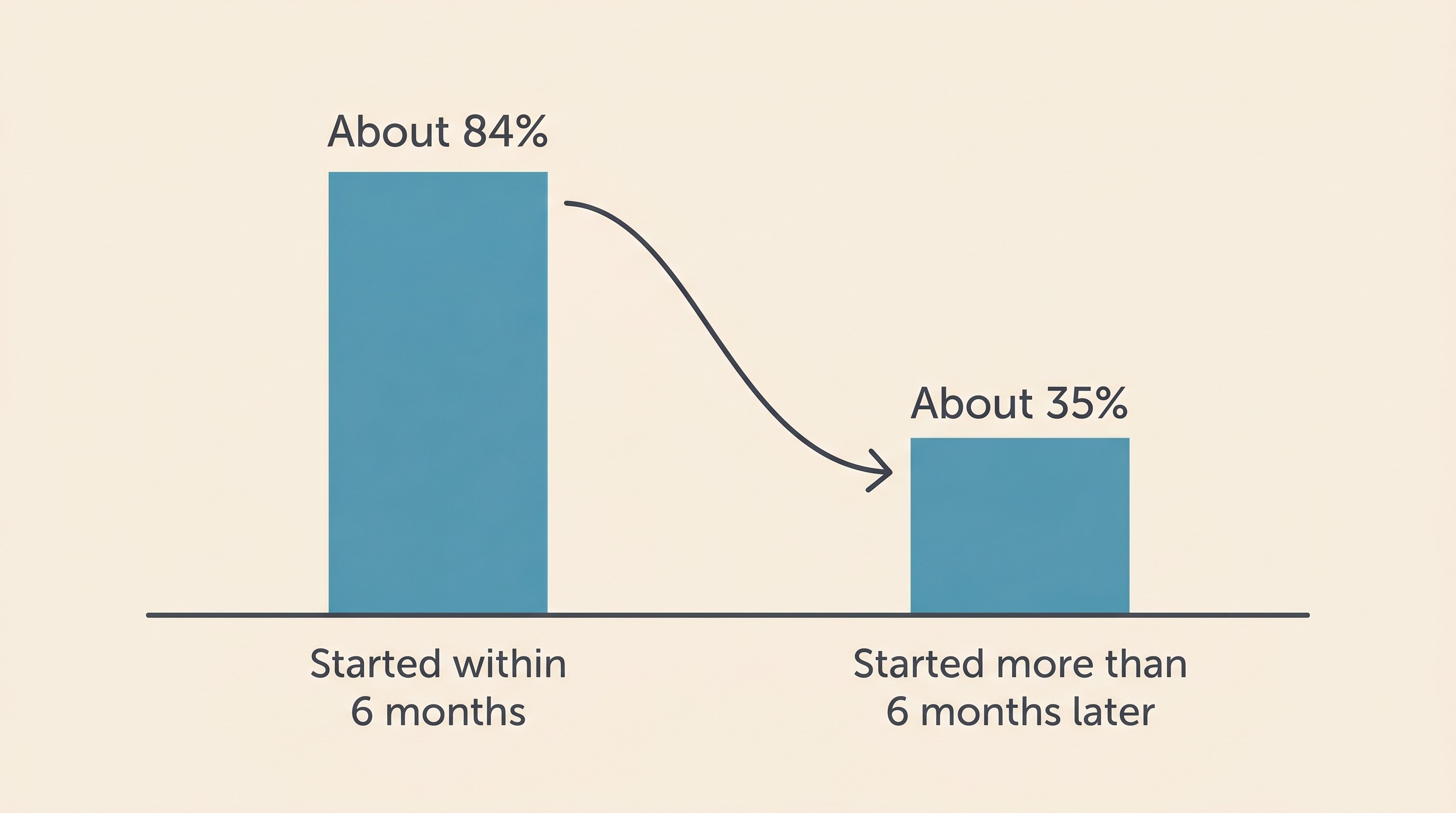
That's the thesis in one picture. Remission is real, but it's on a clock. If your cat has just been diagnosed, you're standing in the best part of the window right now, and the most useful thing you can do is have the remission conversation with your vet today rather than after a few months of "seeing how she gets on." A cat merely stable on a comfortable dose is not the same as a cat we're actively steering off insulin.
What tilts the odds in your favour
The consensus has mapped fairly clearly which cats are more likely to remit, and these predictors double as the headline of the playbook. Remission is more likely in cats with a shorter duration of diabetes and less severe hyperglycaemia at diagnosis, and in those who achieve good control rapidly (Taylor et al., 2025). Weight loss of at least 2% of body weight in overweight cats during the first month of insulin treatment predicts remission, dietary carbohydrate restriction is thought to improve the chance, and cats who developed diabetes while on corticosteroids are more likely to remit once those steroids are stopped (Taylor et al., 2025). Cats showing diabetic neuropathy, the weak, dropped-hock stance that follows prolonged high sugar, are less likely to remit, presumably because the disease has been running longer (Taylor et al., 2025).
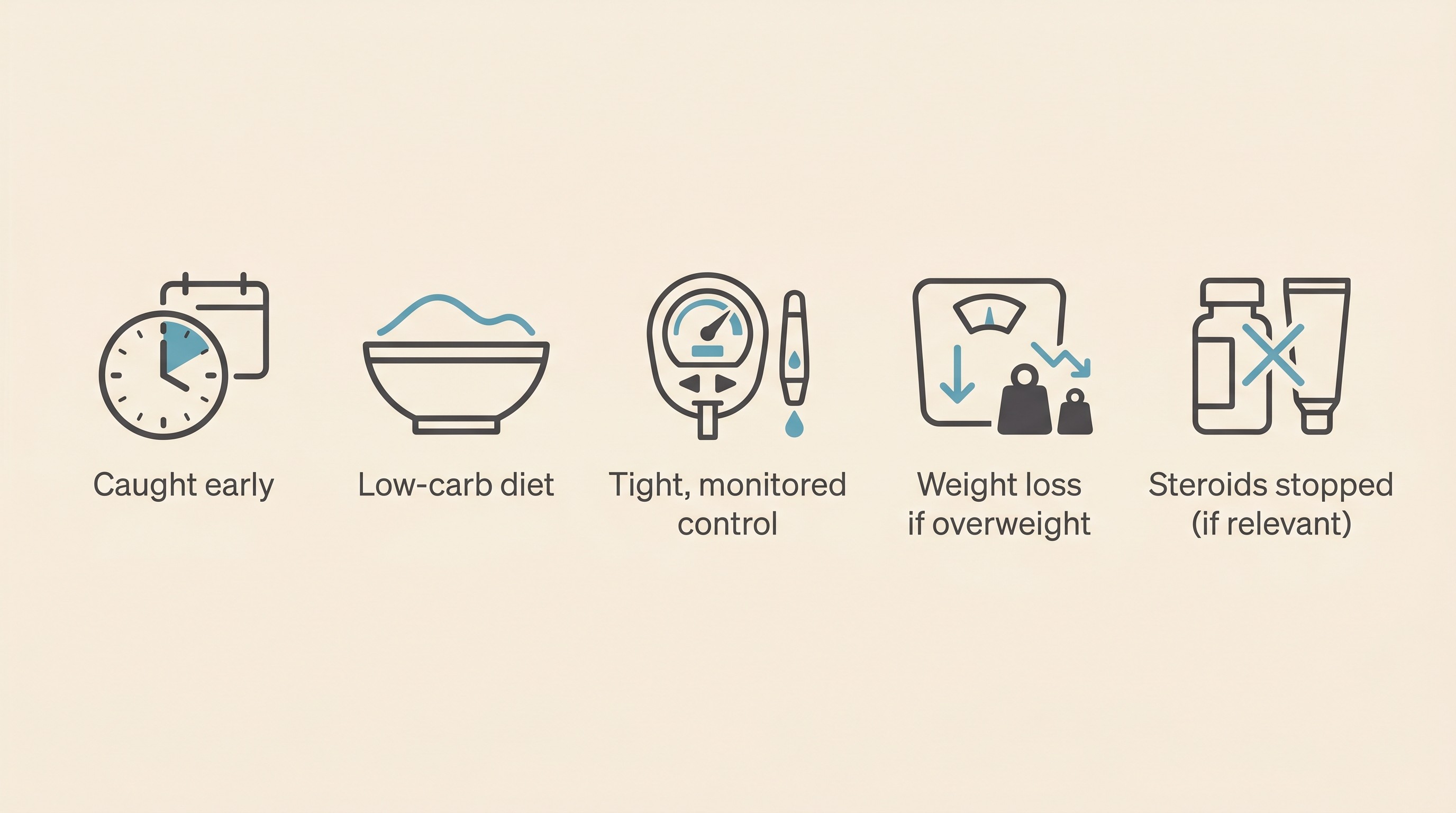
Those predictors are the playbook in miniature: act early, feed low-carbohydrate, get tight monitored control quickly, shed excess weight, drop any glucose-raising drugs you safely can. The choice of insulin nudges things too, a long-acting analogue such as glargine (Lantus) or detemir (Levemir) carrying higher remission rates than older insulins in newly diagnosed cats (Marshall, Rand & Morton, 2009). Doing all of that well is what the remission playbook is for, with the detail in diet as a lever and the insulin options guide, so I'll keep the step-by-step out of here. One sobering footnote: even with all of this, no single factor reliably predicts which cats will remit, and a systematic review found the field's certainty has often outrun its data (Gostelow et al., 2014). We tilt the odds, we don't dictate the outcome.
What to realistically expect
The headline figures of 64% or "up to 100%" come from intensive, closely supervised settings, so let me set a more everyday benchmark. In a large group of 174 newly diagnosed cats on a lower-cost, moderate-intensity home protocol with twice-daily glargine, 47% achieved remission, at a median of 93 days (Gottlieb, Rand & Anderson, 2024). In another well-controlled cohort of 90 cats, 50% achieved remission after a median of 48 days (Zini et al., 2010). So a fair expectation for a cat given good early care is roughly half may come off insulin, often within about six to thirteen weeks: genuinely hopeful, worth every effort, and a long way from a guarantee. Older cats aren't written off, either: in that second study, older age actually increased the likelihood of remission (Zini et al., 2010), so an elderly newly diagnosed cat is very much in the game.
The catch you must not skip: tight control raises the hypo risk
Now the safety point, and it's the one part of this page I won't let you skip. The very thing that wins remission, pushing glucose down firmly to relieve the toxicity on the beta cells, is also what makes hypoglycaemia, a dangerously low blood sugar, more likely. The consensus is explicit: glucose sitting consistently below 10 mmol/l (180 mg/dl) for several days, or a persistent absence of glucose in the urine, indicates excellent control but could increase the risk of periods of hypoglycaemia (Taylor et al., 2025). This isn't theoretical. In that 174-cat protocol, 27 cats (15.5%) were hospitalised for clinical hypoglycaemia along the way (Gottlieb et al., 2024), yet the closely supervised cohort that achieved 64% remission recorded only a single mild episode (Roomp & Rand, 2009). The difference between those two outcomes was monitoring.
So here's the non-negotiable. Chasing remission means tight control, tight control means a real risk of going too low, so it must be done with your vet and with home glucose or continuous glucose monitoring, never as solo "tight regulation" worked out from a forum thread. Logging diet, doses and readings in one place is how you both watch the dose come safely down towards zero while catching a low before it becomes a crisis, and that's the job the Glucose Companion does. Two house rules ride alongside it. If your cat ever goes wobbly, weak, dull or trembling, treat it as a possible hypo: rub glucose or honey onto the gums (never pour liquid into a cat that can't swallow) and ring your vet now. And never re-dose insulin into a suspected hypo: if you're ever unsure a dose went in, skip it and wait for the next one rather than risk doubling up. The full emergency is in the hypoglycaemia guide. The prize and the risk travel together, so the monitoring isn't optional.
A word on the oral drugs
You may have read about the newer once-daily oral medicines for cats, the SGLT2 inhibitors (Senvelgo, velagliflozin, in the UK and Europe; Bexacat, bexagliflozin, in the US). Because relieving glucose toxicity can recover beta cells, some cats on these drugs may restore enough of their own insulin to maintain normal glucose, though the only way to identify such a cat is to stop the drug and monitor, and the guidelines note that further study is needed (Taylor et al., 2025). The crucial safety line: these are only for clinically well, insulin-naive cats, and they carry a real risk of euglycaemic diabetic ketoacidosis, where a cat can be in a life-threatening ketoacidotic crisis while its blood glucose still looks normal. They are never a casual oral alternative to insulin, and whether one suits your cat is firmly a decision for your vet.
Holding both truths
So where does that leave you? Remission is real and worth chasing, roughly half of well-treated cats may get there, and the odds are best in these early weeks while the window is open (Roomp & Rand, 2009; Gottlieb et al., 2024; Zini et al., 2010). It's not a cure, though: remission is by definition a temporary state, so even a cat who comes off insulin keeps her vulnerable beta cells and needs the diet, weight and monitoring to protect it (Taylor et al., 2025). And relapse is part of the picture, with between 13% and 40% of cats reported to return to needing insulin and a second remission generally less likely than the first (Taylor et al., 2025). I'd flip that rather than be deflated by it: a remission of months to a couple of years, off injections, is a real gift even if it doesn't last, and guarding it is what staying in remission is for.
So if you do one thing today, while it counts most, make the remission plan an explicit conversation with your vet rather than something you hope happens on its own. Pick up the concrete steps in the remission playbook, and log her diet, doses and glucose in the Glucose Companion from the outset, so you and your vet can watch the dose come down safely and recognise the moment she no longer needs it. Above all, let her wellbeing lead, not any single number on the meter. The window is open now: that's the good news, and the reason to begin.
References
- Behrend, E., Holford, A., Lathan, P., Rucinsky, R., & Schulman, R. (2018). 2018 AAHA diabetes management guidelines for dogs and cats. Journal of the American Animal Hospital Association, 54(1), 1-21.
- Gostelow, R., Forcada, Y., Graves, T., Church, D., & Niessen, S. (2014). Systematic review of feline diabetic remission: separating fact from opinion. The Veterinary Journal, 202(2), 208-221.
- Gottlieb, S., Rand, J. S., & Anderson, S. T. (2024). Frequency of diabetic remission, predictors of remission and survival in cats using a low-cost, moderate-intensity, home-monitoring protocol and twice-daily glargine. Journal of Feline Medicine and Surgery, 26(4), 1098612X241232546.
- Marshall, R. D., Rand, J. S., & Morton, J. M. (2009). Treatment of newly diagnosed diabetic cats with glargine insulin improves glycaemic control and results in higher probability of remission than protamine zinc and lente insulins. Journal of Feline Medicine and Surgery, 11(8), 683-691.
- Nelson, R. W., & Reusch, C. E. (2014). Animal models of disease: classification and etiology of diabetes in dogs and cats. Journal of Endocrinology, 222(3), T1-T9.
- Roomp, K., & Rand, J. (2009). Intensive blood glucose control is safe and effective in diabetic cats using home monitoring and treatment with glargine. Journal of Feline Medicine and Surgery, 11(8), 668-682.
- Taylor, S., et al. (2025). iCatCare 2025 consensus guidelines on the diagnosis and management of diabetes mellitus in cats. Journal of Feline Medicine and Surgery, 27(11), 1098612X251399103.
- Zini, E., Hafner, M., Osto, M., Franchini, M., Ackermann, M., Lutz, T. A., & Reusch, C. E. (2010). Predictors of clinical remission in cats with diabetes mellitus. Journal of Veterinary Internal Medicine, 24(6), 1314-1321.
Keep track of how your pet is doing
The owners who cope best are the ones who notice changes early. A simple health log shows you what is working, and what is not, before the next vet visit.
Start tracking, freeYou're not doing this alone
Compare treatment journeys and talk to owners managing diabetes mellitus. Free to join.
Join PetsLikeMine