

The Insulin Types Explained (and the New Oral Options for Cats)
Alastair Greenway
BVM&S MRCVS
Most owners meet their pet's insulin as a single box pushed across the desk, a name they've never heard, with no sense of why that one. Then they search it and fall into forum threads arguing about Lantus versus ProZinc versus something they can't even buy here. So let me do what the leaflets and the forums both struggle to: lay out the line-up clearly, tell you what your pet is most likely on and why, and give a straight account of the new oral tablets for cats.
One thing first, because it takes the pressure off. Which insulin your pet goes on isn't yours to agonise over; it's a well-founded clinical choice your vet makes, and you only need to understand it enough to follow the plan and ask good questions. I won't teach you to inject, your first insulin injection does that. This is simply the map of the medicines.
Match the insulin to the animal
The idea that makes all of this make sense is that an insulin is chosen to suit the species and, specifically, how long it lasts in that species. The guidelines pick a first choice for dogs and another for cats precisely "based on efficacy and duration of effect in the respective species" (Behrend et al., 2018), which is why the dog box and the cat box are usually not the same product.
There's a deeper reason for the split: dogs and cats have, in effect, two different diseases wearing the same name. A diabetic dog has lost almost all of its beta cells, a type-1-like failure, so it needs injected insulin for life and does not go into remission (Behrend et al., 2018). A diabetic cat is more like a person with type-2 diabetes, and a meaningful proportion can come off insulin altogether if control is good early (Taylor et al., 2025). The full version lives in the same word, two different diseases. The consequence here: cats get their insulin chosen partly as a remission strategy, and the new oral drugs exist for cats alone.
Dogs: lente first, and in the UK that means Caninsulin
For dogs, the consensus first choice is a lente insulin, a porcine (pig-derived) insulin zinc suspension of intermediate duration (Behrend et al., 2018). In the UK and Europe that's Caninsulin; in the US the identical product is Vetsulin. It was the first veterinary insulin licensed in the UK and remains the default starting point for a diabetic dog (Caninsulin product information, MSD Animal Health UK).
How it behaves explains what follows. Caninsulin is U-40 strength (40 units per millilitre), a cloudy suspension that must be gently re-mixed before each dose and given under the skin, usually twice daily. In dogs its effect lasts roughly 14 to 24 hours, fitting the twice-daily-with-meals rhythm most diabetic dogs settle into (Caninsulin product information). The guideline starting point is deliberately cautious, around 0.25 units per kilogram twice daily, with most dogs ending up well controlled near 0.5 (Behrend et al., 2018). I quote those only so the early numbers don't alarm you; adjusting the dose is a monitored process with its own guide, how insulin dose titration works, never something to change on your own.
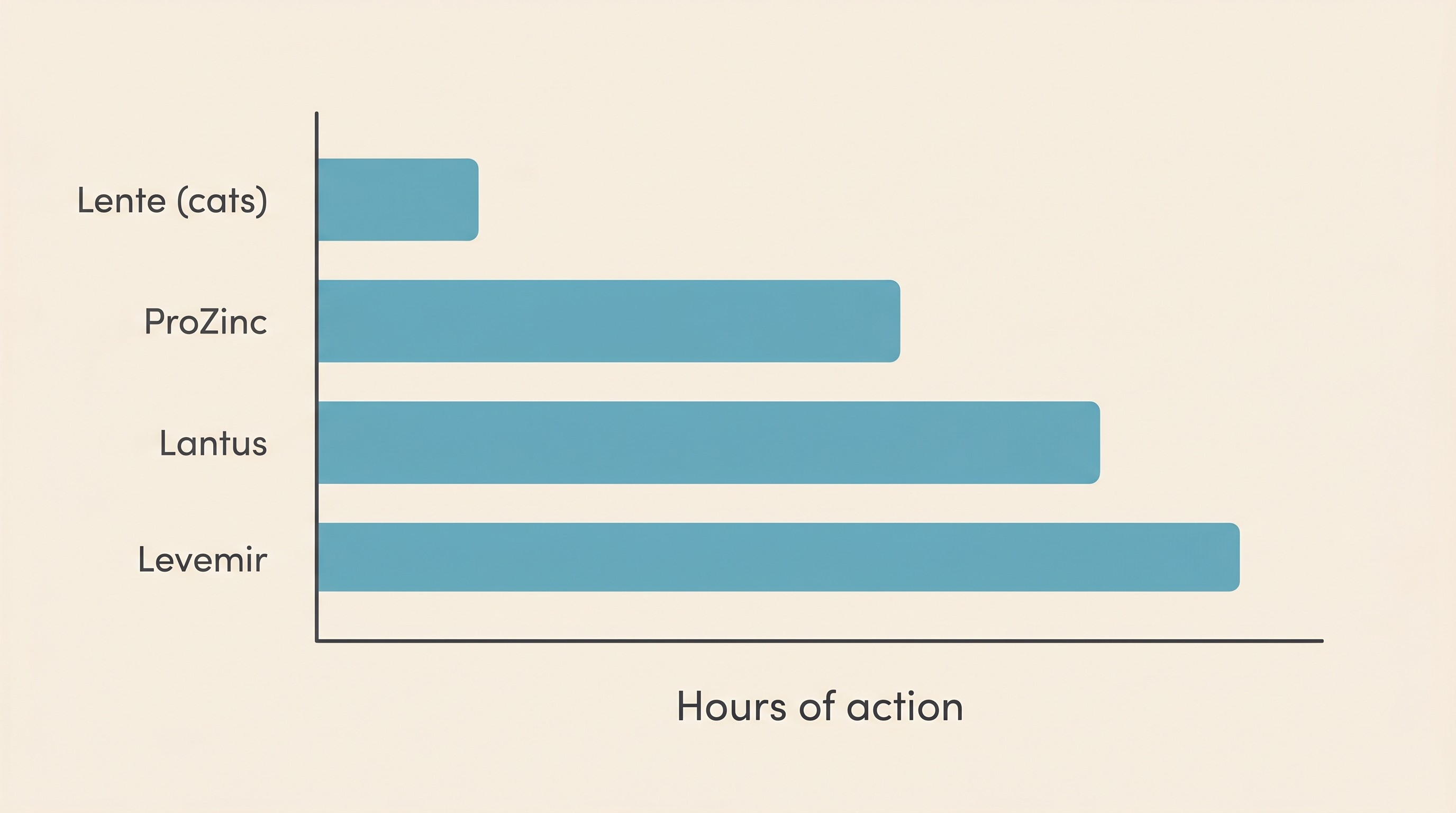
Here's the quietly important bit for cat owners. In cats, that same Caninsulin lasts only about 8 to 12 hours, often not quite reaching the next dose (Caninsulin product information). That shorter feline duration is the whole reason cats usually do better on a longer-acting insulin.
Cats: longer-acting insulins, chosen with remission in mind
For cats the modern preference is a long-acting insulin. The two consensus front-runners are glargine (the human analogue sold as Lantus) and protamine zinc insulin, known as PZI and sold for pets as ProZinc, a recombinant human insulin, also U-40, usually given twice daily (Taylor et al., 2025; Sparkes et al., 2015). The current feline consensus is direct about why: "long-acting insulin formulations are likely optimal for control and, therefore, remission" (Taylor et al., 2025).
Remission is the key to the feline section, so here's the evidence plainly rather than as a slogan. In a small randomised study of newly diagnosed cats, remission was far more likely on glargine than on PZI or lente: 100% (8 of 8) on glargine, against 37.5% on PZI and 25% on lente (Marshall et al., 2009). Striking, but with only eight cats per group that 100% is directional, not a promise. In a larger, intensive home-monitored protocol pairing glargine with a very low-carbohydrate diet, overall remission ran at 64%, rising to 84% when tight control began within six months of diagnosis but falling to 35% when it started later (Roomp & Rand, 2009). Across the wider literature, rates range from 11% to over 60% (Taylor et al., 2025). So the truthful headline is that remission is real, and insulin choice and timing genuinely affect your odds, not any single magic figure.
A third long-acting option you'll see named is detemir (the human analogue Levemir), a recognised feline insulin used in the same intensive-control protocols (Roomp & Rand, 2012). It's more potent in cats, so its doses are smaller numbers, which is exactly why a dose is never transferable between insulins or between pets. That low-carb-plus-glargine approach is what much of the online community means by "tight regulation": it can work well, but only with real home monitoring and a vet-agreed plan, because chasing tight numbers solo off a forum is how cats end up dangerously low (Roomp & Rand, 2009). The remission playbook, done safely, is its own guide, giving your cat the best shot at remission.
What the leaflets won't tell you about UK supply
Now a wrinkle the manufacturer pages skate over: in the UK, which insulin your cat ends up on is shaped as much by what's available as by what's ideal. Caninsulin is UK-licensed for cats as well as dogs, but ProZinc has had real supply interruptions (notably from around 2020), and when a licensed product can't be obtained, many UK cats are quite legitimately put on the human analogues glargine (Lantus) or detemir (Levemir) under the veterinary "prescribing cascade", the legal route to a human medicine when no suitable veterinary one exists (FDMB UK supply threads, 2020). So if your cat is on Lantus, that isn't your vet going rogue, it's normal UK practice; a supply hiccup is a conversation with your practice, not a crisis.
One safety point earns a line, because it bites hardest when insulins get switched. The veterinary insulins (Caninsulin, ProZinc) are U-40, while the human analogues (Lantus, Levemir) are U-100, two and a half times more concentrated, and each needs its own matching syringe. Put the wrong syringe to the wrong insulin and you don't nudge the dose, you multiply or divide it. I'm naming the trap, not teaching it; the detail lives in storing, drawing up and handling insulin.
New oral options for cats, and the line you must not cross
This is the part everyone's heard a headline about, and the one I'm keenest to get right, because the gap between marketing and medicine is real. There are now oral antidiabetic drugs for cats, a class called SGLT2 inhibitors, of which two are licensed (in the US, emerging elsewhere): Senvelgo (velagliflozin, an oral solution) and Bexacat (bexagliflozin, a tablet; the first oral antidiabetic ever approved for cats, in late 2022). They work in a completely different way to insulin: rather than helping glucose into cells, they block the kidney from reabsorbing it, so the body passes the excess sugar out in the urine (Senvelgo product information; Bexacat product information). Given once daily by mouth, no needles, you can see the appeal. But the licensed indication is narrow and identical for both: they improve glycaemic control in otherwise healthy cats with diabetes that have not previously been treated with insulin (Senvelgo product information; Bexacat product information). Cats only, never dogs, and only those that are well in themselves and not already on insulin.
Here is the hard safety line, and I won't soften it because the regulators haven't. Both labels state plainly that these drugs must not be used in cats that have been or are being treated with insulin, or that have insulin-dependent diabetes, because doing so risks diabetic ketoacidosis, including euglycaemic DKA, and death (Bexacat product information; Senvelgo product information; FDA Dear Veterinarian Letter, Bexacat). DKA is the emergency in which the body, short of usable energy, turns fat into acidic ketones; diabetic ketoacidosis covers it in full. The word "euglycaemic" is what makes this class sneaky: because these drugs keep dumping glucose into the urine, a cat can slide into life-threatening DKA while its blood glucose still reads near-normal, so the number you'd usually lean on to reassure yourself simply isn't there.
This is no small-print risk. In the current consensus, ketoacidosis (including the euglycaemic kind) occurred in roughly 1 in 15 newly diagnosed cats started on an SGLT2 inhibitor, rising to about 1 in 10 in cats previously on insulin (Taylor et al., 2025). The field studies bear that out: Senvelgo saw DKA or euglycaemic DKA in 18 of 252 cats (7.1%), and among the 38 already on insulin, 12 (32%) became ketoacidotic within the first week alone (Senvelgo product information); Bexacat reported it in 5 of 84 (Bexacat product information). The FDA thought the risk serious enough to write to vets about careful case selection (FDA Dear Veterinarian Letter, Bexacat). A genuinely useful tool for the right cat, then, but not the easy needle-free alternative the word "oral" makes them sound.
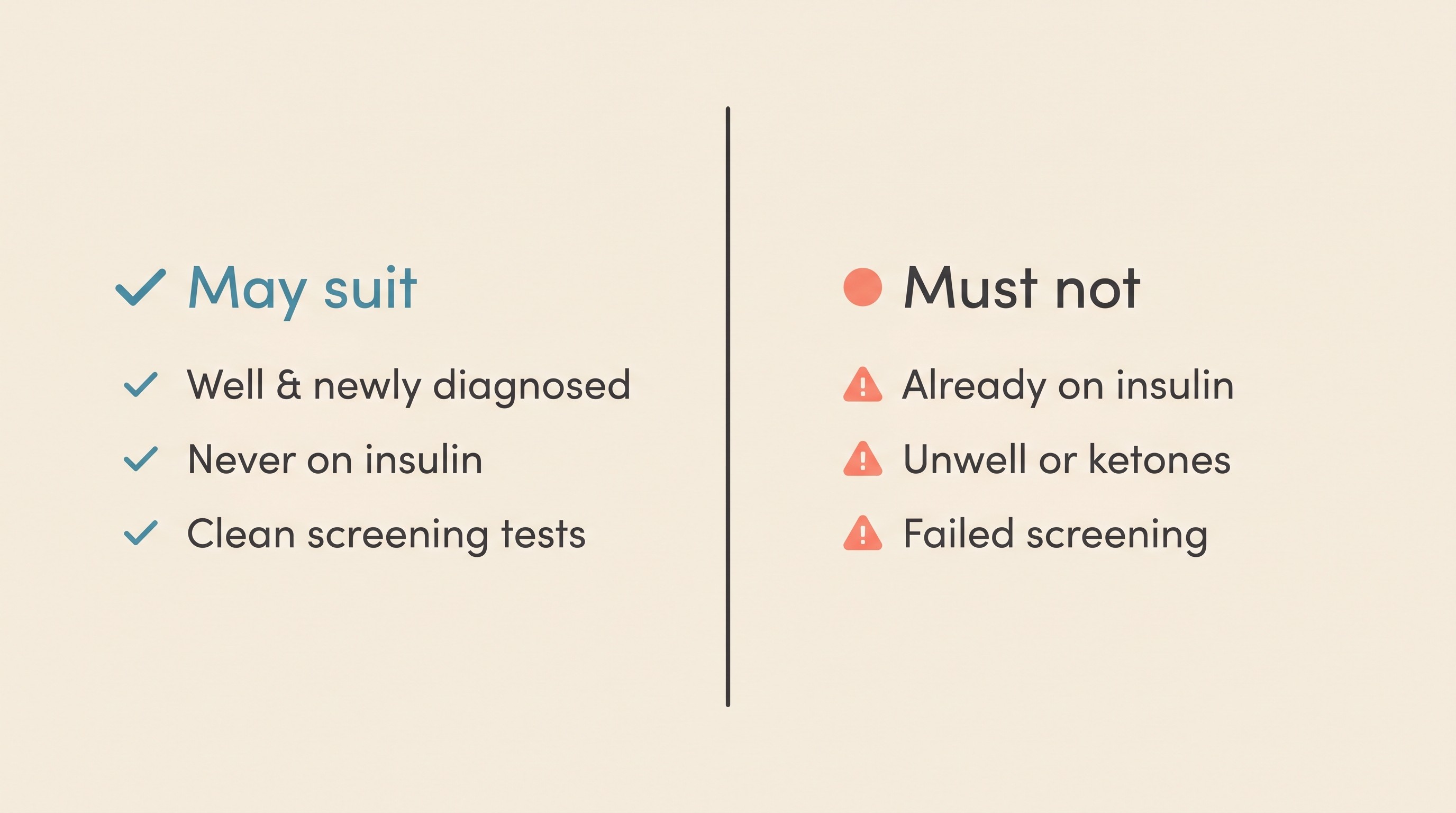
Which is why they come with mandatory homework: screening blood and urine tests before starting, in particular checking for ketones, and never starting a cat that's already off-colour (Taylor et al., 2025; Senvelgo product information; Bexacat product information). And a standing rule for any cat on one, which is the same sick-day logic that applies on insulin: if it goes off its food, vomits, or seems unwell, that's a same-day vet trip with a ketone check, not a wait-and-see, precisely because the blood glucose can lie.
So which is "best"? How to think about it
People want a league table, a "this is the best insulin" they can ask for by name, and there genuinely isn't one. The right drug depends on the species, on how long it lasts in your particular animal, on what's licensed and in stock where you live, on cost, on how much home monitoring you can manage, and, for cats, on whether remission is the goal (Behrend et al., 2018; Taylor et al., 2025). The "best" insulin is simply the one that controls this pet safely, fits your life, and is in the bottle you can actually fill this month.
| What it is | Names | Strength | Roughly how long | Mainly for | The catch to know |
|---|---|---|---|---|---|
| Lente (porcine zinc suspension) | Caninsulin (UK/EU) = Vetsulin (US) | U-40 | ~14–24 h in dogs; only ~8–12 h in cats | Dog first choice | Shorter action in cats is why cats often need a longer-acting insulin |
| PZI (protamine zinc) | ProZinc | U-40 | Long-acting | Cats (and licensed for dogs in the US) | UK supply has fluctuated; ask what's currently available |
| Glargine (human analogue) | Lantus (Toujeo = U-300) | U-100 | Long-acting | Cats, via the UK prescribing cascade | The insulin most linked to feline remission in studies |
| Detemir (human analogue) | Levemir | U-100 | Long-acting | Cats, intensive-control protocols | More potent in cats, so doses are smaller; never copy another pet's dose |
| SGLT2 inhibitor (oral) | Senvelgo (liquid), Bexacat (tablet) | Oral, once daily | n/a | Cats only, newly diagnosed, never on insulin | Real risk of fatal euglycaemic DKA; not for insulin-treated cats; needs screening |
If your cat is freshly diagnosed and well, ask your vet whether an SGLT2 inhibitor or a long-acting insulin makes more sense, and what monitoring each would involve. Whichever medicine your pet ends up on, what keeps you safe is tracking how well it's working, so you and your vet react to a trend rather than a single anxious reading. The Glucose Companion handles exactly that: logging doses, plotting the curve, flagging lows, and turning it into something you can take to a recheck. And because a surprising amount of "this insulin isn't working" is really a re-mixing, storage or syringe issue, storing and handling insulin is the natural next step, alongside the cat-specific picture in feline diabetes explained.
References
- Behrend, E., Holford, A., Lathan, P., Rucinsky, R., & Schulman, R. (2018). 2018 AAHA Diabetes Management Guidelines for Dogs and Cats. Journal of the American Animal Hospital Association, 54(1), 1-21.
- Taylor, S., Cannon, M., Church, D., Fleeman, L., Fracassi, F., Gilor, C., Mott, J., & Niessen, S. (2025). 2025 iCatCare consensus guidelines on the diagnosis and management of diabetes mellitus in cats. Journal of Feline Medicine and Surgery, 27(11), 1098612X251399103.
- Marshall, R. D., Rand, J. S., & Morton, J. M. (2009). Treatment of newly diagnosed diabetic cats with glargine insulin improves glycaemic control and results in higher probability of remission than protamine zinc and lente insulins. Journal of Feline Medicine and Surgery, 11(8), 683-691.
- Roomp, K., & Rand, J. (2009). Intensive blood glucose control is safe and effective in diabetic cats using home monitoring and treatment with glargine. Journal of Feline Medicine and Surgery, 11(8), 668-682.
- Roomp, K., & Rand, J. (2012). Evaluation of detemir in diabetic cats managed with a protocol for intensive blood glucose control. Journal of Feline Medicine and Surgery, 14(8), 566-572.
- Senvelgo (velagliflozin oral solution) Prescribing Information. Boehringer Ingelheim; FDA-approved.
- Bexacat (bexagliflozin tablets) Prescribing Information. Elanco; FDA-approved. US FDA Center for Veterinary Medicine.
- FDA. Dear Veterinarian Letter advising veterinarians of important safety conditions associated with the use of Bexacat. US Food and Drug Administration, Center for Veterinary Medicine.
- Caninsulin 40 IU/ml Suspension for Injection product information. MSD Animal Health UK.
- ProZinc (protamine zinc recombinant human insulin) 40 IU/ml product information. Boehringer Ingelheim.
- Feline Diabetes Message Board. (2020). UK insulin supply and prescribing-cascade discussions (ProZinc availability).
- Sparkes, A. H., Cannon, M., Church, D., Fleeman, L., Harvey, A., Hoenig, M., Peterson, M. E., Reusch, C. E., Taylor, S., & Rosenberg, D. (2015). ISFM consensus guidelines on the practical management of diabetes mellitus in cats. Journal of Feline Medicine and Surgery, 17(3), 235-250.
Keep track of how your pet is doing
The owners who cope best are the ones who notice changes early. A simple health log shows you what is working, and what is not, before the next vet visit.
Start tracking, freeYou're not doing this alone
Compare treatment journeys and talk to owners managing diabetes mellitus. Free to join.
Join PetsLikeMine