


Diabetic Ketoacidosis (DKA): The Emergency and Its Warning Signs
Alastair Greenway
BVM&S MRCVS
Diabetes can throw up two emergencies, and they run in opposite directions. One is the hypo: too much insulin, a blood sugar that crashes in minutes, the wobbly, trembling pet I write about in the hypoglycaemia guide. This page is about the other one, and it worries me more, because it's quieter at the start and builds while you're not looking. Diabetic ketoacidosis, DKA, is what happens when there isn't enough insulin to go round. It creeps up over hours to days, makes a pet dangerously ill, and can kill if it's missed.
So I want to hold two things at once. The alarm first: DKA is not something you fix at home, and a diabetic pet that goes off its food or starts vomiting needs a phone call to the vet, not a wait-and-see evening. Then the reassurance, because fear without facts helps no one. Caught early and treated properly, most pets come through this, and what tips the odds the right way more than anything else is how early it's caught.
How the body tips over
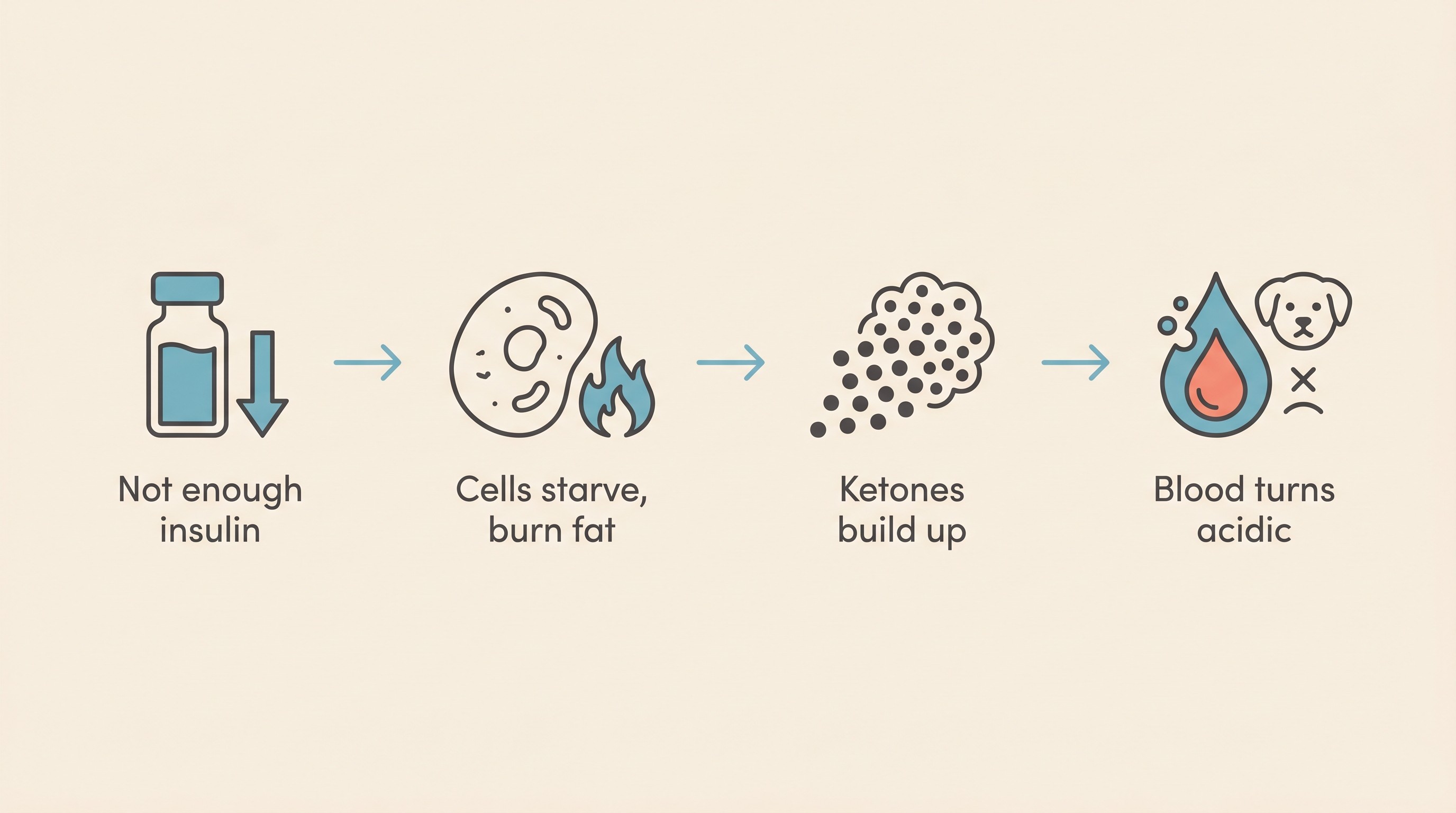
Once you see the mechanism, the warning signs stop feeling random. Insulin is the key that lets glucose, the body's main fuel, get out of the blood and into the cells. In diabetes there isn't enough of it, so the cells starve in the middle of plenty, with the glucose locked out in the bloodstream. The body responds by breaking down fat for energy instead, and burning fat this way throws off acidic by-products called ketones. As they pile up the blood turns acidic, and that acid state, on top of a high blood sugar, dehydration and lost salts, is diabetic ketoacidosis (Behrend et al., 2018; Bugbee et al., 2026).
So DKA is not simply "a bad sugar day". A diabetic pet can run high for an afternoon and be fine. DKA is decompensation: the whole system tipping over into illness, the pet sick, often vomiting, dried out and acidotic. There's a milder stage on the same road, diabetic ketosis, where ketones are present but the pet isn't yet markedly acidic or unwell, so ketosis is the warning shot and ketoacidosis the crisis (Cuddy et al., 2025). One practical detail to carry from this: the main ketone in active DKA is beta-hydroxybutyrate (BHB), and the old urine "ketone" strips mainly detect a different one, so a reassuring urine strip in a visibly unwell pet can read falsely low and means little (Duarte et al., 2002; Zeugswetter & Pagitz, 2012; Bugbee et al., 2026). Blood BHB is the measure that counts.
Who's at risk, and what sets it off
DKA very often shows up at the very moment diabetes is first diagnosed: in one large study of dogs, 82 of 127, that's 65%, had DKA at the same time their diabetes was first picked up (Hume et al., 2006). So "but she was fine last week" is entirely compatible with this, and sometimes the DKA is what brings the diabetes to light at all.
DKA also rarely arrives alone. In that same canine study, 69% of the dogs had at least one other illness running alongside it: acute pancreatitis in 41%, a urinary tract infection in 20%, and Cushing's disease in 15% (Hume et al., 2006). Cats follow suit, commonly with concurrent pancreatitis, infection, kidney disease or liver problems (Cooper et al., 2015; Bugbee et al., 2026). So the precipitants worth knowing are an infection or other illness, a missed or insufficient dose of insulin, a stress event, and newly developing or under-treated diabetes (Behrend et al., 2018; Bugbee et al., 2026). Those comorbidities are their own subject in the concurrent diseases guide.
For this page the take-home is simpler: a diabetic pet who becomes unwell for any reason is at risk of DKA, so illness in a diabetic is never something to ride out at home.
Warning signs you must recognise
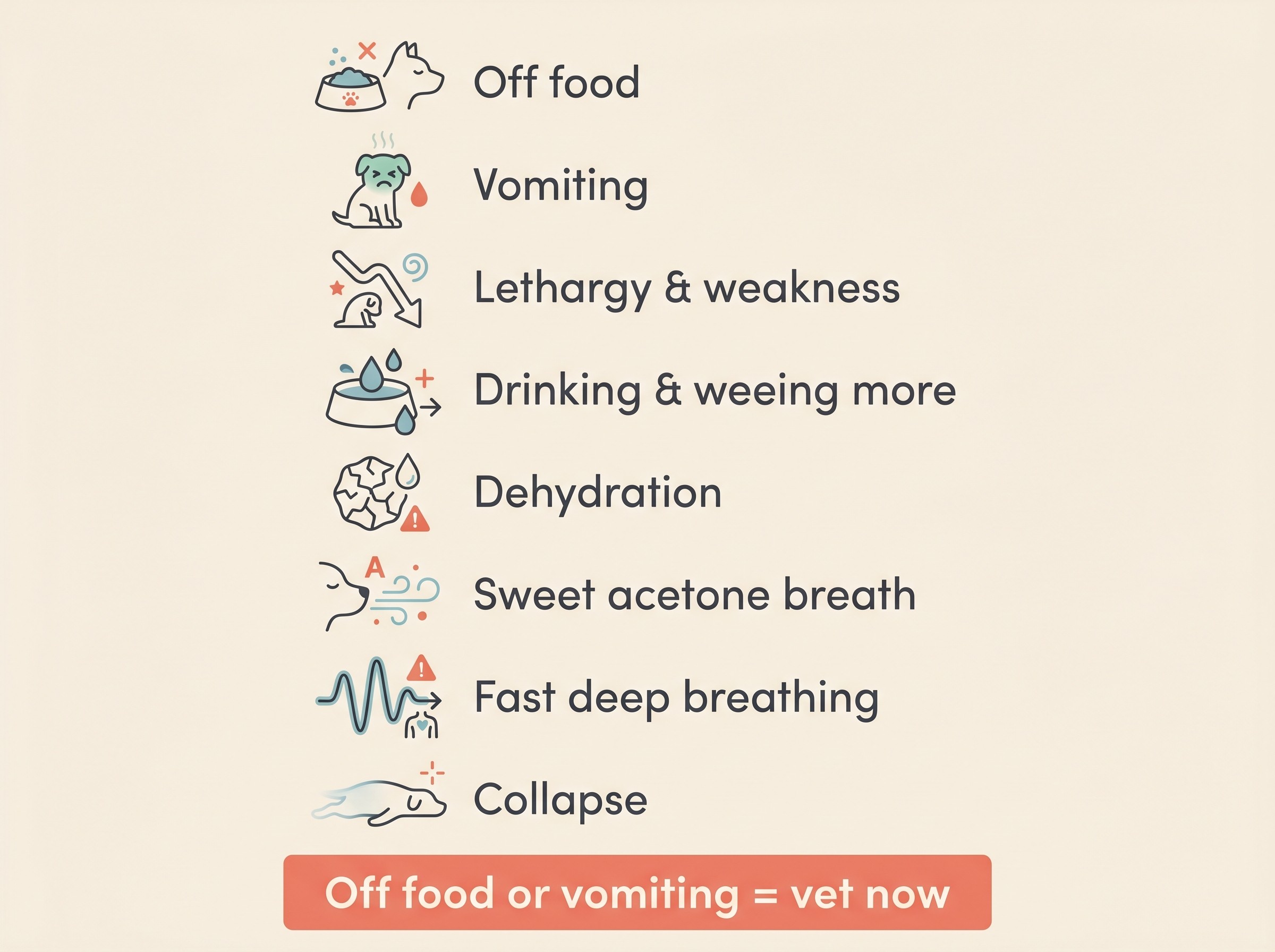
This is the part to read twice, because catching DKA early is almost entirely about you spotting these signs and acting on them. It builds over hours to a few days, and the earliest changes are easy to miss because they're the vague things any illness causes: going off food, then vomiting, then lethargy and weakness. Often the thirst and urination climb above the usual diabetic baseline, the pet looks and feels dehydrated, and left to run it ends in collapse (Behrend et al., 2018; Bugbee et al., 2026). Two further signs are classic, though not always present, so don't wait for them: a sweet, almost nail-varnish smell on the breath, the smell of ketones being exhaled, and fast, deep breathing as the body tries to blow off acid (Behrend et al., 2018; Bugbee et al., 2026).
If you take a single rule from this whole page, make it this: a diabetic pet that stops eating, or vomits, is the DKA red flag and an urgent phone call, not a wait-and-see (Behrend et al., 2018; Bugbee et al., 2026). I would far rather see a pet who turns out to have a simple upset tummy than miss one sliding into ketoacidosis. You are not overreacting by ringing.
The contrast with the hypo guides what you do. A hypo comes on in minutes, looks neurological, and is treated with sugar on the gums (the rescue is in its own guide), whereas DKA builds over days and cannot be fixed at home. Both are "vet now". One rule spans both: if you are ever unsure whether an insulin dose went in, do not re-dose. Skip it and wait for the next, and ring the vet, because a missed dose is a far smaller problem than a double one.
Serious, but survivable
DKA needs the hospital, and that is not a criticism of you. A pet in ketoacidosis needs intravenous fluids, careful correction of deranged electrolytes (potassium above all), short-acting insulin given in a controlled way, and treatment of whatever illness set it off (Behrend et al., 2018; Bugbee et al., 2026). That's a round-the-clock job with repeated blood tests, so admitting your pet is the right call.
And the reassurance is real, because you deserve the odds and not just the threat. In the largest canine study, 89 of 127 dogs (around 70%) survived to discharge, with a median stay of about six days (Hume et al., 2006); in cats, one large series reported about 61% survival (Cooper et al., 2015) and a more recent one around 69% (Judy et al., 2025). These were pets who arrived critically ill, and most went home. DKA is serious, but it is not a death sentence. What mostly shifts those odds, gently said, is how far gone the animal is by the time it's treated, which is the whole reason for acting on the early signs rather than waiting (Hume et al., 2006; Cooper et al., 2015).
Heading it off, and what to do tonight
Prevention folds into the routine you're already building. Don't skip insulin on a whim, because under-dosing is itself a trigger, but equally never give a full dose to a pet that won't eat or is vomiting: when a diabetic is off-colour the safe path is your vet's sick-day plan, often a reduced or partial dose agreed with them, never a full dose into an empty stomach (Behrend et al., 2018). The whole sick-day playbook lives in the travel and sick-day guide. Beyond that, get illness seen early, because infection and pancreatitis are the usual triggers (Hume et al., 2006); and where your vet advises it, you can track blood BHB at home with a handheld ketone meter rather than the unreliable urine sticks, on thresholds your vet sets, a rising level in a sick pet meaning vet now (Duarte et al., 2002; Zeugswetter & Pagitz, 2012; Bugbee et al., 2026).
So here's where I'd leave you, with something to do rather than just something to fear. Before you close this page, make a sick-day plan with your vet: write down what to do if your pet goes off its food or vomits, what dose to give or skip, and the number to ring out of hours. If you log your pet's diabetes in the Glucose Companion, use it to record any illness, ketone reading or off-food day, so a worrying pattern becomes a fact you can read down the phone rather than a feeling you can't put into words. DKA is the diabetic emergency that kills when it's missed, but caught early it's the one most pets survive, and the sick-day plan you write tonight is how you make that possible.
References
- Behrend, E., Holford, A., Lathan, P., Rucinsky, R., & Schulman, R. (2018). 2018 AAHA Diabetes Management Guidelines for Dogs and Cats. Journal of the American Animal Hospital Association, 54(1), 1-21.
- Bugbee, A., Rucinsky, R., Alvarez, E., Cook, A., Lathan, P., & Panning, C. (2026). 2026 AAHA Diabetes Management Guidelines for Cats. Journal of the American Animal Hospital Association, 62(3), 65-93.
- Cook, A. K., & Behrend, E. (2025). SGLT2 inhibitor use in the management of feline diabetes mellitus. Journal of Veterinary Pharmacology and Therapeutics, 48(Suppl 1), 19-30.
- Cooper, R. L., Drobatz, K. J., Lennon, E. M., & Hess, R. S. (2015). Retrospective evaluation of risk factors and outcome predictors in cats with diabetic ketoacidosis (1997-2007): 93 cases. Journal of Veterinary Emergency and Critical Care, 25(2), 263-272.
- Cuddy, L. C., et al. (2025). Retrospective evaluation of acid-base analysis in dogs and cats with diabetic ketosis (2017-2021): 96 cases. Journal of Veterinary Emergency and Critical Care, 35(1), 65-72.
- Duarte, R., Simões, D. M. N., Franchini, M. L., Marquezi, M. L., Ikesaki, J. H., & Kogika, M. M. (2002). Accuracy of serum β-hydroxybutyrate measurements for the diagnosis of diabetic ketoacidosis in 116 dogs. Journal of Veterinary Internal Medicine, 16(4), 411-417.
- European Medicines Agency / Boehringer Ingelheim. (2024). Direct Healthcare Professional Communication: Senvelgo (velagliflozin) 15 mg/mL oral solution for cats, known risk of diabetic ketoacidosis.
- Hume, D. Z., Drobatz, K. J., & Hess, R. S. (2006). Outcome of dogs with diabetic ketoacidosis: 127 dogs (1993-2003). Journal of Veterinary Internal Medicine, 20(3), 547-555.
- Judy, A., Rendahl, A., & Tart, K. (2025). Retrospective evaluation of prognostic variables and overall survival associated with nonketotic hyperosmolar hyperglycemia in diabetic cats: 29 cases (2000-2020). Journal of Veterinary Emergency and Critical Care, 35(4), 415-424.
- US Food and Drug Administration, Center for Veterinary Medicine. (2022/2023). Bexacat (bexagliflozin tablets): approval announcement, Dear Veterinarian Letter and boxed warning.
- Zeugswetter, F. K., & Pagitz, F. (2012). Point-of-care β-hydroxybutyrate measurement for the diagnosis of feline diabetic ketoacidaemia. Journal of Small Animal Practice, 53(6), 328-331.
Keep track of how your pet is doing
The owners who cope best are the ones who notice changes early. A simple health log shows you what is working, and what is not, before the next vet visit.
Start tracking, freeYou're not doing this alone
Compare treatment journeys and talk to owners managing diabetes mellitus. Free to join.
Join PetsLikeMine