

The Concurrent Diseases That Fight Your Insulin
Alastair Greenway
BVM&S MRCVS
The dose has crept up again. We're at numbers that would have sounded alarming three months ago, the glucose curve is still a flat high line that barely dips, and you're doing everything right. And yet the insulin just isn't working. The natural instinct, yours and sometimes mine, is to reach for the dial and turn it up once more.
I want to talk you out of that instinct, gently, because by the time the insulin "stops working" the answer is very rarely more insulin. It's usually a second disease quietly fighting the first. Find that disease and treat it, and a pet who looked like an impossible case can become a straightforward one again.
This is the tour of those second diseases. It sits alongside the calm overview in The Unstable, Brittle Diabetic and the ordered step-by-step hunt in The Resistance Work-Up; the everyday destabilisers, obesity and dental disease above all, get their own full treatment in Weight, Dental Disease and the Other Things That Quietly Wreck Control. My job here is the diseases themselves.
What "resistance" actually means
Your vet isn't reaching for the word "resistance" arbitrarily. It's suspected once control stays poor despite a dose above roughly 1.5 units per kilogram per injection in a dog, or more than about 5 to 6 units per injection in a cat, or whenever the requirement keeps climbing without settling (Behrend et al., 2018). Hold that number lightly: it's a trigger to investigate, not a target to dose toward. Crossing it doesn't mean "give more", it means "stop and look for why".
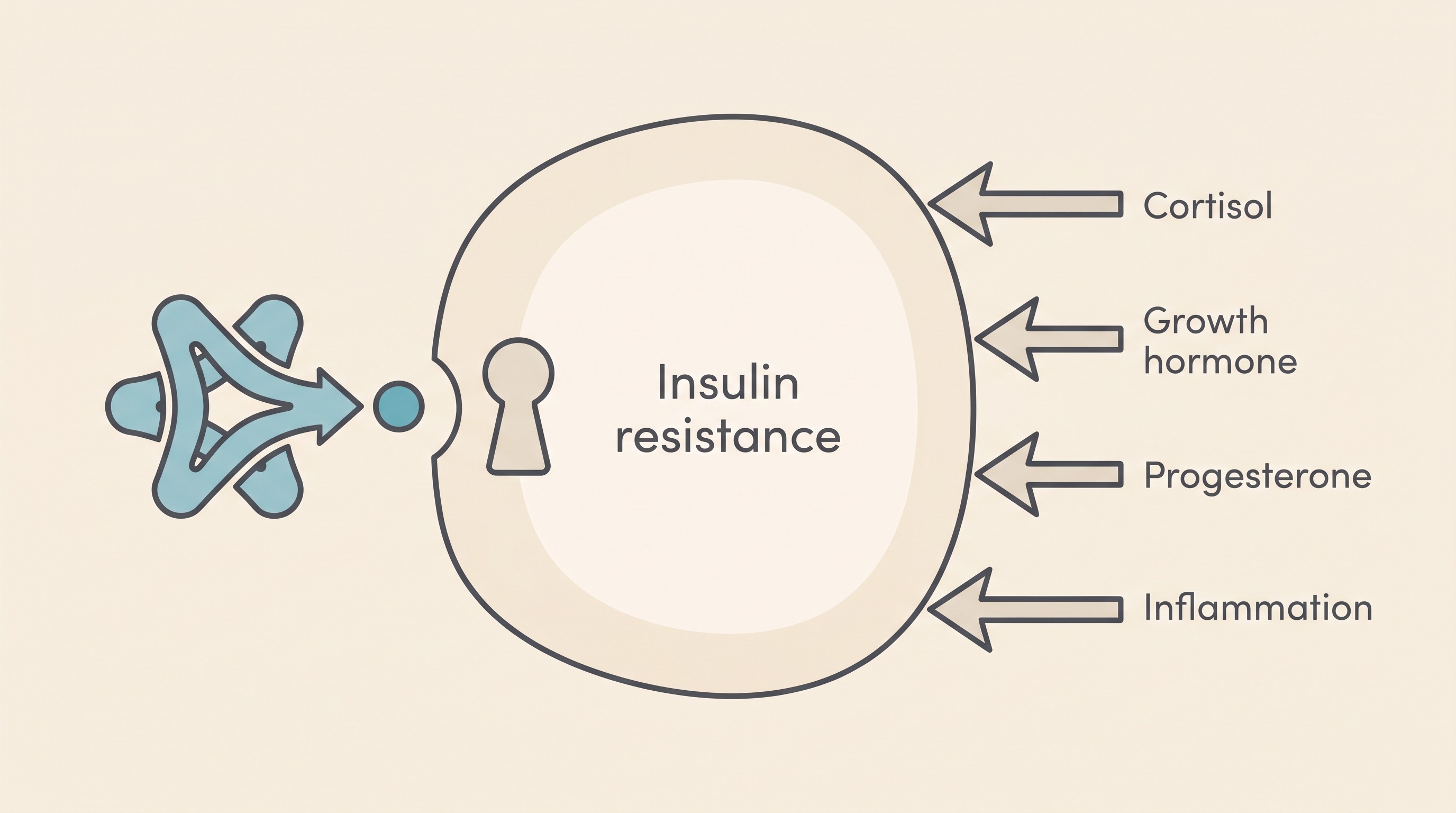
The reason other diseases push the need up is that several hormones and inflammatory states actively oppose insulin at the tissues. Cortisol, growth hormone, progesterone, thyroid hormone and the chemical signals of inflammation all do roughly the same two things: they make cells less willing to take glucose in, and they push the liver to pour more glucose out (Behrend et al., 2018). The insulin is still going in, but now against a headwind. In one study, cats with a resistance-causing tumour needed around five times the dose of unaffected diabetics for the same effect (Miceli et al., 2023). That is the scale of what a hidden disease can do, and exactly why climbing the dose to "beat" it is the wrong move, and a real way to trip your pet into a dangerous low.
One thing shapes the whole tour: dogs and cats develop different second diseases. The dog's list is led by Cushing's and, in entire females, the hormone cycle itself. The cat's is led by something most owners have never heard of. So read the half that fits your pet.
In dogs: Cushing's, the season, and the rest
Cushing's disease (hyperadrenocorticism) is the big one in dogs: a condition where the body makes too much of its own cortisol, the natural stress steroid and a powerful insulin antagonist. Around one in ten dogs with Cushing's also has diabetes, and when the two travel together the diabetic is typically very hard to regulate until the Cushing's is controlled (Merck Veterinary Manual). So in a poorly controlled diabetic dog, especially one with a pot-bellied shape, thinning coat or recurrent infections, Cushing's climbs the list. As a standalone condition it has its own home in our Endocrine and Hormones space; the point here is that the diabetes often won't behave until it's addressed.
Dioestrus and progesterone in the entire bitch is the one I'd most like every owner of an unspayed female to know about, because it's hidden, reversible, and the treatment is concrete. In the second half of an unspayed female dog's cycle, and in pregnancy, progesterone rises and drives the mammary tissue to secrete growth hormone. That growth hormone causes insulin resistance and in some bitches tips them into diabetes, with the first signs often appearing around 30 days after a season (Fall et al., 2010; Pöppl et al., 2024). Removing the source can reverse it: in one study of affected bitches, 46 percent of those that were spayed recovered from their diabetes, with the chance higher the sooner surgery happened and the lower the glucose was at diagnosis (Fall et al., 2010).
I have to be straight about the limits of that hope. Remission is possible, not guaranteed, and your dog is still an insulin-dependent diabetic until proven otherwise. Spaying is not a switch that lets you stop insulin that day: the insulin and the monitoring keep going, and any reduction happens only on a vet-agreed plan as the curve shows the resistance lifting. But for the right bitch, caught early, this is one of the few situations in canine diabetes where we can sometimes genuinely turn the disease off.
Pancreatitis and infection belong on the dog list too, but they hit both species, so I've gathered them below. And steroid drugs get their own section at the end, because they're the commonest resistance we create ourselves.
Cats: start with acromegaly
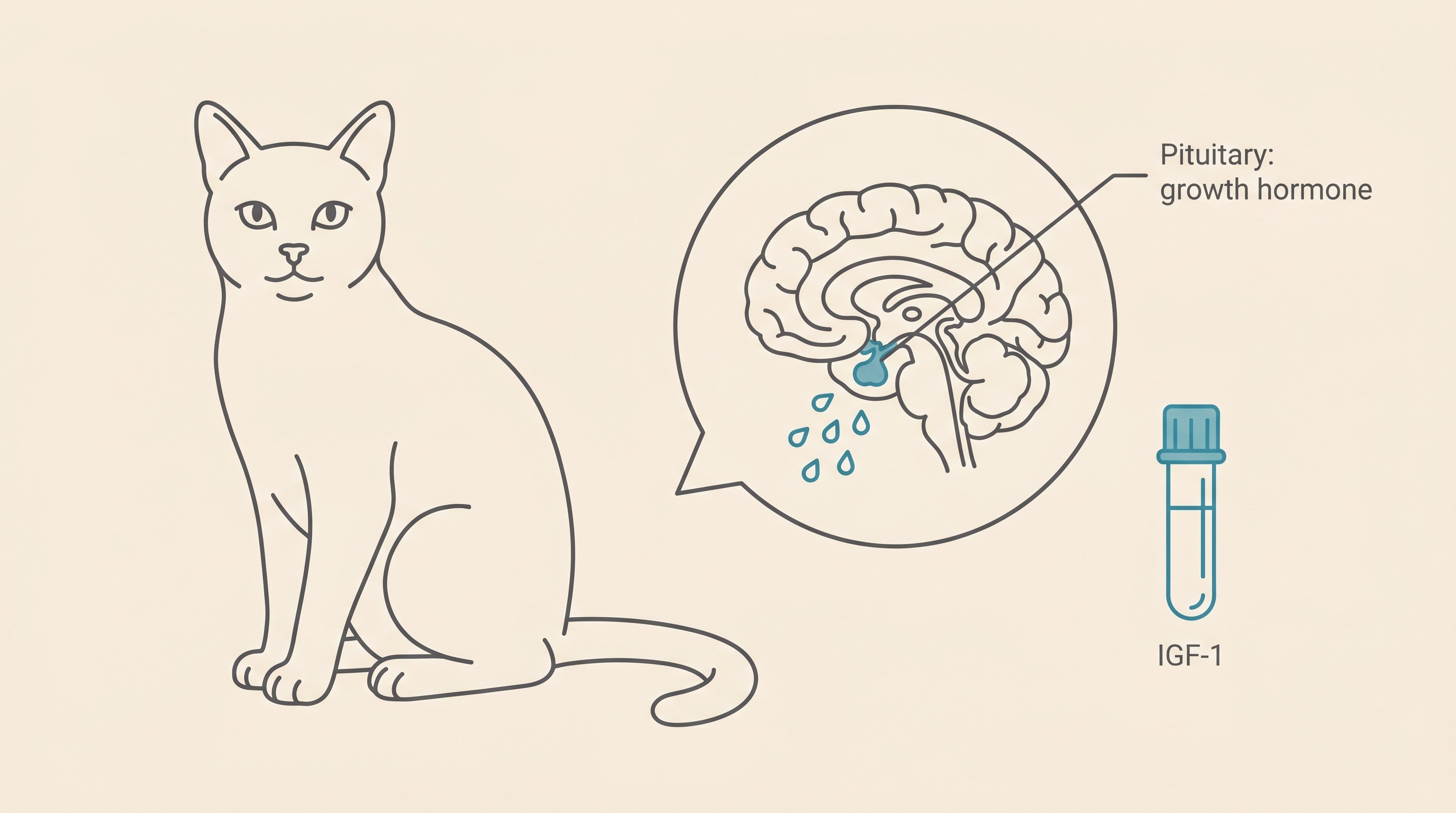
The leading cause of stubborn insulin resistance in cats is hypersomatotropism, better known as acromegaly: a small, usually benign pituitary tumour that pumps out excess growth hormone, a potent insulin antagonist. It's far commoner than almost anyone expects, present in somewhere around 15 to 25 percent of diabetic cats (Scudder & Church, 2024). When UK researchers screened 1,221 diabetic cats, 26.1 percent had a growth-hormone marker (IGF-1) above 1,000 nanograms per millilitre, and of those imaged the great majority had a visible pituitary tumour (Niessen et al., 2015). In a hard-to-control diabetic cat, it's one of the first things on my mind.
Here's the part that catches everyone out. Most acromegalic cats do not look acromegalic. The textbook picture, the broad face, big paws and jutting jaw, is real but late, and the recognisable physical changes show in only about a quarter of affected cats (Scudder & Church, 2024). So you cannot rule it out by looking at your cat across the kitchen, and neither can I across the consulting table. The only way to find it is a blood test for IGF-1. A level above 1,000 ng/mL has roughly a 95 percent chance of being a true positive, with a "grey zone" between about 700 and 1,000 that needs repeating or imaging to interpret (Niessen et al., 2007; Scudder & Church, 2024). One caveat worth flagging: insulin treatment itself nudges IGF-1 upward, so a test run very early, before a newly diagnosed cat has had much insulin, can read falsely low and is worth repeating later (Scudder & Church, 2024).
And the reason to find it is that it's treatable, with real prospects. Because the resistance is driven by the growth hormone, controlling that hormone can lift the resistance and, in many cats, resolve the diabetes altogether. Pituitary surgery (hypophysectomy) achieves diabetic remission in roughly 71 to 92 percent of cats in specialist hands, radiotherapy helps a smaller proportion, and medical options such as pasireotide and cabergoline exist (Scudder & Church, 2024). These are referral-level decisions, so the next step is a conversation with your vet and, where it points that way, the Endocrine and Hormones space. But the headline is genuinely good news: a cat who seemed impossible to control may have a findable, treatable reason behind it, and treating it can even reopen the door to remission, covered in Feline Diabetic Remission.
Feline Cushing's is a much rarer cause, but worth a mention for how it behaves. It is genuinely uncommon, yet when a cat does have hyperadrenocorticism, it almost always travels with a difficult, insulin-resistant diabetes, with the great majority of these cats (commonly cited as around 80 percent or more) showing concurrent hard-to-control diabetes (Cook & Evans, 2021). So in the unregulated diabetic cat where acromegaly has been excluded, Cushing's is the next adrenal door to check.
Hyperthyroidism is a recognised if less common contributor, turning up in a small minority of diabetic cats, in the region of 2.5 to 6 percent, and because it's another older-cat disease it frequently coexists and worsens control (Miceli et al., 2023). It's screened simply with a total T4, often on the same sample as everything else. (In dogs the thyroid story runs the other way: hypothyroidism can accompany diabetes, and when it does, both disorders need treating together rather than one being chased through the other (Behrend et al., 2018).)
Pancreatitis and infection: the two that hit both species
Two more diseases hit dogs and cats alike, and both are easy to miss.
Pancreatitis, inflammation of the pancreas, is extraordinarily common alongside diabetes and the relationship runs both ways. In cats, depending how you look, between 31 and 83 percent of diabetics show evidence of pancreatitis, with around half confirmed on tissue samples (Xenoulis & Fracassi, 2022). In dogs it is also a recognised travelling companion, and chronic pancreatitis can be the underlying reason a dog became diabetic at all by gradually destroying the insulin-producing cells. The two feed each other: poorly controlled diabetes can inflame the pancreas, while pancreatitis damages the insulin-producing islet cells and adds its own layer of peripheral insulin resistance. Cats carrying both tend to be the unstable ones, and those with more pancreatic inflammation are less likely to achieve remission (Xenoulis & Fracassi, 2022). It can be subtle, a grumbling rather than a dramatic illness, which is why it's worth testing for with pancreatic lipase and imaging rather than waiting for a crisis.
Infection is the classic fixable resistance driver, and the most commonly overlooked sits in the urinary tract. Bacterial cystitis is present in roughly 13 percent of diabetic dogs and 10 percent of diabetic cats at diagnosis, and it's often completely silent: diabetic urine is dilute and sugar-rich, exactly what bacteria thrive in, and a poorly controlled diabetic may not show the usual straining (Bailiff et al., 2006; Behrend et al., 2018). Infection or inflammation anywhere, urinary, oral or skin, antagonises insulin, which is why a urine culture is standard in any unstable diabetic, and why the deeper how-to on dental and skin infection sits with Weight, Dental Disease and the Other Things That Quietly Wreck Control. A hidden infection can single-handedly explain a pet who suddenly needs far more insulin, and finding it is far better news than it sounds.
Steroids: the resistance we cause ourselves
The commonest man-made cause of insulin resistance is glucocorticoid medication, in both species (Behrend et al., 2018). Any steroid can blunt insulin: oral tablets, a long-acting injection, and sometimes even preparations you wouldn't think of as "real" steroids, such as some skin, ear and eye treatments. This isn't a reason to suddenly stop a medication your pet needs, since some are genuinely important and stopping certain steroids abruptly is its own hazard. It's a reason to tell every vet and nurse who sees your diabetic pet about every product they're on, so steroids can be minimised or swapped for a non-steroid alternative wherever it's safe. In cats this matters doubly, because reducing steroid exposure can help protect the chance of remission (Behrend et al., 2018).
What the work-up looks for
When your pet crosses into resistance territory, the work-up is broad on purpose: full bloods and a urinalysis with culture, pancreatic lipase, an IGF-1 if it's a cat, adrenal testing such as an ACTH stimulation or low-dose dexamethasone test, a thyroid check, and imaging where indicated (Behrend et al., 2018). The aim is to find the one fixable thing before anyone settles for the word "brittle". I won't set out the order here, because that ordered ladder, the unglamorous technical causes checked before the exotic diseases, is the whole job of The Resistance Work-Up, the piece to read next.
A glucose curve or CGM trace that stays high and flat despite a big dose is not telling you to keep climbing. It's telling you to look, and our Glucose Companion was made to capture exactly that pattern so you can show your vet a clear, resistant trace rather than a feeling. (If your pet ever goes wobbly, weak, dull or trembling, treat it as a possible low: rub a little glucose, honey or sugar on the gums, never pour liquid into a pet that can't swallow, and ring your vet straight away.)
So if your vet has started talking about "looking for something else", that isn't giving up on your pet. It's the opposite. A concurrent disease is the explanation that comes with a treatment, and treating it, rather than forever feeding the insulin, is what turns the impossible diabetic back into a manageable one. Some of these, the entire bitch's season, the cat's acromegaly, even carry the chance of switching the diabetes off altogether. The flat line on the curve isn't the end of the story. Very often it's the first real clue to fixing it.
References
- Bailiff, N. L., Nelson, R. W., Feldman, E. C., Westropp, J. L., Ling, G. V., Jang, S. S., & Kass, P. H. (2006). Frequency and risk factors for urinary tract infection in cats with diabetes mellitus. Journal of Veterinary Internal Medicine, 20(4), 850-855.
- Behrend, E., Holford, A., Lathan, P., Rucinsky, R., & Schulman, R. (2018). 2018 AAHA Diabetes Management Guidelines for Dogs and Cats. Journal of the American Animal Hospital Association, 54(1), 1-21.
- Cook, A. K., & Evans, J. B. (2021). Feline comorbidities: Recognition, diagnosis and management of the cushingoid diabetic. Journal of Feline Medicine and Surgery, 23(1), 35-47.
- Fall, T., Hedhammar, Å., Wallberg, A., Fall, N., Ahlgren, K. M., Hamlin, H. H., Lindblad-Toh, K., Andersson, G., & Kämpe, O. (2010). Diabetes mellitus in Elkhounds is associated with diestrus and pregnancy. Journal of Veterinary Internal Medicine, 24(6), 1322-1328.
- Merck Veterinary Manual. (n.d.). Diabetes mellitus in dogs and cats and Cushing disease (hyperadrenocorticism) in animals. Merck & Co.
- Miceli, D. D., García, J. D., Rey Amunategui, J. P., Pompili, G. A., Rial, L. A., Más, J., Molina, E. M., & Pignataro, O. P. (2023). Prevalence of hypersomatotropism and hyperthyroidism in cats with diabetes mellitus from referral centers in Buenos Aires (2020-2022). Journal of Feline Medicine and Surgery, 25(2), 1098612X221148565.
- Niessen, S. J. M., Petrie, G., Gaudiano, F., Khalid, M., Smyth, J. B. A., Mahoney, P., & Church, D. B. (2007). Feline acromegaly: an underdiagnosed endocrinopathy? Journal of Veterinary Internal Medicine, 21(5), 899-905.
- Niessen, S. J. M., Forcada, Y., Mantis, P., Lamb, C. R., Harrington, N., Fowkes, R., Korbonits, M., Smith, K., & Church, D. B. (2015). Studying cat (Felis catus) diabetes: beware of the acromegalic imposter. PLoS ONE, 10(5), e0127794.
- Pöppl, Á. G., de Carvalho, G. L. C., Vivian, I. F., Corbellini, L. G., & González, F. H. D. (2013). Diabetes mellitus remission after resolution of inflammatory and progesterone-related conditions in bitches. Research in Veterinary Science, 94(3), 471-473.
- Pöppl, Á. G., Coelho, I. C. B., Silveira, C. A., Moresco, M. B., & de Carvalho, G. L. C. (2024). Progesterone-related diabetes mellitus in the bitch: current knowledge, the role of pyometra, and relevance in practice. Animals, 14(6), 890.
- Scudder, C., & Church, D. (2024). Feline comorbidities: hypersomatotropism-induced diabetes in cats. Journal of Feline Medicine and Surgery, 26(2), 1098612X241226690.
- Xenoulis, P. G., & Fracassi, F. (2022). Feline comorbidities: clinical perspective on diabetes mellitus and pancreatitis. Journal of Feline Medicine and Surgery, 24(7), 651-661.
Keep track of how your pet is doing
The owners who cope best are the ones who notice changes early. A simple health log shows you what is working, and what is not, before the next vet visit.
Start tracking, freeYou're not doing this alone
Compare treatment journeys and talk to owners managing diabetes mellitus. Free to join.
Join PetsLikeMine