

Travel, Boarding and Sick-Day Rules for a Diabetic Pet
Alastair Greenway
BVM&S MRCVS
Diabetes settles, in the end, into a pleasant kind of dull. Two meals, two injections, a quick note in the app, twice a day, until it's muscle memory. And then one of three things happens. Your pet wakes up off their food. You've a holiday booked and a cool bag you're not sure how to pack. Or you need to leave them with someone, and handing over the needles makes your stomach drop. These are the moments the smooth routine doesn't cover, and they're exactly when owners ring the practice slightly panicked, because nobody told them the plan for when the plan breaks.
So this page is that plan. The settled daily rhythm itself, the twelve-hour anchors and the give in the timing, lives in the daily routine guide, and I'll assume you've got that working. What follows is the three exceptions: the sick day, the journey, and handing care to someone else. Sort each one in advance and it stops being an emergency and becomes something you simply know how to handle.
Sick days: the one rule worth reading twice
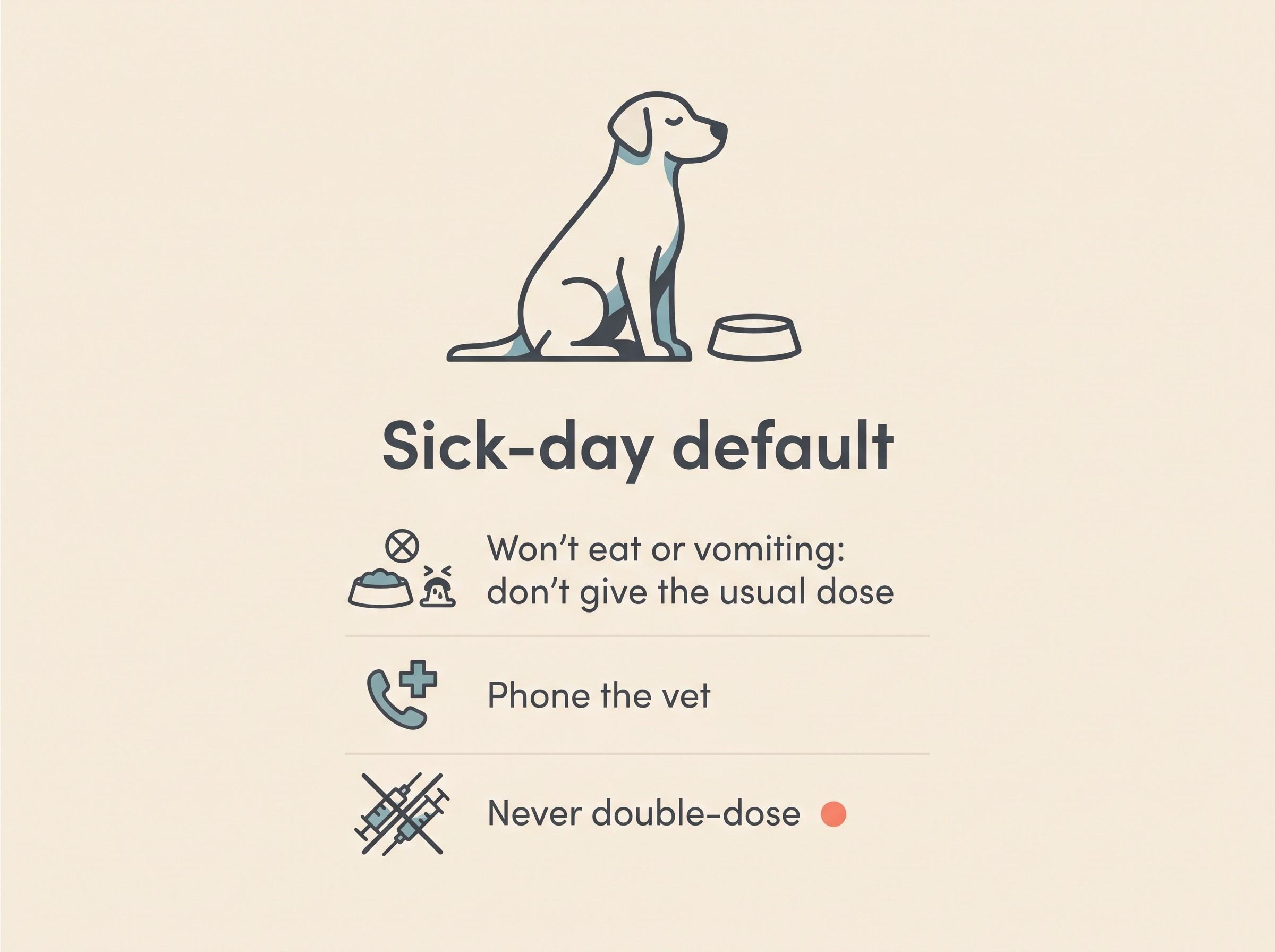
If your diabetic pet will not eat, do not give the usual insulin dose on autopilot. Phone your vet.
This isn't my opinion, and it isn't fussiness. The insulin manufacturer says it in plain words: the Caninsulin owner manual tells owners, "If your dog is not eating do not give Caninsulin or any other insulin! Consult your vet on how to proceed with insulin injections" (Caninsulin owner manual). Cornell's veterinary school puts the reasoning behind it just as bluntly: "If your dog skips their morning meal and doesn't eat, you need to contact your veterinarian to discuss adjustments in the insulin dose. Insulin needs the 'raw material' of the food to be effective" (Cornell Riney Canine Health Center).
That phrase, the raw material, is the whole mechanism in three words. The dose your vet arrived at is matched to a meal: insulin pushes glucose out of the bloodstream and into the cells, and the food is what restocks the bloodstream so it doesn't fall too far. Give a full dose to a pet who hasn't eaten, or whose breakfast comes straight back up an hour later, and there's nothing to refill the tank, so the blood sugar can drop dangerously low (Behrend et al., 2018). A hypo, wobbly and weak and dull, then trembling, then collapse, is the emergency that kills a diabetic pet fastest, and a full dose on a sick day is one of the classic ways owners stumble into one. The rescue, sugar or honey rubbed onto the gums and never poured into a mouth that can't swallow, then straight to the vet, lives in the hypoglycaemia guide; here I only want you to know that a sick day is when that risk spikes.
Now, why phone the vet rather than just halve the dose yourself? Because a sick day pulls in two opposite directions at once, and only a clinician, ideally with a glucose or ketone check, can tell which way your pet is going. If your pet simply isn't eating, the danger is too much insulin for too little food, and they may need a reduced dose or none. But illness can also tip a diabetic the other way, into diabetic ketoacidosis, where the body, starved of working insulin, burns fat for fuel and floods the blood with acidic ketones, and that needs more care, not less. The same pet on the same morning could need their insulin held back or could be sliding into an emergency, which is why a fixed home rule is no substitute for the call. One safety rule never bends, though: never give two doses, and if you're ever unsure whether an injection went in, skip it and wait for the next scheduled one. A missed dose is a few hours of high blood sugar, a nuisance; a double is a potential emergency. When in doubt you always err toward the skip (Behrend et al., 2018).
When an off day tips into an emergency
Most off-colour days in a diabetic pet are minor, the same upsets any pet has. But diabetes raises the stakes, because an ordinary-looking illness is the classic thing that tips a diabetic into ketoacidosis, and a vomiting, not-eating diabetic should never be filed under "just a tummy bug" without a second thought.
The evidence here is sobering and worth knowing. In a study of 127 dogs admitted with diabetic ketoacidosis, 69% had at least one other illness going on at the same time, most often pancreatitis, a urinary infection or Cushing's disease (Hume et al., 2006). Look at how those dogs presented: 87% were lethargic, 87% were off their food, and 83% were vomiting (Hume et al., 2006). That is exactly what a "sick day" looks like from the sofa. The cat picture is the same shape and just as serious: in a series of 93 cats with ketoacidosis, 39% died or were put to sleep, and again the disease rode in on a concurrent illness, pancreatitis, liver trouble or infection (Cooper et al., 2015). The point is not to frighten you, it's to lower your threshold. A diabetic that goes off food or starts vomiting during any illness needs a vet's eyes sooner rather than later, not a day of watchful waiting to see how they go.
The warning signs that mean ring now, not in the morning, are: not eating, repeated vomiting, marked lethargy or weakness, fast or laboured breathing, a sweet or acetone smell on the breath, or collapse. What ketoacidosis actually is and how the hospital treats it belongs to the DKA guide; your job at home is simply to recognise that this list means a phone call, and make it. A genuinely unwell diabetic pet is one of the few situations in this whole space where waiting is the wrong instinct.
One important species note, because it's a real trap. A small number of cats are managed not on insulin but on an oral drug from the SGLT2 group, such as Senvelgo. For those cats, anorexia, lethargy or vomiting is a specific red flag to stop the drug and get veterinary care straight away, because these drugs can cause a form of ketoacidosis in which the blood glucose reads normal or only mildly raised (Senvelgo PI / FDA, 2023). That matters enormously, because a home glucometer can say "fine" while the cat is critically ill. The label is explicit that an affected cat should be stabilised with short-acting insulin and the drug discontinued, and that it should never be started in a cat already off-colour (Senvelgo PI / FDA, 2023). This applies only to cats on these oral drugs, never to insulin-treated cats; how the drugs work sits in the insulin and oral options guide. If your cat is on one, make sure their sick-day plan is written around this rule specifically.
Travelling with insulin: cold, but never frozen
Now the happier exception. Going away with a diabetic pet is entirely doable, and the logistics come down to two things: keeping the insulin good, and carrying enough spare that one mishap doesn't ruin the trip.
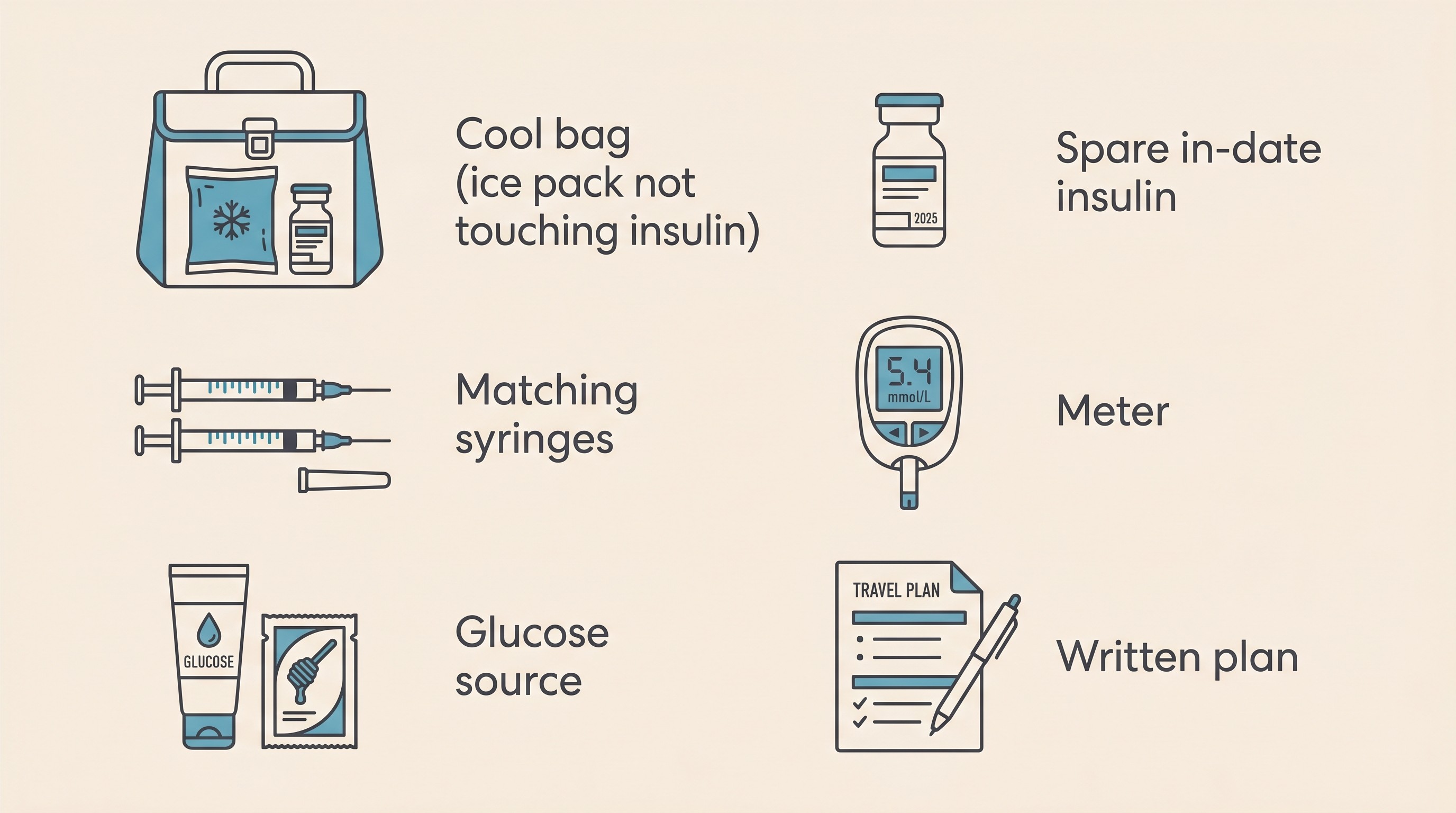
The cold chain is where people overthink the heat and underthink the cold. Insulin is actually more sensitive to freezing than to warmth: freezing damages the insulin molecules and destroys its potency, and a vial that has frozen must be thrown away (Caninsulin owner manual). So the failure that catches owners out on a journey isn't the hot car, it's the ice block. The Caninsulin product information is precise: before first use, store it upright in a fridge at 2 to 8 degrees; once open, store it below 25 degrees, upright, do not freeze, and protect from light, with a 42-day life after opening (Caninsulin SPC). The feline insulin ProZinc is the same: refrigerate at 2 to 8 degrees, do not freeze, protect from light (ProZinc label). The practical translation for a car or a plane is a cool bag with an ice pack the insulin never touches directly. The nuance that matters: a half-melted ice pack can sit right around freezing, so a vial pressed against it can freeze solid even on a warm day. Near but not touching is the phrase to hold. Keep it out of direct sun and a hot boot, accept that a brief spell at room temperature on the move is fine, and treat freezing as the thing you're really guarding against.
Then pack as though something will go wrong, because over a week away something occasionally does. Carry spare, in-date insulin kept separately from your main supply, so losing or breaking one vial isn't a crisis. Carry spare syringes or pens of the correct concentration, which genuinely matters, because diabetic insulins come in different strengths and the syringe must match: Caninsulin is U-40, many human-type insulins are U-100, and mixing them up mismeasures the dose badly. The detail of that trap and how to draw up correctly lives in storing and handling insulin; on the road, just take spares of the right kind. Bring the meter or sensor kit, a glucose source for a hypo, and the written plan we'll come to. And if you're on a suspension like Caninsulin or ProZinc, a travelling vial that's been still in a bag needs gently mixing before each dose to keep it uniform: roll it, don't shake it (Caninsulin SPC; ProZinc label).
Crossing time zones, don't snap the schedule to the new clock in one jump. Keep the roughly twelve-hour rhythm and shift it gradually toward the new local time over a day or two rather than making a sudden five-hour leap; for a short trip, many owners simply keep dosing on home time. Either way, it's a conversation to have with your vet before you fly, not in the airport.
Boarding and sitters: the written plan is the whole job
I'll say plainly that handing over a diabetic pet is one of the genuinely hard parts of this disease, because the evidence says so plainly. When researchers built and validated quality-of-life tools for owners of diabetic pets, the things that weighed most heavily weren't the injections or even the cost. Near the very top, for both dog and cat owners, sat the difficulty of leaving the pet with friends or family and the difficulty of finding boarding (Niessen et al., 2010; Niessen et al., 2012). So if the thought of going away fills you with dread, that's not you being precious, it's one of the most measured burdens of the whole condition. The fix is not to never leave, it's to solve it properly and in advance.
The deliverable is a written plan, and it does two jobs: it tells the carer exactly what to do, and it guards against the classic disaster of a pet being injected twice because two people didn't know what the other had done. Write it on a single card, keep a copy with the pet, and cover:
- The insulin name, the exact dose, and the two times it's due.
- Feed first, then inject, and what to do if the pet won't eat, which is your agreed sick-day plan: do not give the usual dose, ring the vet.
- Never give two doses; if unsure it went in, skip and wait for the next one.
- The hypo signs and the rescue: sugar or honey on the gums, never into a mouth that can't swallow, then vet now.
- The sick-day red flags that mean call the vet today: vomiting, not eating, lethargy, laboured or sweet-smelling breathing, collapse.
- Where the insulin is kept and how to handle it, including keeping it cold but not frozen.
- A place to log every dose the moment it's given, so nobody doubles up.
- Your number, the vet's number, and the out-of-hours emergency number.
Then choose your carer for competence, not just convenience. A diabetic pet needs someone genuinely comfortable giving an injection and, just as importantly, able to recognise a hypo and act. Plenty of boarding kennels and catteries will take diabetic patients, some are vet-run or vet-linked, and many sitters are happy to learn, but brief them in person and watch them give a dose before you go, rather than assume the card is enough. The best move of all, and the one that quietly transforms your own quality of life, is to teach a second confident pair of hands long before you need them, while everything is calm.
A handover like this is exactly what the Glucose Companion was made to carry. You can keep the routine and the dose log in one place, share the picture with your sitter or the boarding vet, and export a clean summary of how your pet has been running, so whoever is caring for them, or treating them in a crisis, starts with the full story rather than guesswork. The same record lets you see, when you get home, exactly how the few days went.
None of these three exceptions is as frightening as it first feels. The sick day has one rule, don't dose a pet who won't eat, phone the vet, plus a short list of red flags that mean go now. The journey is a cool bag, some spares and a gentle shift across time zones. The handover is a single written card and someone you've watched do it. Sort each one before you need it, ideally as a written sick-day-and-travel plan agreed with your own vet, and the holiday, the kennel and the off-colour Tuesday all become things you've already handled in your head. That preparation is what lets you keep living a normal life around a manageable disease, which was always the point.
References
- Behrend E, Holford A, Lathan P, Rucinsky R, Schulman R. 2018 AAHA Diabetes Management Guidelines for Dogs and Cats. Journal of the American Animal Hospital Association. 2018;54(1):1-21.
- Caninsulin owner manual. MSD Animal Health. Caring for Your Diabetic Dog (owner manual / FAQ), caninsulin.co.uk.
- Caninsulin SPC. MSD Animal Health. Caninsulin 40 IU/ml suspension for injection: Summary of Product Characteristics. UK Veterinary Medicines Directorate Product Information Database; revised February 2026.
- Cooper RL, Drobatz KJ, Lennon EM, Hess RS. Retrospective evaluation of risk factors and outcome predictors in cats with diabetic ketoacidosis (1997-2007): 93 cases. Journal of Veterinary Emergency and Critical Care. 2015;25(2):263-272.
- Cornell University Riney Canine Health Center. Managing Canine Diabetes (owner resource).
- Hume DZ, Drobatz KJ, Hess RS. Outcome of dogs with diabetic ketoacidosis: 127 dogs (1993-2003). Journal of Veterinary Internal Medicine. 2006;20(3):547-555.
- Niessen SJM, Powney S, Guitian J, et al. Evaluation of a quality-of-life tool for cats with diabetes mellitus. Journal of Veterinary Internal Medicine. 2010;24(5):1098-1105.
- Niessen SJM, Powney S, Guitian J, Niessen APM, Pion PD, Shaw JAM, Church DB. Evaluation of a quality-of-life tool for dogs with diabetes mellitus. Journal of Veterinary Internal Medicine. 2012;26(4):953-961.
- ProZinc label. Boehringer Ingelheim. ProZinc (protamine zinc recombinant human insulin, U-40) prescribing information / EMA product information. 2021/2023.
- Senvelgo PI / FDA. Boehringer Ingelheim / U.S. Food and Drug Administration. Senvelgo (velagliflozin oral solution) Prescribing Information and FDA Dear Veterinarian Letter. 2023.
Keep track of how your pet is doing
The owners who cope best are the ones who notice changes early. A simple health log shows you what is working, and what is not, before the next vet visit.
Start tracking, freeYou're not doing this alone
Compare treatment journeys and talk to owners managing diabetes mellitus. Free to join.
Join PetsLikeMine