

Settling Into the Daily Routine That Works
Alastair Greenway
BVM&S MRCVS
There's a moment, usually around the third or fourth week, when an owner rings the practice and I can hear that something has shifted. The panic has gone, the needle they were certain they could never manage has become a non-event done while the kettle boils, and the question is no longer "can I do this?" but "is this how it's meant to feel now, ordinary?" Yes. The whole aim of this disease, once the scary start is behind you, is for it to fade into the background of an ordinary good life, and this page is about how you get there.
If you're still finding your feet, the first two weeks on insulin is the better start, and the "can I fit this into my life" reckoning lives in the commitment of caring for a diabetic pet. What follows is the rhythm itself.
Two anchors a day
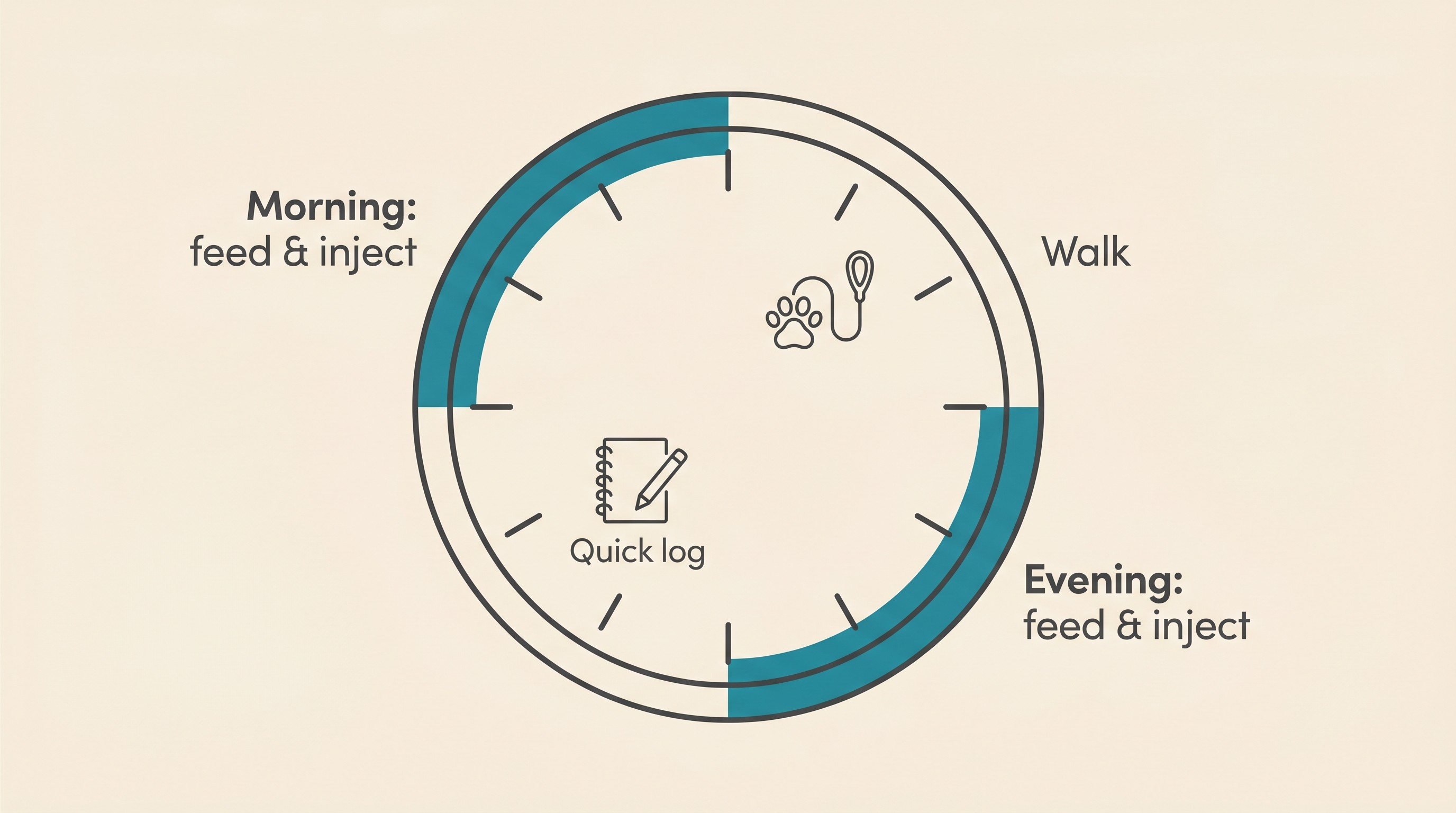
Most diabetic dogs and cats are managed on two insulin injections a day, given roughly twelve hours apart and timed around meals (Behrend et al., 2018; Taylor et al., 2025). The intermediate-acting insulins we use in pets, the porcine lente in Caninsulin (the same product sold as Vetsulin in the US), protamine zinc in ProZinc, glargine and the rest, all need at least twice-daily dosing to work properly (Taylor et al., 2025). That pattern is the backbone of your day, and almost everything else flexes around it.
So you have two fixed points, morning and evening, and at each the same small sequence: food, then injection. For a dog the order is firm. Your dog should eat before the injection goes in, because the insulin needs that meal to work on, and giving it to a dog who hasn't eaten is how blood sugar drops too low (Ward et al., VCA). For most cats the same habit is sensible, though the latest feline guidance is more relaxed: it isn't strictly necessary to give insulin after a meal, especially for cats on a low-carbohydrate diet, cats who graze, or cats on a basal insulin (Taylor et al., 2025). I still ask cat owners to watch the bowl first where they can, because that glance is a daily check on appetite. The food itself belongs to feeding a diabetic pet, the needle technique to your first insulin injection.
The routine is the medicine
The consistency isn't fussiness, it's the treatment. A diabetic pet does best with consistent insulin, consistent feeding and a stable, settled lifestyle (Ward et al., VCA), ideally the same food at the same times every day (Cornell Riney Canine Health Center). The reason is mechanical: insulin and food are a partnership, the dose matched to a particular meal at a particular time, so keep both steady and your pet's blood sugar follows roughly the same path each day. That is what lets the dose keep working and lets your vet trust the numbers. Consistency isn't a cage, it's what sets you free: once the rhythm is fixed, it does the worrying so you don't have to.
How much slack you've got
Does it have to be exactly twelve hours, to the minute, forever? No. The target is two set times about twelve hours apart, the injection given around feeding time (Ward et al., VCA; Cornell Riney Canine Health Center), and in a stable, well pet an occasional slip of an hour or so is not a crisis.
The give isn't free, though. What unsettles control isn't the odd late breakfast, it's frequent, large changes in routine, which is exactly why the consensus advice is to keep things steady and change the dose only cautiously and infrequently (Sparkes et al., 2015). So the rule I give owners is this: aim for the same two windows every day, and if life forces a shift, move the whole day gently rather than panicking, then ease back to schedule.
What about the genuinely late or missed dose? Follow your vet's agreed plan, but broadly: if the dose is late and your pet is well and has eaten, you can usually give it and push the next one back to restore the twelve-hour gap, or skip it and resume at the next scheduled time. The one rule that never bends is the safety rule underneath all of diabetic care. If you are not sure the injection actually went in, the pet flinched, you got a fur shot, you can't tell, do not give a second dose. Skip it, wait for the next scheduled dose, and never give two doses at once or add an extra to make up for a missed one (Ward et al., VCA; VCA Insulin handout). A missed dose means a few hours of slightly high blood sugar, a nuisance; a double dose can mean a hypoglycaemic emergency, which can kill. When in doubt, you always err towards the missed dose.
One related safety beat, briefly, because the emergency has its own home. If your pet ever goes wobbly, weak, dull, trembling or starts to collapse, treat it as a possible hypo: rub a little honey or glucose syrup onto the gums, never pour liquid into a pet that can't swallow, and get to a vet straight away (Cornell Riney Canine Health Center). The full rescue and aftercare live in the hypoglycaemia emergency guide, and the moment your pet is actually ill, off its food or vomiting, you've left ordinary-routine territory and want travel, boarding and sick-day rules instead.
Don't carry it alone
This is the part of diabetic life that catches people out, and the evidence is striking. When researchers validated a quality-of-life tool for owners of diabetic dogs, the things that weighed most heavily weren't the injections or even the cost. They were the logistics of sharing care: the difficulty of leaving the dog with friends or family, and of finding boarding, alongside the constant low hum of worry and the fear of hypos. Eighty-four per cent of owners reported that diabetes had a negative impact on their quality of life (Niessen et al., 2012), and the matching study in cat owners found the same cluster at the top (Niessen et al., 2010).
So fix the right thing early: set up a second pair of hands before you need them. Teach someone else, your partner, an older child, a neighbour, how to give the injection and feed to the routine while everything is calm. A pet who can only be cared for by one person is a fragile arrangement; a pet two or three people can comfortably manage is the difference between dreading every commitment and living a normal life around a manageable condition.
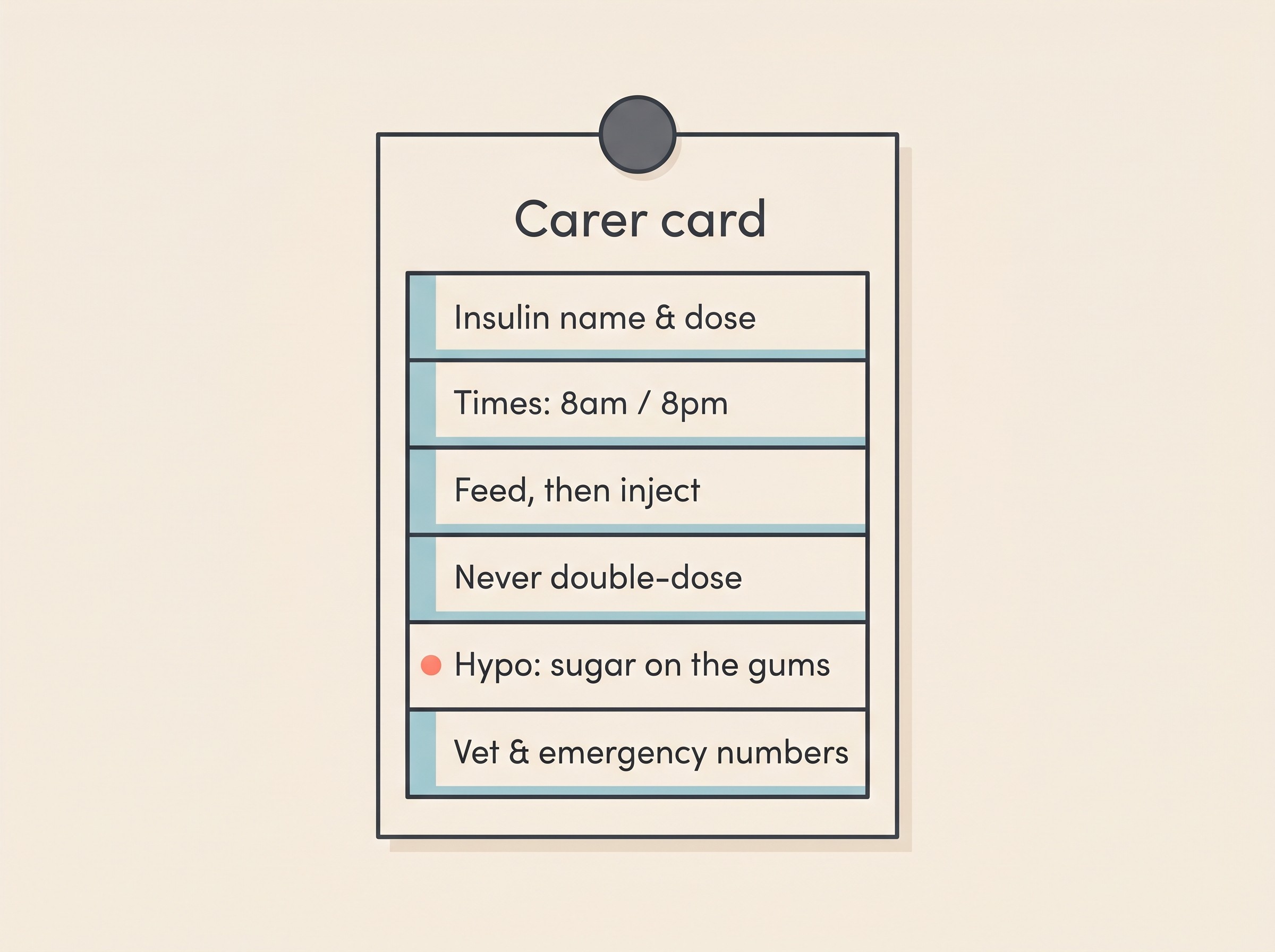
When you do hand over, do it in writing. The classic and dangerous mistake in a multi-person household is the pet getting injected twice because no one knew the other had done it. The fix is strongly advised: keep a chart in a central place, the fridge door is perfect, where every dose is recorded the moment it's given, so a second carer can see at a glance that breakfast's jab is already done (Ward et al., VCA). A good carer briefing fits on one card:
- The insulin name, the exact dose, and the two times it's due.
- Feed first, then inject; what to do if the pet won't eat (your agreed plan).
- Never give two doses; if unsure it went in, skip and wait for the next one.
- The hypo signs and the rescue: sugar on the gums, then vet now.
- Where the insulin lives, where to log each dose, and the vet and out-of-hours emergency numbers.
Writing it all down
If consistency is the medicine, logging is what proves it's working. Writing down each dose, each meal, any home glucose reading, the occasional weight and a line on how your pet seems turns a fog of vague impressions into a trend your vet can act on. And reassuringly, home monitoring is not just another chore: when owners of newly diagnosed diabetic cats took up home blood glucose monitoring, their quality-of-life scores, including worry about the diabetes, worry about hypos and worry about cost, improved over the following months, while the scores of owners who didn't monitor did not (Hazuchova et al., 2017). The current feline guidelines go further and recommend wearing a continuous glucose sensor from diagnosis to help get the dose right (Taylor et al., 2025), so logging is no longer the optional extra it once was.
That is the job we made the Glucose Companion to do: one place to record doses and meals, log home or sensor readings, share the picture with whoever else is caring for your pet, and export a clean report for vet visits. I'm not teaching you here how to read a curve or when the dose should change, because those are their own skills with their own pages. The signs to watch between readings, the thirst, the appetite, the energy, live in what to watch at home.
Exercise: same length, same time
Exercise belongs in the routine too: consistent and moderate beats heroic and erratic. Regular activity genuinely helps glycaemic control and weight, so it isn't to be avoided, but changes in activity move blood sugar, and a big unaccustomed outing on a normal insulin dose can tip a pet low. In a small early study of insulin-treated diabetic dogs, a single half-hour bout of aerobic exercise lowered glucose for up to about two hours afterwards before it returned to baseline (Mampe et al., 2025). It was only five dogs, so take the exact figures lightly, but the direction is the lesson. Keep walks roughly the same length at roughly the same time each day, watch for low-sugar signs during and for an hour or two afterwards, and treat a planned big day out as an exception to clear with your vet in advance, who may suggest a small adjustment to food or insulin or a snack around the exertion (Cornell Riney Canine Health Center). Cats are harder, because you can't schedule a cat's zoomies, but keep their feeding, dosing and household steady and stay watchful on busier days.
None of this stays effortful for long. The routine that feels like a lot to carry now becomes muscle memory faster than you'd believe, until the food and the jab and the quick note in the app happen on autopilot and you forget it was ever frightening. The proof is a pet who's bright, steady and themselves, and a trend on the Glucose Companion you can hand to your vet that says, in black and white, the rhythm you built is working. Not perfect numbers, just a good ordinary day, happening twice, every day.
References
- Behrend E, Holford A, Lathan P, Rucinsky R, Schulman R. 2018 AAHA Diabetes Management Guidelines for Dogs and Cats. Journal of the American Animal Hospital Association. 2018;54(1):1-21.
- Cornell University Riney Canine Health Center. Managing Canine Diabetes (owner resource).
- Hazuchova K, Gostelow R, Scudder C, Forcada Y, Church DB, Niessen SJM. Acceptance of home blood glucose monitoring by owners of recently diagnosed diabetic cats and impact on quality of life changes in cat and owner. Journal of Feline Medicine and Surgery. 2018;20(8):711-720.
- Mampe JR, Stefanovski D, Hess RS. Aerobic exercise decreases interstitial glucose concentrations up to 2 h after exercise in dogs with insulin-treated diabetes mellitus: a preliminary study. Frontiers in Veterinary Science. 2025;12:1595952.
- Niessen SJM, Powney S, Guitian J, et al. Evaluation of a quality-of-life tool for cats with diabetes mellitus. Journal of Veterinary Internal Medicine. 2010;24(5):1098-1105.
- Niessen SJM, Powney S, Guitian J, Niessen APM, Pion PD, Shaw JAM, Church DB. Evaluation of a quality-of-life tool for dogs with diabetes mellitus. Journal of Veterinary Internal Medicine. 2012;26(4):953-961.
- Sparkes AH, Cannon M, Church D, Fleeman L, Harvey A, Hoenig M, Peterson ME, Reusch CE, Taylor S, Rosenberg D. ISFM consensus guidelines on the practical management of diabetes mellitus in cats. Journal of Feline Medicine and Surgery. 2015;17(3):235-250.
- Taylor S, Cannon M, Church D, Fleeman L, Fracassi F, Gilor C, Mott J, Niessen S. iCatCare/ISFM 2025 consensus guidelines on the diagnosis and management of diabetes mellitus in cats. Journal of Feline Medicine and Surgery. 2025;27(11):1098612X251399103.
- VCA Animal Hospitals. Insulin (medication handout).
- Ward E, et al. (VCA Animal Hospitals). Diabetes Mellitus: Insulin Treatment in Dogs (client education).
Keep track of how your pet is doing
The owners who cope best are the ones who notice changes early. A simple health log shows you what is working, and what is not, before the next vet visit.
Start tracking, freeYou're not doing this alone
Compare treatment journeys and talk to owners managing diabetes mellitus. Free to join.
Join PetsLikeMine