


Can I Do This? The Honest Commitment of Caring for a Diabetic Pet
Alastair Greenway
BVM&S MRCVS
There's a particular silence that falls in the consult room after I say the word diabetes. The owner nods, asks a sensible question or two about insulin, and then, often while standing up to leave, comes the real one, the quiet one. "I work full time." "I'm not sure I'm the right person for this." Underneath both is the same fear, and it isn't really about needles or numbers. It's simpler: can I do this, and fit it into the life I have?
I want to answer that straight, because you deserve more than a brochure that says "it's easy, don't worry." It isn't quite easy, and you're right to take it seriously, but it's far more doable than the panic of the first afternoon suggests. The profession's own guidelines open on exactly that balance, calling diabetes "a treatable condition that requires a committed effort by veterinarian and client" (Behrend et al., 2018): a shared job, not one you carry alone, but not a casual one either. This page is about the can-I-cope question specifically: the money lives in the cost and insurance guide, the hour-by-hour timetable in the daily routine, and the "is this even fair on my pet" question in the real prognosis.
What you're actually signing up for
For most diabetic pets, day-to-day care comes down to insulin by injection, usually twice a day, roughly twelve hours apart, with a meal each time. About two-thirds of diabetic dogs end up on twice-daily insulin and the rest on once daily, given just before food; cats are usually started twice daily too, the injection timed with or just after a meal (MSD Animal Health, Caninsulin; Behrend et al., 2018). In the UK that insulin is most often Caninsulin, the same product sold as Vetsulin in the United States. Add some home monitoring and periodic check-ups, and that's the core of it. The "twelve hours" that frightens people is a target, not a stopwatch: an hour either side is normal.
One safety point belongs up here, not buried at the end, because it's the one emergency every diabetic owner should know cold. The real danger of insulin is blood sugar going too low, not too high. A pet that turns suddenly wobbly, weak, dull, trembling or disorientated may be having a hypo, and the first-aid is to rub honey, syrup or a glucose gel onto the gums (never poured into the mouth of a pet that can't swallow) and ring your vet straight away. It's rare once you're settled, but knowing that one rule from day one takes a lot of the fear out of the rest; the hypoglycaemia guide covers it properly.
Perfect numbers were never the goal
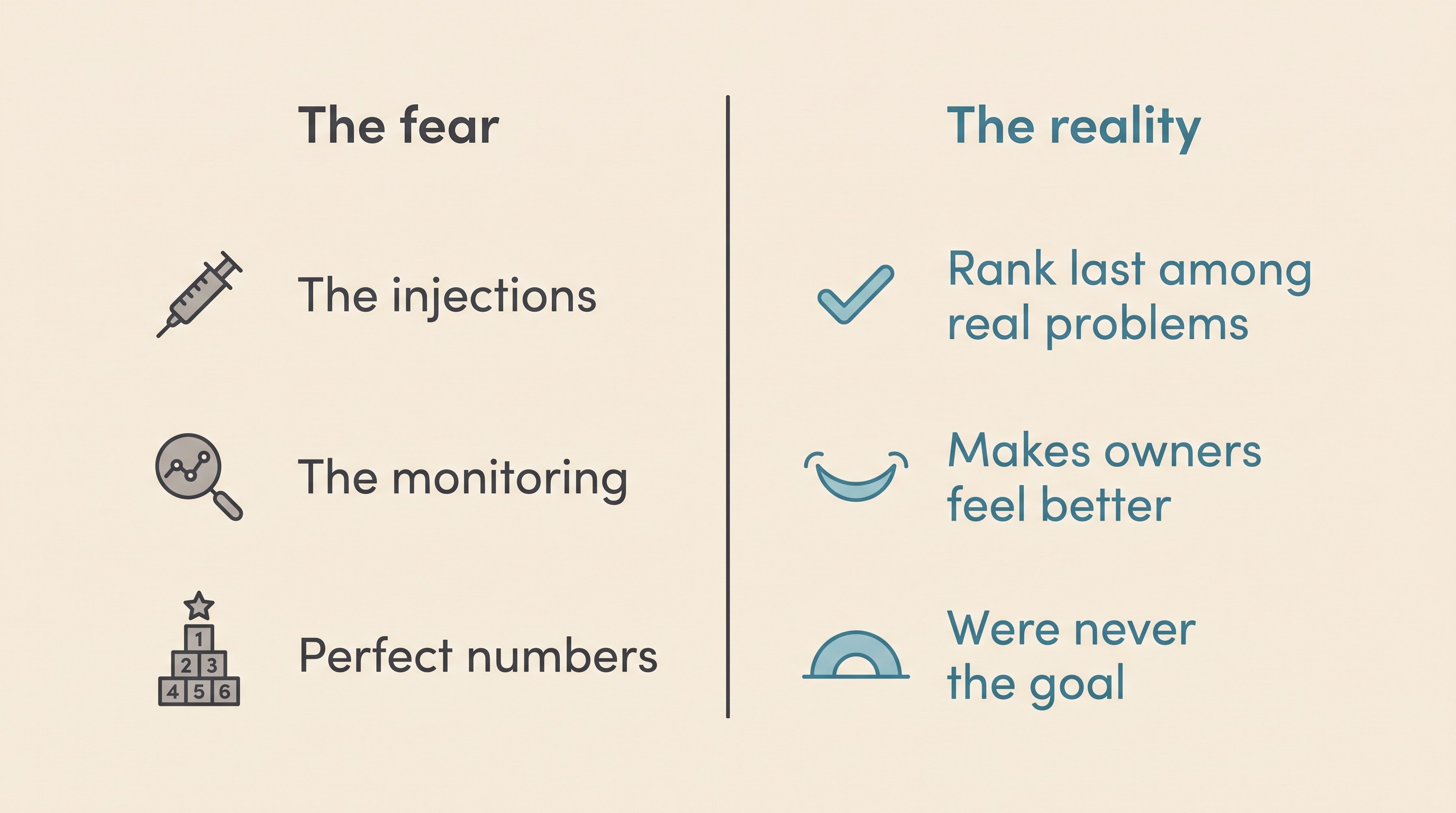
Here is the reassurance I wish every owner heard on day one. The goal of treating a diabetic pet is not a perfect blood-glucose number, it is a well, comfortable pet whose symptoms have settled and who isn't suffering dangerous lows. That isn't me being soft, it's the official definition of success: the guidelines define a controlled diabetic as one whose clinical signs are decreasing while hypoglycaemia is avoided, state that "clinical signs supersede all else," and say a specific glucose figure should not be the primary aim, so that when the signs are gone and the weight is steady the diabetes is likely well controlled (Behrend et al., 2018). Your pet drinking normally, eating well, holding weight and being themselves matters more than any meter reading, and you don't chase one stray number either: a single high, especially from a stressed cat at the vet's, proves very little, so we follow the trend. What good control looks like day to day sits in what good control really looks like. Perfection was never the assignment.
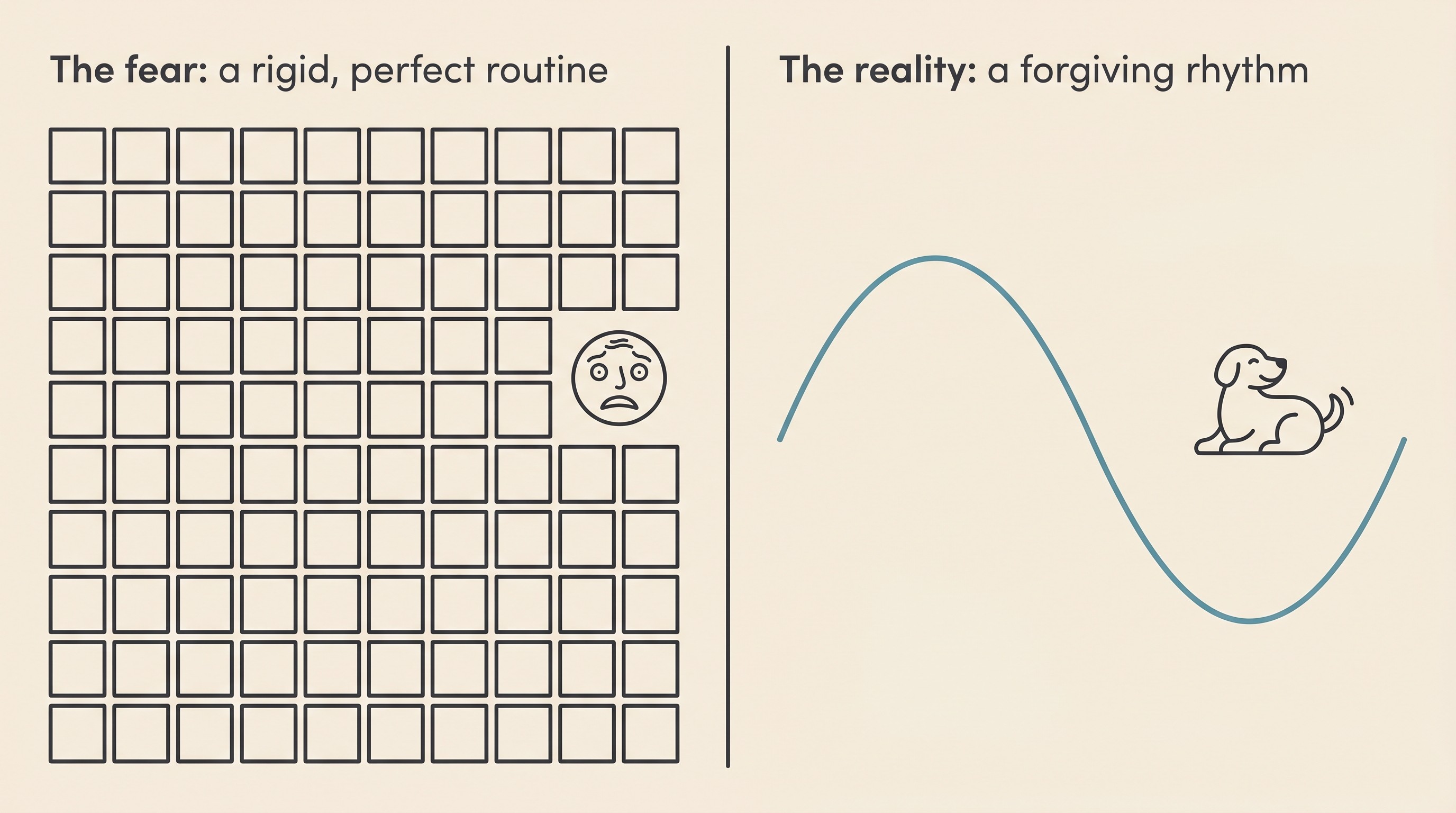
You're not the only one feeling overwhelmed
If you're feeling overwhelmed, that response is so common it has been measured. Among owners of diabetic dogs, 84% reported some negative impact on their own lives, and among owners of diabetic cats, 41% felt their cat's life would be at least "a little better" without the diabetes (Niessen et al., 2012; Niessen et al., 2010). So if part of you is grieving the easy life you had before, you are in the majority, not failing. Caring for a chronically ill pet carries a genuine emotional cost too: compared with matched owners of healthy pets, carers of chronically or terminally ill pets show measurably greater burden, stress, anxiety and low mood (Spitznagel et al., 2017). If the first weeks leave you tearful or exhausted, that is a normal response, not weakness.
But look at what actually weighs on owners, and it isn't the things people dread in advance. In the dog study the most negatively-impacting item was worry itself, with leaving the dog with others, boarding and cost close behind (Niessen et al., 2012); in cats the top burden was boarding difficulty, then leaving the cat with others, worry and cost (Niessen et al., 2010). The heaviest weights are anxiety and "who looks after them when I'm away," and those you can plan around: travel, boarding and sick-day rules is written precisely for the away-from-home worry. The dread, it turns out, mostly responds to information and a plan.
The injections are easier than you fear
Take the three fears in turn, starting with the one nearly everyone leads with: I couldn't possibly inject my own pet. You almost certainly could, and within a fortnight it will feel like a non-event. Vets estimate around 48% of owners are greatly concerned about injecting before they start (Niessen et al., 2017), so your apprehension is normal. And yet, when researchers asked vets what actually drives diabetic pets to be put to sleep, injection problems came dead last of all the factors, cited in just 17% of cases, far below concurrent illness and cost (Niessen et al., 2017). The thing feared most beforehand is one of the smallest real obstacles. The needles are tiny, the dose is a fraction of a millilitre, and pets barely register the injection alongside dinner. I won't teach the technique here, because your first insulin injection does that step by step, with the rules that matter, including the big one: if you're ever unsure a dose went in, skip it and wait for the next, you never give it twice. It's a skill, and it flattens out fast.
Monitoring tends to calm owners, not burden them
The second fear is the monitoring: pricking for blood, plotting numbers, watching like a hawk. It sounds like a second job, but the evidence surprises. When researchers offered home blood-glucose monitoring to owners of newly diagnosed diabetic cats, 74% took it up successfully, and of those, 89% found it straightforward or mostly so, ordinary owners, not nurses (Hazuchova et al., 2017). What matters most is what it did to how they felt: monitoring at home significantly improved owners' overall quality of life and significantly reduced their worry about the diabetes, about hypos, and even about cost, while owners who didn't monitor saw no such improvement (Hazuchova et al., 2017). It isn't effortless, and the same study is candid about that: roughly a third found it time-consuming and around a third felt their cat seemed uncomfortable (Hazuchova et al., 2017). But the headline is counter-intuitive and real: taking on the "extra" task of monitoring tends to make owners feel calmer, not more burdened. The information reassures; not knowing gnaws.
And monitoring is getting lighter all the time. Continuous glucose sensors, the small disc worn on the skin that reads glucose without any pricks, have cut the day-to-day load enormously, so you're not facing a lifetime of finger-pricks (continuous glucose monitors on pets explains how they work, and home monitoring covers the kit if you prick by hand). Whichever route you take, the Glucose Companion keeps it all in one place: it logs injections and readings, imports sensor data, flags a dangerous low and produces a tidy report for your vet.
What the commitment buys you
The commitment isn't a sentence to be served, though; it buys something worth having. In a large study of diabetic cats, 63% were still alive more than a year after diagnosis, and, more telling than survival alone, 97% of owners whose cats were still living rated their cat's quality of life as excellent or good, not pets merely surviving but having good lives (Rothlin-Zachrisson et al., 2023). The same study found that the initial concerns and sense of disruption "seem to decrease significantly with time" (Rothlin-Zachrisson et al., 2023). What you're staring up at is mostly the learning curve, and it flattens.
One species note, because the hope differs and a dog's diabetes and a cat's are really two different conditions: dogs need insulin for life, while many cats, caught early and managed well, can go into remission and come off it altogether. The full picture sits in the dog-versus-cat guide; I flag it here only to put the hope on the table from the start.
When it's genuinely hard, ask for help early
I won't pretend it's always manageable. For some owners, in some circumstances, it is genuinely too hard, and that is a recognised reality, not a personal failure. The same large survey of vets found that a median of roughly one in ten diabetic pets is put to sleep at diagnosis, with a further one in ten or so within the first year, often because control or compliance proved too difficult (Niessen et al., 2017). The factors driving those decisions are worth naming plainly: concurrent illness, cost, the animal's age, difficulty getting control, welfare, and the impact on the owner's own lifestyle (Niessen et al., 2017). The researchers say without flinching that diabetes and its treatment "might represent a significant temporal, financial and emotional burden" (Niessen et al., 2017). So if you're finding it hard, you are not imagining it.
But I tell you this for the opposite of fatalism. The hard cases are the argument for asking for help early, because almost everything on that list has a response if it's caught in time. Struggling because your shifts are erratic, you live alone, or there are other pets in the mix? Talk to your practice about who else can give a dose, boarding that handles diabetics, simplifying the regimen where it's safe. Frightened by the cost? The cost and insurance guide lays out where you can economise safely, and cost should never be the silent reason a treatable pet doesn't get a chance. Bring the difficulty to your vet sooner, while there are still levers to pull.
So, can you do this? Far more likely yes than you think tonight. The injections shrink to nothing, the monitoring tends to settle your nerves rather than fray them, the numbers were never meant to be perfect, and the worry, which is the real weight, eases as competence grows. A good next step is to set up the Glucose Companion and start logging from day one, because the owners who track tend to be the owners who worry less, and a calm, prepared owner with a plan is exactly the person a diabetic pet needs. You can be that person. Most people are.
References
- Behrend, E., Holford, A., Lathan, P., Rucinsky, R., & Schulman, R. (2018). 2018 AAHA Diabetes Management Guidelines for Dogs and Cats. Journal of the American Animal Hospital Association, 54(1), 1-21.
- Hazuchova, K., Gostelow, R., Scudder, C., Forcada, Y., Church, D. B., & Niessen, S. J. M. (2017). Acceptance of home blood glucose monitoring by owners of recently diagnosed diabetic cats and impact on quality of life changes in cat and owner. Journal of Feline Medicine and Surgery, 20(8), 711-720.
- MSD Animal Health. Caninsulin (porcine insulin zinc suspension) dosing guidance, UK.
- Niessen, S. J. M., Powney, S., Guitian, J., Niessen, A. P. M., Pion, P. D., Shaw, J. A. M., & Church, D. B. (2010). Evaluation of a Quality-of-Life Tool for Cats with Diabetes Mellitus. Journal of Veterinary Internal Medicine, 24(5), 1098-1105.
- Niessen, S. J. M., Powney, S., Guitian, J., Niessen, A. P. M., Pion, P. D., Shaw, J. A. M., & Church, D. B. (2012). Evaluation of a Quality-of-Life Tool for Dogs with Diabetes Mellitus. Journal of Veterinary Internal Medicine, 26(4), 953-961.
- Niessen, S. J. M., Hazuchova, K., Powney, S. L., Guitian, J., Niessen, A. P. M., Pion, P. D., Shaw, J. A. M., & Church, D. B. (2017). The Big Pet Diabetes Survey: Perceived Frequency and Triggers for Euthanasia. Veterinary Sciences, 4(2), 27.
- Rothlin-Zachrisson, N., Öhlund, M., Röcklinsberg, H., & Ström Holst, B. (2023). Survival, remission, and quality of life in diabetic cats. Journal of Veterinary Internal Medicine, 37(1), 58-69.
- Spitznagel, M. B., Jacobson, D. M., Cox, M. D., & Carlson, M. D. (2017). Caregiver burden in owners of a sick companion animal: a cross-sectional observational study. Veterinary Record, 181(12), 321.
Keep track of how your pet is doing
The owners who cope best are the ones who notice changes early. A simple health log shows you what is working, and what is not, before the next vet visit.
Start tracking, freeYou're not doing this alone
Compare treatment journeys and talk to owners managing diabetes mellitus. Free to join.
Join PetsLikeMine