

Home Blood Glucose Monitoring: Curves and Spot-Checks, Done Properly
Alastair Greenway
BVM&S MRCVS
The first time most owners hear the words "blood glucose curve", the real question follows fast: you want me to take my pet's blood, at home, with a needle, every couple of hours? It sounds like something that should happen in a hospital.
So let me say the reassuring thing first. You do not have to be a nurse to do this, and it is one of the kindest, most useful things you can do for a diabetic dog or cat. In two sister studies ten of twelve dog owners and twelve of fifteen cat owners produced usable curves at home over several months, and a separate survey found owners rated it "practical and simple" and, despite some early reluctance, kept it up (Casella et al., 2003; Casella et al., 2005; Van de Maele et al., 2005). One caveat: home monitoring is the goal of good diabetes care, but the profession calls it ideal rather than mandatory (Behrend et al., 2018). If you cannot face the blood, a reasonable diabetic life can still be built on the vet's tests, your observations and the occasional clinic check; home monitoring just makes the fine-tuning safer and quicker. This is the practical guide: the meter, the drop of blood, and what a spot-check and a curve actually are. What the curve then means is the next article's job.
What home testing buys you
The faff only feels worth it once you know what it buys you, so here is the payoff before the how-to.
The first reason is safety: a curve can reveal a low that is happening invisibly, before your pet ever wobbles or trembles, so the dose can be eased back before there is a crisis (Behrend et al., 2018; Taylor et al., 2025). Catching a quiet dip on a Tuesday afternoon beats discovering it because your pet collapsed. The second is that home numbers guide the dose properly: readings taken where your pet is relaxed and eating normally beat numbers snatched during a frightening morning at the clinic.
The third reason, the big one for cats especially, is stress. A frightened cat can drive its own glucose up purely on adrenaline and cortisol. This stress hyperglycaemia is a genuine trap: a stressed cat's clinic reading can read high when its diabetes is actually well controlled, tempting everyone into raising a dose the cat never needed (Sparkes et al., 2015; Taylor et al., 2025). It is not a small effect. When researchers compared clinic curves against home curves on the same animals, the readings differed enough that the treatment decision would have changed in 42% of dog pairs and 38% of cat pairs (Casella et al., 2003; Casella et al., 2005). That is why I would rather have a week of your home numbers than one stressed reading on my table. One thing I will not blur: dogs and cats are really two different diseases, and stress is mainly a cat story. The sites and meters below apply to both; the species targets differ, so I give those only as a sense of scale.
Buy a meter made for pets
The first piece of kit advice matters more than any other, and it surprises people: a standard human glucometer from the pharmacy reads a pet's blood too low. Glucose is split between the watery plasma and the red blood cells differently across species: in humans around 58% of it sits in the plasma, in dogs roughly 87.5%, in cats around 93% (Behrend et al., 2018). A human meter is calibrated for the human ratio, so on dog or cat blood it underestimates the true value. You cannot read its numbers against your vet's targets, and a low reading on one is even more alarming than it looks, because the real figure is probably lower still.
So use a meter calibrated for pets. The veterinary standard most owners use is the AlphaTrak family; the AlphaTrak 3 is built to meet the same accuracy standard set for human meters, and in a clinical study in cats it agreed very closely with laboratory glucose across a wide range of values (Domori et al., 2024). A human meter is not useless in a pinch, but a pet-calibrated one is not expensive in the scheme of a diabetic year.
Getting the drop
This is the part owners dread and then, almost always, stop dreading. You need one small hanging drop, and there are two good places to get it.
The classic site is the marginal ear vein, the rim of the ear. Warm it first between your fingers or with a warm pad, because warm tissue bleeds more willingly, and a smear of petroleum jelly stops the drop soaking into the fur. Then a quick, confident nick with a lancet along the rim.
The other site, and the one I increasingly steer people towards, is the paw pad. A study comparing the two in cats found the pad gave essentially the same glucose values as the ear, an average difference of about 0.05 mmol/L, which is nothing (Zeugswetter et al., 2010). Better still, it takes an ordinary lancet, it was better tolerated than the researchers expected, and it rests the ears if they have become sore. The inner flap of the ear, the lip margin and an elbow callus are other spots to rotate through (Behrend et al., 2018). Find the site your pet minds least, and stick with it.
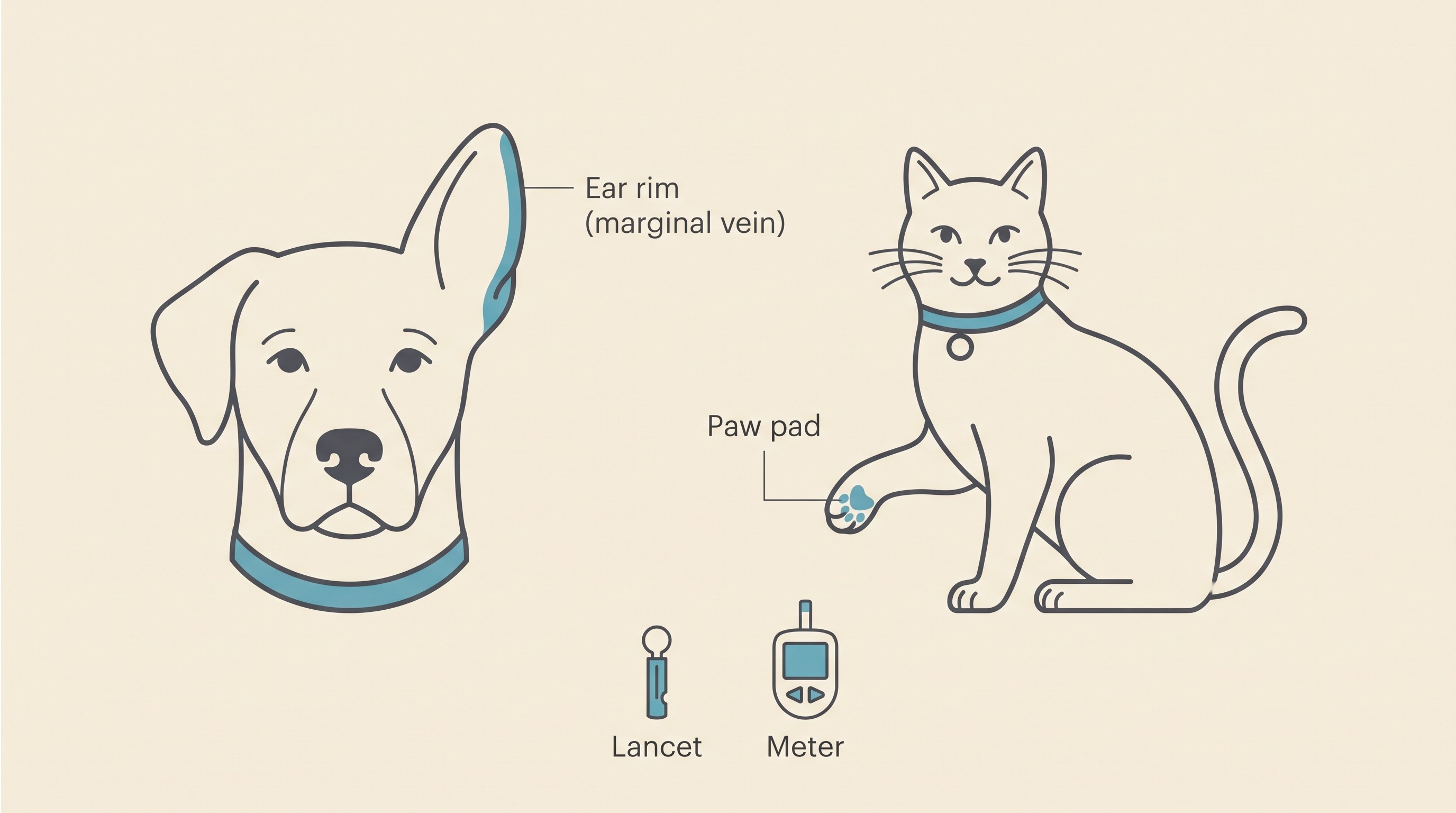
A few technique points make the difference between this working and you giving up. Prick decisively rather than timidly, because a half-hearted jab hurts more and bleeds less. Let the drop well up on its own, or coax it gently, rather than squeezing hard, because hard squeezing dilutes the blood with tissue fluid and can read falsely low. Touch the strip to the drop, then make it a non-event: food, fuss, praise, every single time. And be realistic with yourself about the start. In the feline study most owners struggled at first, mainly with coaxing enough suction from the lancing device and raising a usable drop, and in most cases that resolved over the study with practice (Casella et al., 2005; Zeugswetter et al., 2010). So if your first few attempts are fumbly and your cat looks unimpressed, that is not failure, that is the normal first week. It gets easy fast.
Spot-check versus curve
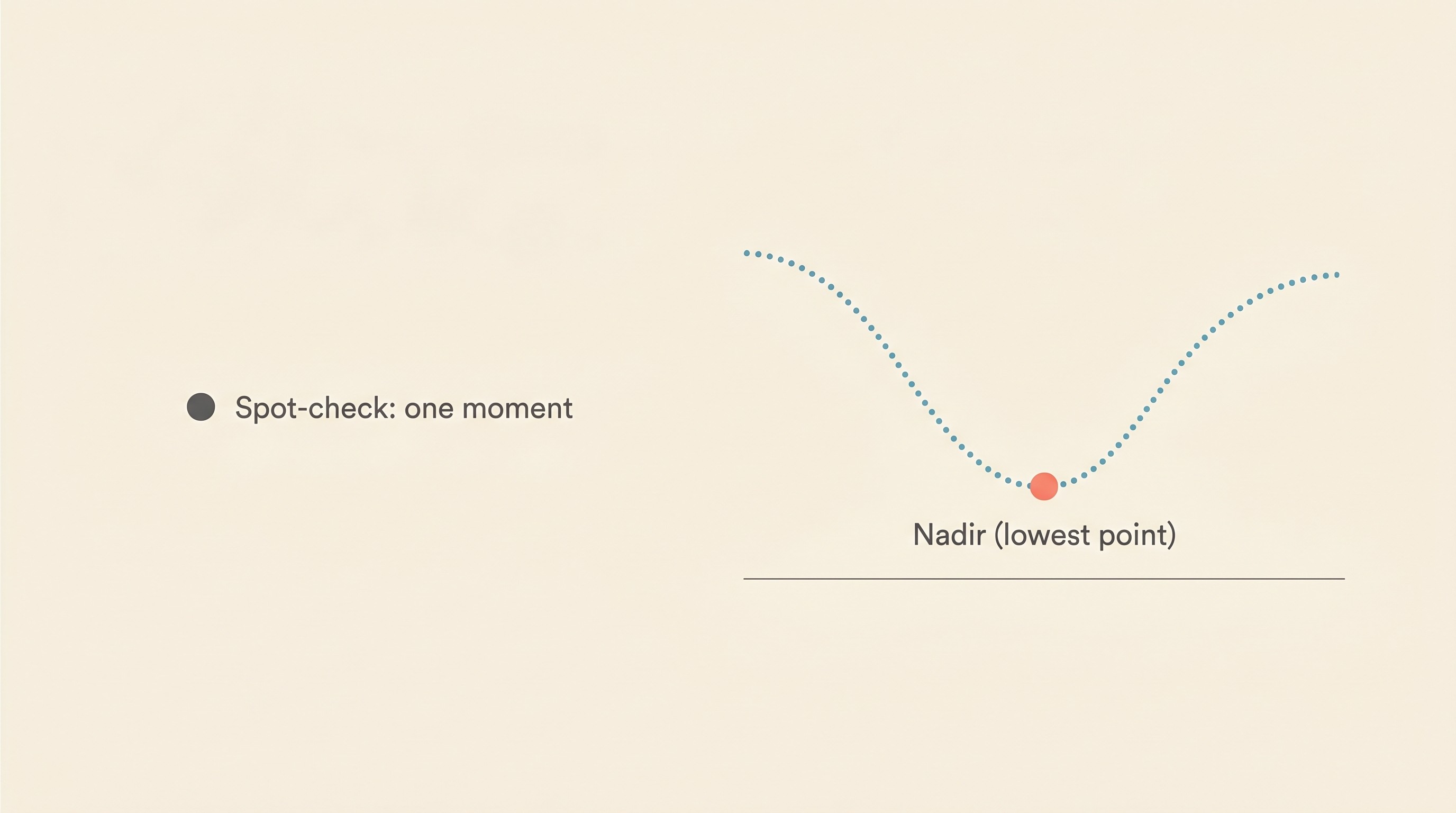
A spot-check is a single reading at a single moment. It tells you where your pet's glucose is right now, useful for two things: a quick sanity-check before an injection, and, above all, checking a pet you suspect might be going low. What it cannot tell you is how far the insulin pushes the glucose down, or for how long.
A curve is a series of readings across a whole dosing interval, usually the roughly twelve hours between injections. Stitched together, those dots draw a line that shows three things a single number cannot: the lowest point the glucose reaches, called the nadir, which is the moment of peak insulin effect; how long the insulin is working; and where the glucose has climbed back to just before the next dose (Behrend et al., 2018; Taylor et al., 2025). The nadir is the safety-critical one, because it is where a hidden low would show itself.
Running one is mostly about keeping the day normal. Feed the usual meal and give the usual insulin, and if your pet will not eat that morning, postpone rather than dose into an empty stomach (Behrend et al., 2018). Take the first reading before the morning food and insulin, as your baseline, then sample every couple of hours, dropping to hourly once the glucose falls below about 8.3 mmol/L (150 mg/dL) so you do not miss the true nadir (Behrend et al., 2018; Taylor et al., 2025). That marathon day is the traditional method, but the 2025 feline guidelines now also bless a gentler alternative: around ten readings at varied times over two or three ordinary days, which suits a cat who hates a long day of pricks (Taylor et al., 2025).
For a rough sense of scale, an acceptable low point in a dog sits around 4.4 to 8.3 mmol/L (80 to 150 mg/dL), and the current feline goal runs from a low point of roughly 4.5 to 5.5 mmol/L up to a peak near 14 to 19 mmol/L (Behrend et al., 2018; Taylor et al., 2025). Read those as your vet's targets, not numbers to dose against yourself. What they actually mean is the next article's job; this one gets you the dots, and reading a glucose curve teaches you to read them.
Two rules that keep your pet safe
Two rules sit above everything else here, and they keep your pet safe.
The first: do not change the insulin dose off your home numbers on your own. Bring the trend to your vet (Cornell Feline Health Center; Behrend et al., 2018). It is tempting once you have a run of readings, and it is genuinely dangerous, because dosing decisions are built on the full picture, the fructosamine, the clinical signs and the pattern over weeks (insulin dose titration covers that craft). React to trends and clinical signs, never to one number, which is a snapshot, not a verdict.
The second rule is the one exception, and it is why a spot-check earns its place. If a reading shows your pet is low, that you act on immediately. Hypoglycaemia is conventionally a glucose below about 3.3 mmol/L (60 mg/dL), though many pets show no signs until it falls further, to around 2.2 to 2.8 mmol/L (40 to 50 mg/dL) (Idowu & Heading, 2018). This is the one number you never wait on: if you see it, or your pet is wobbly, weak, dull, trembling or worse, rub glucose or honey or sugar onto the gums and contact your vet straight away. The full drill, and crucially why you never re-dose or double-dose insulin into a low, lives in the hypoglycaemia emergency guide, which every diabetic owner should read before they need it.
Making it stick
The thing that defeats home monitoring is almost never biology. It is burden. In the owner survey the barriers people named were fear of hurting their pet (around 56%), squeamishness about the blood (around 44%) and cost (around 44%), yet most pushed through and kept going (Van de Maele et al., 2005). The fear is normal, and it fades fast once your pet learns that a quick prick means a treat.
So start gently, and do not try to be intensive forever. Curves cluster early, around when a new insulin is started and roughly one to two weeks after any dose change, then space right out, with a check perhaps every one to three months once your pet is stable (Behrend et al., 2018; Taylor et al., 2025; Cornell Feline Health Center). After the first fortnight it becomes an occasional habit, running quietly alongside your vet's own longer-term blood test, fructosamine (its own article). And you do not have to do the maths: do the pricks, log each reading, and let the Glucose Companion plot the curve, mark the nadir, flag any low and turn it into a tidy report for your vet. The diabetic community has kept these numbers in spreadsheets for years; the tool just makes that automatic. A skin sensor is the other modern way to gather all this with no pricks at all, so if the lancing genuinely is not for you, continuous glucose monitors are the very next thing to read.
For now the homework is small. This week, one calm pre-dinner spot-check, on a pet-calibrated meter, with a treat straight after, logged in the Companion. Once that feels like nothing, the dots will start joining into a curve, and learning to read what it is telling you is exactly where you go next.
References
- Behrend E, Holford A, Lathan P, Rucinsky R, Schulman R. 2018 AAHA Diabetes Management Guidelines for Dogs and Cats. Journal of the American Animal Hospital Association. 2018;54(1):1-21.
- Casella M, Wess G, Hässig M, Reusch CE. Home monitoring of blood glucose concentration by owners of diabetic dogs. Journal of Small Animal Practice. 2003;44(7):298-305.
- Casella M, Hässig M, Reusch CE. Home-monitoring of blood glucose in cats with diabetes mellitus: evaluation over a 4-month period. Journal of Feline Medicine and Surgery. 2005;7(3):163-171.
- Cornell Feline Health Center. Feline Diabetes. Cornell University College of Veterinary Medicine.
- Domori A, et al. Concordance of blood glucose measurement in cats between a veterinary-calibrated point-of-care glucometer and a reference laboratory standard in a clinical setting. Journal of the American Veterinary Medical Association. 2024;262(4).
- Idowu O, Heading K. Hypoglycemia in dogs: causes, management, and diagnosis. The Canadian Veterinary Journal. 2018;59(6):642-649.
- Sparkes AH, Cannon M, Church D, Fleeman L, Harvey A, Hoenig M, Peterson ME, Reusch CE, Taylor S, Rosenberg D. ISFM Consensus Guidelines on the Practical Management of Diabetes Mellitus in Cats. Journal of Feline Medicine and Surgery. 2015;17(3):235-250.
- Taylor S, Cannon M, Church D, Fleeman L, Fracassi F, Gilor C, Mott J, Niessen S. iCatCare consensus guidelines on the diagnosis and management of diabetes mellitus in cats. Journal of Feline Medicine and Surgery. 2025;27(11).
- Van de Maele I, Rogier N, Daminet S. Retrospective study of owners' perception on home monitoring of blood glucose in diabetic dogs and cats. The Canadian Veterinary Journal. 2005;46(8):718-723.
- Zeugswetter FK, Rebuzzi L, Karlovits S. Alternative sampling site for blood glucose testing in cats: giving the ears a rest. Journal of Feline Medicine and Surgery. 2010;12(9):710-713.
Keep track of how your pet is doing
The owners who cope best are the ones who notice changes early. A simple health log shows you what is working, and what is not, before the next vet visit.
Start tracking, freeYou're not doing this alone
Compare treatment journeys and talk to owners managing diabetes mellitus. Free to join.
Join PetsLikeMine