

Continuous Glucose Monitors (FreeStyle Libre) on Pets: The Game-Changer
Alastair Greenway
BVM&S MRCVS
A few years ago, knowing what your diabetic pet's glucose did across a day meant grim choices: a row of finger or ear pricks at home, or a long, stressful day at the clinic having blood drawn every couple of hours. Then a small white disc designed for people with diabetes quietly changed everything. I now have owners walking into my consult room with a fortnight of glucose data on their phone, gathered without pricking their dog or cat once. Is the FreeStyle Libre really the leap forward the forums say? My answer is yes, mostly, and here is where it earns that word, and where it doesn't.
This is the page that owns the sensor story. The everyday ear-prick meter, the technique, the spot-check versus the curve, all of that lives in home blood glucose monitoring. Here the whole point is the contrast: no repeated pricks, a near-continuous picture instead of a handful of dots.
So what is it, really
A continuous glucose monitor, or flash glucose monitor, is a small sensor that sits on the skin and reads glucose for up to a fortnight. The most common one in pets is the Abbott FreeStyle Libre. It measures glucose not in the blood but in the interstitial fluid, the fluid in the tissue just under the skin, through a tiny flexible filament about 5 mm long, and it does this every fifteen minutes for up to fourteen days (Behrend et al., 2018). You or your vet scan it with a phone or reader and a graph appears. One review counted more than 1,400 readings a day from a single sensor (Linklater, 2020). Set that against the three or four pricks a devoted owner might manage at home: this is a near-continuous film of the glucose, not a few still photographs.
The first thing to be straight about, because the marketing won't tell you, is that the Libre is a human device used off-label in animals. No continuous glucose monitor has been approved for veterinary use (Linklater, 2020). It isn't calibrated for pets, although it does appear to be generally accurate in them (Behrend et al., 2018). Think of it as a brilliant tool borrowed from human medicine, used with a vet's blessing because it works, not an officially pet-approved product. That distinction matters when we get to its weak spots.
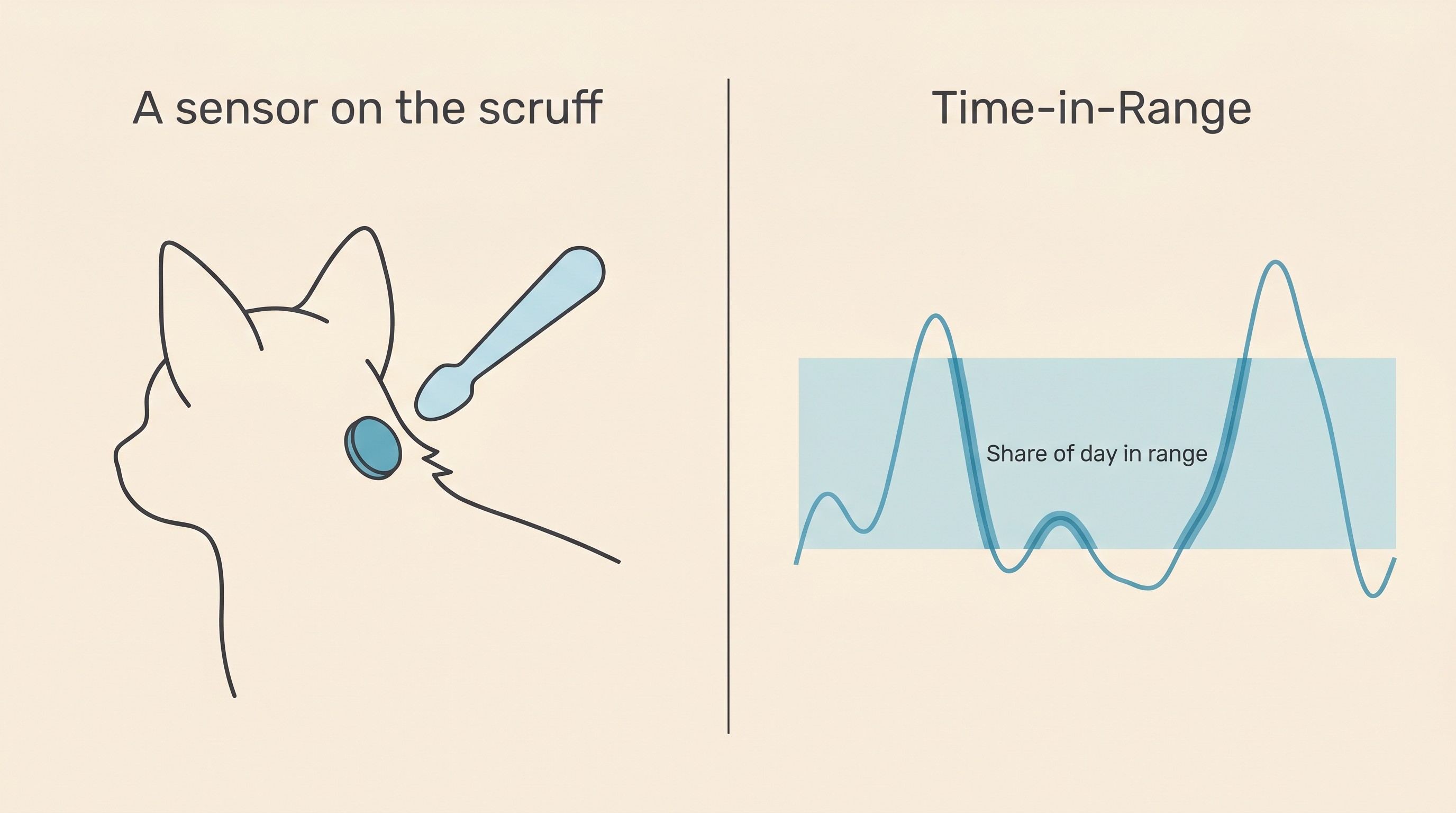
The sensor goes on a small clipped patch of skin, most often the back of the neck or scruff, with the lateral chest wall and the muscle over the lower back as good validated alternatives (Taylor et al., 2025; Corradini et al., 2016). Putting it on is quick and, by every account I trust, genuinely well tolerated. In the original canine study, application was described as apparently painless, easy and well tolerated by all the dogs (Corradini et al., 2016), and the AAHA guidance notes that even less agreeable patients usually take it in their stride (Behrend et al., 2018).
The case for it
In a study of twenty diabetic dogs, the flash monitor caught 60% of the low-glucose episodes, against just 9% caught by an owner using a normal blood glucose meter (Del Baldo et al., 2020). It also found the glucose nadir, the lowest point of the day, in 79% of profiles, where the traditional spot curve found it only 41% of the time (Del Baldo et al., 2020). That is the heart of the matter: a handful of spot checks sail straight over most of the dangerous dips, and a sensor reading every fifteen minutes catches them.
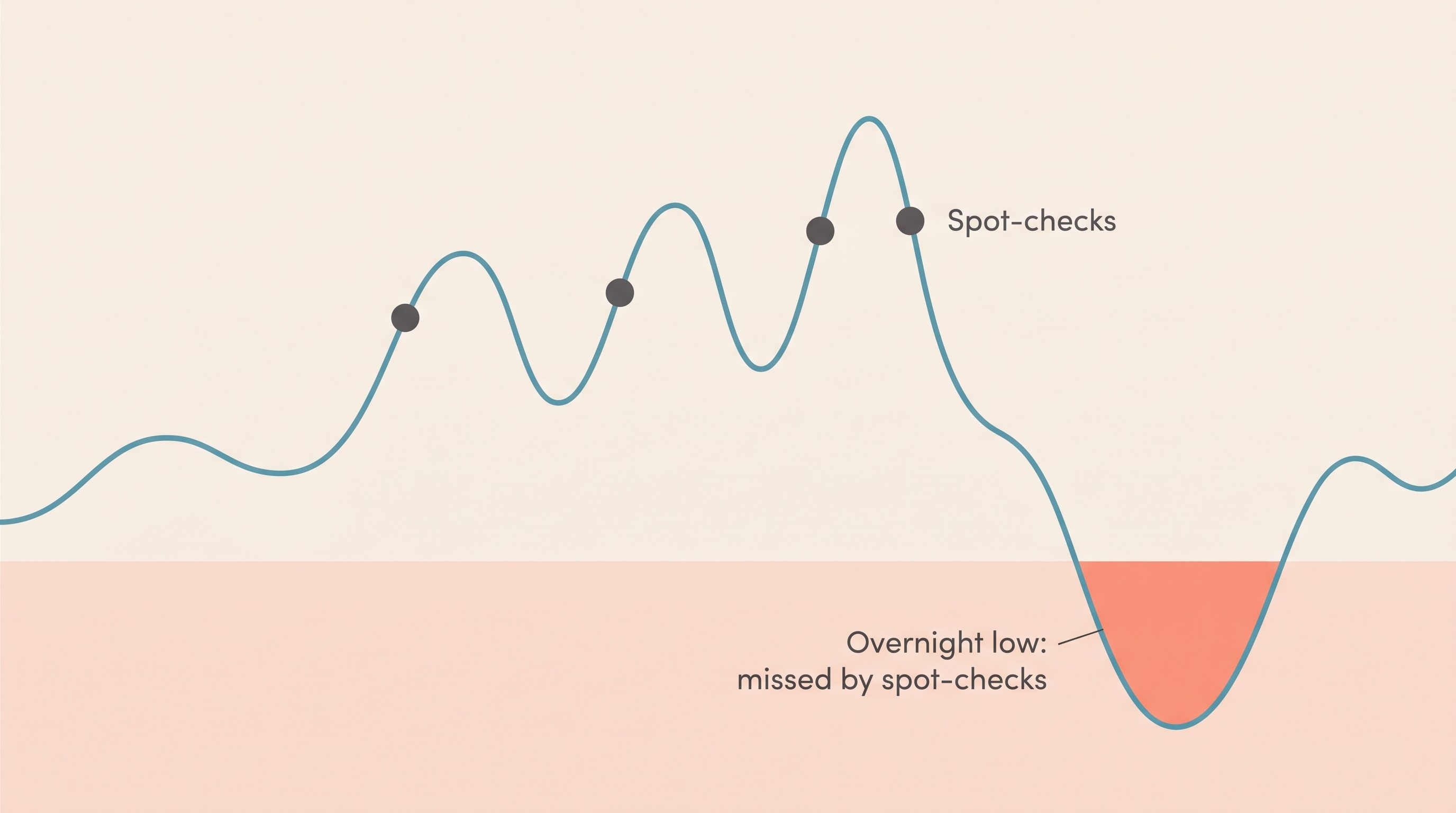
This is why I link the sensor so tightly to the hypoglycaemia emergency. A hypo, a glucose that drops too low, is the killer emergency in a diabetic pet, and the most frightening ones are the overnight dips nobody sees. Catching an unseen low while your pet sleeps, before it becomes a wobbly, collapsing crisis, is the difference this device makes. It's also how an overnight rebound, the dip that drives a deceptively high morning reading, gets caught; that puzzle lives in the Somogyi article.
For cats there's a second prize. A frightened cat at the vet can run a falsely high glucose, stress hyperglycaemia of any magnitude, so a clinic curve can genuinely mislead you (Taylor et al., 2025). A sensor worn at home, where the cat is relaxed on its own sofa, gives a far truer picture, and the feline consensus points to home monitoring and CGM as a way to tell true diabetes from stress (Taylor et al., 2025). The concept itself belongs to reading a glucose curve; here, just know it's a strong reason a cat in particular benefits from a sensor.
And then there's welfare, which I never undersell. No repeated needle pricks, no long stressful day in a clinic. The AAHA diabetes guidance makes the same point: sensors are easily placed and give considerably more useable information than a single clinic curve, and even a few days of sensor data is usually more helpful than one in-clinic curve (Behrend et al., 2018). Less suffering for the pet, less anguish for you, and better information.
Where it falls short
So here are the real limits, and you need all of them.
It often doesn't last the full fourteen days. This is the biggest practical caveat. In those twenty diabetic dogs, only 8 of 20 sensors lasted the full fortnight; 12 stopped early, some falling off, some failing with persistent error readings, and median wear was twelve days (Del Baldo et al., 2020). Cats are harder still: in one accuracy study median wear was just 5.5 days, some cats removing the sensor within a day or two (Del Baldo et al., 2021), and the feline consensus names a reduced sensor lifespan of 5.5 to 10 days as the commonest complication in cats, to be discussed with owners before you start (Taylor et al., 2025). Reviews put outright device failure at 10% to 25% of sensors (Linklater, 2020). So budget for the odd sensor that detaches or fails early; a few good days is still a win. The skin underneath is usually fine, with at most mild redness in some dogs when it comes off (Corradini et al., 2016).
It's least trustworthy exactly where it matters most, at the low end. This is a true safety point, so I'll state it plainly. Across the validation work the Libre tends to read a little low through most of the normal and mildly-low range, but in marked hypoglycaemia, the genuinely dangerous lows, it flips and reads falsely higher than the real blood value. With the FreeStyle Libre 2 in cats, researchers found it overestimates blood glucose in marked hypoglycaemia (below about 3.3 mmol/L, 60 mg/dL) and warned that it is imperative to treat sensor results in this critical range with caution (Berg et al., 2023). The newer Libre 3 behaves the same way, overestimating in marked hypoglycaemia below about 3.1 mmol/L (55 mg/dL) (Tardo et al., 2025). The feline consensus agrees accuracy is lower in the hypoglycaemic range (Taylor et al., 2025), and the original dog data is the same, with accuracy lowest at low glucose (Corradini et al., 2016).
In plain terms: a sensor sitting near the floor might be reading higher than the real blood glucose, so a number that looks merely "a bit low" could be worse than it appears. The rule I give every owner is simple: treat the pet, not the dot. If your pet looks hypo, wobbly, weak, dull, trembling, rub glucose or honey on the gums (never poured into a mouth that can't swallow) and ring your vet straight away, and confirm a worrying sensor low with a quick prick on a proper blood meter such as an AlphaTrak. Do not let an "okay-ish" sensor number talk you out of acting, and never re-dose insulin into a suspected hypo. The full rescue belongs to the hypoglycaemia article.
The number trails reality. Interstitial glucose lags behind blood glucose by minutes, because the glucose has to move from the blood into the tissue fluid before the sensor sees it. In dogs that lag is roughly 5 to 12 minutes (Linklater, 2020), and in a feline study the interstitial reading peaked about 30 minutes after a glucose load was given into the vein (Del Baldo et al., 2021). When glucose is moving fast, especially dropping fast, the sensor is behind. The shared rule of diabetic care, never chase one number, applies doubly to a sensor that is, by design, a few minutes out of date: treat the trend and the pet, not a single instantaneous reading.
The very first readings can be less reliable. A freshly fitted sensor needs a little while to settle; in human use it's ready in as little as 60 minutes (Linklater, 2020). Treat the first readings with extra scepticism and lean on how your pet looks, not the early figures.
Getting it on, and making sense of it
Fitting is genuinely straightforward, and most owners learn it in a single appointment. A patch of fur is clipped, the sensor applied with its little applicator, and many people add a light protective cover or a soft body suit to help it survive a fortnight of normal dog or cat life. Placement on the scruff, the side of the chest or the muscle over the lower back all work (Taylor et al., 2025; Corradini et al., 2016), and your vet will steer you to the spot that suits your pet and how active they are.
Reading it is where modern monitoring has really moved on. The old way was to stare at one twelve-hour curve and hunt for the single lowest point. The modern way is Time-in-Range: the share of the day your pet's glucose spends inside a sensible band. In a study of 85 diabetic dogs, Time-in-Range was the time spent between 3.9 and 13.9 mmol/L (70 to 250 mg/dL), and the dogs with the best clinical control spent more of the day in that band, a median of 49.5% versus 35.0% for the rest (Del Baldo et al., 2025). More good hours, fewer dangerous lows. Crucially, more time in range tracked with better real-world control on a validated clinical score (Del Baldo et al., 2025), which is the whole reason it's worth measuring.
Two caveats. First, "in range" looks modest, not textbook-perfect. The feline consensus describes a sensible daily glucose swing as running from around 4.5 to 5.5 mmol/L (80 to 100 mg/dL) at its lowest to 14 to 19 mmol/L (250 to 350 mg/dL) at its peak (Taylor et al., 2025). A diabetic pet's good day is not a flat normal line, and formal feline Time-in-Range targets aren't standardised yet; what "good control" really means is its own conversation in what good control looks like. Second, the deep skill of reading curve shapes, the nadir, the duration, the stress spike, lives in reading a glucose curve. This page just gets you to Time-in-Range and points you on.
The one thing I'll say twice, because it's where owners come unstuck: a sensor produces a flood of numbers, and the temptation to start tweaking the insulin yourself is the real danger. Don't. Bring the trend to your vet. Dose changes are vet-led and gradual, and the how and why is the titration article. A sensor makes you a wonderfully well-informed partner in your pet's care. It does not make you the one who changes the dose. Nor does it replace the periodic vet recheck and fructosamine; the two work together, which is the job of fructosamine and rechecks.
A home for the numbers
One last, practical thing. The Libre's own app is built for a person on human glucose targets. A diabetic dog or cat needs those readings plotted alongside the insulin log, with the nadir marked, the lows flagged, and a report you can hand your vet. The Glucose Companion exists to close that gap: you import your sensor data into a place that speaks pet and insulin, not a human app on human numbers. It plots the trend, flags the dips, logs each dose against the glucose, and produces a vet report that turns a fortnight of data into a five-minute conversation.
Because that is the point of the whole device. Not a wall of numbers to fret over at midnight, but a clear, true picture of how your pet's days are really going, the unseen lows caught and the trend visible, ready for the person who'll help you make the next decision. Borrowed off-label from human medicine, occasionally falling off early, a touch unreliable right at the dangerous floor, and still, for most diabetic pets I look after, the single biggest leap forward in monitoring I've seen in my career.
References
- Behrend, E., Holford, A., Lathan, P., Rucinsky, R., & Schulman, R. (2018). 2018 AAHA Diabetes Management Guidelines for Dogs and Cats. Journal of the American Animal Hospital Association, 54(1), 1-21.
- Berg, A. S., Crews, C. D., Adin, C., et al. (2023). Assessment of the FreeStyle Libre 2 interstitial glucose monitor in hypo- and euglycemic cats. Journal of Veterinary Internal Medicine, 37(5), 1703-1709.
- Corradini, S., Pilosio, B., Dondi, F., et al. (2016). Accuracy of a flash glucose monitoring system in diabetic dogs. Journal of Veterinary Internal Medicine, 30(4), 983-988.
- Del Baldo, F., Canton, C., Testardi, S., et al. (2020). Comparison between a flash glucose monitoring system and a portable blood glucose meter for monitoring dogs with diabetes mellitus. Journal of Veterinary Internal Medicine, 34(6), 2296-2305.
- Del Baldo, F., Fracassi, F., Pires, J., et al. (2021). Accuracy of a flash glucose monitoring system in cats and determination of the time lag between blood glucose and interstitial glucose concentrations. Journal of Veterinary Internal Medicine, 35(3), 1279-1287.
- Del Baldo, F., Tardo, A. M., Gilor, C., et al. (2025). Freestyle Libre-derived metrics in assessing glycemic control in diabetic dogs. Journal of Veterinary Internal Medicine, 39(4), e70151.
- Linklater, A. (2020). Continuous glucose monitoring in veterinary patients. Today's Veterinary Practice.
- Tardo, A. M., Crews, C., Mott, J., Porter, L. T., Adin, C., & Gilor, C. (2025). Accuracy of the Freestyle Libre 3 continuous glucose monitoring system in hypo- and euglycemic cats. Journal of Veterinary Internal Medicine, 39(2), e70048.
- Taylor, S., Cannon, M., Church, D., Fleeman, L., Fracassi, F., Gilor, C., Mott, J., & Niessen, S. (2025). iCatCare 2025 consensus guidelines on the diagnosis and management of diabetes mellitus in cats. Journal of Feline Medicine and Surgery, 27(11), 1098612X251399103.
Keep track of how your pet is doing
The owners who cope best are the ones who notice changes early. A simple health log shows you what is working, and what is not, before the next vet visit.
Start tracking, freeYou're not doing this alone
Compare treatment journeys and talk to owners managing diabetes mellitus. Free to join.
Join PetsLikeMine