

The Lifetime Cost of a Diabetic Pet, and How Insurance Really Works
Alastair Greenway
BVM&S MRCVS
There's a moment, usually a day or two after the diagnosis, when the worry turns from your pet to your bank account. The leaflet says "diabetes is manageable," the forum says "it cost me a fortune," and nobody has given you the actual numbers. So let me lay them out plainly, because in twenty years I've found almost no one does: what a diabetic pet really costs to run in the UK, where the money goes, where you can safely save it, and how insurance behaves, including the one trap that catches owners out again and again. I'm a vet, not a salesman, so none of this is a pitch. The wider "can I cope with my life around this?" question lives in the commitment guide, and the heaviest "is treating even fair?" reckoning sits in the real prognosis. This page is about money.
One caveat first, said once so the rest can stand clean. Every pound figure here is a practical UK estimate, accurate at the time of writing in mid-2026, and it varies by your pet's size, the insulin and dose they end up on, whether you home-monitor, and where you live. These are real, sourced prices, not a quote: the shape of the thing, not the invoice.
Start with what a pet already costs
The day-to-day pet was never free. Before a single drop of insulin, the PDSA's 2024 figures put the minimum lifetime cost of a dog at "at least £6,200" for a small breed, rising to "£18,800" for a large one, and a cat at "at least £11,400 to £13,600", excluding "any vet fees (should they become ill or injured)" (PDSA, 2024). So the scary "lifetime cost of a diabetic pet" is mostly just the lifetime cost of a pet, with a manageable extra on top, not a separate financial universe.
The cost has a shape, and it works in your favour
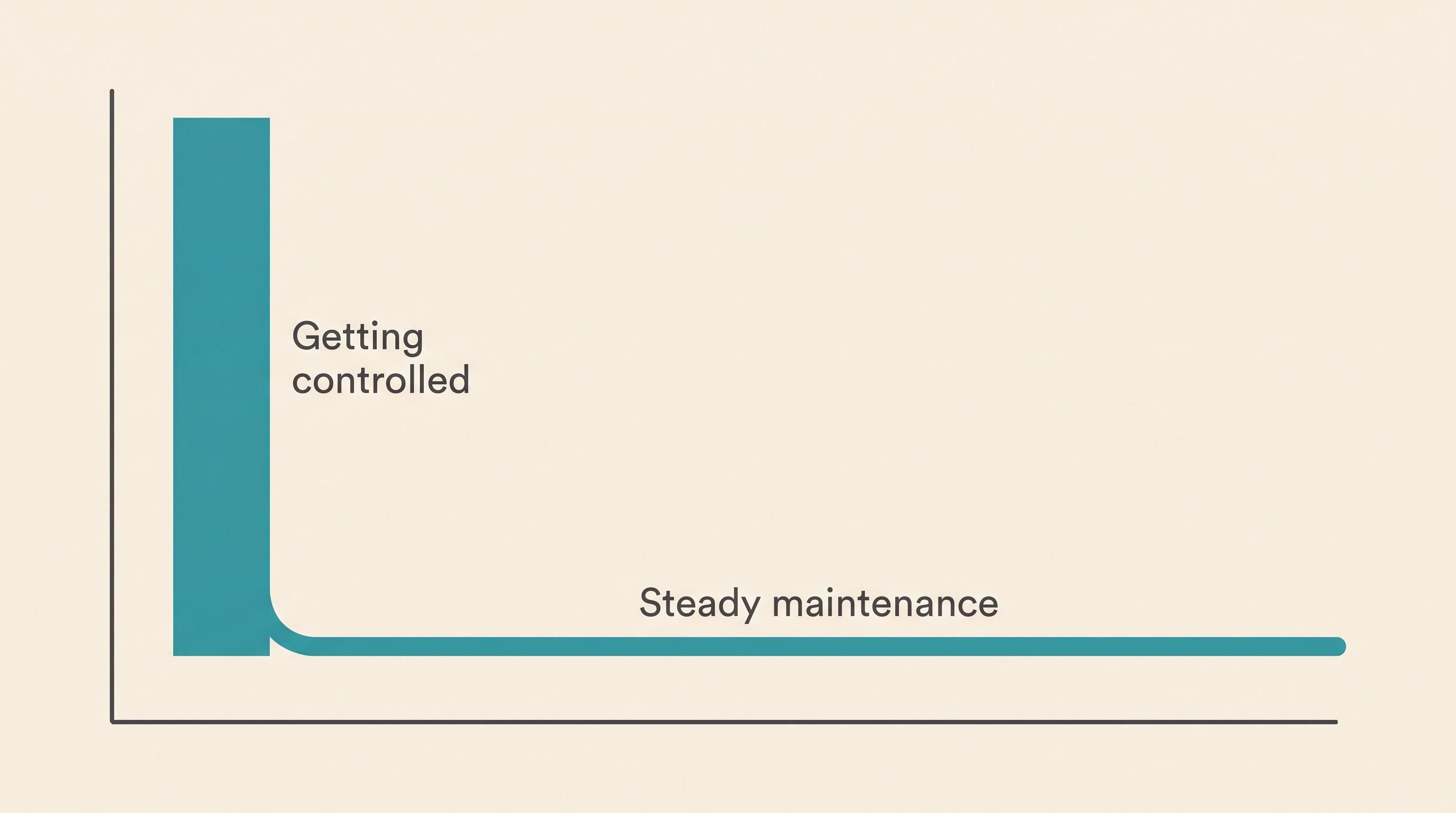
If there's one thing worth telling a newly-diagnosed owner about money, it's this: diabetes is most expensive at the start, then it settles. There's a higher, front-loaded "getting controlled" phase, the diagnosis, sometimes a stabilisation or hospital stay, the first glucose curves, the dose changes and frequent rechecks, then a lower, steady "maintenance" phase once your pet is stable (Vet Help Direct, 2022). This isn't guesswork; it falls straight out of how the disease is monitored, with the professional guidelines calling for frequent rechecks early while the dose is found, then spacing them out once control is good (Behrend et al., 2018). If you're staring at the early bills in a panic, hold onto that: this is the peak, not the plateau.
Monthly running costs, line by line
Once you're past stabilisation, here's where the money goes. Ranges with the drivers, never a single number, because a single number would be a lie for somebody.
Insulin is the core. A 10ml vial of Caninsulin (the UK porcine lente insulin, sold as Vetsulin in the US) is around £34.49 from a registered online pharmacy against roughly £61 at a typical vet price; ProZinc, the protamine zinc insulin used mainly in cats, is around £68 online (Pet Drugs Online, 2026). How long a vial lasts depends entirely on dose and species: a small cat on a low dose may make one last most of its usable life, while a big dog on a high dose can go through one in a fortnight (and a slow-burning vial isn't wasted, since Caninsulin's in-use shelf life is 42 days once broached and out of the light; MSD Animal Health, 2026). All told, insulin alone runs from roughly £20 to £80 or more a month (Vet Help Direct, 2022). A Chihuahua and a Rottweiler are not on the same budget.
Syringes are a small steady line, roughly £10 to £20 a month, since a box of 100 lasts around two months at twice-daily dosing (Vet Help Direct, 2022). One note that costs nothing to get right: Caninsulin and ProZinc are U-40 insulins and need U-40 syringes (or the matching pen), and why that match matters belongs to the storing-and-handling guide.
Monitoring kit is mostly up-front. A pet-calibrated meter such as the AlphaTrak is a starter pack of around £90 to £120, then strips ongoing (Vet Help Direct, 2022). A continuous glucose sensor, the off-label FreeStyle Libre many owners now use, is around £50 each and lasts a couple of weeks, so worn continuously it runs £100 or more a month (FreeStyle Libre UK pharmacies, 2026); but almost nobody does that, most popping one on around a dose change instead. How to use any of it is owned by home blood glucose monitoring and the Glucose Companion.
A prescription diet, where used, especially low-carbohydrate food for cats, adds roughly £20 to £50 a month (Vet Help Direct, 2022), and whether your pet needs one is a question for the diet guide. Vet rechecks, including fructosamine bloods, are the last line, and the budgeting point is the cost shape above: frequent early, then falling away once stable. The mechanics sit with fructosamine and rechecks.
Add it up, and a realistic all-in figure once stable lands around £50 to £200 a month, perhaps £600 to £2,400 a year on top of baseline ownership (Vet Help Direct, 2022): the top of that range is a big dog on a high dose with a prescription diet and frequent sensors, the bottom a small, stable cat home-monitored intermittently. Species shifts the bill one way worth knowing, because cats can sometimes go into remission and come off insulin, so a well-managed cat may eventually cost less than a dog, who stays insulin-dependent for life. Why those are two different diseases is its own article.
What actually breaks a budget
The day-to-day insulin is the predictable, manageable cost. What actually breaks budgets is the occasional crisis: a bout of diabetic ketoacidosis needing hospitalisation, or cataract surgery in a dog who's gone blind. Even at the routine end, one UK insurer reported an average diabetes claim of £1,096 in 2020 (Animal Friends, reported via Vet Help Direct, 2022), and that's before anything goes seriously wrong. I name DKA and diabetic cataracts only as the lumpy costs that justify insurance; the clinical detail lives there. The point is the asymmetry: the monthly cost you can plan for, the crisis you cannot, and flattening that is exactly what insurance is for.
How pet insurance actually works (and the trap)
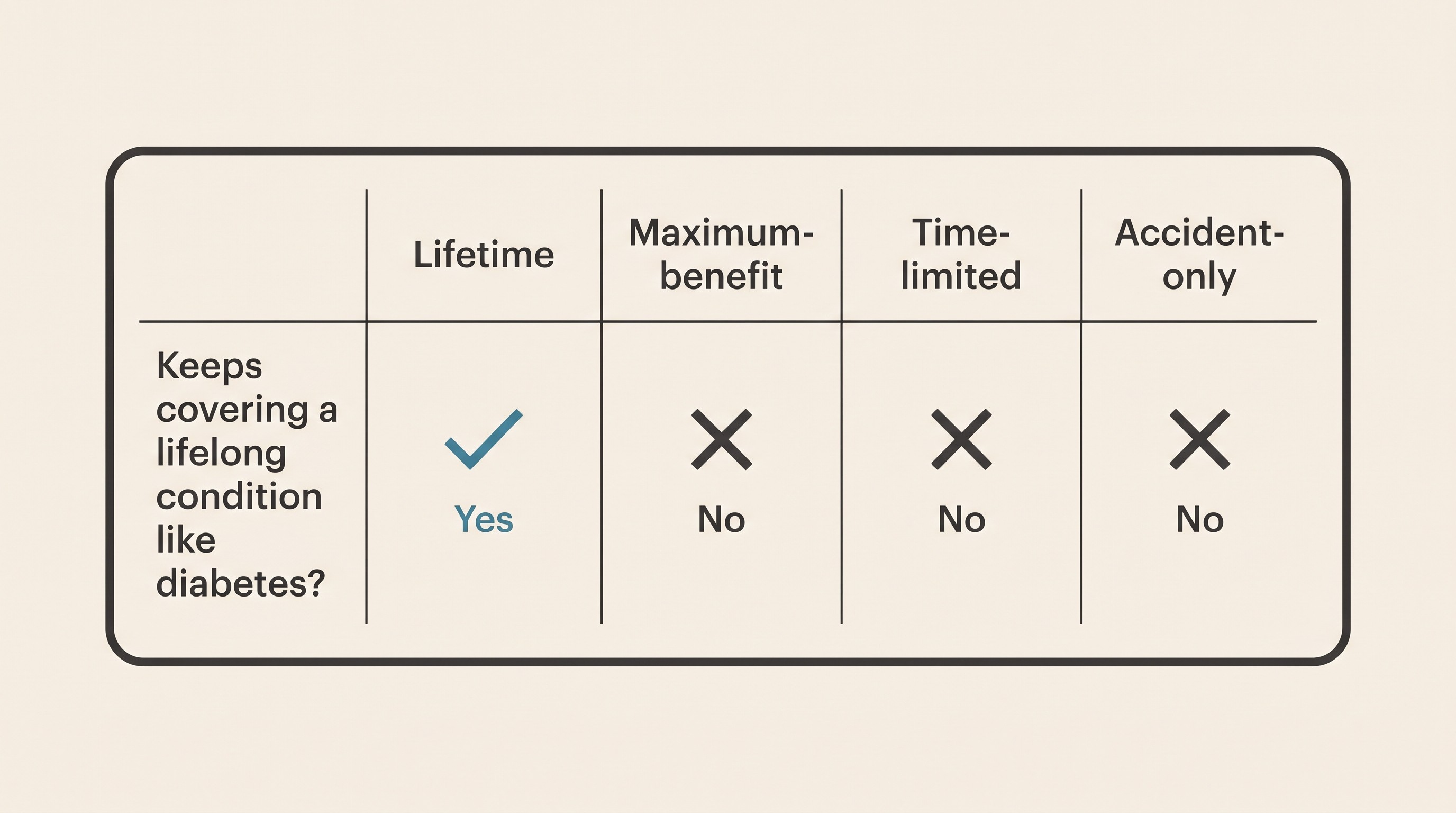
There are four kinds of UK pet insurance, and for a lifelong condition like diabetes only one really does the job.
With a lifetime policy, the Association of British Insurers explains that "each time you renew your policy the full amount of cover becomes available again under each section of cover," so "a long-term or recurring illness or injury that has needed treatment in one year will be covered again by the policy the next year" (ABI, 2025). That is exactly what a diabetic pet needs: diabetes is for life, so the cover has to renew for life.
The other three run out or time out. With maximum-benefit cover, "once the full amount of benefit has been spent, the treatment of that particular illness or injury will not be covered again" (ABI, 2025), so a lifelong condition eats the per-condition cap and then you pay out of pocket forever. With time-limited cover, policies "typically cover the cost of treating your pet for a particular illness or injury for 12 months from the start of that illness or injury," after which a further episode of that same illness is no longer covered (ABI, 2025). And accident-only cover pays "a fixed sum for each accidental injury" and doesn't cover illness at all (ABI, 2025). For a chronic illness, lifetime is the only structure that keeps paying.
Now the trap, and it's the headline. Across every policy type, the ABI is blunt: "any illness or injury your pet had before the policy started will not be covered" (ABI, 2025). Once your pet is a diagnosed diabetic, no standard new policy will cover their diabetes, or usually anything linked to it. This is why a lifetime policy taken out while a pet is young and well is worth so much, and why the time to think about insurance is before you ever need it.
The same fact has a hard corollary: if your pet develops diabetes while already on a lifetime policy, don't shop around and switch, because a new insurer would treat the diabetes as pre-existing and exclude the very thing you now need cover for. Keep the policy you have, even as the premium climbs with age and after the diagnosis goes on record. That rise is expected, not a betrayal; against an open-ended out-of-pocket bill, the lifetime policy still wins for most owners. And in case it helps to know you're not being paranoid: in 2024 UK insurers paid out a record £1.23 billion across 1.8 million pet-insurance claims, average claim £685 (ABI, 2025, claims data). Serious, costly pet illness is common, so "should I insure?" is a real question.
Saving money without cutting corners
You can cut the running cost without cutting corners, and the biggest safe saving is the most overlooked: you don't have to buy your pet's medication from your vet. The RCVS confirms you may "buy this medicine directly from the practice, or request a written prescription and buy it elsewhere," and that while a vet "is entitled to charge a reasonable fee for writing a prescription," buying elsewhere "could still save you money" (RCVS). That fee is modest, averaging £21.29 across around 1,600 UK practices (Vet Help Direct, 2024), and online pharmacies undercut clinics because they carry lower overheads and buy in bulk (Vet Help Direct, 2024). On Caninsulin that's £34.49 against roughly £61 a vial (Pet Drugs Online, 2026); on a medicine you'll buy for life, a gap like that comfortably adds up to a three-figure saving over a year.
One safety rule comes with this, and it isn't optional: only ever buy from a Veterinary Medicines Directorate Accredited Internet Retailer. The RCVS says to "always use a regulated, authorised retailer" accredited under that VMD scheme, because they "have met strict standards for storing, handling, and dispensing medicines safely" (RCVS). Insulin is temperature-sensitive, and a seller shipping it warm is a false economy that can quietly wreck your pet's control. Check the VMD accreditation every time.
The trap on the other side is the cheap human glucometer: a human meter reads pet blood low, so a pet-calibrated meter or a CGM is the right tool (the detail is owned by home monitoring). Save on the pharmacy, not on the accuracy of the number you're dosing against. And home monitoring, though an up-front cost, lowers lifetime cost by sparing the stressful, billable in-clinic glucose curves and catching problems sooner; it "can save costs in the long run after you have made the initial purchase" (Vet Help Direct, 2022). The Glucose Companion is there to make that path doable.
When money is genuinely the barrier
If, having done all this, the money still isn't there, please don't assume it's hopeless. There is real charitable help in the UK, with the caveat that it's means-tested and area-dependent, not universal. The PDSA, the largest provider of free and low-cost vet care, requires you to live in the catchment of one of their Pet Hospitals or Clinics and to receive a qualifying means-tested benefit (Universal Credit, Pension Credit, PIP and similar); eligible owners can register one pet free, with no limit on the number registered for the reduced-cost service (PDSA eligibility, 2026). Others signpost further help, the RSPCA pointing owners towards schemes like the PDSA and Dogs Trust (the latter for people in housing crises or homelessness), with the plain rider that "in most cases, you'll need to fit specific criteria to use them so check first" (RSPCA financial help). Its first piece of advice is the one I'd echo too: "speak honestly with your vet about what you can afford as there may be alternative options" (RSPCA financial help).
All of this matters more than it seems, because cost is one of the leading reasons diabetic pets are put to sleep before they need to be. In the Big Pet Diabetes Survey of 1,192 vets, "costs" was the second most cited trigger for euthanasia at 44%, just behind concurrent disease, and the survey found a median of one in ten diabetic pets euthanised at diagnosis, with a further one in ten within the year (Niessen et al., 2017). The authors' own answer to that sobering number is better information, "with emphasis on offering a choice of treatment styles ranging from intense and expensive to hands-off and cheap" (Niessen et al., 2017). Cheaper insulins bought safely online, a written prescription, less-intensive monitoring, charitable help: explore those before you ever conclude you can't afford this. The heaviest version of that decision, where affordability truly meets the end of the road, is held with care in the quality-of-life guide. But the thing to leave with is simpler: money has more options than the first week's panic suggests, so call your vet and ask about a cheaper way through before you let a rough estimate make the decision for you.
References
- Association of British Insurers. Types of pet insurance policy (consumer guide). 2025.
- Association of British Insurers. Insurance payouts for 'pawly' pets top £1 billion for third year in a row (press release reporting 2024 data). 2025.
- Behrend E, Holford A, Lathan P, Rucinsky R, Schulman R. 2018 AAHA Diabetes Management Guidelines for Dogs and Cats. Journal of the American Animal Hospital Association. 2018;54(1):1-21.
- FreeStyle Libre UK pharmacies (Cured Pharmacy, Hive Pharmacy and others). FreeStyle Libre 2 / 2 Plus sensor pricing. 2026.
- MSD Animal Health UK. Caninsulin frequently asked questions (storage and in-use shelf life). 2026.
- Niessen SJM, Hazuchova K, Powney SL, Guitian J, Niessen APM, Pion PD, Shaw JAM, Church DB. The Big Pet Diabetes Survey: perceived frequency and triggers for euthanasia. Veterinary Sciences. 2017;4(2):27.
- PDSA. The cost of owning a dog; The cost of owning a cat (cost guides). 2024.
- PDSA. Eligibility FAQs for free and reduced-cost treatment. 2026.
- Pet Drugs Online (VMD-accredited UK pharmacy). Caninsulin and ProZinc product and price pages. 2026. and https://www.petdrugsonline.co.uk/prozinc-insulin-for-cats-and-dogs
- Royal College of Veterinary Surgeons. Prescription medication (animal-owner guidance).
- RSPCA. Veterinary financial assistance in your local area.
- Vet Help Direct. How much does it cost to treat diabetes in a cat? 2022.
- Vet Help Direct. How much does it cost to get a written prescription from a vet in the UK? 2024.
Keep track of how your pet is doing
The owners who cope best are the ones who notice changes early. A simple health log shows you what is working, and what is not, before the next vet visit.
Start tracking, freeYou're not doing this alone
Compare treatment journeys and talk to owners managing diabetes mellitus. Free to join.
Join PetsLikeMine