


"Is This a Death Sentence?" The Honest Prognosis for a Diabetic Pet
Alastair Greenway
BVM&S MRCVS
It's the question really underneath all the others, even when no one says it out loud. An owner takes in the word diabetes, asks sensible things about insulin and diet, and behind their eyes is the thought they're too frightened to voice: is this it? Am I about to lose her? It's a fair thing to wonder, and I won't pretend the fear is irrational. But the truth is so much kinder than it.
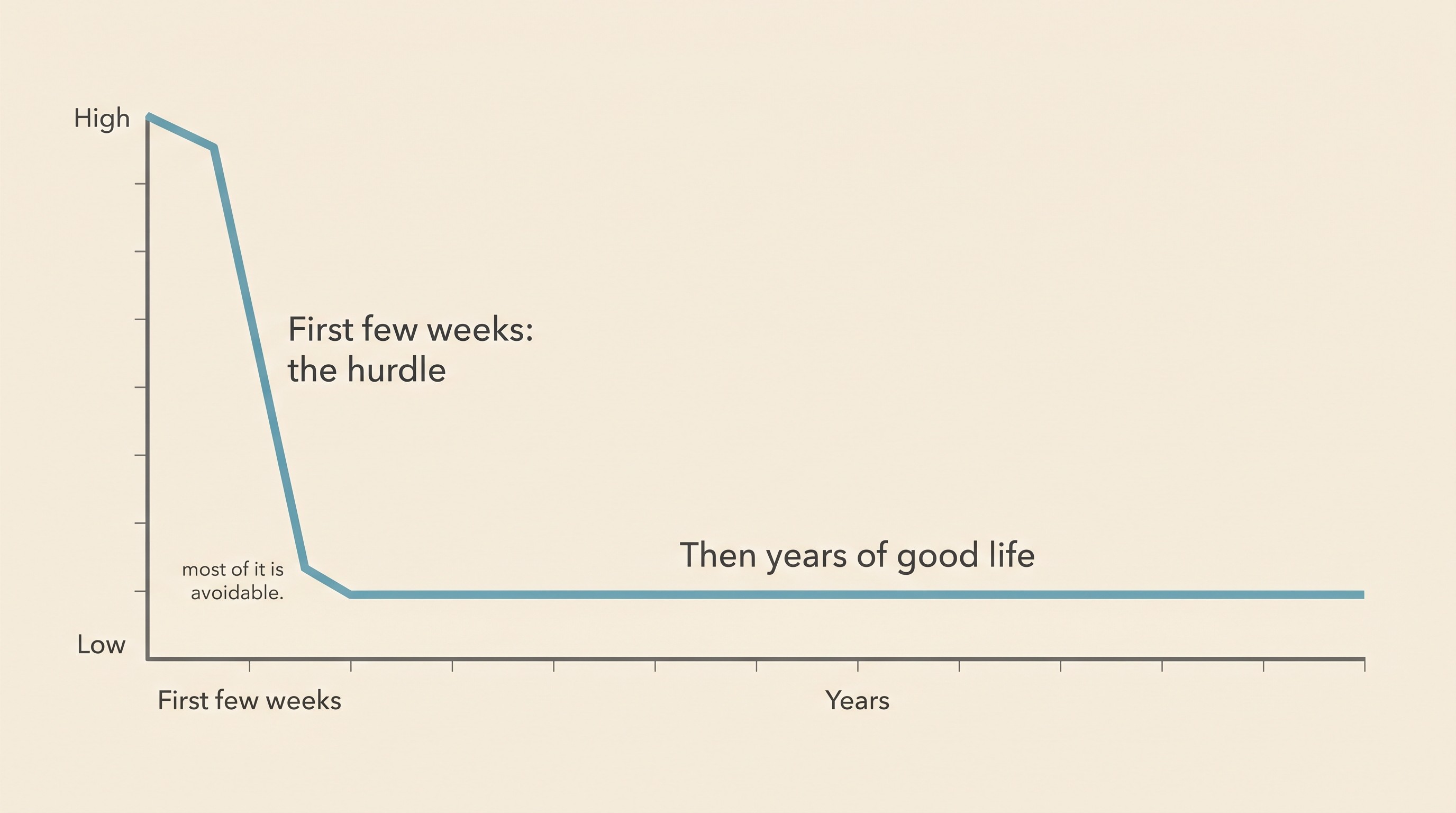
No. Diabetes is not a death sentence. It is a treatable, manageable, long-term condition, and with proper care most diabetic pets go on to have years of good life. The profession's own guidelines open on exactly that footing, describing diabetes as a treatable condition that asks for committed effort from vet and owner together, aimed at a comfortable pet whose signs have settled, not a cure and not perfect numbers (Behrend et al., 2018). Many cats go further still and come off insulin entirely. So hold these two truths together: diabetes is a real commitment, and it is very far from a hopeless one. The cost reckoning lives in the cost and insurance guide, and the "can I fit this into my life" question in can I do this. Here I just want to answer the one that hurts most.
Why those grim survival figures mislead
Go looking and you'll find survival figures that look grim at a glance, but once you understand the shape of those numbers, they stop being frightening. The danger in pet diabetes is heavily front-loaded into the very beginning, and a large share of the deaths in those statistics are not pets the disease defeated. They are pets put to sleep at diagnosis, often out of fear, sometimes before any treatment was tried. A landmark survey of the profession found that, by vets' own reckoning, a median of around one in ten diabetic pets is euthanised at diagnosis, with a further one in ten or so within the first year (Niessen et al., 2017). A new study of more than 1.2 million UK cats put hard numbers on it: of newly diagnosed diabetic cats, 10% were euthanised within three days, and around 72% of those had never received any diabetes treatment at all (Waite et al., 2025). The median time to death there looks short, just 68 days, but it is dragged down by those early decisions, not by the disease running its course. The authors themselves say this high early mortality warrants review, especially now that easier treatment options exist. I'd put it more bluntly: much of what looks like diabetes killing pets is fear killing them first.
The dog data tells the same story. In a large UK primary-care study, median survival after diagnosis looked sobering at around 15.6 months, but among dogs that survived their first week it rose to 20.2 months, and of the dogs never started on insulin only 17.5% survived more than seven days (Heeley et al., 2020). That is the whole argument in one statistic: the dogs that did badly were, in the main, the ones never properly treated.
The realistic horizon: years, not weeks
Set aside the untried euthanasias, and the realistic horizon for a treated diabetic pet is years, with a wide and hopeful range. In dogs cared for in a specialist setting, median survival from diagnosis was 964 days, comfortably over two and a half years, with a range stretching beyond eight (Tardo et al., 2019). A median is a midpoint, not a verdict, and your dog is an individual. Cats follow the same shape: median survival of around 17 months, but a long tail, with 46% still alive more than two years after diagnosis (Callegari et al., 2013). A larger, recent study makes the pattern unmistakable: of 477 diabetic cats, 85% were alive at least four weeks after diagnosis, and of those that cleared that early window, 63% lived more than a year and a quarter lived more than three years (Rothlin-Zachrisson et al., 2023). The dangerous stretch is the very beginning; survive it, and the horizon opens up.
Even a frightening arrival need not change that. Cats presenting in diabetic ketoacidosis, the serious crisis that can accompany a new diagnosis, did not have significantly shorter long-term survival than those that didn't, and around 70% of dogs presenting in full ketoacidosis survive to go home (Callegari et al., 2013; Hume et al., 2006). It is a genuine emergency, covered in diabetic ketoacidosis, but not a hopeless one.
Life once you're past the start
"Managing diabetes" sounds heavier in the abstract than it is in the kitchen: for most pets it is insulin by injection twice a day with a meal each time, plus some monitoring, and vast numbers of ordinary owners do this without it taking over their lives. The goal was never perfection. A well-controlled diabetic, in the guidelines' own words, is simply one whose clinical signs are easing while dangerous lows are avoided, signs mattering more than any single reading (Behrend et al., 2018). You're aiming for a happy, comfortable pet, not a flawless graph, which is the subject of what good control looks like.
The fear that the pet will suffer deserves a straight answer too. In that study of nearly 500 cats, 67% of owners whose cat was still living rated its quality of life as the same as before diagnosis (Rothlin-Zachrisson et al., 2023): not pets merely surviving, but living recognisably their old lives. And the worry you feel tonight tends to ease as competence grows, with owners' own quality of life and hypo-worry measurably improving once they settle into treatment and home monitoring (Hazuchova et al., 2018). The first fortnight is the hardest; it gets lighter from there.
And the harder parts
I won't leave you with only the reassuring half. It is a genuine commitment of routine, two injections and two meals a day, and the heaviest burden owners report is worry itself, which responds to information and a plan (how it fits round real life is the whole of can I do this). The one hard part to learn before you ever need it is the real day-to-day danger: hypoglycaemia, a blood sugar that drops too low. A diabetic pet that goes wobbly, weak, dull or trembling is one you treat as a possible hypo, by rubbing glucose or honey on the gums, never pouring liquid into a mouth that can't swallow, then getting to a vet straight away. Two rules sit under all of it: never give a double dose, and never re-dose insulin into a pet you think is having a hypo. If you're ever unsure whether a dose went in, skip it and wait for the next one, because a missed dose is far safer than a double. That's only the headline; the full emergency plan is the hypoglycaemia guide.
There are complications too, the commonest being cataracts in dogs, around 80% of whom develop them within about 16 months (Beam et al., 1999), yet even that has an answer in modern surgery (see diabetic cataracts in dogs). The pattern holds: the hard parts are real, and each one has a plan.
Where the outlook is genuinely more guarded
The picture cuts both ways, so you can hold realistic hope rather than false hope. The big factor is concurrent disease. Diabetes alongside another significant illness, kidney disease, Cushing's, pancreatitis, a smouldering infection, is harder to control and carries a more guarded outlook than diabetes alone. In cats, raised kidney values were the strongest predictor of shorter survival (Callegari et al., 2013), and concurrent illness is the most cited reason owners and vets reach for euthanasia (Niessen et al., 2017). Often these conditions are also why the diabetes won't settle, and untangling them is a whole stage of this library further along, in the concurrent diseases that fight your insulin. That, and a late diagnosis with poor early control, make a situation to face with eyes open and a vet hunting for anything fixable, rather than a hopeless one.
Euthanasia as an informed choice, not a panic
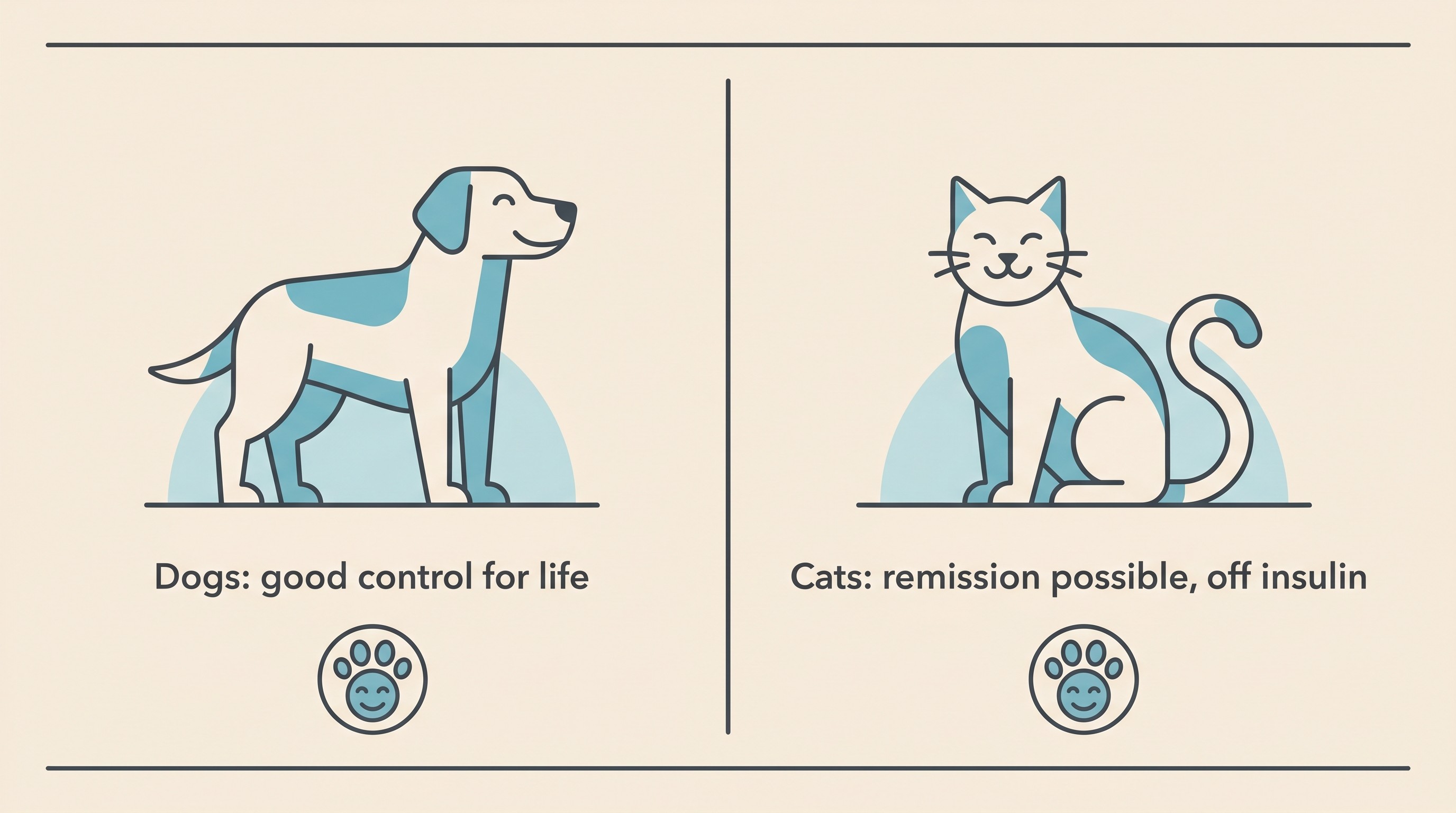
Some owners are weighing, right now, whether to treat at all. First, the species difference, because it changes the hope on the table. In terms of outlook, diabetes in dogs and cats is genuinely two different diseases. Dogs are insulin-dependent for life; the realistic goal is good control and a good long life, not a cure (Behrend et al., 2018). Many cats, by contrast, can go into remission and come off insulin altogether, especially with early diagnosis, prompt control, a low-carbohydrate diet and weight loss in the overweight, and remission is linked to both longer survival and better quality of life (Taylor et al., 2025). If you have a cat, that hope is real and time-sensitive, and it has its own guide in feline diabetic remission. I never want a cat put to sleep at diagnosis without its owner knowing remission was even on the table.
Now the decision itself. Sometimes, after careful reflection, continuing genuinely isn't the right path, and that is a fair and loving choice, not a failure. But it should be an informed choice, made with the real picture in front of you, never a panic taken in the worst hour of the worst day on a half-glimpsed survival figure. The triggers research shows driving these decisions are revealing: concurrent disease, cost, the pet's age, difficulty getting control, welfare worries, and the impact on the owner's own life (Niessen et al., 2017). Notice how much of that list has a response if caught early, which is exactly why the researchers who measured it concluded the answer is better education and a spectrum of treatment intensity, not resignation. Cost especially should never be the silent reason a treatable pet doesn't get a chance, and the cost guide lays out the help that exists. If, after all that, the kindest thing truly is to let your pet go, the gentler conversation about a good goodbye is held with care in quality of life and the hard decisions. I'd ask only one thing first: don't decide it alone, in the dark. Get a second opinion, ask what's fixable, and give the real picture a chance to reach you before the fear does.
So where does that leave the question you arrived with? Almost certainly in a better place than you feared tonight. Diabetes is a hurdle at the start and a routine after it, and on the far side most pets are still recognisably themselves, for years. If you've decided to give your pet that chance, the most useful next step is one small skill and one small habit: learn the injection, far easier than the dread suggests, in your first insulin injection, and start logging from day one with the Glucose Companion, because the owners who track tend to be the owners who worry least. You are not at the end of something here. With a little help, you are at the beginning of managing it well.
References
- Beam, S., Correa, M. T., & Davidson, M. G. (1999). A retrospective-cohort study on the development of cataracts in dogs with diabetes mellitus: 200 cases. Veterinary Ophthalmology, 2(3), 169-172.
- Behrend, E., Holford, A., Lathan, P., Rucinsky, R., & Schulman, R. (2018). 2018 AAHA Diabetes Management Guidelines for Dogs and Cats. Journal of the American Animal Hospital Association, 54(1), 1-21.
- Callegari, C., Mercuriali, E., Hafner, M., Coppola, L. M., Guazzetti, S., Lutz, T. A., Reusch, C. E., & Zini, E. (2013). Survival time and prognostic factors in cats with newly diagnosed diabetes mellitus: 114 cases (2000-2009). Journal of the American Veterinary Medical Association, 243(1), 91-95.
- Hazuchova, K., Gostelow, R., Scudder, C., Forcada, Y., Church, D. B., & Niessen, S. J. M. (2018). Acceptance of home blood glucose monitoring by owners of recently diagnosed diabetic cats and impact on quality of life changes in cat and owner. Journal of Feline Medicine and Surgery, 20(8), 711-720.
- Heeley, A. M., O'Neill, D. G., Davison, L. J., Church, D. B., Corless, E. K., & Brodbelt, D. C. (2020). Diabetes mellitus in dogs attending UK primary-care practices: frequency, risk factors and survival. Canine Medicine and Genetics, 7, 6.
- Hume, D. Z., Drobatz, K. J., & Hess, R. S. (2006). Outcome of dogs with diabetic ketoacidosis: 127 dogs (1993-2003). Journal of Veterinary Internal Medicine, 20(3), 547-555.
- Niessen, S. J. M., Hazuchova, K., Powney, S. L., Guitian, J., Niessen, A. P. M., Pion, P. D., Shaw, J. A. M., & Church, D. B. (2017). The Big Pet Diabetes Survey: Perceived Frequency and Triggers for Euthanasia. Veterinary Sciences, 4(2), 27.
- Rothlin-Zachrisson, N., Öhlund, M., Röcklinsberg, H., & Ström Holst, B. (2023). Survival, remission, and quality of life in diabetic cats. Journal of Veterinary Internal Medicine, 37(1), 58-69.
- Tardo, A. M., Del Baldo, F., Dondi, F., Pietra, M., Chiocchetti, R., & Fracassi, F. (2019). Survival estimates and outcome predictors in dogs with newly diagnosed diabetes mellitus treated in a veterinary teaching hospital. Veterinary Record, 185(22), 692.
- Taylor, S., Cannon, M., Church, D., Fleeman, L., Fracassi, F., Gilor, C., Mott, J., Niessen, S., et al. (2025). 2025 iCatCare consensus guidelines on the diagnosis and management of diabetes mellitus in cats. Journal of Feline Medicine and Surgery, 27(11).
- Waite, O., Gostelow, R., Wright, E., et al. (2025). Frequency, Risk Factors, and Mortality for Diabetes Mellitus in 1,225,130 Cats Under Primary Veterinary Care in the United Kingdom in 2019. Journal of Veterinary Internal Medicine, 39(4), e70161.
Keep track of how your pet is doing
The owners who cope best are the ones who notice changes early. A simple health log shows you what is working, and what is not, before the next vet visit.
Start tracking, freeYou're not doing this alone
Compare treatment journeys and talk to owners managing diabetes mellitus. Free to join.
Join PetsLikeMine