

Storing, Drawing Up and Handling Insulin Properly
Alastair Greenway
BVM&S MRCVS
There's a sentence I hear in the consult room more often than almost any other once a pet is a few months into treatment. "The insulin's stopped working." The dog is drinking again, the cat is losing weight, the readings have crept back up, and the obvious conclusion is that the dose has failed or a second illness has crept in. Sometimes that's true. But a surprising amount of the time the insulin is fine and the handling has quietly gone wrong, and nobody looked there because it's so unglamorous.
This is the article about the boring things: how you store the insulin, how you mix it, which syringe you draw it up with, how you measure a tiny dose without losing a third of it to a bubble. None of it sounds like medicine. All of it is. A denatured, mis-mixed, mis-measured or wrong-syringe dose looks exactly like resistance, and the guidelines say so plainly: before anyone blames the dose or hunts for a second disease, the boring client and handling factors come first, poor storage, giving it the wrong way, the wrong type of insulin, drifted feeding or care, all to be ruled out before you go looking for a hidden disease (Behrend et al., 2018; Thompson et al., 2015). Ten unglamorous minutes here prevents a lot of mysterious trouble later.
This article takes you as far as the needle. The jab, tenting and rotating sites live in giving your pet their insulin injection, and which insulin is right is in insulin types for dogs and cats. I name products here only to explain how their handling differs, never to compare them.
In the fridge: the two things that ruin a vial
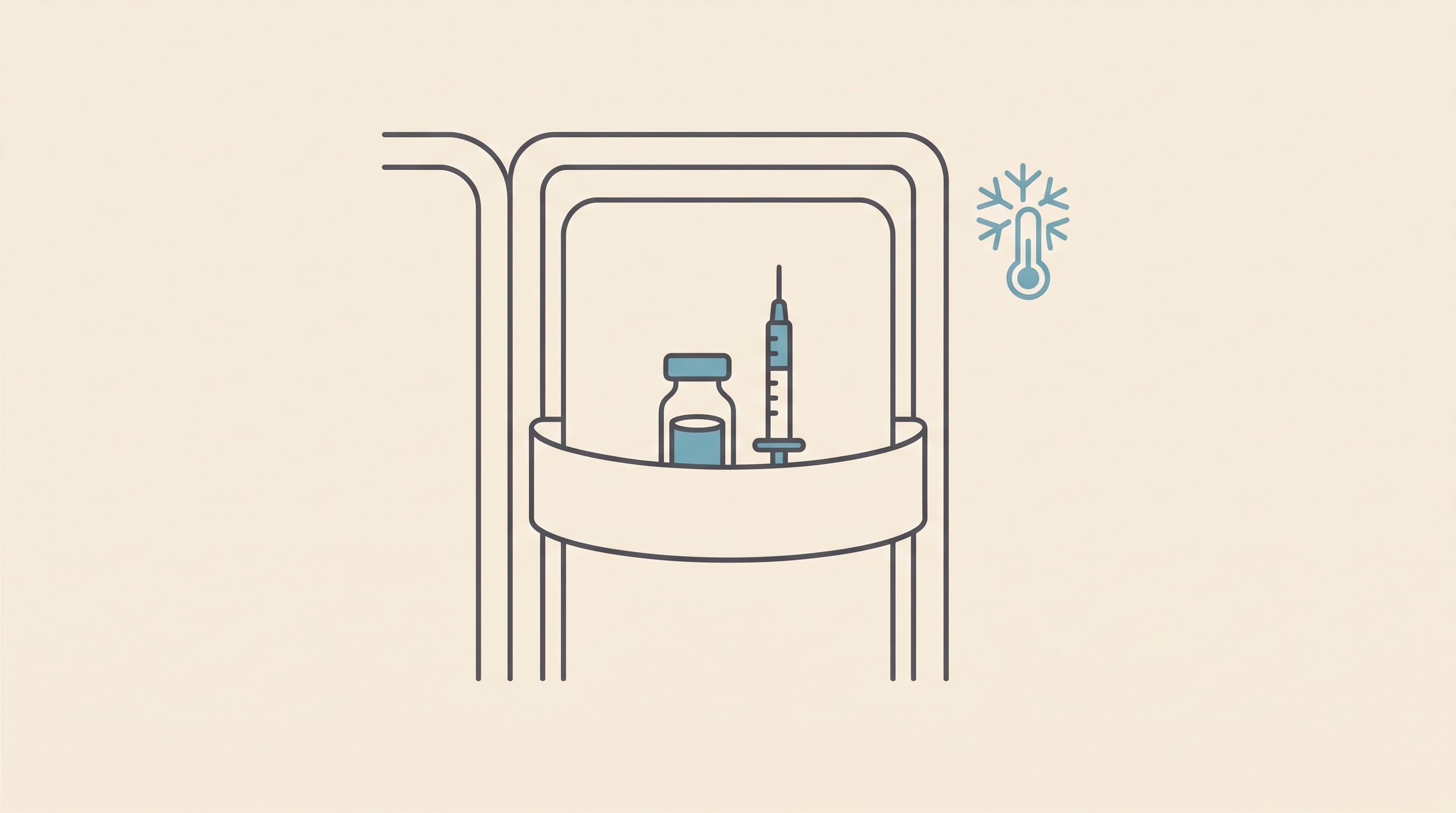
Unopened insulin lives in the fridge, upright, at 2 to 8 °C, and it must not freeze. That isn't a rule I'm interpreting loosely, it's printed on the vet labels: "Store in an upright position under refrigeration at 2 °C to 8 °C. Do not freeze" (Caninsulin/Vetsulin label, DailyMed), with the same wording, plus "protect from light," on the feline PZI insulin (ProZinc PI). Upright matters for the cloudy suspensions, because it lets the precipitate settle evenly and keeps the rubber bung sealed.
Two things genuinely wreck insulin, and they pull in opposite directions. The first is freezing, and it's a hard stop: "Do not use insulin that has been frozen" (FDA insulin storage guidance), which doesn't just weaken the protein but can crack the glass and destroy sterility along with potency (Heinemann et al., 2020). The trap most owners never hear is that the back wall and the door of a domestic fridge both fluctuate, and the back can dip below freezing, so keep your insulin on a middle shelf, not against the cold rear wall and not in the door.
The second is heat and light, and this one is gradual: "the longer the exposure to extreme temperatures, the less effective the insulin becomes ... keep insulin away from direct heat and out of direct sunlight" (FDA insulin storage guidance). The scale is reassuring, though. At room temperature, around 25 °C, insulin loses less than 1% of its potency over a whole month, against less than 0.1% kept refrigerated (Heinemann et al., 2020). So a few hours on the counter does nothing, and letting a dose come up from fridge-cold before you inject is fine and often stings less. What does the damage is a car windscreen in July or a sunny windowsill: a brief warm-up is sensible, baking it is what ruins it. Keeping it cold on a journey or through a power cut belongs to diabetic pet travel and sick-day rules.
Write the open-date on the vial
Once you've broached a vial it has a finite life, and you discard it at the end of that period even if it still looks perfect. The UK Caninsulin vial is good for up to 42 days after first puncture, stored up to 25 °C in use (Caninsulin SPC, MSD Animal Health; Vetsulin label: "Use contents within 42 days of first puncture"); ProZinc runs to 60 days for the 10 ml vial and 80 for the 20 ml (ProZinc PI), and in-use glargine (Lantus) is just 28 (Lantus SmPC; Thompson et al., 2015). Those numbers don't agree, and even the same Caninsulin product carries a 21, 28 or 42-day period depending on which country's regulator approved the box. So the only sound rule is this: follow the leaflet for your insulin, write the open-date on the vial the day you broach it, and bin it on time (Thompson et al., 2015). Out-of-date insulin is a classic silent reason for "it stopped working," preventable with a marker pen. Discard early, too, if it discolours, clumps or just looks wrong.
Re-suspension: shake, roll, or leave it alone
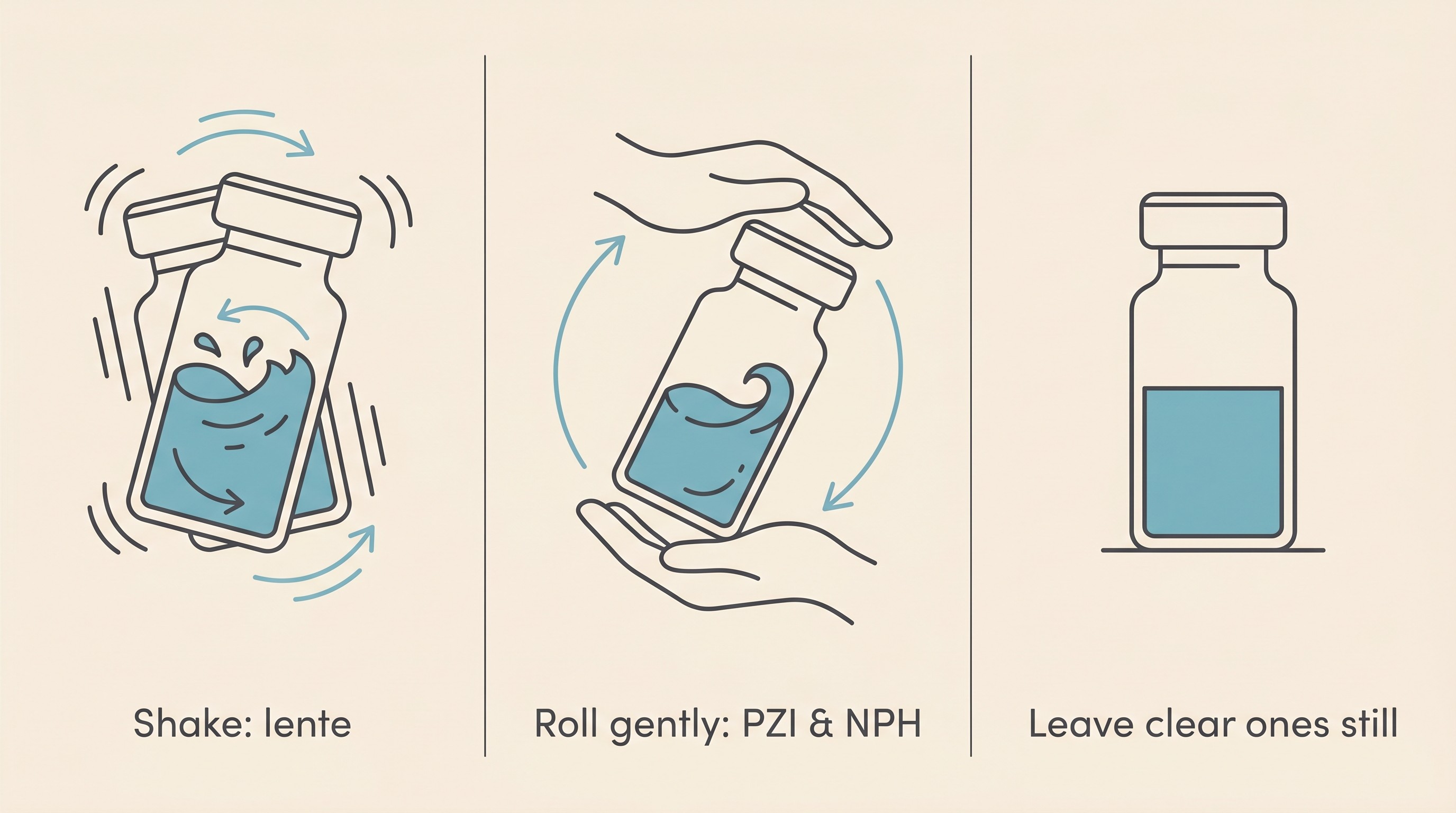
Get this one habit right and you have done more for accurate dosing than almost anything else, and it's the one generic websites most often get wrong. The cloudy insulins are not solutions, they're suspensions: an even cloud of insulin crystals in liquid, and the dose is only correct if those crystals are evenly spread when you draw up. Get the mixing wrong and you mis-dose every single injection: "if resuspension is inconsistent, it will lead to inaccurate dosing," and an uneven, unpredictable break-up of the precipitate can even alter how the dose is absorbed (Taylor et al., 2025). The catch is that there are three different correct answers depending on your insulin.
Porcine lente (Caninsulin in the UK, Vetsulin in the US) is the exception, and you shake it, hard. The label is explicit: "Shake the vial thoroughly until a homogeneous, uniformly milky suspension is obtained. Foam ... should be allowed to disperse" (Caninsulin/Vetsulin label, DailyMed), and the feline consensus agrees that lente should be vigorously shaken to re-suspend (Taylor et al., 2025). It is entirely normal to see fine sand-like particles after re-suspending Caninsulin; just let the foam settle before you draw up.
PZI (ProZinc) and NPH are the opposite: you do not shake them, you roll them gently. "Do not shake or agitate the vial. ProZinc should be mixed by gently rolling the vial prior to withdrawing each dose" (ProZinc PI; Taylor et al., 2025). Rolling it between your palms and inverting it a few times mixes a suspension fully without frothing it (Thompson et al., 2015).
The clear insulins (glargine/Lantus, detemir/Levemir) need no mixing at all. They are clear solutions and should stay clear, which is one reason a syringe dose drawn from them tends to be more accurate (Taylor et al., 2025). The rule here is the reverse: if a clear insulin ever looks cloudy or has floaty bits in it, do not use it, throw it away.
The logic underneath: under-mixing leaves the active drug stratified, so you draw mostly liquid early in the vial's life and mostly drug later, while over-vigorous shaking of the protamine and zinc suspensions can damage the protein and trap air (Taylor et al., 2025). The safe universal rule: mix it exactly the way your leaflet says, let any foam disperse, and never use it if clumps, flecks or discolouration persist (Caninsulin/Vetsulin label, DailyMed; ProZinc PI).
Matching the syringe: U-40 versus U-100
This is the handling error that can do real harm rather than just waste a dose. Insulin comes in different concentrations and the syringe has to match. Caninsulin/Vetsulin and ProZinc are U-40 (40 units per ml); most human insulins, including glargine, detemir and NPH, are U-100. The vet label shouts about it in capitals: "USE OF A SYRINGE OTHER THAN A U-40 SYRINGE WILL RESULT IN INCORRECT DOSING," so always give 40 U/ml insulin with a U-40 syringe or the manufacturer's dosing pen (Caninsulin/Vetsulin label, DailyMed; Thompson et al., 2015).
The maths explains both halves of the danger. A U-40 insulin in a U-100 syringe gives roughly 40% of what you meant, about two and a half times too little, so the signs return and it looks exactly like the insulin has failed. A U-100 insulin in a U-40 syringe over-delivers by around two and a half times, a genuine hypoglycaemia risk: a wobbly, weak, dull or trembling diabetic could be hypo, and the rescue is glucose or honey rubbed onto the gums followed by a vet straight away, never liquid poured into a pet that can't swallow (owned by the hypoglycaemia guide). If you realise you may have used the wrong syringe, ring your vet, and never try to "correct" it with a second injection: re-dosing on top of a possible overdose is how a scare becomes an emergency.
A practical tip: U-40 syringes usually have a red cap and U-100 an orange cap, but never rely on colour alone, because caps vary. Read the box, and ideally buy your syringes from wherever your insulin is dispensed, since the right size is not always stocked alongside human supplies. The one thing I'd ask you never to do is improvise a conversion at home, working out how many U-100 marks equal your U-40 dose: that's a recipe for a decimal-point disaster. If you can't get the right syringe, ring your vet rather than guess.
Tiny doses, air bubbles, and when a pen wins
Cats and small dogs often need very small amounts of insulin, "sometimes less than 5 U and rarely less than 1 U," and at those doses "the tolerance for error is very small" (Malerba et al., 2021). This is where the device matters: in that study, ordinary U-40 syringes significantly over-delivered at low doses, by nearly 31% at a half-unit target, while veterinary pen injectors were the most reliable at 2 units or less (Malerba et al., 2021; Thompson et al., 2015). So if your pet is on a very small dose, ask your vet whether a VetPen or another pen fits. If you stay with a syringe, choose the smallest-capacity one that fits the dose, so each unit is spread over more of the barrel and easier to read.
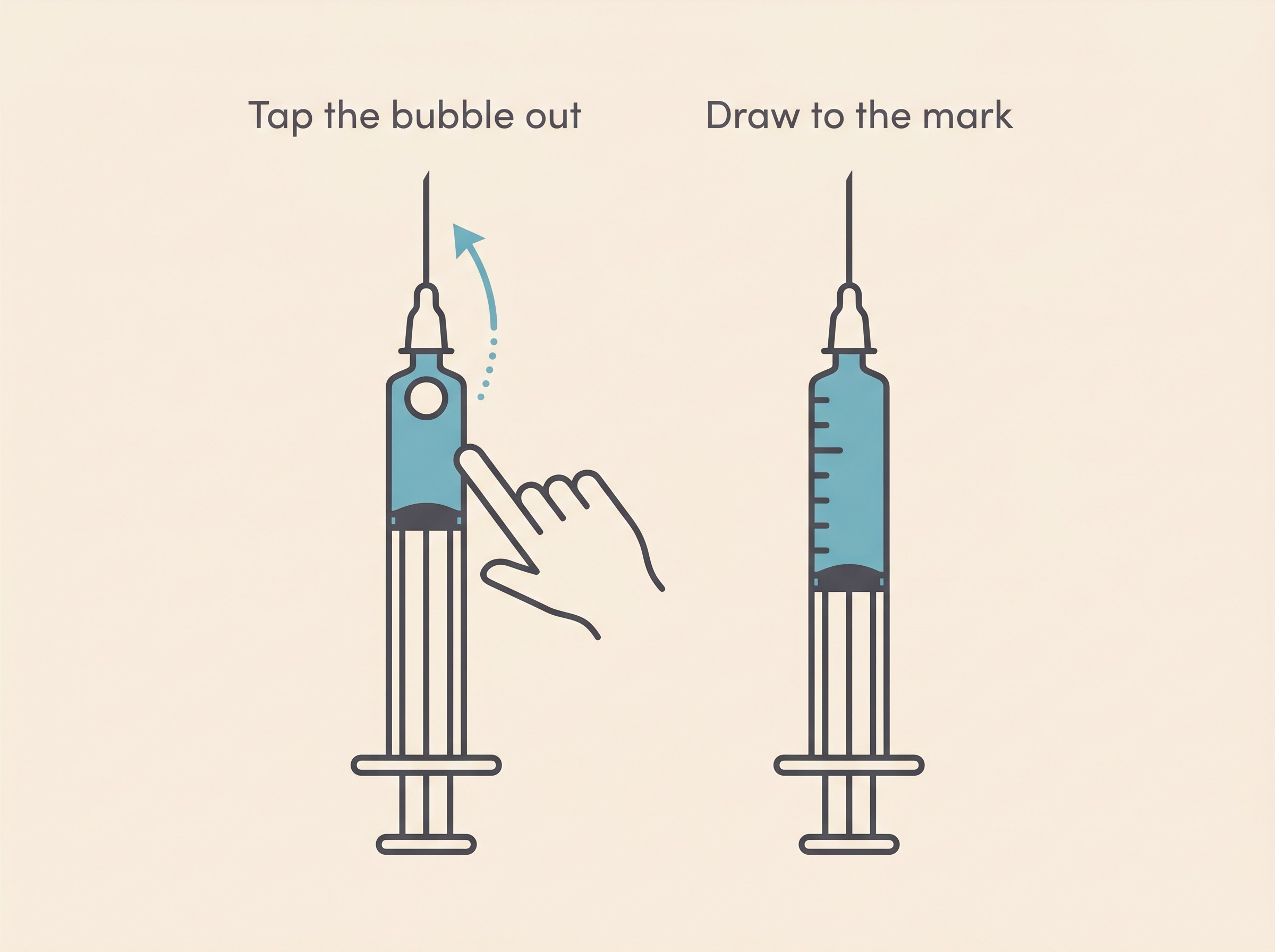
Whichever device you use, expel the air. A bubble is the commonest measuring mistake, and it's sneaky: the air takes up space that should hold insulin, so your pet is quietly under-dosed. Draw up slightly more than the dose, tap the barrel so the bubbles float to the top, push them back into the vial, then re-draw to the exact mark. For a tiny dose even one bubble matters. From here the steps belong to the injection guide.
Throwing sharps away safely
Insulin syringes and pen needles are single-use: a reused needle is blunt, which means more pain and tissue trauma for your pet plus a contamination risk. In the UK, used sharps go into a designated yellow sharps bin, never the household rubbish, available from your GP, pharmacy or vet (Diabetes UK; NHS sharps guidance). Don't fill it past the line, never re-cap or fish out a needle, and when full your local authority or a participating pharmacy collects it.
Get these unglamorous basics right, the fridge, the date on the vial, the correct mix, the matching syringe, the bubble check, and a remarkable amount of "mysterious resistance" simply never happens. It's worth the fuss because poor control lets the classic problems advance, and in dogs that includes diabetic cataracts, which the majority develop within about a year of diagnosis (Beam et al., 1999). If you've done all of this and your pet still isn't responding, stop tinkering: handling is only the first rung, and the full search lives in the insulin resistance work-up. To catch a handling problem early, watch the trend rather than single readings. If you log your doses and plot the response in the Glucose Companion, a flat, non-responsive curve is often the first hint that something here needs a second look.
References
- Behrend E, Holford A, Lathan P, Rucinsky R, Schulman R. 2018 AAHA Diabetes Management Guidelines for Dogs and Cats. Journal of the American Animal Hospital Association. 2018;54(1):1-21.
- Taylor S, Cannon M, Church D, Fleeman L, Fracassi F, Gilor C, Mott J, Niessen S. iCatCare 2025 consensus guidelines on the diagnosis and management of diabetes mellitus in cats. Journal of Feline Medicine and Surgery. 2025;27(11):1098612X251399103.
- Thompson A, Lathan P, Fleeman L. Update on insulin treatment for dogs and cats: insulin dosing pens and more. Veterinary Medicine: Research and Reports. 2015;6:129-142.
- Malerba E, Fracassi F, Del Baldo F, Golinelli S, Ceccherini M, Barbarossa A, et al. The accuracy and precision of insulin administration using human and veterinary pen-injectors and syringes for administration of insulin. Journal of Veterinary Internal Medicine. 2021;35(3):1255-1264.
- Heinemann L, Braune K, Carter A, Zayani A, Krämer LA. Insulin Storage: A Critical Reappraisal. Journal of Diabetes Science and Technology. 2020;15(1):147-159.
- U.S. Food & Drug Administration. Information Regarding Insulin Storage and Switching Between Products in an Emergency. fda.gov.
- Merck Animal Health. VETSULIN (porcine insulin zinc suspension) 40 IU/mL, package insert. DailyMed (NLM).
- MSD Animal Health. Caninsulin 40 IU/ml Suspension for Injection: UK product information.
- Boehringer Ingelheim. ProZinc (protamine zinc recombinant human insulin) U-40, full prescribing information.
- Sanofi. Lantus (insulin glargine 100 units/ml): summary of product characteristics, storage and in-use shelf life.
- Diabetes UK. Safe disposal of sharps (position statement). diabetes.org.uk; and NHS community-pharmacy sharps guidance.
- Beam S, Correa MT, Davidson MG. A retrospective-cohort study on the development of cataracts in dogs with diabetes mellitus: 200 cases (1985-1995). Veterinary Ophthalmology. 1999;2(3):169-172.
Keep track of how your pet is doing
The owners who cope best are the ones who notice changes early. A simple health log shows you what is working, and what is not, before the next vet visit.
Start tracking, freeYou're not doing this alone
Compare treatment journeys and talk to owners managing diabetes mellitus. Free to join.
Join PetsLikeMine