

Diet as a Lever: Low-Carb Cats, Consistent Dogs
Alastair Greenway
BVM&S MRCVS
Most owners arrive at the food question expecting me to hand over the name of a prescription diet and send them on their way. It's a fair expectation, but it sells the subject short. For a diabetic pet, food isn't only fuel. It's one of the levers we actually pull to change the disease, sitting alongside insulin rather than beneath it, and nutrition plays a major role in achieving good glycaemic control and, in many cases, in remission (Witzel Rollins, 2024).
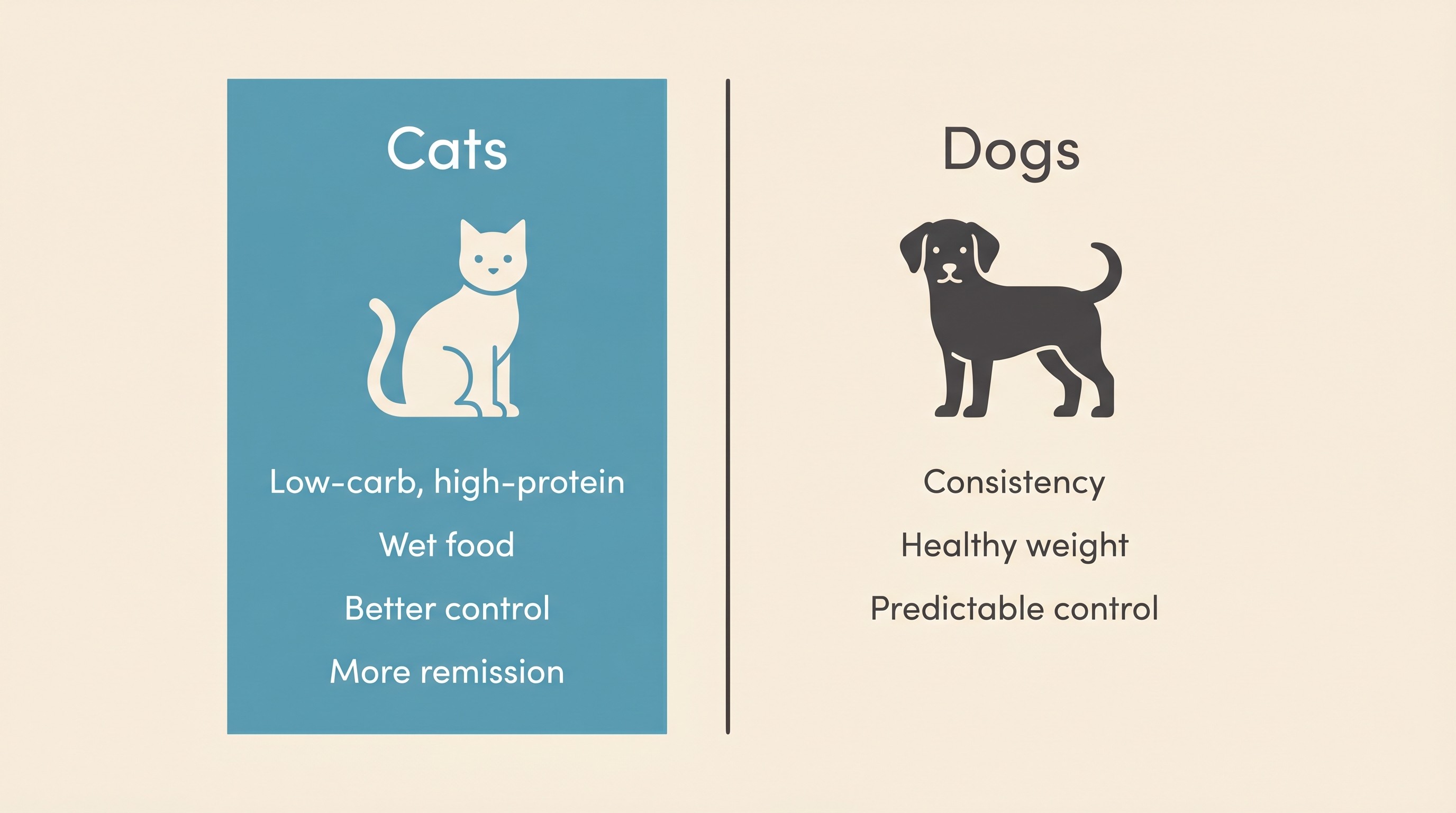
Here's the catch the generic "feed a diabetic diet" pages get wrong, though. The lever works differently in dogs and in cats, because they have, in effect, two different diseases. For a cat, the right diet can be one of the single most powerful things you do, capable of cutting the insulin dose hard and tilting the odds toward coming off injections. For a dog, diet matters too, but in a quieter way: through consistency and a healthy weight far more than through any clever composition. Pour the cat enthusiasm onto a dog and you'll chase a benefit the evidence doesn't support, so this whole page is built around that split.
This is the strategy and evidence layer, the why. The kitchen-table mechanics, what to put down at 7am, feeding the fussy cat, feeding then injecting, the treats list, all live in feeding a diabetic pet.
Cats: low-carb is the real lever
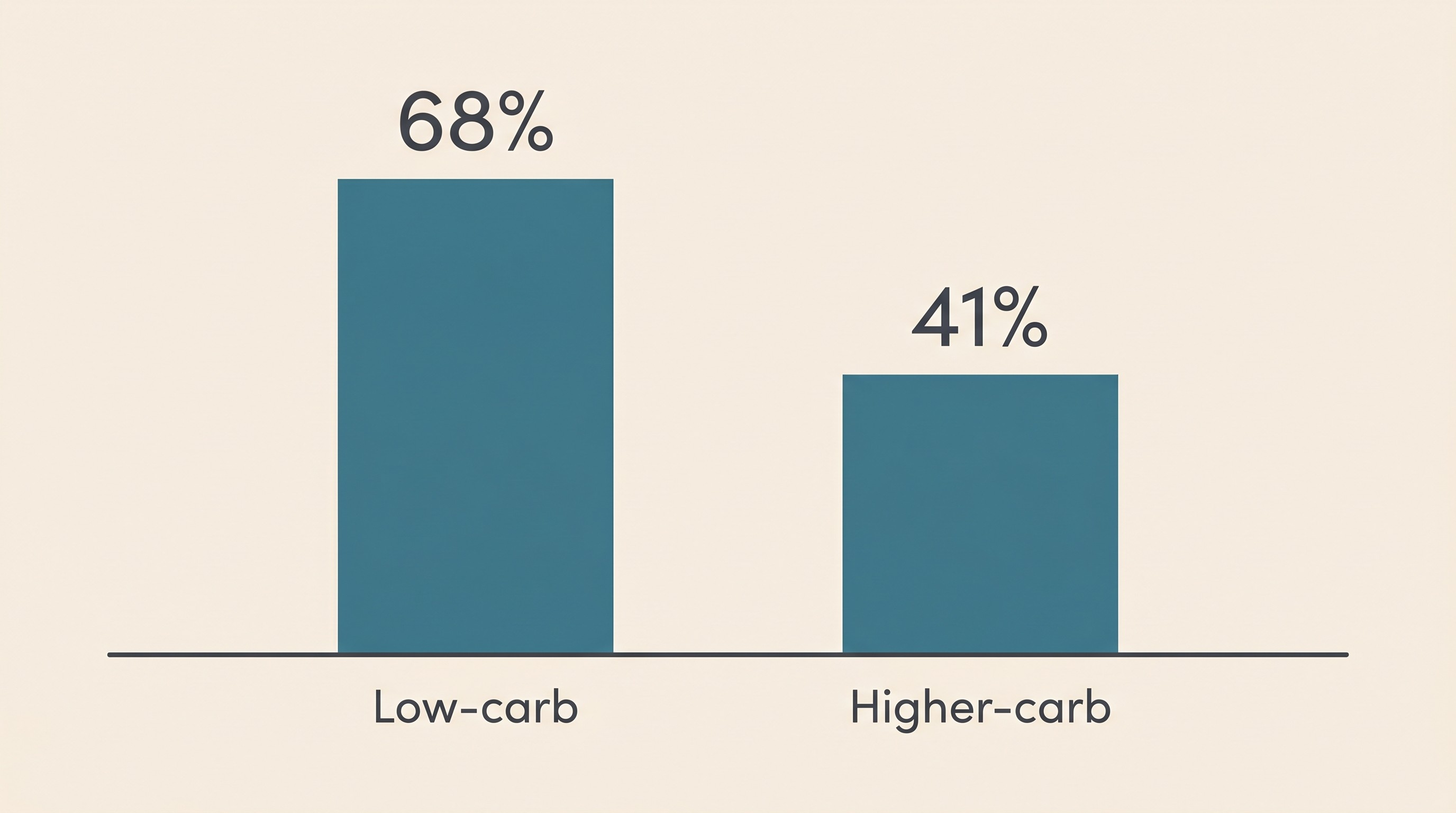
The feline low-carbohydrate story is the strongest dietary evidence in this field, strong enough that you deserve the actual numbers rather than a vague "it helps." The cornerstone is a randomised controlled trial of 63 diabetic cats, followed for 16 weeks, fed either a canned low-carbohydrate, low-fibre food or a moderate-carbohydrate, high-fibre one (Bennett et al., 2006). Both diets helped: glucose and fructosamine fell significantly in both groups, so this was never "one works, one doesn't." But the low-carb cats pulled clearly ahead where it counts. Sixty-eight per cent of them (22 of 31) reverted to a non-insulin-dependent state, against 41% (13 of 32) on the higher-carbohydrate food, a difference that was statistically significant (P=0.03), and they tended to achieve better overall glucose control as well (Bennett et al., 2006). Put another way, the low-carb cats had roughly three times the odds of coming off insulin. That is why, for a cat, food is not a side issue.
Why does this work in cats and not dogs? Because cats are obligate carnivores, evolved on a prey diet that draws less than 5% of its calories from carbohydrate, while a lot of commercial food, dry food especially, runs at 20 to 40% of energy as carbohydrate (Witzel Rollins, 2024). Feed a carnivore a high-carbohydrate diet and you load its already-struggling glucose system; take the carbohydrate away and you take that load off.
So what does "low-carb" actually mean? The current feline consensus puts numbers on it: under 25% carbohydrate on a dry-matter basis, under 15% of metabolisable energy, or under 5g per 100kcal (Taylor et al., 2025). Protein sits high, generally 40 to 50% of energy unless there's a reason not to, which suits the carnivore (Witzel Rollins, 2024). And wet beats dry, because canned foods are typically lower in carbohydrate and carry more moisture than kibble, with many at just 5 to 10% of energy as carbohydrate, and a wet, low-carbohydrate diet may benefit many cats and improve their blood sugar regulation (Witzel Rollins, 2024; Cornell Feline Health Center). So the direction of travel is clear: wet, low-carbohydrate, higher-protein.
Two caveats. First, low-carb improves the odds, it doesn't guarantee anything: the same consensus that recommends it concedes that remission can still be achieved in cats eating higher-carbohydrate diets (Taylor et al., 2025). It's a powerful lever, not a magic switch. Second, you do not need a prescription "diabetic" food to pull it; the target can be met with diets formulated for diabetic cats or with appropriate commercial complete wet foods (Taylor et al., 2025). The consensus is blunt that pursuing a particular diet at the cost of the cat actually eating, or of real financial pressure on the owner, should be avoided (Taylor et al., 2025). A decent low-carb supermarket food the cat eats beats a "perfect" prescription tin it refuses. Home cooking can hit a low-carbohydrate target too, but only if the recipe is complete and balanced and drawn up with a vet or veterinary nutritionist, because an ad-hoc "all-meat" bowl is easy to get dangerously wrong on minerals and taurine, so it is not a shortcut to attempt unsupervised.
When the food changes, the dose has to follow
This is the part of the page I'd circle in red. When you drop a cat's dietary carbohydrate, you reduce how much insulin it needs, often dramatically. In an early high-protein, low-carbohydrate trial, the insulin dose could be reduced by over 50% with no loss of glucose control; insulin fell in eight of nine cats, and three came off injections entirely (Frank et al., 2001).
Sit with what that means at home. The dose keeping your cat steady last week is, the moment the new food goes down, potentially far too much, and giving the old dose on the new diet can drive the cat into a hypoglycaemic crisis. So the rule is firm: never change a diabetic pet's diet as a solo move. Do it with your vet, alongside home glucose or CGM monitoring, expecting the dose to need lowering. This is the kind of change worth tracking properly: keep the diet switch, the doses and the readings together in the Glucose Companion, so you and your vet bring the dose down deliberately rather than discover the drop the hard way (how it's stepped down is covered in insulin dose titration). The same applies, with less drama, to dogs: any meaningful change in what or how much you feed can shift the requirement.
This dovetails with the universal rule running through all of diabetes care: you don't self-adjust insulin off a single number or a hunch. And if your pet ever goes wobbly, weak, dull or trembling after a diet change, treat it as a possible hypo and act, the full rescue is in the hypoglycaemia emergency guide.
Diet helps cats, but it never works alone
A low-carbohydrate diet, remission, and lower blood glucose are each associated with longer survival in cats (Taylor et al., 2025), but two things sit alongside the food. Timing is one: the remission window is widest in the first weeks to months after diagnosis, so this is a lever to pull early. Weight is the other: effective early weight loss is among the strongest remission predictors we have, with a loss of at least 2% of body weight in obese cats in the first month tied to a large jump in remission odds (Taylor et al., 2025). AAHA puts the combined effect at remission rates anywhere between 15 and 100% when a high-protein, low-carbohydrate diet is paired with insulin (Behrend et al., 2018).
So it's "early, plus low-carb, plus weight, plus tight monitored control" that genuinely wins, with food a major lever rather than a solo act. The step-by-step playbook is in how to get your cat into remission, the concept and window in feline diabetic remission, and the weight side in weight, dental and the things that wreck control.
Dogs: consistency, not composition
Now the counterweight, and please don't skim it if you have a dog, because this is where well-meaning owners go wrong by importing the cat advice. A dog's diabetes is insulin-dependent and does not remit. So the dietary goal isn't reversal, it's predictability and a sensible weight, and the low-carb case does not transfer. The trial that settles this followed dogs with stabilised diabetes and compared a high-fibre, moderate-carbohydrate diet against a commercial diet with moderate fibre and low carbohydrate (Fleeman et al., 2009). The high-fibre approach offered no advantage in insulin requirement or glycaemic control, and it actually caused unwanted weight loss, a real problem in a thin dog (Fleeman et al., 2009). So for most dogs, feed a good-quality, complete, vet-appropriate diet consistently, and don't fixate on "diabetic" labels or chase low-carbohydrate the way cat owners reasonably do.
That isn't the same as "diet doesn't matter for dogs." The lever is simply different: fibre and weight, used appropriately. Diets with increased soluble and insoluble fibre, or diets for weight maintenance or weight loss in obese diabetics, can improve glycaemic control by blunting the post-meal glucose rise (Behrend et al., 2018), and older controlled work agrees: a high-insoluble-fibre diet produced significantly lower mean 24-hour glucose than a low-fibre one (Nelson et al., 1998). So fibre is a legitimate but modest tool, and the goals of canine dietary therapy come down to optimising body weight and minimising post-meal hyperglycaemia, with an obese dog aiming to lose around 1 to 2% of body weight per week (Behrend et al., 2018). But hold onto the exception the fibre enthusiasm forgets: an underweight diabetic dog should not be put on a high-fibre, weight-loss diet. A thin diabetic, and newly-diagnosed dogs are often thin, needs a high-quality maintenance or diabetic diet that holds weight on (Behrend et al., 2018). So the right diet depends on the dog in front of you: fibre and gentle weight loss for the portly, weight-holding nutrition for the thin, consistency for every one.
Same food, same amount, same times
Underneath both species sits one rule that turns food into a usable lever at all, and it's the unglamorous one: feed the same diet, the same amount, at the same times (Behrend et al., 2018; Witzel Rollins, 2024). Insulin is dosed to match a glucose pattern, and that pattern only stays matchable if the meals behind it stay the same, which is why a "settled" diabetic can wobble for no apparent reason when the food quietly changes, a new bag, a different flavour, a generous relative with the treat jar. Treats fit here too: they aren't banned, but the same logic applies, because hidden carbohydrate calories from snacks undermine the very predictability the plan depends on, so they need counting and are best kept low in carbohydrate. The treats-and-portions detail, like the meal-timing mechanics, lives in feeding a diabetic pet.
So where does this leave you and a food bowl? For a cat, the most useful next step is a conversation with your vet about transitioning to a wet, low-carbohydrate diet, done early, monitored closely, with the dose ready to come down. For a dog, it's choosing a good complete diet you can feed identically every day, getting the weight right for that particular dog, then leaving the composition well alone. Either way, log the change, the doses and the readings in the Glucose Companion so you and your vet can watch the control improve and catch the post-change low before it catches you. Food is one of the few levers in this disease you get to pull with your own hands, and pulled with care, alongside your vet, it is a genuinely rewarding one.
References
- Behrend E, Holford A, Lathan P, Rucinsky R, Schulman R. 2018 AAHA Diabetes Management Guidelines for Dogs and Cats. Journal of the American Animal Hospital Association. 2018;54(1):1-21.
- Bennett N, Greco DS, Peterson ME, Kirk C, Mathes M, Fettman MJ. Comparison of a low carbohydrate-low fiber diet and a moderate carbohydrate-high fiber diet in the management of feline diabetes mellitus. Journal of Feline Medicine and Surgery. 2006;8(2):73-84.
- Cornell Feline Health Center. Feline Diabetes. Cornell University College of Veterinary Medicine.
- Fleeman LM, Rand JS, Markwell PJ. Lack of advantage of high-fibre, moderate-carbohydrate diets in dogs with stabilised diabetes. Journal of Small Animal Practice. 2009;50(11):604-614.
- Frank G, Anderson W, Pazak H, Hodgkins E, Ballam J, Laflamme D. Use of a high-protein diet in the management of feline diabetes mellitus. Veterinary Therapeutics. 2001;2(3):238-246.
- Nelson RW, Duesberg CA, Ford SL, Feldman EC, Davenport DJ, Kiernan C, Neal L. Effect of dietary insoluble fiber on control of glycemia in dogs with naturally acquired diabetes mellitus. Journal of the American Veterinary Medical Association. 1998;212(3):380-386.
- Taylor S, Cannon M, Church D, Fleeman L, Fracassi F, Gilor C, Mott J, Niessen S, et al. iCatCare 2025 consensus guidelines on the diagnosis and management of diabetes mellitus in cats. Journal of Feline Medicine and Surgery. 2025;27(11):1098612X251399103.
- Witzel Rollins A. Nutritional Strategies for Cats With Diabetes. Today's Veterinary Practice. Updated June 2024.
Keep track of how your pet is doing
The owners who cope best are the ones who notice changes early. A simple health log shows you what is working, and what is not, before the next vet visit.
Start tracking, freeYou're not doing this alone
Compare treatment journeys and talk to owners managing diabetes mellitus. Free to join.
Join PetsLikeMine