

Feeding a Diabetic Pet: Timing, Portions and Treats
Alastair Greenway
BVM&S MRCVS
Owners walk out of the diagnosis consult braced for the injections. Almost no one walks out worried about the bowl, and yet it's the bowl that trips most people up a fortnight later. What do I feed? How much? When, relative to the jab? Can he still have his bedtime biscuit? Feeding quietly does a large share of the work of keeping a diabetic pet steady.
So let me take the pressure off: you do not need a nutrition degree to do this well. For the great majority of diabetic dogs and cats, what matters most isn't the food at all, it's consistency: the same food, the same amount, at the same times every day (Caninsulin SPC, 2026; Behrend et al., 2018). This page is the kitchen-table mechanics of that: timing meals with the injection, what to do when breakfast gets ignored, treats, and changing food safely. The deeper question of whether food can itself be a treatment, even tip a cat off insulin, has its own home: diet as a treatment.
Consistency is the whole game
Insulin and food are a partnership, and it only works if one half stays predictable. Feed the same thing in the same quantity at the same times and the rise in blood sugar after the meal follows roughly the same shape each day, so the dose can be matched to it. Change what's in the bowl, or how much, or when, and yesterday's perfect dose can be too much or too little today. The manufacturer's guidance puts it plainly: the composition and quantity of the daily food intake should be constant, and changes in diet may alter insulin requirements (Caninsulin SPC, 2026); the clinical guidelines agree, keeping the pet on the same daily schedule of meals and insulin (Behrend et al., 2018).
Feed and inject together: the twice-daily rhythm
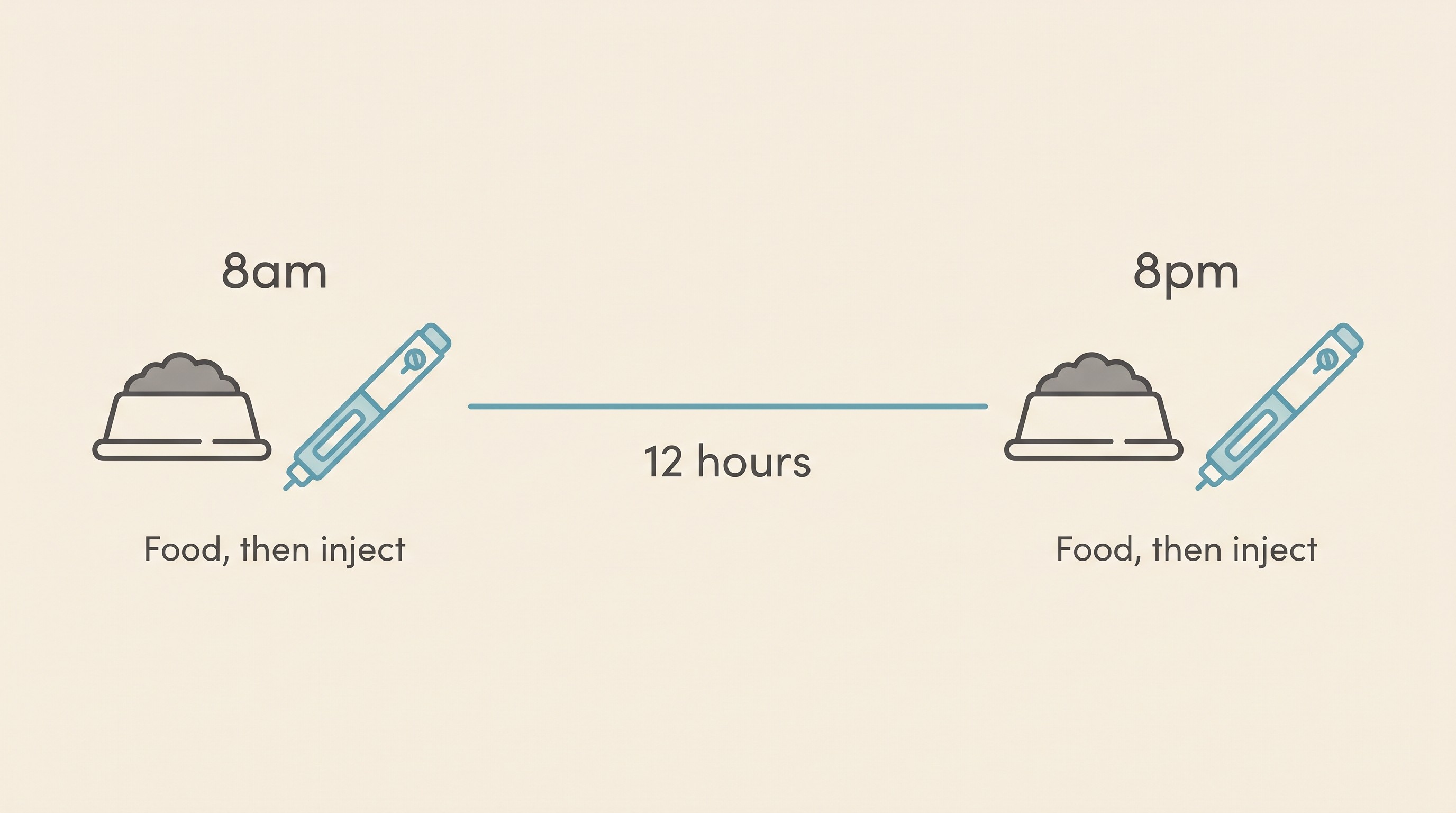
The standard regimen for most diabetic pets is two equal meals roughly twelve hours apart, each at the time of the insulin injection: feed half the daily ration with each, at the same two times every day (Caninsulin SPC, 2026; Behrend et al., 2018).
The order matters, and here's the habit I'd give almost everyone: put the food down, watch them eat it, then give the injection. Not because the needle must chemically follow the bowl, but because watching your pet eat is your daily safety check. A pet who clears the bowl is almost always safe to inject; a pet who sniffs breakfast and walks away is telling you something that changes the plan.
One nuance, because the science has moved. The most recent feline guidelines state that it is not necessary to give insulin after a meal, particularly in cats on a low-carbohydrate diet, cats that graze, or cats on a long-acting basal insulin that has no real peak, because the rise in glucose after eating is small (Taylor et al., 2025). So for a grazing cat the precise minute the needle goes in matters less than people once feared, but for a dog and most cats, feed-then-inject stays the sensible default for that appetite check. The injection itself, including matching your syringe to your insulin's concentration, lives in your first insulin injection.
Never a full dose into an empty stomach
This is the one rule on the page I'd ask you to tattoo somewhere. If your pet doesn't eat, you don't give a full dose of insulin. The insulin is there to deal with the glucose from a meal; give it to a pet that hasn't eaten and there's nothing to soak it up, which can drop the blood sugar dangerously low (Cornell Riney; Behrend et al., 2018). In the short term it is far safer for blood sugar to run a little high than too low (VCA client education).
So what do you do on the morning the bowl gets ignored? Follow the plan you agreed with your own vet; if you haven't, agree one now. As a general framework your vet will tailor: if it eats only about half its food, you may be told to give about half the dose; if it eats nothing, the usual default is to skip that dose and ring the practice (VCA client education; Behrend et al., 2018). The rule that runs underneath all of diabetic care is the one that keeps pets alive: skip and wait for the next dose, never double up to make it good later (Cornell Riney; Behrend et al., 2018).
Two hand-offs. If your pet isn't just refusing food but is wobbly, weak, dull, trembling or collapsing, that is a hypoglycaemic emergency: rub sugar onto the gums, never liquid into a pet that can't swallow, then the vet straight away, set out in full in the hypoglycaemia emergency guide. And while one skipped breakfast is ordinary life, a pet repeatedly off its food, vomiting, or unwell in itself isn't a feeding problem, it's a sick pet: diabetic pets are not usually fussy eaters, so a reduced appetite should prompt a search for an underlying cause (Taylor et al., 2025). The sick-day playbook is in travel, boarding and sick-day rules.
Treats: allowed, but counted
Owners often arrive braced for me to ban treats, and I almost never do: the bond matters, and a life with no biscuits in it is a sadder one. The rule isn't abstinence, it's discipline: keep treats to roughly ten per cent or less of your pet's daily calories, the standard veterinary nutrition ceiling for any pet, and fold them into the day rather than adding them on top (Behrend et al., 2018).
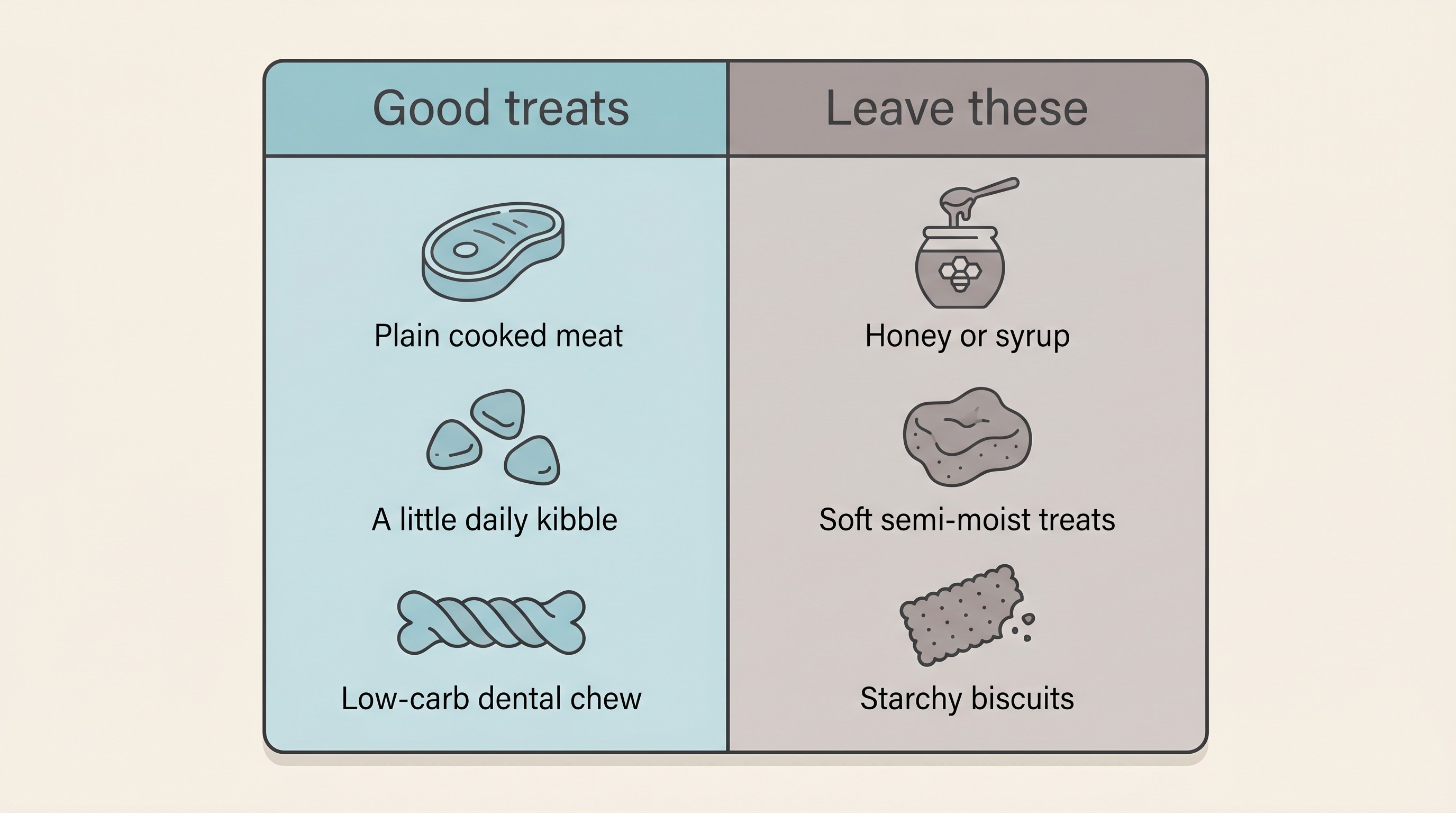
Within that allowance, choose well. The best treats are single-ingredient and low in carbohydrate: a little plain cooked chicken, a few pieces of their own kibble counted out of the day's ration, a purpose-made low-carb treat. Steer clear of sugar in every form, so no honey, no molasses, no fruit syrups, and none of the soft, semi-moist chewy treats, which are usually held together with sugars. Watch too for hidden carbohydrate in "meaty" treats and biscuits bulked out with grain or potato.
And there's a timing trick: a treat is just a small meal, so give treats at meal and injection times rather than scattering them through the day, where the insulin is already covering them. A mid-afternoon snack moves the blood sugar when nothing is there to manage it (Behrend et al., 2018; VCA client education).
Dogs and cats: two different diseases
This is where the path splits, because diabetes in a dog and diabetes in a cat are genuinely two different diseases, and the feeding logic follows.
For dogs, consistency beats any magic composition. Older work suggested high-fibre diets improved glycaemic control in diabetic dogs, and high-fibre "diabetic" diets were recommended for years on that basis (Nelson et al., 1998). But a better-designed, randomised study later found no real advantage of high-fibre, moderate-carbohydrate diets over a reduced-carbohydrate, moderate-fibre diet in stabilised diabetic dogs, and cautioned against recommending the high-fibre ones routinely, especially in thin dogs that lost weight on them (Fleeman et al., 2009). So the take-home is liberating: you don't need a special label. A good-quality, complete diet your dog likes, fed in a fixed amount to a fixed routine, with weight corrected if there's weight to lose, matters far more than the word "diabetic" on the bag (Fleeman et al., 2009; Behrend et al., 2018). But hold the harder truth alongside it: a dog's diabetes is lifelong and insulin-dependent, so diet supports control, it does not reverse it.
For cats, the bowl pulls more weight. The current feline target is low in carbohydrate and higher in protein: carbohydrate below about fifteen per cent of metabolisable energy, which is under twenty-five per cent on a dry-matter basis or under five grams per hundred kilocalories, with medium-to-high protein and fat, a bar nudged down from the older figure of nearer twelve per cent (Sparkes et al., 2015; Taylor et al., 2025). Wet or canned food is generally preferred, partly because it's easier to hit those numbers in a tin than a biscuit, partly because it aids hydration and portion control (Behrend et al., 2018; Taylor et al., 2025). For a cat, unlike a dog, the bowl is a genuine therapeutic lever that can change the disease, and the case for it, with the remission figures, belongs to diet as a treatment.
One caveat for every cat owner: the ideal diet is worthless if your cat won't eat it. Chasing the perfect low-carb food until the cat is hungry, refusing meals, or your budget is wrecked is counter-productive, because remission can still happen on a less-than-ideal diet (Taylor et al., 2025). The same goes for the grazer who won't take two set meals: for a cat the low-carbohydrate intake matters more than the meal pattern (Behrend et al., 2018; Taylor et al., 2025). An eating cat on a slightly-less-than-perfect food beats a hungry cat sulking at the "right" one.
Weight is the long game
Carrying extra weight makes a diabetic pet harder to control, and in cats especially, getting an overweight one down to a healthy body condition is strongly linked to better control and a better shot at remission (Taylor et al., 2025; Gottlieb et al., 2024). The pace matters: aim for a controlled loss of roughly half to one per cent of body weight a week toward a body condition score of five out of nine, never a crash diet (Taylor et al., 2025). Of everything on this page you can change, weight is the one most worth acting on, and the how-to is in weight, dental health and keeping diabetes controlled.
Changing food without losing control
Sooner or later you may need to change the diet, perhaps onto a low-carb food for a cat, perhaps because the old one's been discontinued. One rule keeps it safe, and it catches people out because the danger is invisible: any change to what you feed, or how much, can lower the blood glucose and so the insulin the pet needs, so make the change with your vet and with monitoring, never on a whim (Caninsulin SPC, 2026; Taylor et al., 2025). The trap is the new food dropping the glucose while the dose is still set for the old one. You catch that early by watching the numbers across the changeover, which is where the Glucose Companion earns its keep: log the food change, doses and readings in one place, and bring the dose down deliberately instead of discovering the drop the hard way.
So if you carry three things away, carry these: the same food at the same two times alongside the injection; never a full dose into a pet that hasn't eaten; and treats kept, chosen and counted. The plan will still evolve with the disease, and in cats it is increasingly tailored to whether the cat is at risk, actively diabetic, or in remission (Hookey et al., 2026). When you're ready to ask whether the food itself can become part of the treatment, that waits in diet as a treatment, and the Glucose Companion will show you in black and white that the routine you're quietly building is working.
References
- Behrend E, Holford A, Lathan P, Rucinsky R, Schulman R. 2018 AAHA Diabetes Management Guidelines for Dogs and Cats. Journal of the American Animal Hospital Association. 2018;54(1):1-21.
- Cornell University Riney Canine Health Center. Managing Canine Diabetes (owner resource).
- Fleeman LM, Rand JS, Markwell PJ. Lack of advantage of high-fibre, moderate-carbohydrate diets in dogs with stabilised diabetes. Journal of Small Animal Practice. 2009;50(11):604-614.
- Gottlieb S, Rand JS, Anderson ST. Frequency of diabetic remission, predictors of remission and survival in cats using a low-cost, moderate-intensity, home-monitoring protocol and twice-daily glargine. Journal of Feline Medicine and Surgery. 2024;26(3):1098612X241232546.
- Hookey T, Backus RC, Bjørnvad CR, et al. Guidelines for nutritional management of feline diabetes mellitus: a proposed classification system integrating medical considerations. Journal of Feline Medicine and Surgery. 2026;28(3):1098612X251409019.
- MSD Animal Health. Caninsulin 40 IU/ml suspension for injection, Summary of Product Characteristics (UK). VMD Product Information Database, SPC AN: 00541/2025, revised February 2026.
- Nelson RW, Duesberg CA, Ford SL, et al. Effect of dietary insoluble fiber on control of glycemia in dogs with naturally acquired diabetes mellitus. Journal of the American Veterinary Medical Association. 1998;212(3):380-386.
- Sparkes AH, Cannon M, Church D, Fleeman L, Harvey A, Hoenig M, Peterson ME, Reusch CE, Taylor S, Rosenberg D. ISFM consensus guidelines on the practical management of diabetes mellitus in cats. Journal of Feline Medicine and Surgery. 2015;17(3):235-250.
- Taylor S, Cannon M, Church D, Fleeman L, Fracassi F, Gilor C, Mott J, Niessen S. iCatCare/ISFM 2025 consensus guidelines on the diagnosis and management of diabetes mellitus in cats. Journal of Feline Medicine and Surgery. 2025;27(11):1098612X251399103.
- VCA Animal Hospitals (Brooks WC). Diabetes Mellitus, Principles of Treatment in Dogs (client education).
Keep track of how your pet is doing
The owners who cope best are the ones who notice changes early. A simple health log shows you what is working, and what is not, before the next vet visit.
Start tracking, freeYou're not doing this alone
Compare treatment journeys and talk to owners managing diabetes mellitus. Free to join.
Join PetsLikeMine