

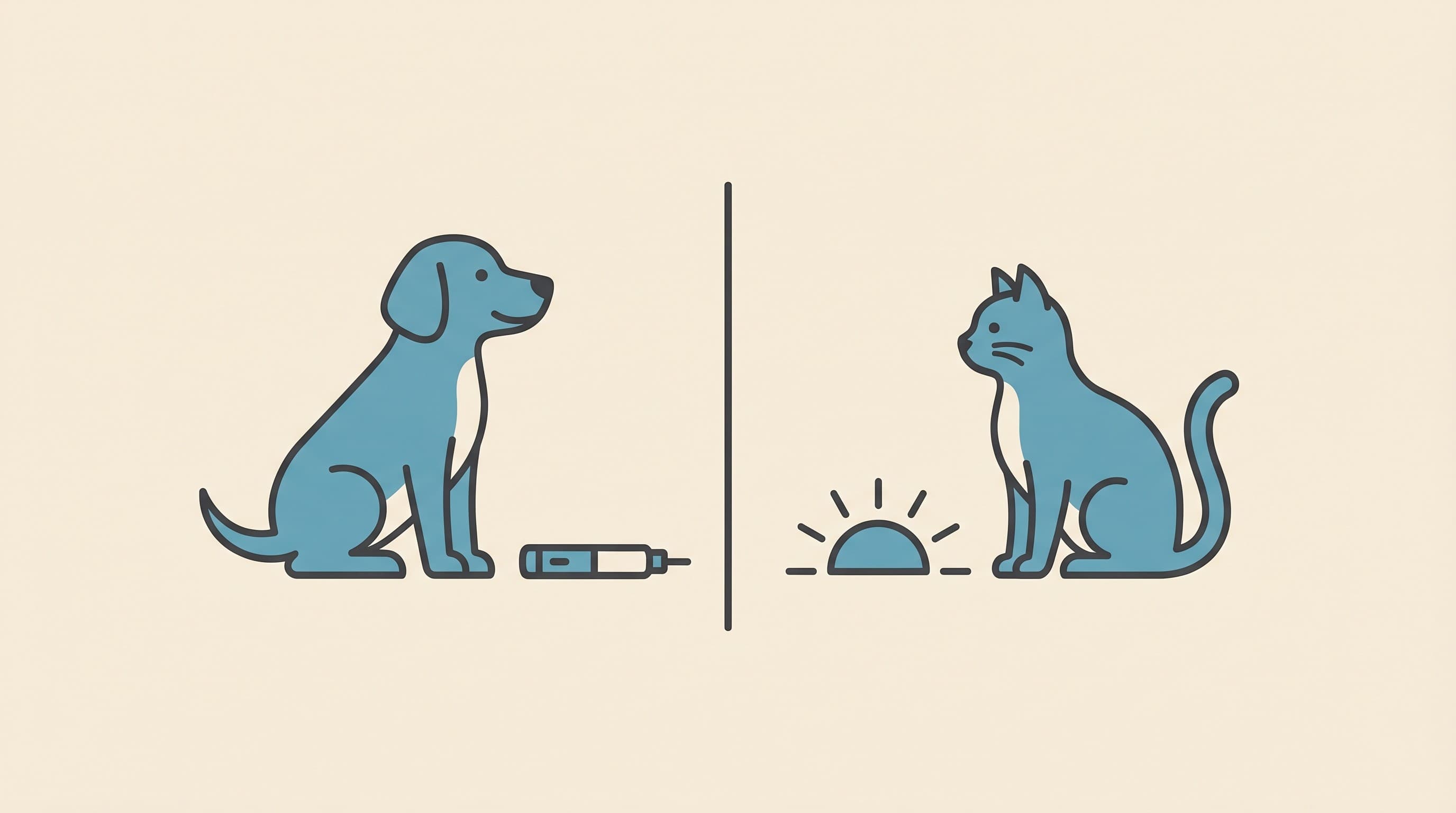
Diabetes in Dogs and Cats: The Same Word, Two Different Diseases
Alastair Greenway
BVM&S MRCVS
When a dog or a cat is diagnosed as diabetic, most owners' minds reach straight for what they know about diabetes in people: a relative who injects insulin, a colleague who manages theirs with tablets and diet. Let me gently take that off the table, because the most useful thing I can tell you on day one is this: the word "diabetes" is doing a lot of quiet lying here. What your dog has and what your cat has are not the same illness with a different coat of fur. They are two genuinely different diseases that happen to share a name, a few symptoms and a syringe.
This isn't trivia. Whether you're facing the canine version or the feline one changes what you should aim for and what you can hope for. It's worth saying plainly, because almost every page online blurs it: most are written by and for cat owners, and quietly leave dog owners with the wrong map.
What the word actually means, in one paragraph
I'll keep the biology light, because it has its own home in what diabetes actually is. In plain terms: insulin is the hormone that lets sugar (glucose) move out of the bloodstream and into the body's cells as fuel. In diabetes that system fails, either because there isn't enough insulin or because the body has stopped responding to it. Glucose then piles up in the blood, spills into the urine, and drags water out with it. That's why the classic signs are the same whichever animal you have: increased thirst and weeing (draining the water bowl, filling the litter tray), a bigger appetite yet weight falling off them, and a general flatness or lethargy. Thirst becomes genuinely abnormal once a pet drinks more than roughly 100 ml per kilogram of body weight per day, with normal dogs well below that and cats lower still. Those shared signs are about where the similarity ends. Why the insulin system has failed is completely different in the two species, and that difference is the whole story.
In dogs: a type-1 disease, and a lifelong commitment
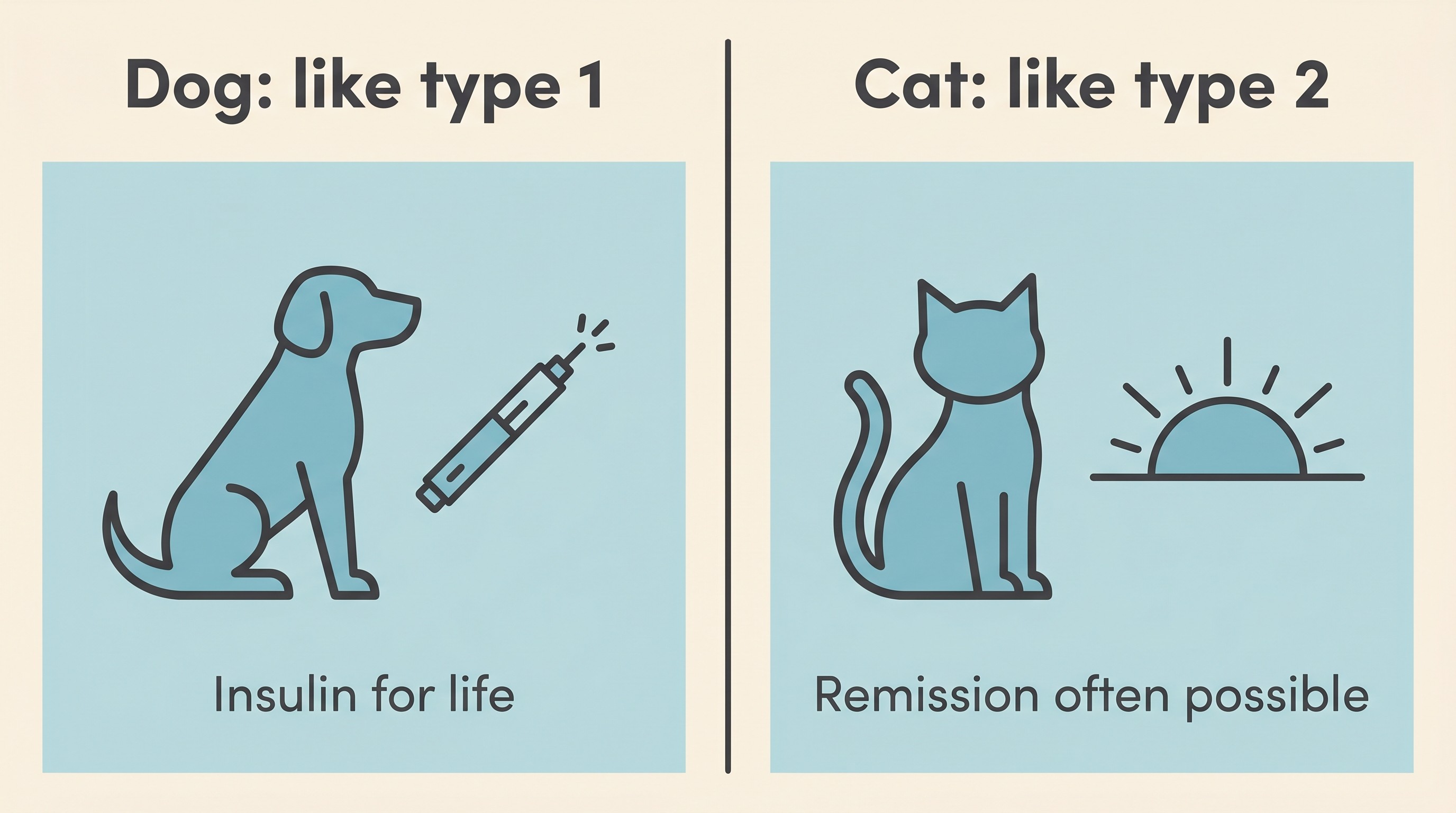
In dogs, diabetes most closely resembles human type 1 (Gilor et al., 2016; Nelson & Reusch, 2014). The pancreas has lost the cells that make insulin and it doesn't get them back, so insulin has to come from outside, by injection, for the rest of the dog's life (Gilor et al., 2016; Nelson & Reusch, 2014). That word "lifelong" lands hard the first time, so let me not soften it: for the overwhelming majority of diabetic dogs it is permanent, and remission, the holy grail you may have read cat owners chasing, essentially does not happen in dogs (Gilor et al., 2016; Behrend et al., 2018).
There's one narrow but important exception, worth knowing because it can change a dog's future. In entire (unspayed) female dogs, the hormone progesterone, which surges in the weeks after a season, drives the body to overproduce growth hormone, and that in turn makes the dog resistant to its own insulin (Eigenmann et al., 1983; Gilor et al., 2016). In UK first-opinion practice, entire females had around three times the odds of developing diabetes compared with entire males (Heeley et al., 2020), with onset often a month or so after a season (Fall et al., 2010). What matters is that it's partly reversible: if an intact bitch is diagnosed and spayed promptly, the insulin resistance can lift, and caught early enough some of these dogs even come off insulin (Eigenmann et al., 1983; Gilor et al., 2016). So if your newly diagnosed dog is an unspayed female, your vet will almost certainly recommend spaying as part of the treatment, not a separate decision for later. It genuinely is treatment.
The other thing every dog owner should hear early is about the eyes. Cataracts are the signature complication of canine diabetes, and they are common: around 80% of diabetic dogs develop them within roughly the first year to sixteen months of diagnosis, often coming on fast enough that a dog who saw fine last month is suddenly cloudy and bumping into furniture (Beam et al., 1999). I flag it so it isn't a nasty surprise, but the detail of why it happens and what can be done, including genuinely good news about restoring sight, has its own guide in diabetic cataracts in dogs. Cats, tellingly, almost never get diabetic cataracts, one more sign we're dealing with two different diseases.
In cats: a type-2 disease, and a real shot at remission
Now the other animal, and the other disease. In cats, diabetes most closely resembles human type 2 (Gilor et al., 2016; Nelson & Reusch, 2014), and around 75 to 80% of feline diabetes is this type-2-like form (Taylor et al., 2025). Here the pancreas can, at least at first, still make insulin, but the cat's body has become resistant to it, and the overworked insulin-producing cells gradually flag under the strain (Gilor et al., 2016; Taylor et al., 2025). The major driver of that resistance is body weight, which is why the overweight, indoor, middle-aged cat is the classic patient. The cat-specific detail lives in feline diabetes explained.
This distinction isn't academic, and it comes down to one word: remission. Because a diabetic cat's insulin-producing cells are often exhausted rather than destroyed, they can sometimes recover. Relieve the strain on them, by getting the blood sugar under control, taking the weight off and switching to the right diet, and a meaningful proportion of cats can come off insulin altogether and run their own glucose normally again (Gilor et al., 2016; Taylor et al., 2025). This simply does not happen in the type-1 dog, and it is the biggest practical difference between the two diseases.
Let me be truthful about remission rather than wave it about like a guarantee. Reported rates vary enormously between studies, anywhere from about 11% to over 60%, and a realistic figure to hold in your head is around a quarter to a third of cats (Taylor et al., 2025; Gostelow et al., 2014). It's not a cure, either: remission can end, and cats relapse in roughly 13 to 40% of cases (Taylor et al., 2025). And it's time-sensitive. Cats diagnosed and treated promptly have the best chance, and one of the strongest predictors is early weight loss: cats who lost even 2% of their body weight in the first month had something like a fifteen-fold increase in their odds of remission (Taylor et al., 2025). The how-to, the playbook of diet and timing and monitoring, has its own guide in feline diabetic remission. For now, just know the door exists, and that it's wider open in the first weeks than it will be later.
Two more cat-specific things flow from this type-2 biology. The first is a diagnostic quirk: fear alone, a car journey, a waiting room full of dogs, can push a cat's blood glucose sky-high temporarily (Taylor et al., 2025). This is called stress hyperglycaemia, and it means a single high reading at the vet's does not by itself prove a cat is diabetic or poorly controlled. It's why we lean on home monitoring, longer-term blood tests and the overall picture rather than one number in cats, and why your cat's diagnosis may have needed more than one test. How diabetes is confirmed sits in getting the diagnosis.
The second is treatment options. There is now a class of oral medication for cats, the SGLT2 inhibitors (you may see the names Senvelgo or Bexacat), given as a liquid or tablet rather than an injection (Taylor et al., 2025; Senvelgo SPC, 2023). I can hear the hope in that, so let me be very clear, because this is a hard safety line, not a casual "tablets instead of needles" swap. These drugs are for cats only, and only for certain newly diagnosed cats who have never had insulin: not for cats currently or previously on insulin, or with insulin-dependent diabetes (Senvelgo SPC, 2023; Taylor et al., 2025). They carry a real and potentially fatal risk of ketoacidosis, which can develop even when the blood sugar looks deceptively normal (so-called euglycaemic DKA), affecting roughly one in fifteen newly diagnosed cats started on them (Taylor et al., 2025; Senvelgo SPC, 2023). For the right cat, monitored properly with your vet, they are a genuine option, not a shortcut, and there is no equivalent for dogs (Senvelgo SPC, 2023). The fuller rundown is in the insulin types explained.
So why does the difference change what you do?
Here's where it comes together. The day-to-day scaffolding actually rhymes between the two: both are usually treated with twice-daily insulin, given every twelve hours and usually timed around meals, and both need a settled routine (Taylor et al., 2025; Behrend et al., 2018). One steadying rule holds for both: react to the overall trend and how your pet is doing, not to a single reading, and never change the insulin dose off your own bat without a plan agreed with your vet (Behrend et al., 2018). To make that easier, our Glucose Companion logs readings, plots the curve, flags worrying lows and produces something useful to take to your vet. The mechanics of managing the two are more alike than different.
But the goal is not. For a dog, with no remission to chase, the whole game is steady, comfortable consistency over the long run. For a newly diagnosed cat, there's a second, time-limited goal on top: throw everything at the early window, the weight loss, the right diet, tight but carefully monitored control, because pulling it off can mean your cat comes off insulin entirely. Same word, two completely different games to play.
One last thing, the same for both animals. A diabetes diagnosis is frightening, and it's normal to wonder, sitting in the car park afterwards, whether you've been handed a death sentence. You almost certainly haven't: this is a real, daily commitment, but not, for most pets, a short or unhappy life, and that worry gets the fuller answer it deserves in "is this a death sentence?". For now, hold onto the one idea this page exists to give you: find out which disease you're actually facing, the dog's or the cat's, because everything you do next, the aims, the hopes, the urgency, follows from that. If you're not sure which applies to your pet, that's the first question to ask your vet.
References
- Beam, S., Correa, M. T., & Davidson, M. G. (1999). A retrospective-cohort study on the development of cataracts in dogs with diabetes mellitus: 200 cases. Veterinary Ophthalmology, 2(3), 169-172.
- Behrend, E., Holford, A., Lathan, P., Rucinsky, R., & Schulman, R. (2018). 2018 AAHA Diabetes Management Guidelines for Dogs and Cats. Journal of the American Animal Hospital Association, 54(1), 1-21.
- Eigenmann, J. E., Eigenmann, R. Y., Rijnberk, A., van der Gaag, I., Zapf, J., & Froesch, E. R. (1983). Progesterone-controlled growth hormone overproduction and naturally occurring canine diabetes and acromegaly. Acta Endocrinologica (Copenhagen), 104(2), 167-176.
- Fall, T., Hedhammar, Å., Wallberg, A., Fall, N., Ahlgren, K. M., Hamlin, H. H., Lindblad-Toh, K., Andersson, G., & Kämpe, O. (2010). Diabetes mellitus in Elkhounds is associated with diestrus and pregnancy. Journal of Veterinary Internal Medicine, 24(6), 1322-1328.
- Gilor, C., Niessen, S. J. M., Furrow, E., & DiBartola, S. P. (2016). What's in a name? Classification of diabetes mellitus in veterinary medicine and why it matters. Journal of Veterinary Internal Medicine, 30(4), 927-940.
- Gostelow, R., Forcada, Y., Graves, T., Church, D., & Niessen, S. (2014). Systematic review of feline diabetic remission: separating fact from opinion. The Veterinary Journal, 202(2), 208-221.
- Heeley, A. M., O'Neill, D. G., Davison, L. J., Church, D. B., Corless, E. K., & Brodbelt, D. C. (2020). Diabetes mellitus in dogs attending UK primary-care practices: frequency, risk factors and survival. Canine Medicine and Genetics, 7, 6.
- Nelson, R. W., & Reusch, C. E. (2014). Animal models of disease: classification and etiology of diabetes in dogs and cats. Journal of Endocrinology, 222(3), T1-T9.
- Senvelgo (velagliflozin) Summary of Product Characteristics. (2023). European Medicines Agency / Boehringer Ingelheim.
- Taylor, S., Cannon, M., Church, D., Fleeman, L., Fracassi, F., Gilor, C., Mott, J., Niessen, S. J. M., et al. (2025). 2025 iCatCare consensus guidelines on the diagnosis and management of diabetes mellitus in cats. Journal of Feline Medicine and Surgery, 27(11).
Keep track of how your pet is doing
The owners who cope best are the ones who notice changes early. A simple health log shows you what is working, and what is not, before the next vet visit.
Start tracking, freeYou're not doing this alone
Compare treatment journeys and talk to owners managing diabetes mellitus. Free to join.
Join PetsLikeMine