

What Diabetes Actually Is in Dogs and Cats
Alastair Greenway
BVM&S MRCVS
When I tell an owner their dog or cat has diabetes, I can see the same thing happen behind their eyes. They half-remember something about human diabetes, sugar, injections, and they're trying to map all of it onto the animal in front of them. Some have already decided it sounds like a death sentence. It isn't, but the fear settles fastest not when I say "don't worry" but when I explain what's actually going wrong inside their pet. Once the mechanism makes sense, everything that comes later, the injections, the monitoring, the odd-sounding rules, stops feeling arbitrary. So that's what this page is for: the thing itself, and why it makes a pet thirsty, hungry, tired and thin all at once.
Sugar, and the key that lets it in
Start with sugar, because that's where the whole story lives. Your pet's body runs on glucose, a simple sugar carried in the blood that fuels almost every cell, from the muscles to the brain. But glucose can't just drift into a cell on its own: it needs a key to open the door, and that key is a hormone called insulin, made by the pancreas (MSD Veterinary Manual; Behrend et al., 2018). After a meal, as blood glucose rises, the pancreas releases insulin, the cells unlock, and the glucose moves into them to be burned. That's the system, working quietly several times a day for the whole of a healthy life.
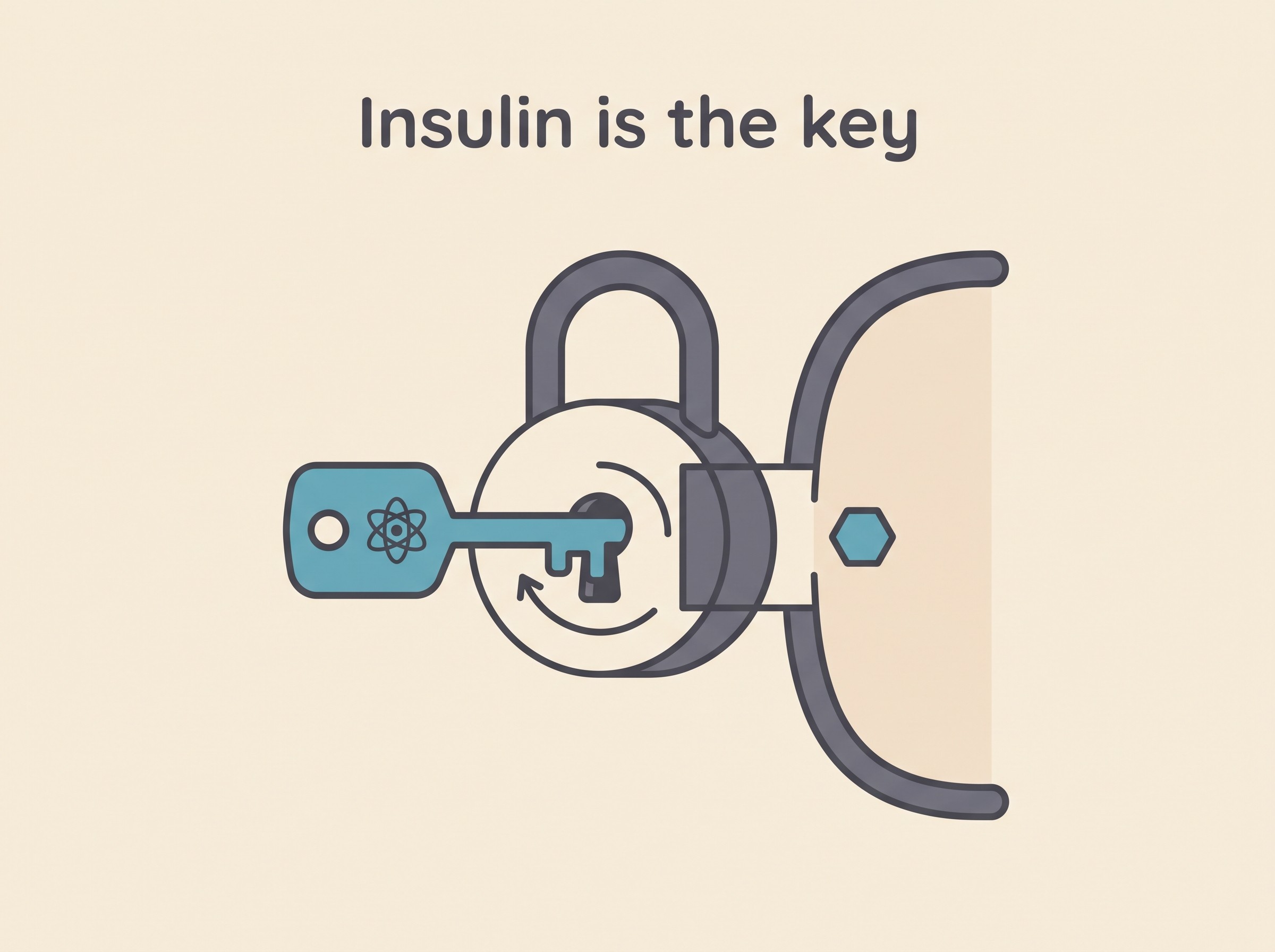
Diabetes is what happens when that key system fails. And here's the part that catches most owners out, because it's where so much of the confusion I meet comes from: it can fail in two genuinely different ways, which is why a dog's diabetes and a cat's diabetes are really two different diseases. In a dog, there's no key left. In a cat, the locks have usually stopped responding. The end result is the same, sugar trapped in the blood while the cells go hungry, but the fault and the outlook differ. The full side-by-side comparison lives in the dog-versus-cat guide.
Dogs: when there's no key left
In dogs, diabetes looks very much like human type 1. The pancreas simply stops making enough insulin, because the cells that produce it, the beta cells, have been lost, and the loss isn't subtle. When researchers examined the pancreases of diabetic dogs they found a roughly twelve-fold reduction in beta-cell area compared with healthy dogs, and crucially that profound loss was present even in newly diagnosed cases (Shields et al., 2015). By the time a dog shows signs, the insulin factory has effectively gone.
That single fact explains almost everything about canine diabetes. It's why dogs are insulin-dependent for life: you can't ask a pancreas to make a hormone when the cells that make it no longer exist, so the insulin has to come from outside, by injection, for good. And it's why, unlike cats, dogs essentially don't go into remission, because there's no reservoir of cells to coax back to work (Shields et al., 2015; MSD Veterinary Manual). With a dog, then, we're not chasing a cure; we're settling in for steady, manageable, lifelong control, and dogs generally do very well on exactly that.
Why the beta cells die varies, from immune destruction to bouts of pancreatitis that take the insulin-producing cells down with them (Gilor & Graves, 2023). One canine wrinkle can change a dog's whole future: in entire (unspayed) female dogs, the hormone swings after a season can drive a powerful insulin resistance that tips some into diabetes, which is why spaying becomes part of the treatment (Gilor & Graves, 2023). The rest of that story sits in the comparison guide linked above.
Cats: when the locks stop listening
A cat's diabetes is a different animal, almost literally. Around three-quarters to four-fifths of diabetic cats have something that closely resembles human type 2, where the problem isn't a lack of insulin but insulin resistance: the body still makes the key, but the locks have stopped responding to it (Taylor et al., 2025; MSD Veterinary Manual). The pancreas compensates by making more and more insulin to force the doors open, but over time those overworked beta cells start to fail too, often with a deposit called amyloid building up in the insulin-producing tissue and adding to the damage (MSD Veterinary Manual; Taylor et al., 2025). Carrying too much weight is the biggest reversible driver of that resistance, which is why an overweight cat is set up for this disease (Taylor et al., 2025).
Here is the hopeful part, and it's a real one. Because a cat's beta cells aren't all destroyed the way a dog's are, just overwhelmed and partly failing, they can sometimes be pulled back from the brink. Relieve the strain early enough, with the right diet and good glucose control, and a meaningful number of cats start making enough of their own insulin again and come off injections altogether. We call that remission (Taylor et al., 2025). It's not every cat, and the window is widest in the first weeks to months, so it deserves a proper treatment of its own: see feline diabetic remission and, for the wider feline picture, feline diabetes explained. For now, just hold the contrast: dog, no key, no remission; cat, faulty locks, remission possible.
One thread ties the two species together and makes both worse if we leave them: glucotoxicity. High blood glucose isn't only a symptom of diabetes, it's part of the engine. Chronically high sugar is itself toxic to the beta cells, poisoning the very cells meant to fix the problem, so high glucose begets more failing insulin, which begets higher glucose, a vicious circle (Taylor et al., 2025; Behrend et al., 2018). In cats much of that is reversible if we break the cycle quickly, which is part of why early control opens the door to remission. That's why we don't shrug at high numbers and wait.
Reading the four classic signs
Now the satisfying bit. Almost every owner arrives having noticed some combination of the same four things, drinking a lot, weeing a lot, losing weight yet eating well, often with a tiredness on top. None of it is random; it's all downstream of sugar trapped in the blood.
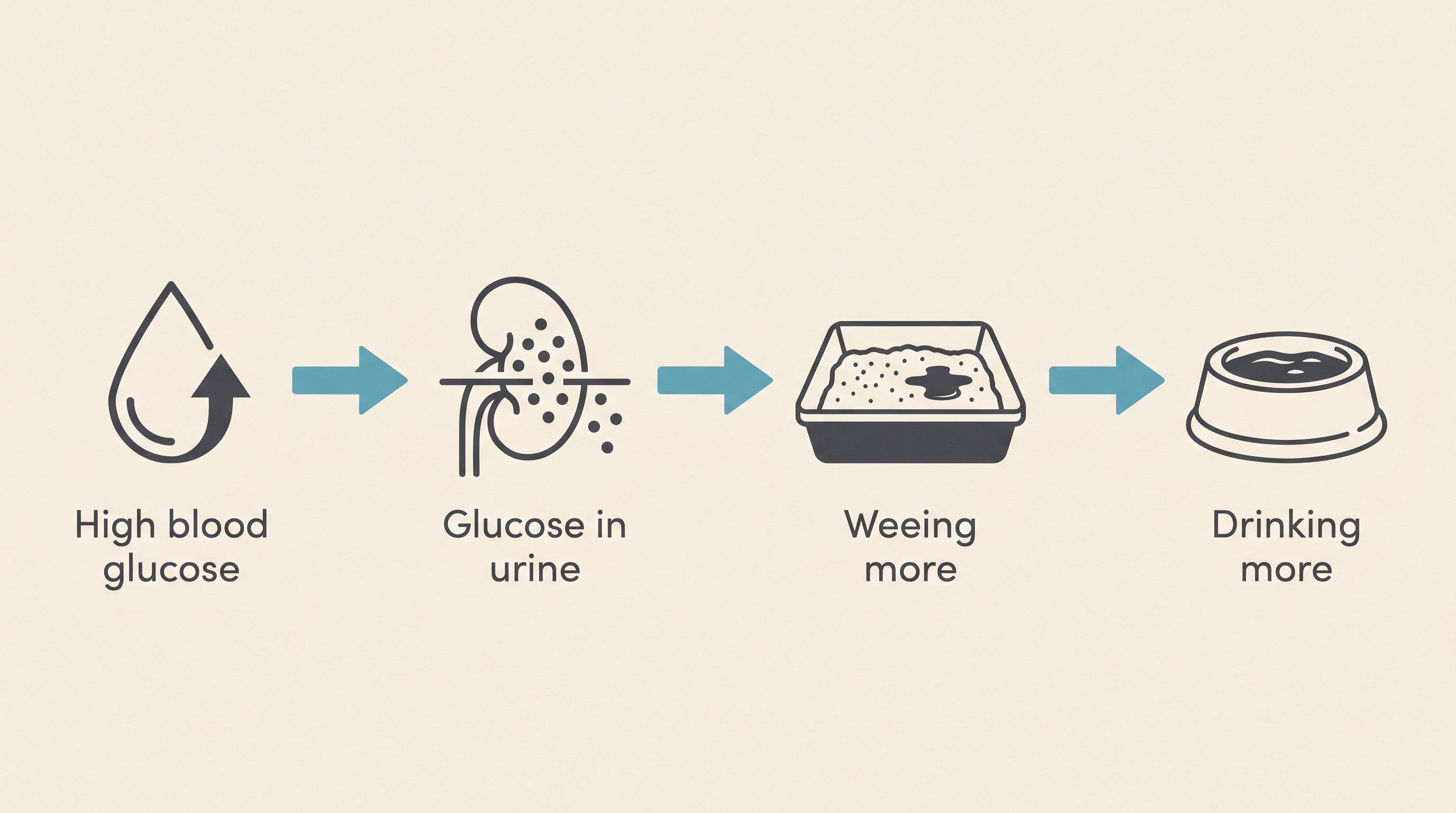
Take the drinking and weeing, usually what tips an owner off. The kidneys filter the blood and reclaim the good stuff, glucose included, but they can only reabsorb so much. Once blood glucose climbs above a certain ceiling, the renal threshold, the excess spills into the urine. That threshold sits at roughly 10 mmol/L (about 180 mg/dL) in dogs and noticeably higher, around 15 to 16 mmol/L (about 280 mg/dL), in cats (MSD Veterinary Manual). And here's the slightly cruel part: glucose in the urine drags water out with it by simple osmosis, so the pet produces far more urine than normal (your vet will call this polyuria), and then becomes desperately thirsty and drinks to keep up (polydipsia). As a rough yardstick, a dog drinking more than about 100 ml per kilogram of bodyweight a day is drinking abnormally, and cats sit lower again (Today's Veterinary Practice).
Now the one that confuses owners most: how can a pet be eating well, even ravenously, and still lose weight? Because for all the sugar swilling about in the blood, the cells themselves are starving. Without the insulin key working, glucose can't get inside to be used, so the body does what it does in any famine and breaks down its own fat and muscle for fuel, often quite rapidly (MSD Veterinary Manual; Behrend et al., 2018). And because the cells genuinely aren't being fed, the brain keeps shouting that the body is hungry, so appetite stays strong or even increases (polyphagia) as the animal wastes. The tiredness fits the same logic: cells starved of their main fuel have less to run on (MSD Veterinary Manual).
Learning to read those signs over time, using thirst, appetite and energy as a gauge of how control is going, is its own skill: that belongs to what to watch at home. This page is about why the signs happen; that one is about using them.
One last point, because owners often fixate on the urine dipstick from the vet's. Sugar only shows up in the urine once blood glucose has already passed the renal threshold, so a positive test is a useful flag but a blunt, after-the-fact one, blunter still in cats (MSD Veterinary Manual; Behrend et al., 2018). Diabetes is diagnosed and controlled on blood glucose, not a urine stick, and never on a single reading: a lone high glucose at the surgery is especially weak proof in a cat, whose glucose can spike from the stress of the visit alone, and even at home ordinary human glucometers tend to read a pet's blood lower than it really is (Behrend et al., 2018). How a diagnosis is confirmed belongs to how diabetes is diagnosed; the principle to take now is simply that we react to the trend, not a single number.
Left untreated, what actually happens
It's fair to ask what the harm is in a bit of high blood sugar. The answer is that untreated diabetes does real damage, and two consequences make the urgency clear. The dangerous one is fast: with no usable glucose reaching the cells, the body's emergency fuel system floods the blood with acidic by-products called ketones until it literally turns acidic, a life-threatening emergency called diabetic ketoacidosis (MSD Veterinary Manual; Behrend et al., 2018). It's why an untreated or unwell diabetic can go downhill frighteningly fast, and it's covered in full, warning signs and all, in diabetic ketoacidosis. The other is slower but very common in dogs: excess glucose in the lens pulls water in and clouds it, so diabetic dogs develop cataracts, often within the first year or so of diagnosis and sometimes quite suddenly (Beam et al., 1999; MSD Veterinary Manual). Cats rarely get them; the detail sits in diabetic cataracts in dogs. I raise neither to frighten you, but to make a point: "manageable" and "harmless if ignored" are very different things.
And that's the note to end on, because the mechanism points straight at the fix. We replace the insulin the body can't use, in both dogs and cats, usually as an injection twice a day given with meals, and in doing so we reverse the very signs we've walked through: the thirst settles, the weeing eases, the weight comes back, the energy returns (MSD Veterinary Manual). There's a learning curve and a few firm safety rules to absorb early, such as never doubling up if you're unsure a dose went in, but it's a routine thousands of owners fold into ordinary life, and it buys a pet years of feeling well. The how-to comes next, and when you start, the glucose companion tool will keep your readings in one place so the monitoring doesn't feel like guesswork. For now you've got the part that makes the rest make sense: what diabetes actually is, and why your pet has been telling you so all along.
References
- Beam, S., Correa, M. T., & Davidson, M. G. (1999). A retrospective-cohort study on the development of cataracts in dogs with diabetes mellitus: 200 cases. Veterinary Ophthalmology, 2(3), 169-172.
- Behrend, E., Holford, A., Lathan, P., Rucinsky, R., & Schulman, R. (2018). 2018 AAHA Diabetes Management Guidelines for Dogs and Cats. Journal of the American Animal Hospital Association, 54(1), 1-21.
- Gilor, C., & Graves, T. K. (Eds.). (2023). Etiology and pathophysiology of diabetes mellitus in dogs. In Diabetes Mellitus in Cats and Dogs (Vol. 53, Issue 3). Veterinary Clinics of North America: Small Animal Practice.
- MSD Veterinary Manual. Diabetes Mellitus in Dogs and Cats (professional edition). Merck & Co.
- Shields, E. J., Lam, C. J., Cox, A. R., Rankin, M. M., Van Winkle, T. J., Hess, R. S., & Kushner, J. A. (2015). Extreme beta-cell deficiency in pancreata of dogs with canine diabetes. PLoS ONE, 10(6), e0129809.
- Taylor, S., Cannon, M., Church, D., Fleeman, L., Fracassi, F., Gilor, C., Mott, J., Niessen, S., et al. (2025). iCatCare 2025 consensus guidelines on the diagnosis and management of diabetes mellitus in cats. Journal of Feline Medicine and Surgery, 27(11), 1098612X251399103.
- Today's Veterinary Practice. Companion animal polyuria and polydipsia.
Keep track of how your pet is doing
The owners who cope best are the ones who notice changes early. A simple health log shows you what is working, and what is not, before the next vet visit.
Start tracking, freeYou're not doing this alone
Compare treatment journeys and talk to owners managing diabetes mellitus. Free to join.
Join PetsLikeMine