

Staying in Remission, and Spotting a Relapse Early
Alastair Greenway
BVM&S MRCVS
There's a particular happiness I see in owners whose cat has just come off insulin. Relief, mostly, after weeks of injections and finger-pricks and worry. And then, usually in the same breath, a flicker of something else: but is it really gone? Will it come back?
The answer is more reassuring than the fearful version you'll have half-imagined. Remission in a cat is real and can last a long time. But it isn't a cure. Your cat's pancreas recovered enough to manage on its own again, which is wonderful, but the cells that do that job came through a hard time and stay a little fragile. So the task now isn't to celebrate and forget. It's to protect what your cat earned, keep a light watch for the small signs it's slipping, and know what to do if it is. Do those three things and most cats stay well.
If you're still working to get your cat there, the remission playbook is where that job lives. This page begins the day the insulin stops.
Remission, defined plainly
Let me pin the word down, because a lot of worry comes from a fuzzy grasp of it. A cat is in remission when it holds normal blood glucose and stays free of diabetic signs without any insulin, for at least around four weeks (Taylor et al., 2025; Zini et al., 2010). The injections stop, the glucose behaves, the thirst and the weeing settle. To you it looks, blessedly, like an ordinary cat again.
One paragraph underneath explains everything that follows. Remission happens because persistently high blood glucose is toxic to the insulin-producing beta cells (a phenomenon called glucotoxicity), and relieving it early enough lets a useful number of those cells recover (Gostelow et al., 2014; Zini et al., 2010). The full why-cats-can-do-this story sits in feline diabetic remission; the point that matters here is the caveat. Recovered is not the same as new. The underlying insulin resistance and the strain on those cells haven't vanished, so your cat sits closer to the diabetic threshold than a cat that was never diabetic (Gostelow et al., 2014; Taylor et al., 2025). The practitioners' way of putting it is blunt: once a diabetic, always a diabetic, always at some risk of needing insulin again (FelineVMA Diabetes Toolkit). That isn't meant to frighten you; it's the fact that makes the rest of this page make sense.
So remission is, by definition, a temporary state (Taylor et al., 2025). That reads bleakly, but hold it alongside this: cats that achieve remission have been shown to live longer and to enjoy a better owner-reported quality of life than cats that don't (Taylor et al., 2025; Rothlin-Zachrisson et al., 2023). You're not guarding something doomed; you're guarding something good that wants a little looking after.
Keep doing what earned it
Here's what owners most often let slip, quietly and with the best intentions: the diet and the weight that helped win remission are the same things that keep it, and the moment to relax them is not when the insulin stops.
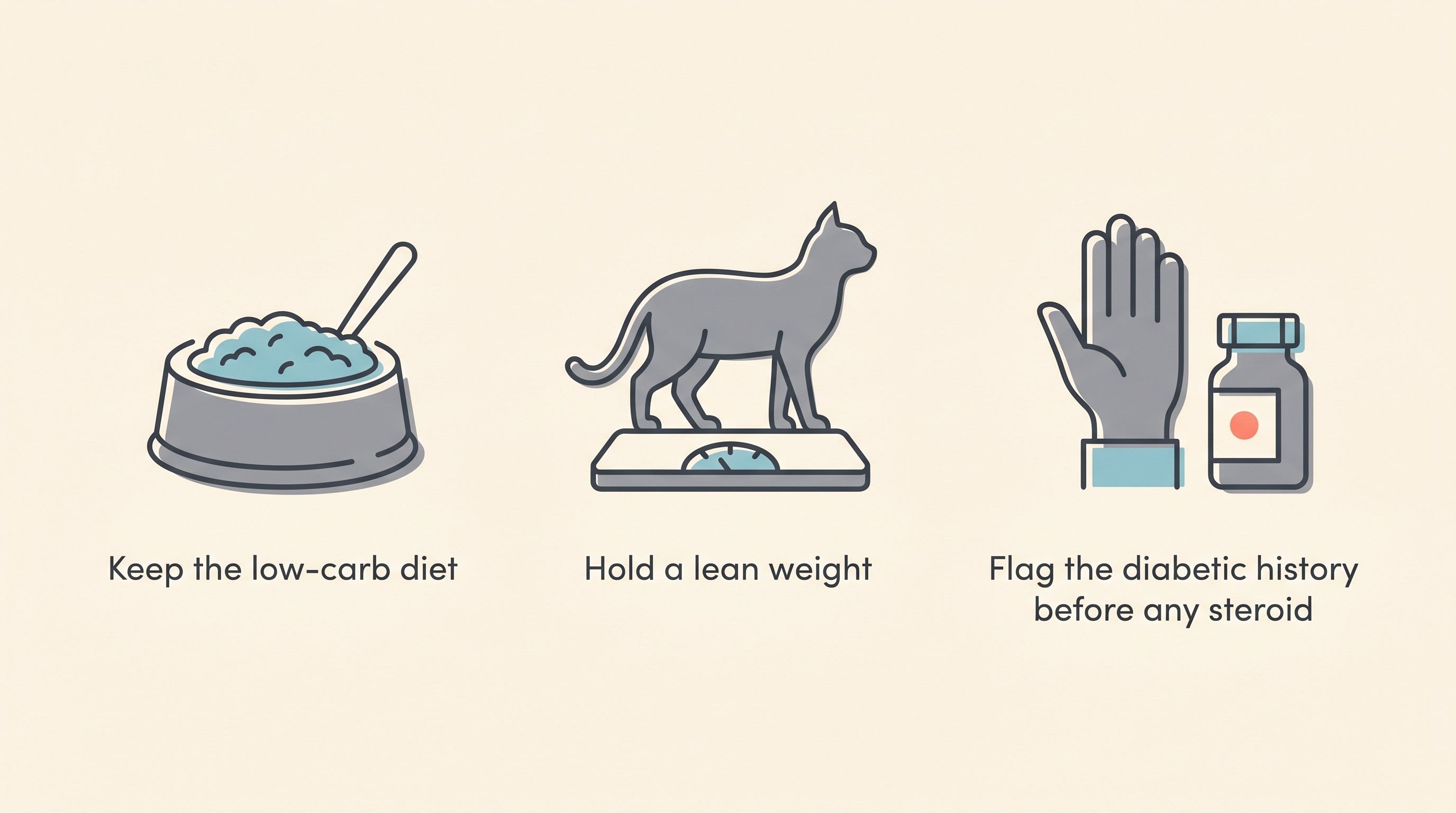
Diet is the lever you control most. A low-carbohydrate, wet or canned diet is the most consistent protective factor we have: in one study, commercial wet food carried markedly higher odds of remission, and far higher odds again of remission without relapse (Rothlin-Zachrisson et al., 2023; Taylor et al., 2025). So the worst thing you can do, having got your cat off insulin on a careful low-carb regime, is drift back to high-carbohydrate biscuits because life got busy: that bowl is precisely the metabolic stress those recovered beta cells don't need. Keep the food the same. The detailed rationale sits in diet as a lever.
Weight is the other half, because obesity drives the insulin resistance that strains the pancreas in the first place (Taylor et al., 2025). A cat that slimmed down to reach remission and then quietly puts the weight back on is loading the dice for relapse. Keeping a lean weight and holding the diet are, in fact, exactly what the consensus links to a longer-lasting remission (Taylor et al., 2025). A lean cat is a protected cat.
Steroids: the trigger worth guarding against
If there's one avoidable thing I want every owner of a remitted cat to know, it's this. Of all the things linked to relapse, corticosteroids are the one you can most often prevent, and the signal is striking: in the cohort that looked hardest at this, cats given a corticosteroid during remission had an estimated odds of relapse close to seven times those that weren't (Gottlieb et al., 2015). That came from a small group, so the precise number is uncertain, but the direction fits everything else we know. The feline consensus names glucocorticoid therapy as a recognised trigger for diabetes in cats, and advises that any cat on a meaningful course of steroids be monitored for diabetes developing (Taylor et al., 2025). The mechanism ties straight back to glucotoxicity: steroids push glucose up and worsen insulin resistance, exactly the stress a recovered pancreas struggles with. In cats with no diabetes at all, a course of high-dose prednisolone tipped nearly one in ten (9.7%, 14 of 143 cats) into a diabetic state, most within three months (Nerhagen et al., 2021). If steroids can do that to a metabolically healthy cat, you can see why they are a genuine hazard to one whose beta cells already run on reduced reserves.
The practical takeaway is simple and entirely within your control. Steroids turn up in more places than owners expect: skin and itch creams and tablets, ear drops, joint injections, asthma inhalers. So whenever any vet, including one who doesn't know your cat's history, reaches for a steroid, say it out loud: this cat had diabetes and is in remission, is there a non-steroid option? Often there is, and even when a steroid is genuinely the right call, your vet will want to know so they can watch for relapse afterwards. Other triggers you can't always prevent, a new illness or infection and simply getting older, add strain too (Taylor et al., 2025), which is why the monitoring below carries on.
Monitoring after the injections stop
Monitoring carries on after the injections stop, though far lighter than before, for two reasons. The first is obvious: to catch a relapse early, while it's a tweak rather than a crisis. The second surprises people. If your cat slipped into remission while still on a dose of insulin, and nobody noticed, that insulin going into a cat that no longer needs it can cause dangerous, even life-threatening, hypoglycaemia (Zini et al., 2010; Taylor et al., 2025). It's one reason your vet weans insulin carefully and asks you to keep watching as the dose comes down. A wobbly, weak, dull or trembling cat in this window may be having a hypo and needs the gums-glucose rescue and a vet straight away; the full how-to is in the hypoglycaemia emergency guide.
A periodic urine glucose dipstick at home is cheap, non-invasive and genuinely useful: persistent glucose in the urine is an early warning that control is slipping (Taylor et al., 2025; FelineVMA Diabetes Toolkit). Some owners add occasional home blood glucose spot-checks or an intermittent sensor, and your vet will check a fructosamine (the blood test that reflects the average glucose over the previous couple of weeks) plus a weight at rechecks. The combination to aim for is straightforward: a negative urine glucose, a normal fructosamine and a well, stable cat means you're staying in remission (Taylor et al., 2025). Don't chase a single perfect number or react to one stray high reading: cats in particular can spike their glucose from the stress of a vet visit alone, so it's the trend and the signs together that matter (Behrend et al., 2018). Jot the odd spot-check, urine result or weight into the Glucose Companion and it keeps a tidy picture for your vet, so "is anything drifting?" becomes a five-second question rather than a guess.
Signs a relapse is coming
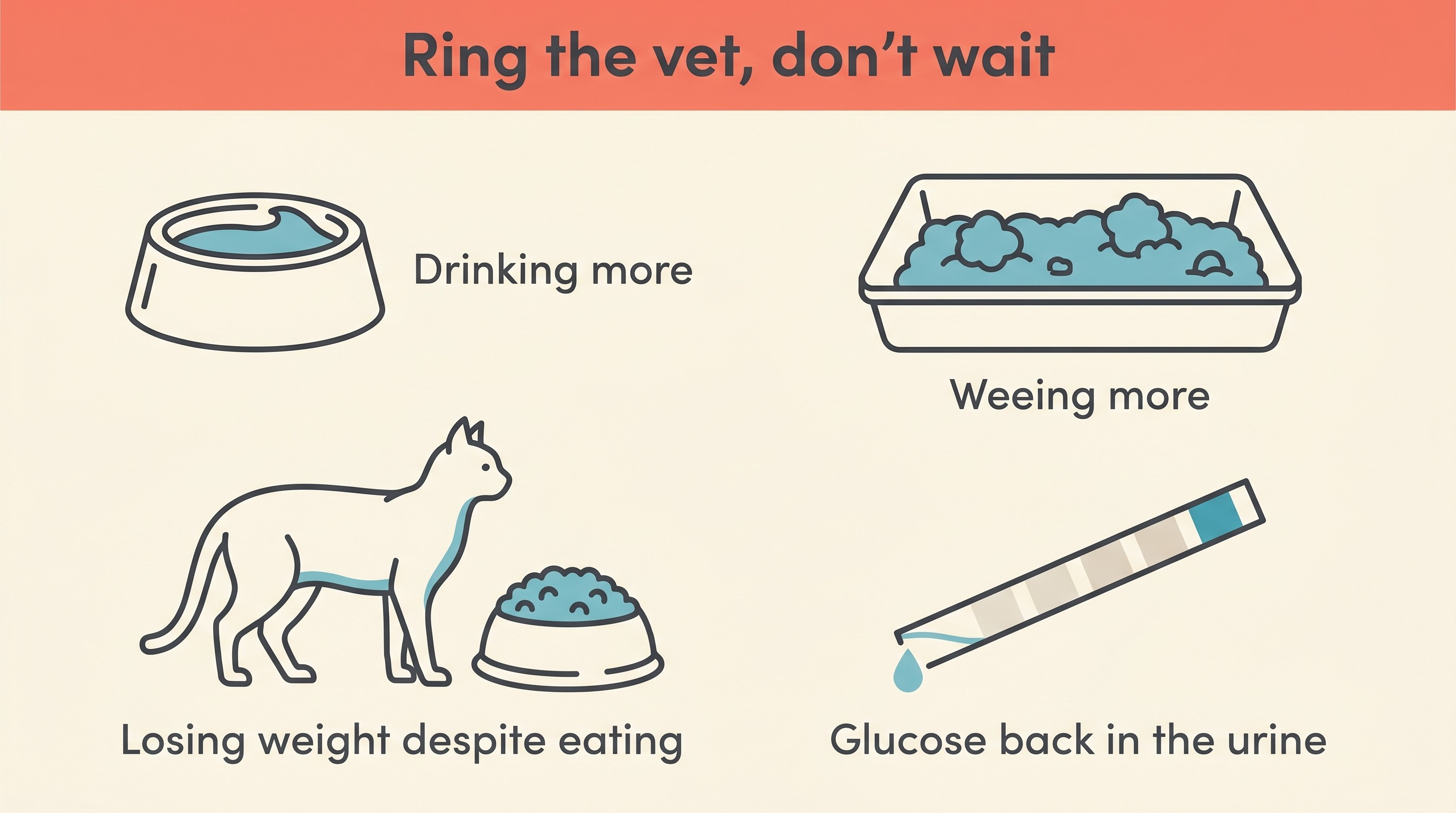
A relapse is the original diabetes coming back, so the signs are the very ones that brought you to the vet the first time. Four to watch for:
- Drinking more. A return of noticeable thirst, the cat hovering at the water bowl or the tap again.
- Weeing more. Bigger or more frequent litter clumps, a tray that needs changing more often.
- Weight loss despite eating well. Often with a normal or even increased appetite: a hungry cat that's getting thinner is the cruel hallmark of diabetes.
- Glucose back in the urine. Which is exactly why that cheap home dipstick earns its place.
You'll know these signs already, which is your advantage second time around: you spotted them once. The full how-to of measuring water intake and the wider menu of things to watch sit in what to watch at home. Catching them early, rather than letting a missed relapse build quietly toward a diabetic ketoacidosis crisis, is the whole reason the light-touch monitoring is worth keeping up.
If you think it's relapsing
Act, but don't panic, and don't act alone. The rule is the same one that governs the whole disease: a single high reading is not proof. So if you spot the signs or a stubbornly positive urine dipstick, ring your vet, don't dig out the old insulin and start guessing. Never restart or adjust insulin yourself; the hypo risk is too real for that.
Your vet's job is to confirm what's going on: usually a fructosamine or repeat glucose to tell a genuine relapse from a one-off stress spike, plus a hunt for a correctable trigger, a recent steroid, a brewing infection, weight that's crept back on. Sometimes fixing that trigger is enough. If diabetes has genuinely returned, your vet will move to get good control back without delay, because treating early in the course of the disease gives the best odds of a good outcome and of remission (Taylor et al., 2025).
And here's a real glimmer of hope, offered without spin. Some cats that relapse go into remission a second time, particularly when a correctable trigger like a steroid is removed, though a second remission is generally less likely than the first (Taylor et al., 2025). So hope for one, but don't bank on it; either way your cat can live well with diabetes managed, and if a second remission is the goal, the same playbook that won the first one is where to look.
Living well, not fearfully
Here's the real shape of it. Somewhere between roughly 13% and 40% of remitted cats relapse, most within the first year, which is why we keep watching (Taylor et al., 2025), with the two best individual cohorts landing near a third (Gottlieb et al., 2015) and a little under four in ten (Rothlin-Zachrisson et al., 2023). But that means many, often the majority, do not, especially the cats whose owners hold the diet, keep the weight off, refuse the avoidable steroids and catch any drift early. And the most reassuring number I know sits at the other end: in one study, the cats that on testing were genuinely metabolically normal off insulin, with both a normal fasting glucose and a normal glucose tolerance, none of them relapsed over a median follow-up of around 527 days (Gottlieb et al., 2015). A cat that's truly come good off insulin can stay good for a long time. A relapse, if it comes, is not your failure, but everything above genuinely moves the odds.
So the right note to end on isn't vigilance, it's perspective. Keep the food the same, keep your cat lean, say the sentence about steroids when it matters, glance at a urine dipstick now and then, and otherwise let your cat be a cat. That's not a life lived watching for disaster. It's a well cat, a sensible routine, and you quietly doing the few small things that keep a good thing going.
References
- Behrend E, Holford A, Lathan P, Rucinsky R, Schulman R. 2018 AAHA Diabetes Management Guidelines for Dogs and Cats. Journal of the American Animal Hospital Association. 2018;54(1):1-21.
- FelineVMA (formerly AAFP) Diabetes Educational Toolkit: FAQ and Remission Strategy.
- Gostelow R, Forcada Y, Graves T, Church D, Niessen S. Systematic review of feline diabetic remission: separating fact from opinion. The Veterinary Journal. 2014;202(2):208-221.
- Gottlieb S, Rand JS, Marshall R, Morton J. Glycemic status and predictors of relapse for diabetic cats in remission. Journal of Veterinary Internal Medicine. 2015;29(1):184-192.
- Nerhagen S, Moberg HL, Boge GS, Glanemann B. Prednisolone-induced diabetes mellitus in the cat: a historical cohort. Journal of Feline Medicine and Surgery. 2021;23(2):175-180.
- Rothlin-Zachrisson N, Öhlund M, Röcklinsberg H, Ström Holst B. Survival, remission, and quality of life in diabetic cats. Journal of Veterinary Internal Medicine. 2023;37(1):58-69.
- Taylor S, Cannon M, Church D, Fleeman L, Fracassi F, Gilor C, Mott J, Niessen S, et al. iCatCare 2025 consensus guidelines on the diagnosis and management of diabetes mellitus in cats. Journal of Feline Medicine and Surgery. 2025;27(11):1098612X251399103.
- Zini E, Hafner M, Osto M, et al. Predictors of clinical remission in cats with diabetes mellitus. Journal of Veterinary Internal Medicine. 2010;24(6):1314-1321.
Keep track of how your pet is doing
The owners who cope best are the ones who notice changes early. A simple health log shows you what is working, and what is not, before the next vet visit.
Start tracking, freeYou're not doing this alone
Compare treatment journeys and talk to owners managing diabetes mellitus. Free to join.
Join PetsLikeMine