

Making the most of the time you have left together
Alastair Greenway
BVM&S MRCVS
There comes a point with an old dog or cat when the question is no longer whether they are getting on in years, but how to make the time you still have a good one. It is a different sort of question from the ones the vet usually answers. It has nothing to do with tests or diagnoses, and everything to do with ordinary days.
That is what this article is about, and nothing else. Not the goodbye, which lives gently elsewhere and is not for today. Not how to measure quality of life, which has its own guide. Just the warm, practical work of spending the time you still have in a way that is genuinely lived, for them and for you.
One instinct is worth naming first, because it quietly steals this time from people. When we can see a loss coming, many of us start to brace, holding the animal a little at arm's length to soften the blow later. It is deeply human, and it does not work. It only shrinks the good part that is happening now. The veterinary hospice service Lap of Love puts the antidote plainly, urging owners to "cherish each and every day you have with your pet" rather than pull away. If the bracing is what you feel most, that is grief arriving early, and we have written about it tenderly in anticipatory grief. For now, hold this: the animal in front of you does not know they are old. They know whether you are here.
More than a bucket list
The phrase "make the most of the time" can land like pressure, conjuring a frantic dash of road trips and grand last adventures while the clock runs down. Let that idea go. A big day out is lovely if your pet is genuinely up to it, but for a frail old animal it is often more exhausting than joyful, and it is almost never the thing that comforts owners afterwards. What comforts them is the small stuff: the favourite sunny spot, the particular treat, ten unhurried minutes of fuss on the floor.
There is a simple, generous way to think about what you are really doing here, and it comes from how the profession defines a good life for an animal. International Cat Care describes quality of life as "a balance between positive and negative experiences," where a good life means "many positive experiences and very few negative ones." That is your whole job, distilled. You are not trying to stop time or fix old age. You are tipping the daily balance, gently and repeatedly, towards the good: more warm naps, more favourite food, more easy contact, fewer aches and indignities. Lap of Love frames the same idea as a daily practice rather than a finish line: "take one day at a time, whether it's a good or bad day," and "focus on the best parts of that day." You do not need a plan for the whole road. You need today to be a little good, and then tomorrow.
Comfort is the floor everything stands on
It is tempting to skip past this part, but it is the part that makes everything else possible: you cannot build good time on top of pain you have not treated. Joy needs a comfortable body to happen in.
This matters because comfort problems in old animals hide, and we are primed to miss them. Slowing down is a symptom, not a diagnosis, and most of what gets shrugged off as "just getting old" is treatable pain or disease. The point is not to alarm you. It is the opposite. It means a stiff, withdrawn, can't-be-bothered old dog or cat is often a pet whose good days are being quietly stolen by something a vet can ease. There is more on telling the difference in our guide to whether it is pain, age, or disease, and if the slowing-down is about achy joints, the Arthritis space and the Mobility Check are where to go next. Pain relief is always a conversation with your vet, never something to reach for off a shelf, but it is genuinely one of the kindest gifts you can give an old animal: it hands them back the energy to enjoy the time they have.
One thing in particular never belongs in the "just old age" basket. A pet quietly losing weight is rarely telling you something harmless, and it earns a vet visit on its own, because the causes worth catching include kidney disease, an overactive thyroid in cats, diabetes, dental pain and others, several of which can be managed in ways that buy real, comfortable time. We go into this properly in weight loss in an older pet. Catching it is not the opposite of cherishing them. It is part of it.
This is also the spirit of modern senior care. The profession's own approach has shifted towards what vets call "comfort over cure," recognising that good palliative care "provides improved quality of life to pets at any stage of life" and can run right alongside ongoing treatment. Comfort is not what you do when there is nothing left to do. It is the whole point, all the way through.
Fitting the joy to a dog's body
Once comfort is looked after, the work becomes lovely: finding the version of your dog's favourite things that still fits the body they have now. The trick is to keep the joy and shed the strain.
The richest place to start is the nose. A long route march may be beyond an arthritic old dog, but the part of a walk dogs love most was never the distance. VCA Animal Hospitals notes that "sniffing is a great way to provide mental stimulation for dogs," and that "a scent walk shifts the focus from the distance traveled or a fast pace to the scents your dog discovers." So let them. A slow, snuffly amble to the end of the road and back, where they set the pace and read every lamppost, can be more satisfying to an old dog than the brisk loop they can no longer manage, and far kinder on the joints. At home, scatter a handful of kibble in the grass to hunt, or hide a treat under one of three cups. Mental work tires a dog gently and leaves them content.
There is more to this than passing the time. A two-year study in older beagles found that behavioural enrichment and a fortified diet "can slow age-dependent cognitive decline", and that the two together did more than either alone. Keeping an ageing dog's mind gently busy is doing real good. There is more on this in keeping an older pet moving and, if your dog's mind itself is changing, in our gentle guide to the first signs of an ageing mind.
A few small things turn the ordinary day into a good one:
- Make the resting comfortable, not just the playing. A thick, supportive bed somewhere warm and draught-free, away from the cold floor, is a daily kindness an old dog feels in every joint.
- Keep the rhythm predictable. Meals, gentle outings and bedtime at steady times settle an ageing dog, and reassure one whose memory is starting to slip.
- Let the menu be a pleasure. Within whatever your vet advises for any conditions, warming food slightly or adding a favourite topper can rekindle the appetite and the joy of a meal.
- Meet them where they are. A dog who used to fetch for an hour may light up at two gentle throws and a cuddle. The wagging is the point, not the distance covered.
Fitting the joy to a cat's world
Cats are too often the afterthought in writing about old age, and it is its own quiet unfairness, because an old cat's good time is just as real and just as makeable. It simply looks different: less about doing, more about a world arranged so they can be comfortably, contentedly themselves.
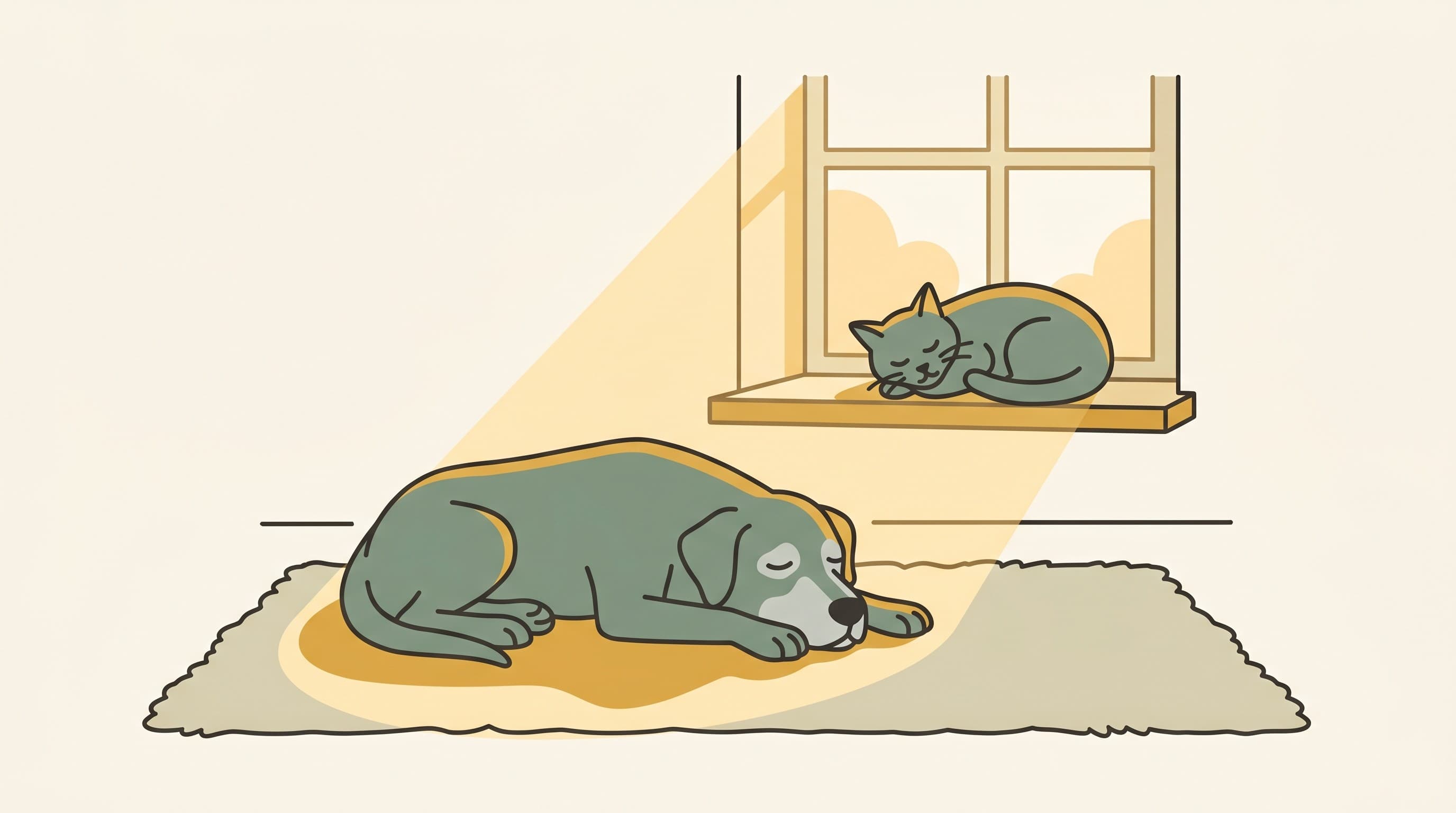
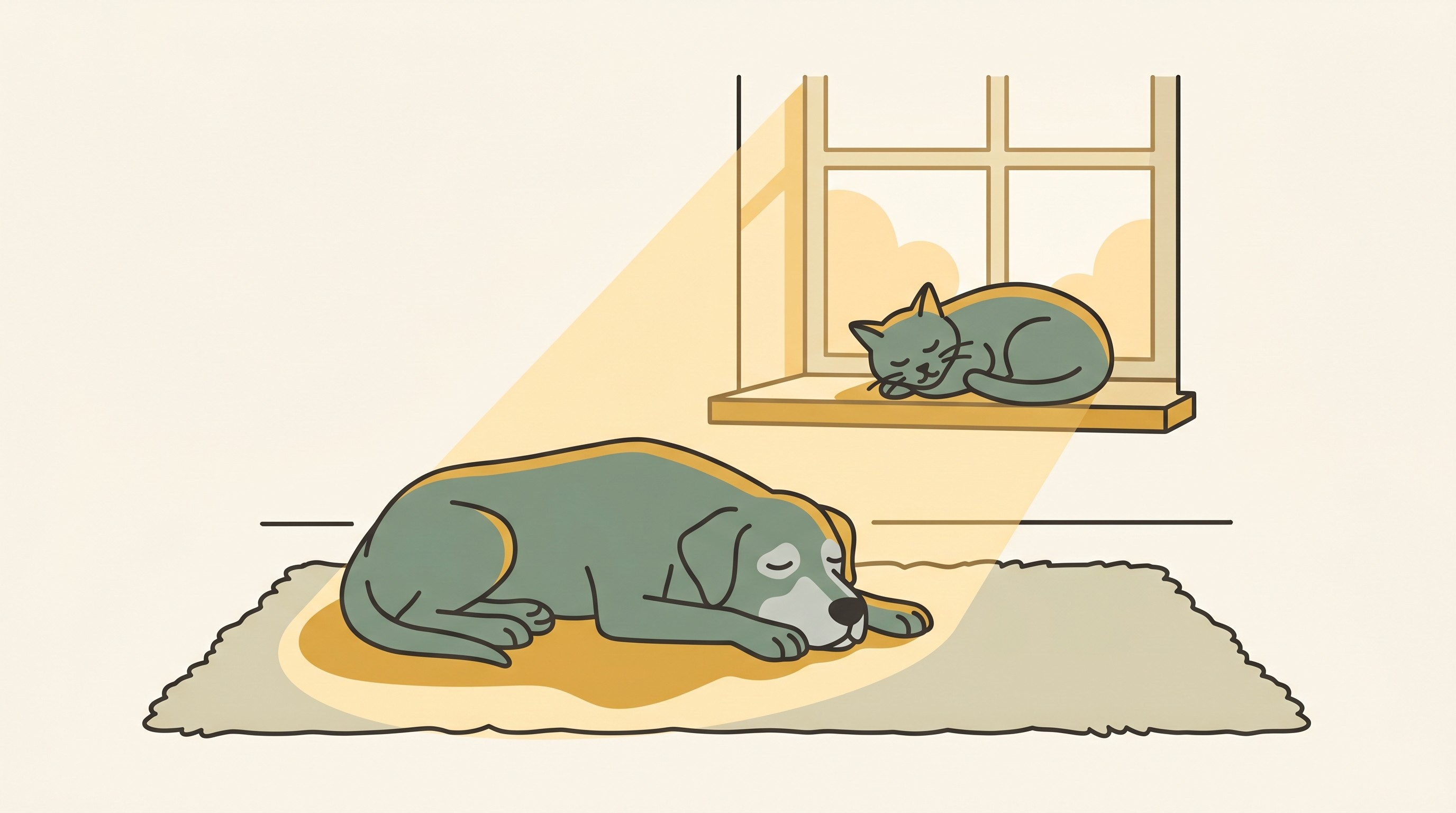
What an elderly cat values most is a body kept warm and resources kept within easy reach. International Cat Care advises that for older cats, food, water and litter trays should be "positioned for easy access," that "older cats may need ramps and steps to reach their favourite sleeping spots," and that "thermal blankets can help keep older cats warm." So give the stiff old cat a heated bed in a sunny window, a ramp up to the spot she always loved, a litter tray she does not have to climb or trek to, and water she does not have to work for. Add gentle, on-her-terms play to her tempo, a feather wand trailed slowly along the floor, a treat to find, and a little help with the grooming she can no longer reach, and you have given her the feline version of a wonderful day.
Reading an old cat takes more attention than reading a dog, because cats are, as VCA puts it, "experts at hiding signs of pain." A cat in discomfort rarely complains. She just stops jumping to the windowsill, grooms a little less so the coat dulls, hides a bit more, gets slow to rise. It is desperately easy to file all of that under "she's just old," but VCA is blunt that while old age is not a disease, "some behavior changes in aging cats are abnormal and may arise from pain," and their rule is a good one to live by: "when in doubt, have it checked out." If your old cat seems to be retreating from her own life, a vet visit may hand a good chunk of it back. And if she is yowling at night, forgetting the litter tray or staring at walls, read feline cognitive dysfunction and helping fading senses, because those changes deserve real help, not resignation.
Keeping the memory of it
Part of making the most of this time is letting yourself keep it, and you will be glad later that you did. None of this needs to be grand.
The memories that comfort people most are the everyday ones, so Lap of Love's suggestion that "spoiling your pet by taking them to special places or sharing delicious treats allows you to create wonderful memories together" is best read gently: the "special place" can be the sunniest corner of the garden. Take the photos now, the unremarkable ones of them asleep in the light. Many owners treasure a paw print pressed into clay, or a snip of fur kept in an envelope. These are small acts, and they cost nothing, and one day they will mean a great deal.
There is a quieter kind of keeping, too, that does double duty. A simple record of the good days, a sun drawn on the calendar, a marble dropped in a jar, the everyday signals gathered in the Senior Wellness Check, is both a memory and a mirror. It lets you look back and see, truthfully, how much good there really was, which on a hard evening can be its own comfort. We explain how to keep one lightly in tracking quality of life, and for a deeper, dedicated quality-of-life log over the long haul there is Sightline (sightline.vet), a separate tool built for exactly that. Used this way, a record is never a verdict on your pet. It is a way of noticing the good while it is happening.
When there is more than one thing to carry
If your old pet is managing several conditions at once, with a handful of medications and more appointments than you would like, the idea of "making the most of the time" can feel almost out of reach, swallowed by the logistics of keeping them going. So a word for you in particular: the goal of all that care is not the care itself. It is the good time it protects.
When a pet is juggling several problems, the kindest organising question, agreed with your vet, is which of these matters most for how they actually feel day to day, and let comfort lead the priorities. You do not have to perfectly optimise everything. You have to keep them comfortable and keep some joy in the days. Our guides to the whole-pet view and the treatment tug-of-war are there for the medical side of that balancing act. And if you are simply worn out, you are in good company and it is not a failure: the profession's senior care guidelines explicitly recognise that ageing is not a disease but a life stage families can "embrace, love, and enjoy", and that good care supports the family too. There are people doing exactly this in our senior pets community, where "what made your old dog's day today" and "I'm exhausted" are equally welcome.
One good thing today
You do not need to do all of this. Making the most of the time is not a project to complete; it is a direction to lean in, one ordinary day at a time. So tonight, do just one thing: give them one small, genuine pleasure suited to the body they have now. The warmed dinner. The slow sniff to the gatepost. The heated bed moved into the last of the sun. Ten minutes on the floor with no phone.
Then two gentle follow-ups. If anything has shifted in their comfort, their appetite, their weight or their nights, book a check with your vet and frame it plainly: "I want to keep them comfortable and enjoying things, what can we do?" That single question, asked early, is how good days get protected. And start, or keep, a light good-days record, so that the warmth of this time is not lost to a tired memory.
The harder questions, the "is it time," the goodbye, and the grief that follows, are held with great care in the Rainbow Bridge space, and there is a gentle guide to what comes next for whenever you are ready. They are there for later. This is not later.