

Is it pain, age, or disease? Reading the slowdown in an older pet
Alastair Greenway
BVM&S MRCVS
The slowdown usually arrives quietly. The walk that used to take in the whole park becomes a slow shuffle to the corner and back. He takes the stairs one careful step at a time now, or waits at the bottom for a lift. She sleeps through things she used to come running for. And at some point you say it out loud, half to reassure yourself: she's just getting old, isn't she. Most owners say it kindly, as a way of giving an old friend some slack.
Old age is not a disease, and it isn't a diagnosis either. "He's just slowing down" describes what you're seeing; it doesn't explain it. And far more often than owners realise, the explanation is something we can actually do something about. The veterinary profession's own senior-care guidance is built on exactly this idea: that an older pet should be assessed properly, not written off, because so much of what looks like inevitable decline turns out to be treatable (2023 AAHA Senior Care Guidelines for Dogs and Cats).
Slowing down is a symptom, not a diagnosis
If you remember nothing else, remember that one line: slowing down is a symptom, not a diagnosis.
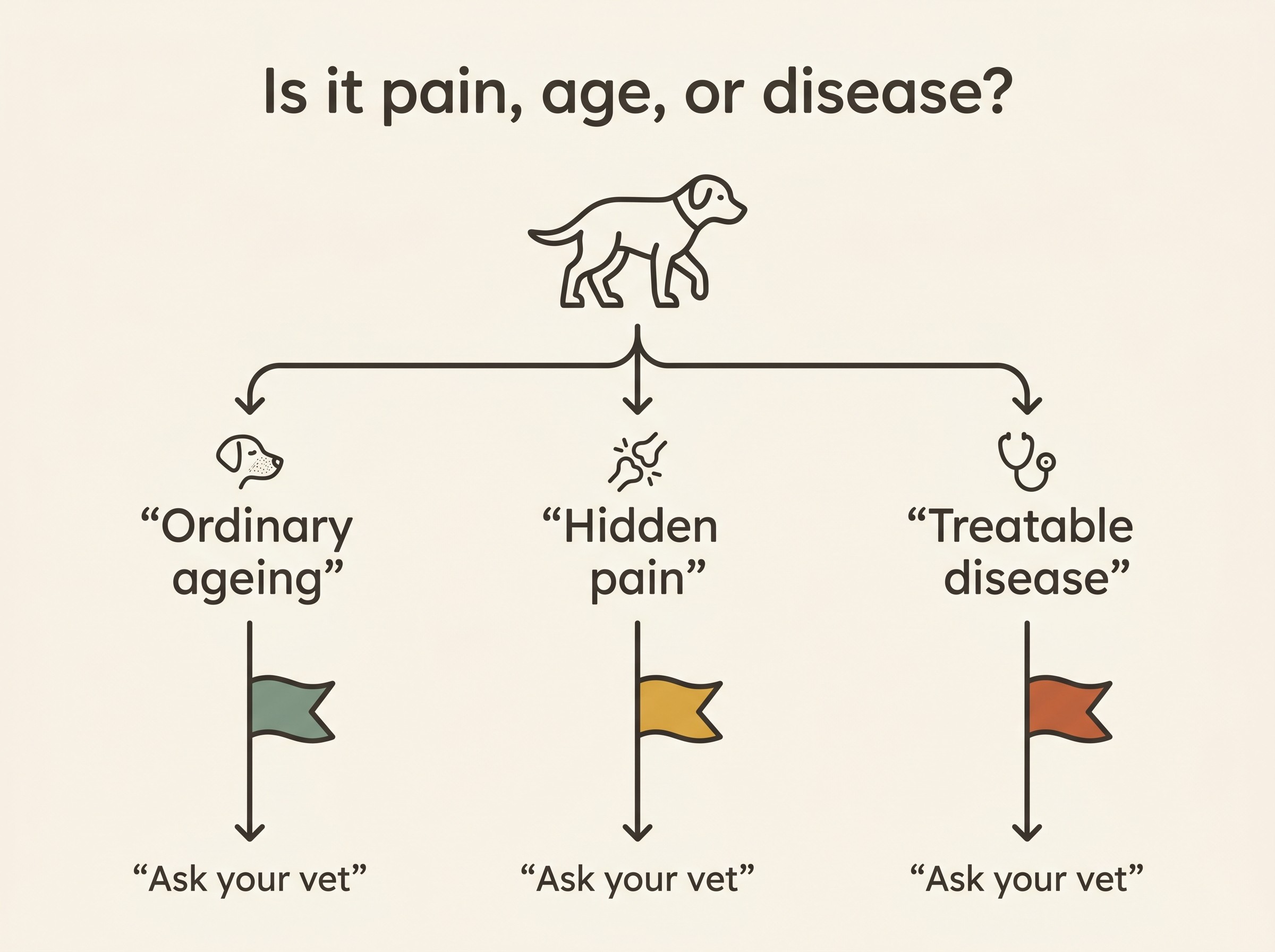
When an older dog or cat gets slower, quieter, stiffer or stranger, there are really three things that could be going on, and they look almost identical from the sofa:
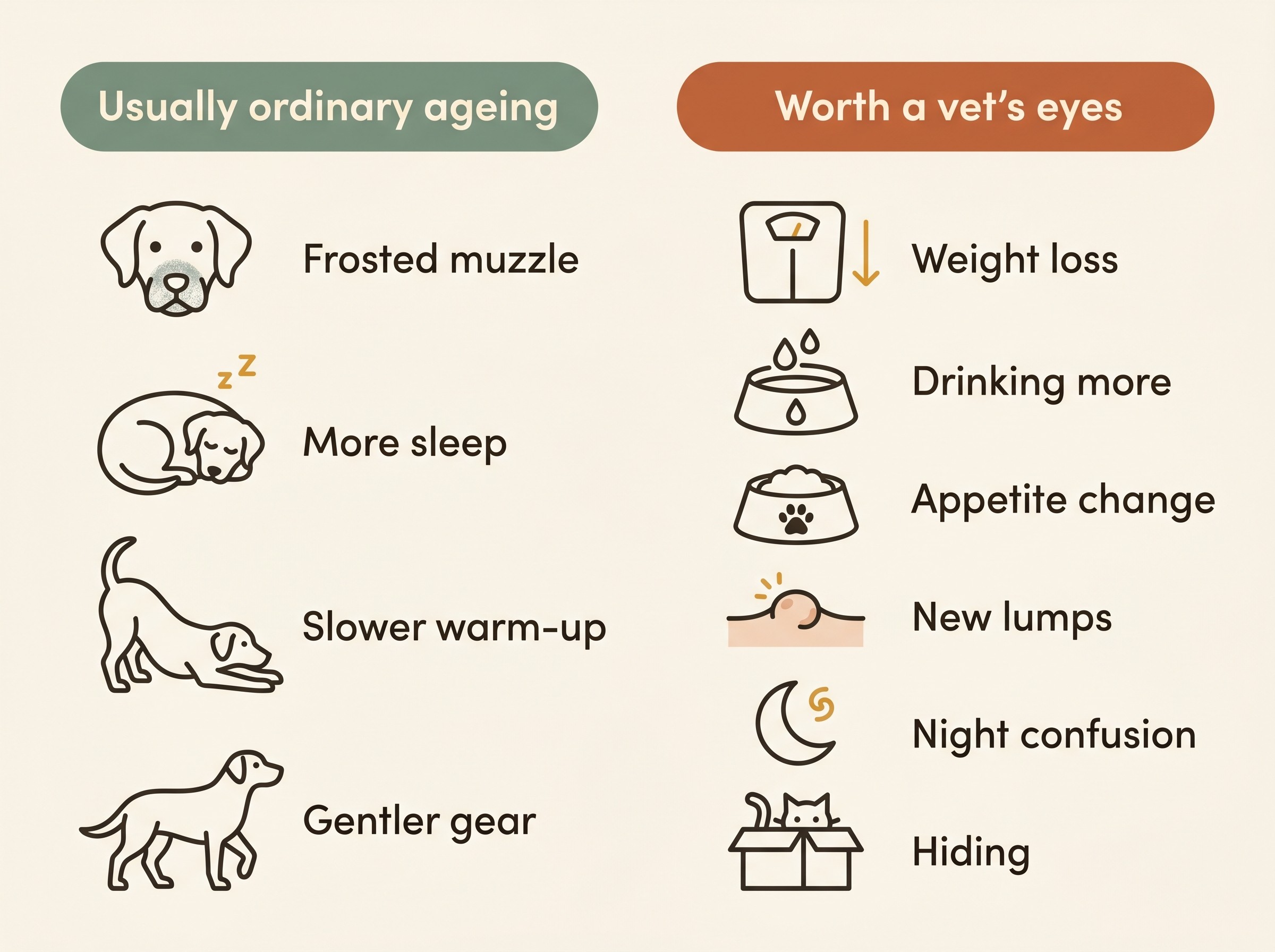
- Genuine ageing. Some slowing is just the years gently catching up: a little more sleep, a slower warm-up on a cold morning, a touch less spring in the jump. Real, and usually nothing to grieve.
- Pain. This is the big one, and the most missed. The reluctant stairs, the shortened walk, the "he's gone grumpy in his old age", the cat who no longer sleeps on the windowsill: an enormous amount of this is treatable pain, usually from sore joints, and we can do a great deal about it.
- Disease. Slowing down can be the first whisper of a treatable illness: kidney disease, an over-active thyroid in a cat, diabetes, dental pain, heart disease, even cancer. These almost never announce themselves; they tiptoe in disguised as "old age".
The trap is resignation. The whole point of telling pain and disease apart from ordinary ageing is that two of the three are things your vet can ease or treat, and your pet has no way of telling you which one they're living with. So the real question isn't "how old is my pet?" It's "how is my pet doing, really, and is something making them this way?"
How pain hides in dogs
Dogs are stoics, and it isn't bravery, it's biology. An animal that limps and whimpers in the wild is an animal that gets noticed, so dogs are wired to carry discomfort quietly and keep going. That instinct is exactly why so much canine pain goes unseen by the people who love them most.
So pain in an older dog rarely looks like pain. It very seldom shows up as yelping or an obvious limp. It shows up as a change in who they are: a dog who grows irritable or snaps when touched in a tender spot, stops bothering with toys, withdraws, or simply goes flat. Dr Lindsey Fry, a vet who specialises in pain and rehabilitation, describes how "the brightness and strong engagement owners recognize in their dog's face starts to disappear", replaced by "a disconnected, glazed-over blank stare" (American Kennel Club). This is so easy to miss that a large veterinary review found pain was a factor in between 28 and 82 percent of canine behaviour cases, and made the point that matters most here: plenty of older dogs are quietly carrying both chronic pain and the beginnings of an ageing mind at once, and the two get conflated and missed (Mills et al., 2020).
The single most common hidden culprit is arthritis. It climbs steeply with age: a large study of UK dogs in everyday practice found that, compared with a young adult, the odds of being diagnosed with osteoarthritis were around fifty times higher in a dog over twelve (Anderson et al., 2018). And that's only the dogs whose pain was spotted and recorded, so the true figure carrying sore joints is higher still. I'll use the clinical word once and then drop it, because "osteoarthritis" sounds frightening and the everyday reality is more hopeful: this is sore, stiff joints, and it's one of the most treatable things in an older dog. The reluctance on the stairs, the pause before the car, the new preference for the floor over the sofa, the snap when a child leans on a hip: read these as questions, not personality. The question is, is he comfortable, or is he sore? If there's any chance the answer is "sore", that isn't something to live with. The whole Arthritis space exists to help you tackle it rather than tolerate it, and if mobility is your main worry, our Mobility Check lets you score and track exactly how your dog is moving so you and your vet can see whether things are sliding.
Cats hide it even better
If dogs are stoics, cats are masters of disguise, and hidden pain in an older cat may be the bigger blind spot of the two. A cat in the wild is both predator and prey, and showing weakness invites trouble: it tells a rival they can be pushed off the best spot, and a bigger predator that they're an easy target. So cats evolved to mask pain and illness almost completely. A cat won't limp to tell you their hips hurt. They'll simply, quietly, stop doing the things that hurt, which is exactly why behaviour change is the main way feline pain ever shows itself, and why your everyday observations matter so much (Mills et al., 2020).
Sore joints are the most under-appreciated example. We tend to think of arthritis as a dog problem, but it's, if anything, even more common in old cats: when researchers x-ray older cats they find signs of joint wear almost everywhere they look, in roughly three-quarters of cats overall and the large majority of cats past twelve (radiographic survey of degenerative joint disease in cats; FDA, Osteoarthritis in Cats). It goes unnoticed because nobody walks a cat or throws a ball for one, so there's no walk to shorten and no game to refuse: the cat just rearranges its life around the soreness. So the things to actually watch for in an older cat are these:
- The high places they've abandoned. A cat who used to land on the windowsill, the bed or the top of the wardrobe, and now stays on the floor, is very often telling you that the jump hurts.
- A coat that has lost its polish, or one over-groomed patch. A cat that finds twisting to groom uncomfortable develops a slightly scurfy, unkempt back end. Some over-groom one sore spot instead.
- Missing the litter tray, or going just outside it. If climbing into a high-sided tray hurts, or getting down the stairs to it is too much, accidents follow. This is so easily, and so unfairly, mistaken for naughtiness or "old age".
- More time hidden away, less time on your lap, a shorter fuse when handled.
None of this is "just an old cat being an old cat". Much of it is treatable joint pain, and the Arthritis space covers cats as well as dogs. The point for both species is the same: pain in an older pet almost never looks like pain. It looks like them becoming a quieter, smaller, grumpier version of themselves, and that's exactly the change worth taking seriously.
Changes that are never "just old age"
There's a short list of changes that should always jump the queue. These aren't things to watch for a few weeks, not things to file under ageing, and not things to wait for the next routine visit. If your older pet shows any of them, that's your cue to ring the vet, not to read on.
- Losing weight. This is the one I'd underline twice. Weight loss in an older pet, even when the appetite looks fine, is never to be shrugged off as normal ageing. A cat who is eating well, even hungrily, and still getting thinner is a near-textbook picture of an over-active thyroid, a hormonal condition that affects around one in ten cats over the age of ten and quietly burns them up (Virginia Tech, on feline hyperthyroidism). But thinning can equally be the first sign of kidney disease, diabetes, dental pain, gut disease, heart disease or cancer, and you usually cannot tell which by eye, which is exactly why it warrants a vet. It helps to know that not all muscle loss is sinister: a slow, gradual thinning of muscle with age and no illness behind it is normal, but weight or muscle melting away over weeks is not, and it needs finding. We go into this in full in why weight loss is never "just old age".
- Drinking and weeing noticeably more. A pet emptying the water bowl and asking to go out more, or a cat with suddenly heavier litter, is one of the most useful early warnings there is. In older animals the usual causes are kidney disease, diabetes, an over-active thyroid (cats) or a hormonal condition (dogs), and these need a vet to tell apart. It's one of the changes feline-health specialists single out as a reason to get an older cat checked rather than waited on (International Cat Care). The Kidney space, the Diabetes space and the Hormone Health space cover the usual suspects, and our thirst-and-wee tracking can help you show your vet just how much has changed.
- A clear change in appetite, up or down. A cat losing weight while eating ravenously is a classic over-active thyroid picture; a pet going off food deserves a look just as much.
- Any new or changing lump. Here's the reality, which is neither alarm nor false comfort: you genuinely cannot tell a harmless lump from a worrying one by look or feel, and neither can I without a closer look (often a quick needle sample). So please don't watch and worry, and please don't assume the worst either. Just get new or changing lumps checked. We talk through this calmly in lumps, bumps and the cancer conversation.
- New restlessness or confusion at night, pacing, waking, or seeming briefly lost in a familiar room.
- Hiding, withdrawing, or a sudden shift in temperament. A pet who hides away or becomes uncharacteristically snappy is often a pet in pain or feeling unwell, not a pet whose personality has simply changed with age.
If any of those describe your pet, treat this as the moment to book in. Everything else in this article is about the slower, subtler changes where you're genuinely unsure. These are the ones that earn a phone call on their own.
When it might be the mind, gently
Sometimes the change is not in the body but in the way an older pet thinks. You might notice they seem a little foggier: slower to catch on, staring at a wall, standing on the wrong side of a door they've used for years, less interested in the family, or muddling up their day and night so the small hours become restless and vocal.
The clinical name for this is cognitive dysfunction (the pet equivalent of dementia), and I'll introduce it once and then go back to plain language, because the label frightens owners far more than it needs to. In fact the researchers who built the main screening questionnaire deliberately renamed it to avoid alarming people, calling it "social and learned behaviour" rather than anything that sounded like dementia. So let's simply call it changes in memory and sharpness. It's real, it's common, and it's badly under-recognised. One large survey put the signs in around 14 percent of older dogs, yet found only about 1.9 percent had actually been diagnosed by a vet, with only about one in seven of the affected dogs picked up and the great majority slipping through, largely because owners put the changes down to old age and never raised them (Salvin et al., 2010). And the risk climbs sharply with the years: in a study of more than 15,000 dogs, the odds of cognitive decline rose by about half with each additional year of age, and were far higher in dogs who had become inactive (Dog Aging Project, 2022).
But changes in sharpness are a diagnosis of exclusion. That means a good vet won't simply label an older pet's confusion as an ageing mind. They'll first rule out the other things that mimic it, because so many of them are treatable, and several common senior illnesses, from sore joints to thyroid, kidney and other hormonal disease, can produce signs that look identical (Today's Veterinary Practice, on cognitive dysfunction). In an older dog, that means ruling out pain, fading sight or hearing, and conditions like an under-active thyroid before concluding it's the mind. In a cat it matters even more, because a cat who yowls at 3am, paces or seems lost is very often the over-active thyroid we met earlier, or has high blood pressure (which can quietly steal their sight), or has kidney disease or sore joints, long before "feline dementia" is the answer. So a foggier older pet isn't a dead end; it's a reason to get the proper checks, because the treatable causes hide in exactly the same clothes.
If memory and sharpness are your worry, you're in one of the loneliest corners of senior care, and you don't have to be. We cover the first signs in dogs in is my dog losing his mind?, the night-time side in the 3am pet, and the disorientation and house-soiling that the Behaviour space so often sends this way. And our senior community is full of owners walking the same road, where the night-waking and the grief of watching a personality change are talked about openly rather than brushed aside.
Watch the trend, not the moment
You can't diagnose your pet from the sofa, and you're not meant to. But you can do the one thing that makes your vet's job dramatically easier: stop trying to judge whether your pet is "worse than they were a while ago" from memory, and start watching the trend.
A single observation is hard to act on. A direction of travel is not. This is the whole idea behind logging your pet's Vitality in our Senior Wellness Check: in a couple of minutes you record how they're doing across a handful of everyday things (energy, appetite, how they're moving, their muscle, and how sociable they're being), plus how their Mind and Sharpness seem, and the tool shows you whether the line is steady or quietly drifting down. Those five things aren't picked at random; they come from a recently validated veterinary tool that flagged the animals most in need of attention, and did so independently of the pet's age (Russell et al., 2024). "Old" and "in trouble" are not the same thing, and tracking the right signs helps you tell them apart.
And when you do go to the vet, take a film. A 30-second phone video of your dog getting up from lying down, or your cat trying to jump onto the sofa, is one of the most useful things you can bring to a consultation: many pets trot around the consulting room looking deceptively fine, and the video shows what really happens at home, on a bad morning, when no one is watching.
This week
You don't need to solve this today. You need to gather the right things so that you, and then your vet, can tell ordinary ageing from something worth treating.
- Film a few everyday moments. Your pet getting up, doing the stairs, jumping (or choosing not to). It takes seconds and tells the truth better than memory.
- Weigh them, and write it down. A vet weigh-in is ideal; standing on the bathroom scales holding a cat or small dog beats nothing. Weight is the single number that most often catches hidden disease early.
- Run your hands slowly over the whole body, head to tail, feeling for any new lump and for muscle that has thinned, especially over the spine and hips. Note anything to mention.
- Log their Vitality and Mind so you have a starting point and can see the direction of travel, rather than guessing next time you wonder "is she slowing down?"
- Book a vet visit now, not "at some point", if any red flag is on the list above (weight loss, more drinking or weeing, appetite change, a new lump, night confusion, hiding). Otherwise, bring all of the above to the next routine check.
A gentle word for those reading this much further down the road, with a pet already known to be unwell, where the question underneath is no longer "what is it?" but "how is their quality of life?": that's a real and loving question, and it has its own careful place to be held, in our writing on tracking good days and bad days and in the Rainbow Bridge space when the time comes. It's simply not the question this article is for. For most owners noticing the first slowdown, the road ahead is long and good, and the task is just to read the change in time.
Sister tool · Sightline
Track quality of life over time
Sightline, a separate ConciergeVet tool, runs a short adaptive weekly assessment with a quality-of-life focus mode built around exactly these frameworks, tracks a single composite score over time so you can see the trend rather than judge a single bad day, and produces a Sightline Report PDF you can bring to your vet.
A written log, or our printable quality-of-life sheet, does much the same job.
See how Sightline tracks quality of lifeKeep track of how your pet is doing
The owners who cope best are the ones who notice changes early. A simple health log shows you what is working, and what is not, before the next vet visit.
Start tracking, freeYou're not doing this alone
Compare treatment journeys and talk to owners managing senior pets. Free to join.
Join PetsLikeMine