

Tracking quality of life: good days, bad days and the bigger picture
Alastair Greenway
BVM&S MRCVS
Most evenings now, a quiet question arrives. Your old dog is asleep by the radiator, or your cat has finally settled after circling the bed for too long, and you find yourself asking: was that a good day? You go to answer it, and you cannot, quite. There was the lovely half-hour in the garden this morning. There was also the meal left half-eaten, and the stiff, careful way they got up from the floor. By tomorrow even those details will have softened, and the day will just be "all right, I think," filed next to all the others.
You are almost certainly past wondering whether your pet is getting old. You know. You are deep in the work of loving an animal whose best days are behind them but who is still, gloriously, here, trying to do the hardest thing an owner ever does: judge how they really are, without panicking or pretending. This article will not tell you when it is time. That decision belongs to a different and quieter place (more on that at the end). What it gives you instead is the thing underneath that question: a calm, repeatable way to see how your dog or cat is really doing, across good days and hard ones, so that when the bigger decisions come you are reading a true picture and not a tired guess.
Why memory keeps letting you down
Start with something that is no reflection on you at all: human memory is a poor witness to a slow decline, and it fails in two opposite, equally misleading directions.
The first is that the recent looms largest. Psychologists call it the recency effect, "our tendency to better remember and recall information presented to us most recently, compared to information we encountered earlier" (The Decision Lab). After three broken nights in a row, it can feel as though there have been nothing but broken nights for weeks, and despair creeps in. The other direction is just as real: one beautiful morning, one proper tail-wag or one cat trotting to the bowl the old way, can paper over a fortnight of quiet slipping, and you tell yourself everything is fine. Neither feeling is lying to you on purpose. They are just feelings, and feelings keep no records.
There is a second blind spot, and it is structural. You are the one judging, because your pet cannot tell you. As a UK study of quality-of-life tools put it, for companion animals "the inability to self-report leads to the necessity of a human proxy ... this inherently makes assessment more difficult and less accurate" (Roberts et al., 2023, Animals). You are reading an animal who cannot describe their own day, while being the person who loves them most and least wants to see decline. That same survey found only about 29 per cent of vets and nurses were even aware these tools exist, and fewer than 4 per cent were using one, so if no one has ever handed you a structured way to do this, that is the norm, not a gap in your care.
The fix is not to try harder to remember. It is to stop relying on memory at all. A written or tracked record does the remembering for you, and lets you do the one thing a feeling never can: stand back and look at the pattern. As the veterinary hospice service Lap of Love advises, "look for weekly patterns for a better indication of your pet's overall health and well-being, rather than a single day" (Lap of Love). A single day tells you almost nothing. Thirty days, written down, tell you everything.
What "a good day" actually looks like
If you are going to track something, it helps to know what you are tracking. "Quality of life" is a phrase everyone uses and no one quite defines, so it is worth pinning down. The most widely used framework in veterinary care comes from Dr Alice Villalobos, an American veterinary oncologist who built a simple scoresheet for exactly this. It is known, a little awkwardly, by the initials of the seven things it asks about: HHHHHMM. You will only ever need to read that name once. Underneath it are seven plain, gentle questions you can ask about any older pet, and they translate beautifully to both dogs and cats.
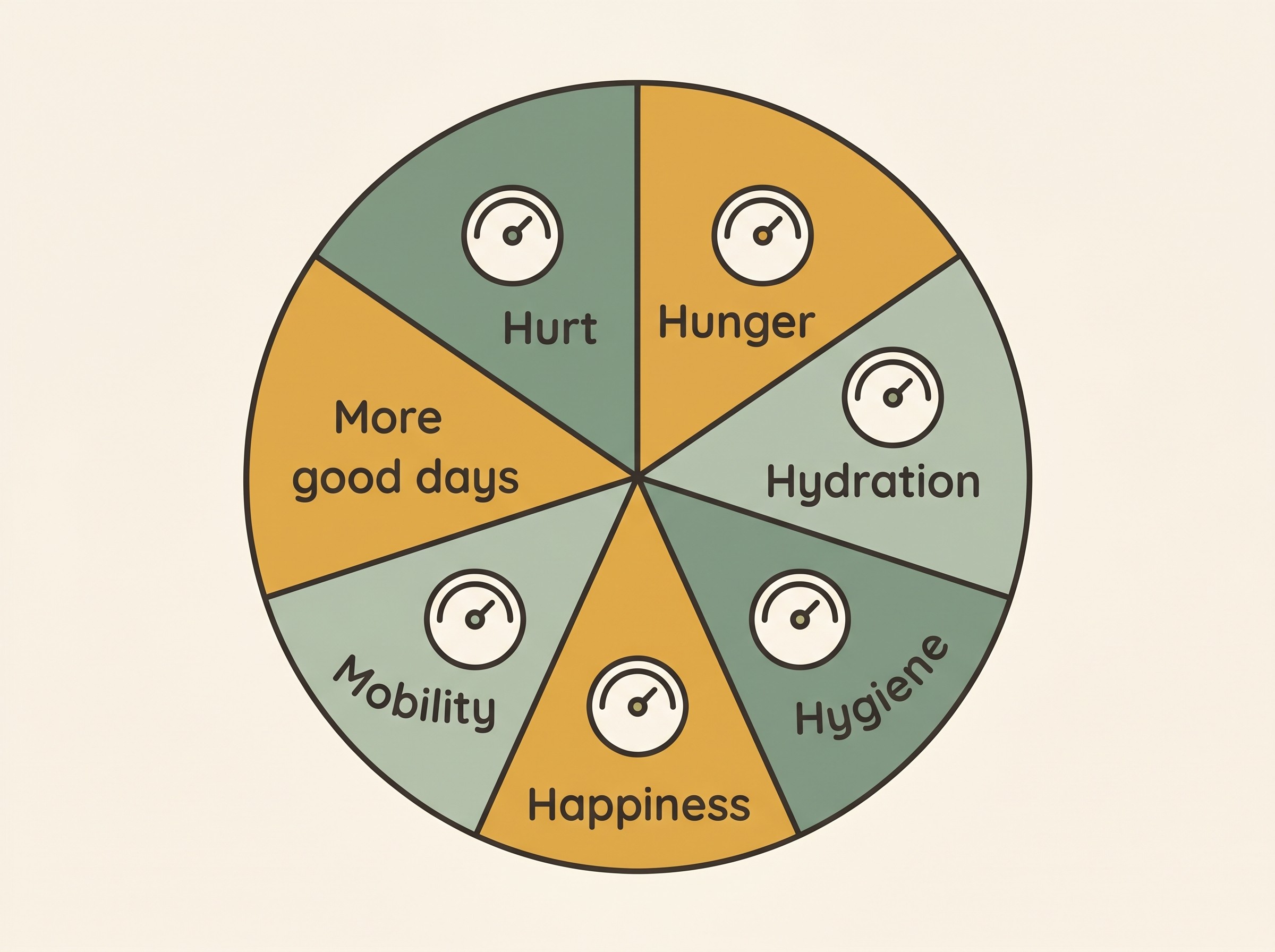
- Hurt. Is pain well controlled, and can they breathe comfortably? In a dog this might be reluctance on the stairs or a new shortness of temper; in a cat it is often invisible, showing only as a pet who has quietly stopped jumping up.
- Hunger. Are they eating enough, willingly? A dog who needs coaxing and a cat who sniffs and walks away both count.
- Hydration. Are they drinking enough and staying hydrated? (If a dog or cat suddenly starts drinking much more, that is a flag for the vet, not a tick in the good column.)
- Hygiene. Can they stay clean, especially after the toilet? A cat who has stopped grooming, or a dog who needs help to stay comfortable, has lost something that mattered to them.
- Happiness. Do they still seem like themselves? The greeting at the door, the headbutt, the patch of sun sought out. This is the one owners feel most keenly.
- Mobility. Can they get to the bowl, the bed, the litter tray or the garden, with or without a little help?
- More good days than bad. The seventh is not really a category. It is the question all the others add up to, and we will come back to it, because it is the one that matters most.
Villalobos's own scoresheet gives each of these a mark out of ten and adds them to a total out of seventy, with anything above about thirty-five regarded as an acceptable quality of life worth supporting (Caring Pathways, reproducing the Villalobos scale). The numbers can be useful, and we will use them in a moment, but hold them lightly. The point of the seven questions is not the arithmetic. It is that they give you the same things to look at every time, so that "how is she doing?" stops being a mood and becomes something you can answer. This is not one clinician's hunch, either: when researchers formally tested the HHHHHMM scale, they concluded it is "a reliable tool that can be used by individuals to make end-of-life decisions for their companion animal" (Testoni et al., 2023, Animals). Assessing quality of life, repeatedly, is also exactly what the profession's own senior care guidelines ask of every team caring for an older animal. You are simply bringing that care home, into the days between visits.
Cats are the reason this matters most
It would be easy to write all of this for dogs and add a line about cats at the end. Resist that, because cats may be the species this tracking helps most, for a specific reason: they are extraordinary at hiding how they feel. As International Cat Care explains, cats are solitary survivors by nature and so are even better than dogs at hiding their weaknesses (International Cat Care). A dog in pain tends to tell you eventually, in ways you can read. A cat in pain often just becomes a quieter version of themselves: a little less time on the windowsill, a coat looking faintly unkempt because the grooming has tailed off, the floor preferred over the favourite high shelf. Day to day you may notice none of it. Across a tracked month, the drift is unmistakable.
A cat's quality of life is just as measurable as a dog's. International Cat Care recommends a standardised assessment that combines an understanding of the species with the individual cat's own living experience, completed on a set schedule so you can compare results over time rather than trusting a single impression. Validated feline tools exist too: one owner-completed questionnaire used in vet research scores a cat across three domains it calls Vitality, Comfort and Emotional Well-being, with a healthy cat scoring around 50, so change in a particular cat can be tracked meaningfully from month to month (Davies et al., 2021, Frontiers in Veterinary Science). You do not need that specific instrument. You need to apply the same seven gentle questions to your cat that you would to a dog, write the answers down, and trust the trend over the snapshot. The cat who "seems fine" is precisely the cat a record will catch slipping before you do.
Keeping a good-days ledger
So how do you actually do this, on a Tuesday, in a busy life? The answer is: as lightly as you can while still doing it at all. The aim is not a research project. It is a ledger of good days and hard ones, kept faithfully enough that the bigger picture becomes visible.
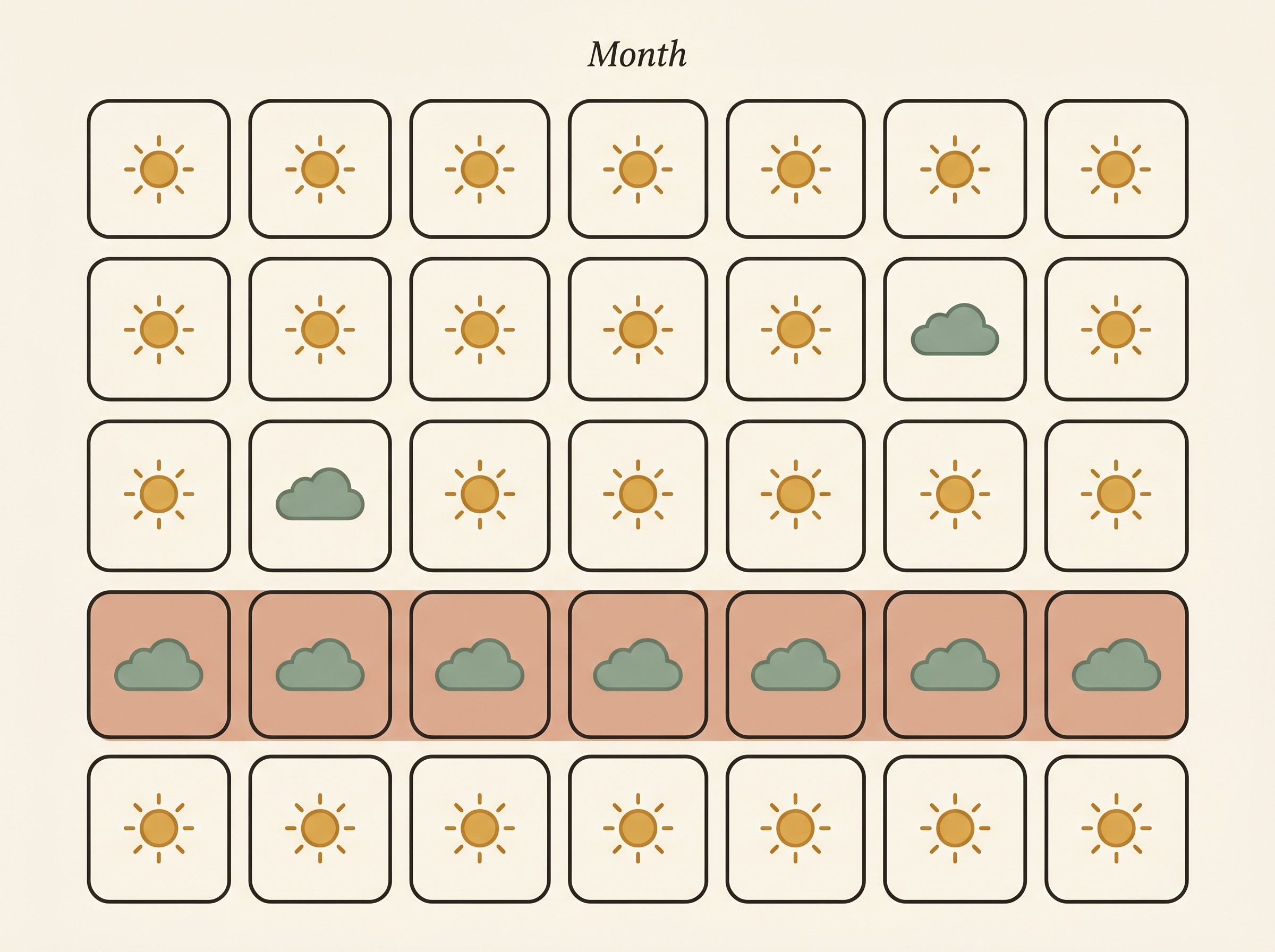
Pick the method that you will genuinely keep up, because the best one is the one that survives past the first fortnight:
- The calendar. At the end of each evening, mark the day on a calendar: a sun for a good day, a cloud for a hard one, perhaps a question mark for the in-between ones. That is the whole task. Within a few weeks the page itself does the talking. This is the method many veterinary hospice teams suggest, precisely because it makes patterns "that may be hard to discern on a daily basis" jump out at a glance (Lap of Love).
- The marble jar. If a calendar feels clinical, use a jar. Drop a marble in for a good day; take one out for a bad one. Some owners find this gentler to live with, and the rising or falling level becomes a quiet, plain gauge you pass every day.
- The seven scores. If you want more detail, score the seven questions out of ten once a week and write the total down. You are not chasing a magic number. You are watching whether this week's total sits roughly where last month's did, or whether it has begun, slowly, to drop.
Whichever you choose, the value is the same: a record that remembers what you cannot, and that turns "I think she's been a bit worse lately" into something you can show, with dates. That matters at the next visit, because it hands your vet the trend over weeks rather than the single, flattering snapshot of a pet who so often rallies in the consulting room and trots out looking deceptively well.
If you would rather not keep this on paper, the Senior Wellness Check gathers the everyday signals of an older pet (weight, appetite, mobility, and the two bigger-picture scores we call Vitality and Mind / Sharpness) into one running view, so "something has changed" becomes something you can see, and you can layer on the matching tracker, such as the Mobility Check, when one signal needs closer attention. And when you want a deeper, dedicated quality-of-life record over the long haul, Sightline (sightline.vet) is a separate ConciergeVet tool built for exactly this: a short weekly check-in that produces a single tracked quality-of-life score with a visible trajectory over months, and a report you can hand to your vet. It exists because the everyday signs of decline in an old dog or cat are subtle enough that memory alone simply cannot hold the trend.
A score is a mirror, not a sentence
A quality-of-life score, a calendar full of clouds, a jar that has emptied a little, none of these decides anything. They are a mirror, held up so you can see clearly. They are never a sentence passed on your pet, never a verdict you have to obey.
It is worth saying plainly what the tracking is for. It is for seeing the pattern clearly, so that love is not flying blind. It is not for converting your dog or cat into a number and then doing whatever the number says. A bad day is not "the day"; every old animal has bad days inside a life still worth living, and one hard week after a wobble can be followed by a good month. Equally, tracking is not a counsel of despair or a way of giving up early. Quite the opposite: it is often how owners catch a treatable problem in time. A run of harder days, a sudden refusal of food, a step down in mobility, a cat who stops grooming, these are reasons to ring your vet rather than entries to sigh over, because the cause may be pain, a flare of an existing condition, or something new and fixable. And one signal never belongs in the "just a bad day" column at all: a pet quietly losing weight is telling you something rarely benign, and it earns a call to the vet on its own.
When you step back and look at the whole ledger, the question to ask is the gentle seventh one that all the others fold into: are the good days still outnumbering the hard ones? As Lap of Love frames it, a quality-of-life assessment is there to help you see "whether your pet is having more good days than bad, or more good than uncomfortable moments" (Lap of Love). For as long as the suns outnumber the clouds, and the things that make your animal themselves are still happening, you are in the long, precious plateau this space is built around, and your job is to keep it that way with your vet's help. When the balance begins, slowly, to tip the other way, the ledger lets you see it plainly and early, which is the kindest place to be: not blindsided, not in denial, but clear-eyed, and still in time to make every remaining good day count.
Start tonight
You do not need to overhaul anything to start. Tonight, before bed, decide which method you will use, a calendar square, a marble, or seven quick scores once a week, and make the first mark. That single act turns your worry from a fog you carry into something you can look at. Bring the record to the next appointment, and ask your vet directly: "Here is how the last few weeks have actually looked. Are we still doing right by them, and is there anything here we can treat?" That one question, backed by real days rather than a tired memory, is the most useful thing you can take into the room.
You are not meant to carry this alone, either. The particular ache of loving an animal who is fading, of grieving a pet still curled up beside you, has a name, and it is a sign of love rather than weakness. We have written about it gently in anticipatory grief: mourning a pet who is still here, and our senior community is full of people doing exactly this work, who understand its weight in a way few others can.
And when the ledger, and your heart, begin to tell you that the harder days are winning, that is not a failure of anything you have done here. It is the natural last chapter of a long love, and you do not have to face the deepest questions in this space. The "is it time?" decision, the goodbye itself, and the grief that follows are held with great care in our Rainbow Bridge space, and there is a gentle guide to what comes next for when you are ready to read it. For now, this space stays where it belongs: here, beside you and your old friend, helping you see the good days clearly, and helping you make sure there are as many of them as there can possibly be.
Sister tool · Sightline
Track quality of life over time
Sightline, a separate ConciergeVet tool, runs a short adaptive weekly assessment with a quality-of-life focus mode built around exactly these frameworks, tracks a single composite score over time so you can see the trend rather than judge a single bad day, and produces a Sightline Report PDF you can bring to your vet.
A written log, or our printable quality-of-life sheet, does much the same job.
See how Sightline tracks quality of lifeKeep track of how your pet is doing
The owners who cope best are the ones who notice changes early. A simple health log shows you what is working, and what is not, before the next vet visit.
Start tracking, freeYou're not doing this alone
Compare treatment journeys and talk to owners managing senior pets. Free to join.
Join PetsLikeMine