

Knowing the road ahead: a gentle guide to what comes next
Alastair Greenway
BVM&S MRCVS
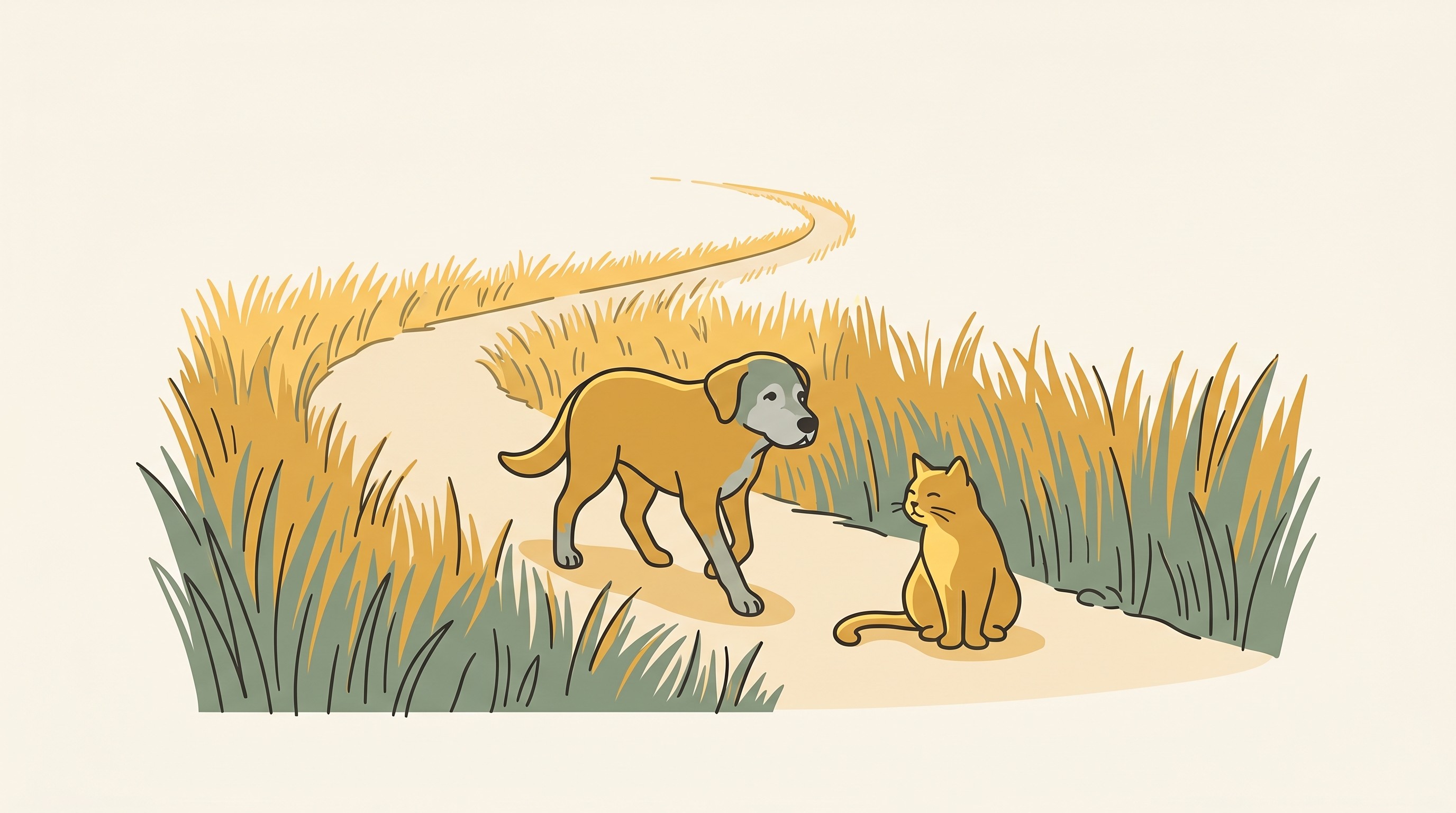
Once you know, deep down, that your dog or your cat is in the last chapter of a long life, a particular kind of fear tends to settle in. It is not the sharp fear of an emergency. It is quieter and more constant: the fear of the unknown road ahead. What is going to happen? How fast? Will you see it coming, or be caught out? You lie awake not because anything is wrong tonight, but because you cannot picture what is coming, and the not-knowing has a weight all its own.
This article is a map for that road, and only a map. It will not tell you when it is time, because no guide can, and that question is held with great care somewhere gentler. What it will do is give the shapeless dread of "what comes next" a shape: how the road of an ageing animal usually unfolds, the kinds of care that exist further along it, and why looking ahead now, calmly, is one of the kindest things you can do for both of you. Knowing the lie of the land does not bring the end any closer. It only means you will not be walking it blind.
A slope, not a cliff
The first thing to know is that the end of a long animal life is almost never a single dramatic event. It is usually a slope: a gradual gathering of small changes, a little less spark this month, a bit more sleep the next, a favourite jump no longer attempted. Each step is small enough that your eye adjusts to it, which is exactly why it is so hard to judge from inside the house.
This matters for two reasons. The reassuring one is that you are rarely facing a sudden drop: there is usually time, often a great deal of it, of ordinary good days inside the gentle decline. The harder one is that nobody, not even your vet, can hand you a date. The road bends out of sight, and that uncertainty is real and it is tiring. If you find the not-knowing is its own grief, rising on a bad night and easing on a good morning, that is normal and it has a name, and we have written about it tenderly in anticipatory grief: mourning a pet who is still here. For now, hold the shape of it: a slope, not a cliff, with more level ground left than the fear would have you believe.
Looking ahead is a kindness, not giving up
There is an instinct worth naming early, because it stops so many people reading on. The moment you start thinking about what comes next, a voice says you are being morbid, or disloyal, or that you will somehow jinx it, that planning for the road ahead is a betrayal of the animal asleep beside you right now. Please let that voice go. Quietly preparing your heart and your plans is not giving up on your pet. It is one of the most loving things you can do, and it is the opposite of pulling away.
The veterinary profession is clear that this kind of forward thinking protects you both. The whole point of looking ahead is to make the later decisions on a calm day rather than in a frightening crisis. The team at Ohio State University's veterinary hospital, who run a dedicated programme for exactly these decisions, advise thinking about them early in the illness, "when your mind may be more clear," precisely because decisions "may seem forced or pressured if you wait until there is a crisis." A conversation with your vet now, about what is likely to come and what you would and would not want, is not tempting fate. It is buying yourself the gift of a clear head later.
That is true for cats just as much as dogs, and arguably more so. The feline hospice guidelines published by the American Association of Feline Practitioners note that good care includes dialogue with the owner about "the expected illness trajectory" for their cat's specific condition, "thereby helping to mitigate the risk of an unanticipated outcome" (Eigner et al., 2023). In plainer words: ask your vet what this particular road tends to look like, so that what comes is less likely to blindside you. None of this is the same as bracing for the worst. As the veterinary hospice service Lap of Love puts it, the work of this time is to "take one day at a time, whether it's a good or bad day," while knowing the road ahead "allows you time to consider your options." You can look ahead and stay fully present. Both at once.
What care looks like further down the road
One of the biggest unknowns is simply not knowing what is available. People often imagine the road ends at a single hard appointment with nothing in between, and that picture is both frightening and wrong. There is a whole kind of care designed for exactly this stretch, and most owners have never had it explained.
The gentle name for it is comfort-focused care, and the clinical word is palliative care. What surprises almost everyone is that it is neither the end of treatment nor reserved for the very last days. As VCA Animal Hospitals explain, palliative care "is typically begun earlier in the disease process, when treatment can still help to alleviate symptoms and enhance quality of life," and can run alongside whatever your pet is already having. The profession's own senior care guidelines put it plainly: this kind of care "provides improved quality of life to pets at any stage of life." Comfort is not what you turn to when there is nothing left to do. It is something you can have now, woven through the ordinary care, with the whole aim of keeping good days good.
Hospice care is the next, gentler step along the same road, when curing the underlying problem is no longer the goal and keeping your pet comfortable and content becomes the whole of it. The point of all of it, as VCA describes, is to give a pet "the opportunity to live until he or she dies, maximizing comfort and quality of life." It rests on a few simple pillars worth knowing in advance: keeping pain well controlled, helping you understand what is happening, keeping the conversation open with your vet, and preparing gently for what is coming. And it is built around a quiet idea borrowed from human hospice, that the family is part of who is being cared for, not just the animal. The feline guidelines say it directly, that "the care unit includes caregivers and their needs" (Eigner et al., 2023). You are allowed to be looked after on this road too.
Cats walk this road too, more quietly
So much writing about the last chapter is about dogs, and old cats slip through the gap, which is its own quiet unfairness, because a cat is travelling exactly the same road. It just tends to do so more silently, and that changes what you need to watch for.
Cats are built to hide weakness, and they are remarkably good at it. The feline hospice guidelines are blunt that "because cats are so adept at hiding pain, many caregivers may not realize their cat is experiencing discomfort" (Eigner et al., 2023). An old cat rarely tells you the road is bending. She simply stops jumping to the windowsill, grooms a little less so her coat dulls, chooses the floor over the high shelf, retreats to a quiet room. Day to day you may notice none of it. That is exactly why, for cats, asking your vet early what this particular road is likely to look like, and watching gently over time rather than waiting for an obvious sign, matters so much. Comfort-focused care is just as real and just as available for them, and can begin while she is still having good days, not only at the very end.
Keep treating what can be treated
Knowing about the road ahead must never tip into resignation, into reading every slow morning as the beginning of the end. Slowing down is a symptom and not a diagnosis, and a great deal of what gets shrugged off as "just getting old" is treatable pain or treatable disease.
So a stiff, withdrawn, can't-be-bothered old dog or cat is very often a pet whose good days are being quietly stolen by something a vet can ease, and easing it can hand back real, comfortable time. Before you accept any decline as simply the road running out, it is worth asking whether part of it is fixable. Our guide to whether it is pain, age, or disease is the place to start, and if the slowing-down is achy joints, the Arthritis space and the Mobility Check are where to go next.
One change in particular never belongs in the "just old age" basket. A pet quietly losing weight is rarely telling you something harmless, and it earns a vet visit on its own, because the causes worth catching include kidney disease, an overactive thyroid in cats, diabetes, dental pain and others, several of which can be managed in ways that buy genuine comfortable time. Catching a treatable problem is not the opposite of preparing for the road ahead. It is part of walking it well.
Seeing the bend before you reach it
If the road is a slope you adjust to without noticing, how do you ever see the turn coming? The answer is not to scan your pet anxiously for signs of the end every single day, which only frightens you. It is to keep a quiet record, so that the trend becomes visible even when any one day does not.
This is the gentle compass for the whole stretch ahead, and it is wonderfully low-tech. The UK charity PDSA advises that "it can help to keep a diary or a log to track changes over weeks, or even months," and the single question they suggest you hold lightly over the whole picture is simply, "are they having more bad days than good days?" That, in the end, is the gauge that matters more than any single hard morning. The Senior Wellness Check keeps this view for you, gathering the everyday signals of an older pet, and the two bigger-picture scores we call Vitality and Mind / Sharpness, into one running line you can actually look at, and there is a full, gentle method for keeping a good-days record in tracking quality of life. For a deeper, dedicated quality-of-life log over the long haul there is Sightline (sightline.vet), a separate tool built for exactly that.
A record like this is a mirror, never a verdict. It is there so that love is not flying blind, not to convert your pet into a number and then obey it. For as long as the good days still outnumber the hard ones, and the small things that make your animal themselves are still happening, you are in the long, precious plateau, not at its edge. And when the balance does begin, slowly, to tip, the record lets you see it clearly and early, which is the kindest place of all to be: not blindsided, not in denial, but clear-eyed, and still in time to make every remaining good day count.
Where the hardest questions are held
You may have come hoping this article would answer the question underneath all the others: how will I know when it is time? It is the most loving question an owner can ask, and it deserves more room and more tenderness than the end of a map can give it.
The deepest questions of the road ahead, the "is it time" decision, what a peaceful goodbye actually involves, and the grief that comes after, are not for today, and they are not held here. They are held with great care in our Rainbow Bridge space, gently, and only when you are ready for them. If reading ahead steadies you, the guide to how you will know when it is time is there whenever you want it, and knowing in advance takes a surprising amount of the fear out of it. If you would rather close the map here for now, that is not avoidance and not a failing. This senior space stays where it belongs: beside you and your old friend, on the part of the road you are actually walking today. And you are not walking even this part alone: the senior pets community is full of people facing the same unknown road, who understand its particular weight in a way few others can.
For today
You do not need a plan for the whole road. You need a few small, doable things, so here they are.
- Do one ordinary good thing with them today, suited to the body they have now, and be wholly in it. As Lap of Love urge, "cherish each and every day you have with your pet."
- At your next appointment, ask your vet one plain question: "I want to understand what is likely ahead, and keep them comfortable, can we talk about that?" Ask too whether anything you have put down to age might actually be treatable. That single conversation, had calmly now, is how the later road stays gentle.
- Start, or keep, a light good-days record, so that when the road does bend you will see it clearly, and so that on the harder evenings you can look back and see how much good there truly was.
The end of the road is real, and it is not today. Knowing its shape does not bring it closer; it only means that when each turn comes you will meet it with clear eyes, having already done the loving, careful watching this whole stretch asks of you. The best use of this entire map is to set it down and go and be on the road with them, in the bit of it that is happening right now.