

Anticipatory grief: mourning a pet who is still here
Alastair Greenway
BVM&S MRCVS
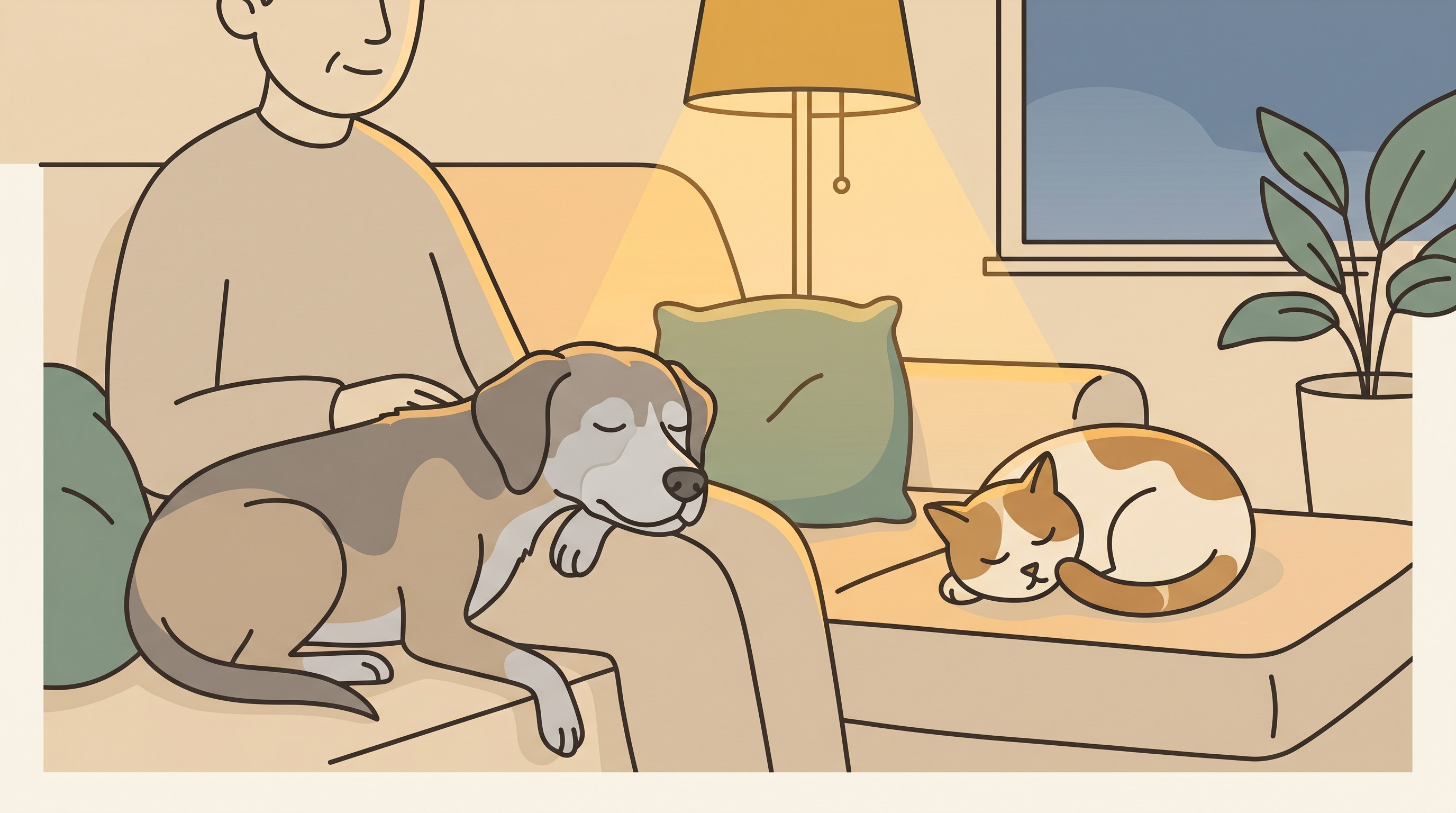
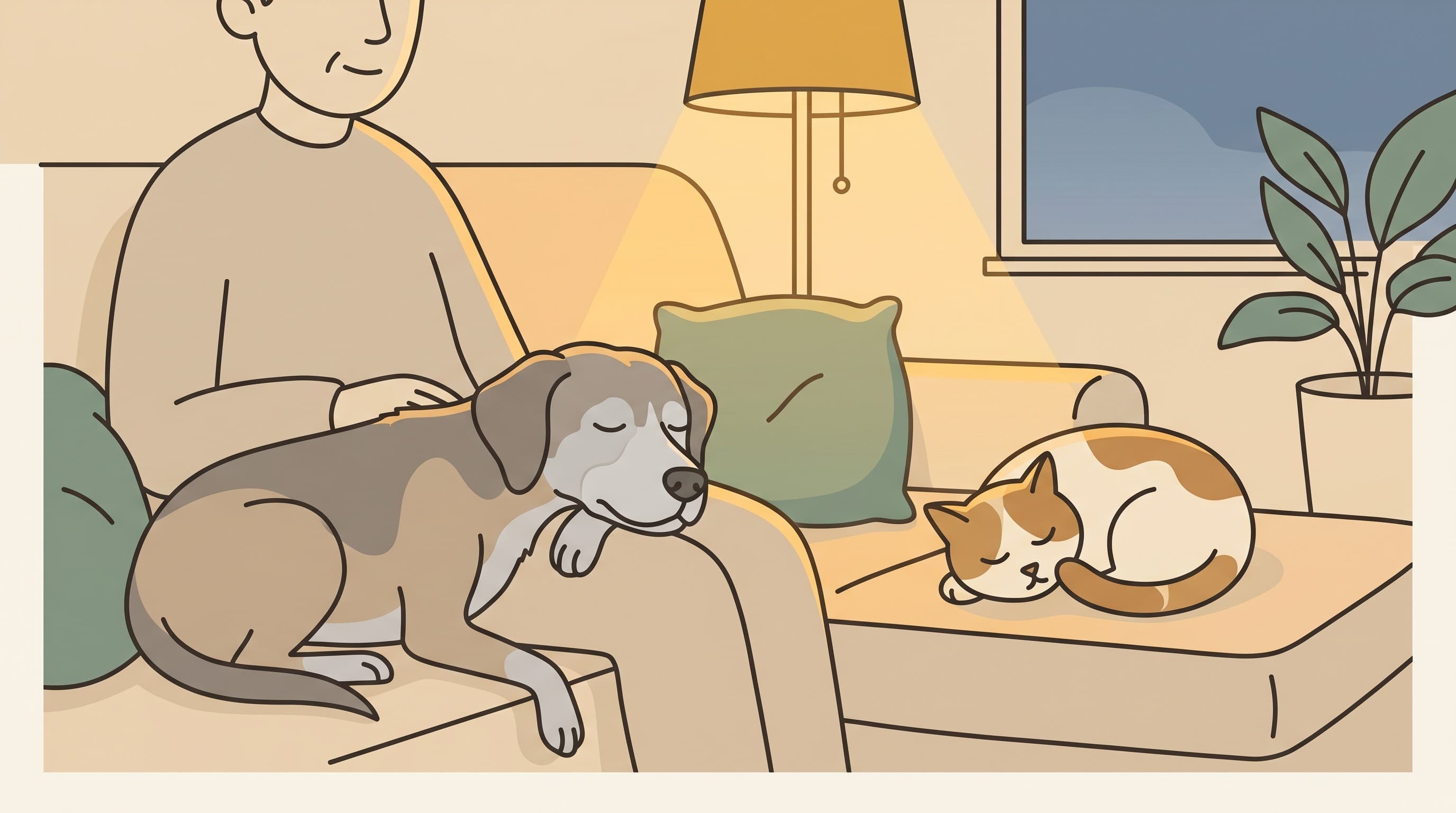
There is a particular kind of crying that happens with an old dog or an old cat still warm beside you. They are right there, breathing softly against your leg, purring under your hand, and the tears come anyway, because some part of you has already started saying goodbye.
The first thing to know is that there is nothing wrong with you. Grieving a pet who is still alive is not morbid or melodramatic, and it is not a sign that you have given up on them. It has a name. Vets and grief researchers call it anticipatory grief: the sorrow that arrives ahead of a loss rather than after it, when you can see it coming and your animal is still here to be held. After this paragraph we will mostly call it what it really is, which is love, doing its mourning early.
It is also far more common than the silence around it suggests. When researchers asked hundreds of people what it was actually like to care for an ageing dog, a strong sense of grief-before-the-loss ran right through their answers, sitting alongside the day-to-day tiredness but separate from it. One owner wrote simply, "I cry when I think about having to live without my dog." Another, of a dog nearly nineteen years old, wrote, "I know he won't be with us much longer." They were not being dramatic. They were paying attention, and they loved their animals, and those two things together produce exactly this ache.
Why naming it matters
This feeling is not new, and it is not a flaw in you. The term anticipatory grief was first used by a psychiatrist back in 1944, and grief specialists have studied it ever since as a normal, even useful, part of how we cope with a loss we can see approaching. One widely used definition describes it as the mourning we begin before the loss itself, taking in not just the future absence but all the small losses happening now and the ones already behind us. In pets specifically, veterinary researchers now treat it as a distinct experience worth recognising in its own right. It is not the same as being worn out by caregiving, and it is not the same as worrying about your pet's quality of life, though it often travels with both.
Having a name for it helps, because the people around you often will not. They mean well when they say "but he's still here, enjoy him," yet it can land like a door closing on your feelings. You can enjoy your pet and grieve them in the same afternoon. Both are true. Both are allowed.
What this grief actually feels like
Anticipatory grief is not one clean emotion. It is a tangle, and knowing the threads can make it feel less like you are losing your mind.
You are mourning who they were. This is often the strangest part, and it is sharpest when the change is in their mind rather than their body. Your dog still looks like your dog, but the dog who used to spin in circles at the lead, who knew exactly what "walkies" meant, now sometimes stands in the corner of the kitchen looking lost. The thinking-and-remembering changes that can come with age have a clinical name, canine cognitive dysfunction in dogs and feline cognitive dysfunction in cats, a slow fading of memory and sharpness that vets compare to dementia in people. We have a whole gentle guide to the first signs of an ageing mind in dogs and to the old cat who yowls and forgets, so we will not repeat that here. What matters for grief is this: you can be heartbroken about losing someone who is still standing in front of you.
Human grief researchers have a phrase that fits our pets uncomfortably well: ambiguous loss, the grief of someone who is physically present but, piece by piece, psychologically slipping away. It is described as loss without closure, and it is widely recognised in families living alongside dementia. There is no funeral for the personality. The body is still warm on the sofa. And yet you find yourself missing them while you are sitting right beside them. That is not ingratitude. It is one of the hardest forms of love there is.
You feel guilty for thinking ahead. You catch yourself wondering how long you have left, and then you feel terrible, as though planning for the future is a betrayal of the present. It is neither. Quietly preparing your heart is one of the kindest things you can do, for them and for you.
There is no timeline, and the not-knowing is its own weight. With an old, fading animal, nobody can hand you a date. The grief comes and goes with no fixed end, rising on a bad night, easing on a good morning, then rising again. One of the leading veterinary hospice services describes this open-ended quality as part of what makes it so tiring: you are bracing for something that has not arrived and may not arrive for a long while. Ageing itself can feel like a series of many small losses strung out over months, the slower walk, the missed jump onto the bed, the night they could not settle. Each one is a tiny goodbye, and they add up.
When it is exhaustion as much as sadness
Most gentle articles stop at the love and the grief. There is more to it than that. Alongside both, you may be flat-out tired, possibly a little resentful, and then guilty about that on top of everything else.
That is normal, and the research backs you up. In that study of people caring for ageing dogs, around one in six were carrying a clinically significant level of caregiver strain, and the single behaviour they found hardest to live with was disturbed nights. Loving your pet and being worn down by caring for them are not opposites. They sit side by side, often in the same person, in the same week. A later study from the same researchers found that this kind of grief tracks how close you feel to your animal, not how advanced their illness is. You do not feel this because things are necessarily near the end. You feel it because you love them. The deeper the bond, the deeper the ache, and that is not something to fix.
So if a broken night has woken you again and you have found this page in the small hours, please hear it plainly: you are not a bad owner for being tired. You are not a bad owner for occasionally wishing it were easier. We have written more for you specifically, on caring for the carer of a senior pet and on getting through the broken nights, because exhaustion is not a side issue. It is part of the grief, and it deserves care of its own.
The one trap to watch for: don't pull away early
There is a way anticipatory grief can quietly cost you, and it is worth naming so you can sidestep it.
Sometimes, to protect ourselves from a loss we can see coming, we start to withdraw. We brace. We hold the animal slightly at arm's length, half-mourning them already, almost to get a head start on the pain. It is a completely human instinct. The cruel part is that it steals the time you still have. Grief specialists and hospice vets both gently warn against it, and the antidote they offer is the same: rather than pulling back, stay present and cherish each day you have. The animal in front of you does not know they are ill. They know whether you are there. Pulling away early does not soften the goodbye later. It only shrinks the good bit that is happening now.
Carrying both the love and the exhaustion
You cannot make this feeling disappear, and you should not try. What you can do is carry it more kindly. None of the following is a grand gesture. The point is the opposite of a frantic dash.
- Take it one day at a time, and let the good days be good. There will be better days and harder days. On a better one, let yourself enjoy it without the shadow of the harder one ruining it. You are allowed to be happy with them today.
- Make ordinary memories, not just a bucket list. A road trip is lovely if they are up to it, but most of the memories that comfort people afterwards are small: the favourite sunny spot, the particular treat, an extra ten minutes of fuss. Gentle, low-key moments count, and they often suit a frail old animal far better than a big day out.
- Lean on people who actually understand. Outsiders may not get why you are grieving a pet who is still alive. People going through the same thing do. Our senior pets community exists for exactly this, the anticipatory grief, the sleepless nights, the things you cannot say to colleagues. You are far from the only one sitting up with an old dog or a fading cat tonight.
- Accept practical help, and protect your own health. Ask someone to cover a night, share the vet trips, take a walk on your own. You cannot pour from an empty cup, and a rested you is a kinder companion for them.
- Let a gentle record show you the pattern, without letting it become a verdict. It is genuinely hard to judge how an old pet is doing from inside the worry, where one bad night can feel like the end. Keeping a simple log of the good days and the harder ones, through the Senior Wellness Check, can quietly reassure you that there is still far more good than not. Quality-of-life tools, such as the well-known seven-part scale that ends with the line "more good days than bad," are a mirror, never a sentence. They help you see clearly. They do not tell you what to do, and they are not there to rush you. There is more on using one well in our guide to tracking quality of life.
When it is the cat curled in the corner
So much of what gets written about ageing pets is about dogs, and cats slip through the gap, which is its own quiet heartbreak. Cats grieve us in advance just as surely, and we grieve them, often more privately because cats fade more quietly.
The change can be just as much in the mind as the body. The thinking-and-remembering decline we mentioned earlier is, if anything, even more common in cats: it affects more than half of cats between eleven and fifteen, and most cats over sixteen, and yet it is often missed, written off as "she's just old." You may notice it as a cat who stares at a wall, forgets where the litter tray is, or stops settling on your lap the way she always did. For many owners the cruellest sign is the night-time crying: an old cat standing in a dark hallway, calling out into an empty room, often because she is disorientated and lost. Grieving the lap cat who no longer climbs up, the affectionate shadow who now seems somewhere else, is every bit as real as grieving a dog, and it can be lonelier, because the world tells you cats are aloof and so your sorrow somehow counts for less. It does not. International Cat Care treats these changes seriously, and so should you, and so do we.
One important kindness to your cat, and to yourself, sits inside this grief: a fading mind in an older cat should never simply be accepted as ageing without a vet's eyes on it first. Many things that look like a confused, withdrawn, crying old cat, such as an overactive thyroid, high blood pressure, kidney disease, pain, or failing sight and hearing, are treatable, and need to be ruled out before anyone calls it dementia. The same is true for dogs. Sometimes what feels like the beginning of a goodbye is actually a comfort problem your vet can ease, and your animal gets some of themselves back. Grief and a vet visit are not in competition. Booking the check is part of loving them well.
Telling your vet you are struggling
Here is the quiet revolution in senior care, and almost nobody knows to ask for it. You are allowed to say to your vet, out loud, "I am finding this really hard." You are allowed to grieve in the consulting room.
It matters that you say it, because most vets will not raise it first. In that recent study of dog owners, around seven in ten said their vet had never once asked about the strain of caring for their ageing dog, and nearly one in five felt they had received no real support at all. Not because vets do not care, but because the conversation has only recently been recognised as part of the job. The profession's own senior care guidelines now state plainly that ageing is not a disease and that good senior care includes supporting the family, not only the animal, and working within what you can realistically manage. So if your vet does not ask, you get to tell them. Saying it is not a weakness. It is how you unlock help, both for your pet's comfort and for your own exhausted heart.
What to do today
If this article found you on a hard evening, you do not need a plan for the whole road ahead. You need a few small, doable things, so here they are.
- Do one ordinary good thing with them today, and let yourself be wholly in it.
- Tell one person who will understand, in your own life or in the senior pets community, that you are grieving a pet who is still here. Saying it out loud loosens its grip.
- If anything has changed in their comfort, their appetite, their nights, book a check with your vet, and mention that you are finding it hard too.
- Start a gentle good-days record so that, on the frightening nights, you can see the truth of how much good is still here.
And when the time does come, whenever that is and it is not today, you will not face it alone or unprepared. The harder questions, the "is it time," the goodbye itself, and the grief that comes after, all live in our Rainbow Bridge space, gently and only when you are ready for them. That space is there for later. This one is for now.
Anticipatory grief is love doing its arithmetic in advance, totting up in your chest everything you stand to lose. There is only one good answer to it, and it is not to brace, or to look away, or to start letting go early. It is to spend the love now, generously, while they are still here to feel it. That is the whole of it. They are on the sofa. Go and sit with them.