

Is my dog losing his mind? First signs of canine cognitive dysfunction
Alastair Greenway
BVM&S MRCVS
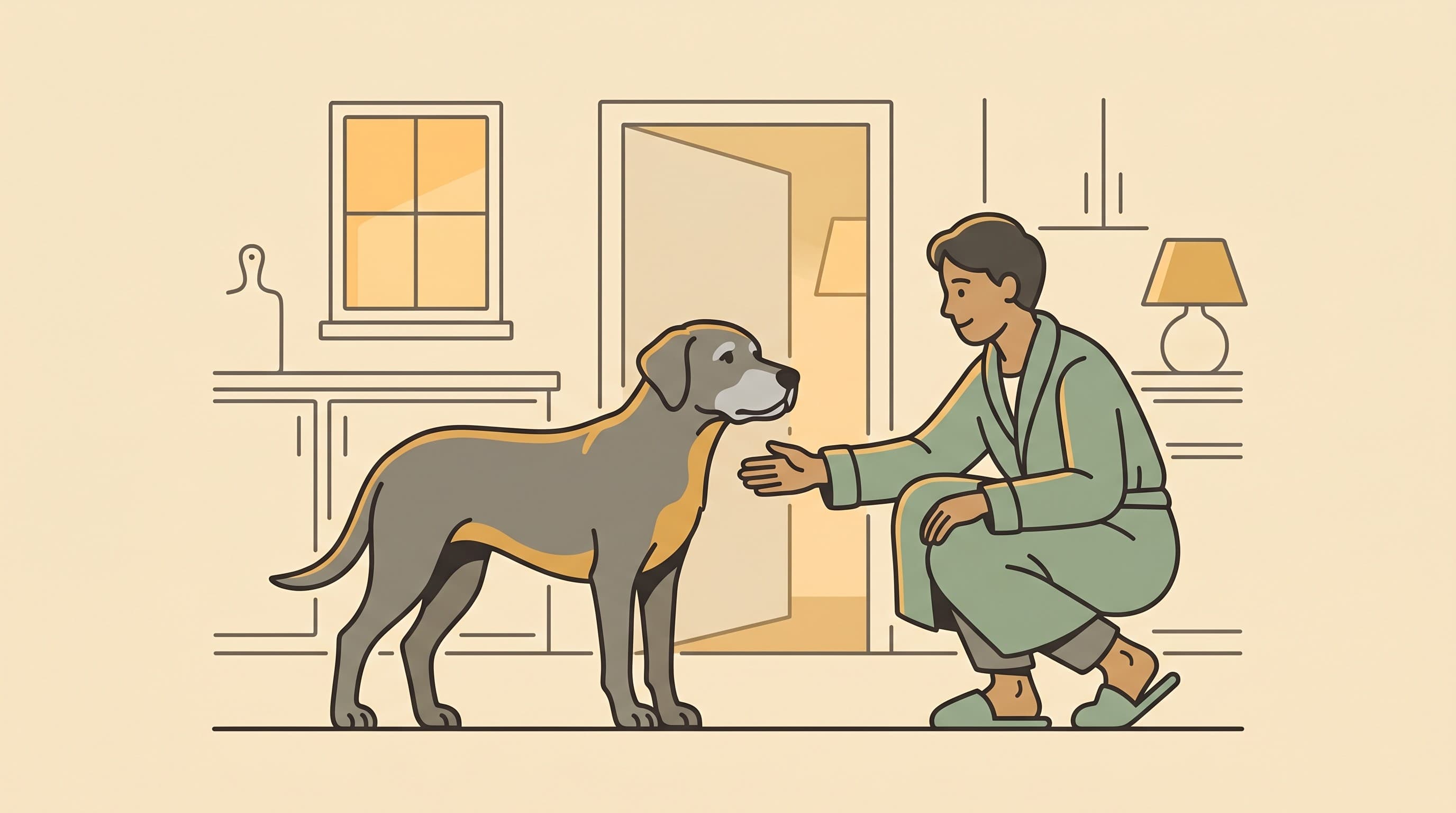
It is usually something small and strange that sends an owner looking. A dog standing in the corner of a room he has lived in for a decade, facing the wall, as if he cannot quite work out how he got there. Or he walks up to the hinge side of a door and waits to be let through. Or you wake at three in the morning to the sound of his nails on the kitchen floor, pacing, pacing, and when you go down he looks at you with an expression you have never seen on his face before: not pain, not need, just a kind of lostness. And the thought arrives before you can stop it, the one you came here half-hoping someone would talk you out of. Is he losing his mind?
Two things need doing at once, and they pull gently against each other. The first is to take that worry seriously, because the changes you are noticing are real and they have a name, and you are not imagining them or being dramatic. The second is to slow you down before you settle on the scariest explanation, because a great many of the things that look like an old dog's mind going are in fact something else, and quite often something we can treat. Both of those things are true at once.
What you are seeing has a name
Older dogs can develop changes in memory and sharpness that look, to anyone who has sat with an ageing human relative, achingly familiar. The clinical name for it is canine cognitive dysfunction, or CCD, and you will also hear it called canine dementia or, more bluntly, "doggy dementia". I will use the plain words from here on, an ageing mind, memory and sharpness, confusion, because the label can frighten owners more than the thing itself, but it helps to know it exists and that it is a recognised condition, not you reading too much into a few odd moments.
It is real, it is common, and it is hugely under-recognised. In the largest surveys of older dogs, signs of cognitive change show up in something like one in seven dogs over the age of eight, and the proportion climbs steeply with every year, affecting a large share of dogs once they pass fourteen (Salvin et al., 2010). Work from the Dog Aging Project, looking at more than fifteen thousand dogs, put a number on that climb: the odds of cognitive dysfunction rose by around 52% with every additional year of a dog's life (Yam et al., 2022). And yet only a tiny fraction of affected dogs are ever formally diagnosed. The reason is heartbreakingly simple: the changes are quietly written off, by owners and sometimes by vets, as "he's just getting old." As one veterinary review puts it plainly, the condition "is commonly under-diagnosed because behavioral changes are often attributed to the natural process of aging" (Vikartovska et al., 2021).
So if some part of you feels foolish for worrying about a thirteen-year-old who is "only" a bit confused, please let that go. You are noticing exactly the kind of thing that the system tends to miss, and noticing early is the most useful thing an owner can do.
The early signs, in plain words
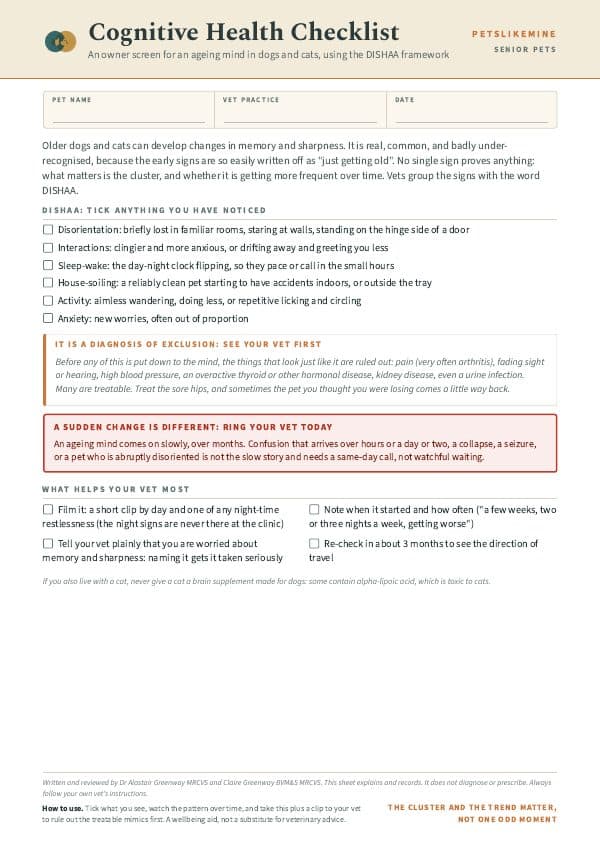
Vets group the early signs of an ageing mind using a memory aid called DISHA (sometimes DISHAA), a framework developed by the veterinary behaviourist Dr Gary Landsberg (VCA Animal Hospitals). It is the same backbone the first international expert guidelines, published in late 2025, chose for diagnosing this condition (Olby, Gruen et al., 2025; NC State). You do not need to remember the acronym. What helps is to recognise the everyday shapes these changes take, because in the early days they are subtle, and they come and go.
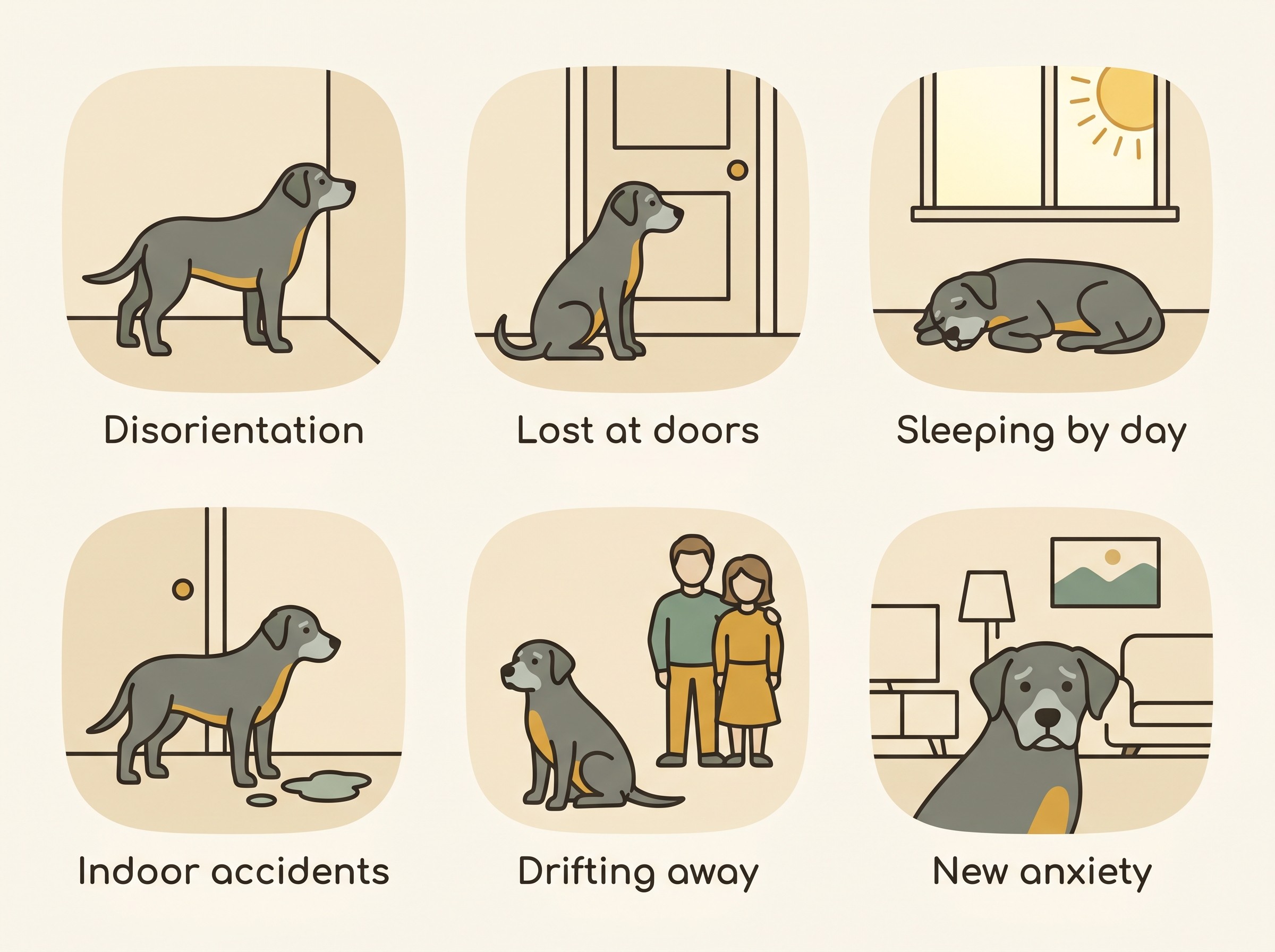
- Disorientation. He seems briefly lost in familiar places. He stares at a wall or into space, gets wedged in a corner or behind the sofa and cannot reverse out, goes to the wrong side of a door, or stands at the hinge instead of the handle (dvm360). For many owners this is the very first thing that makes the hair on their neck stand up.
- Interaction changes. The way he relates to you shifts. Some dogs become clingier and more anxious, following you room to room; others drift away, greeting you less, no longer asking to be near. A dog who used to push his head into your hand and now turns from it is not sulking. His map of the world is changing.
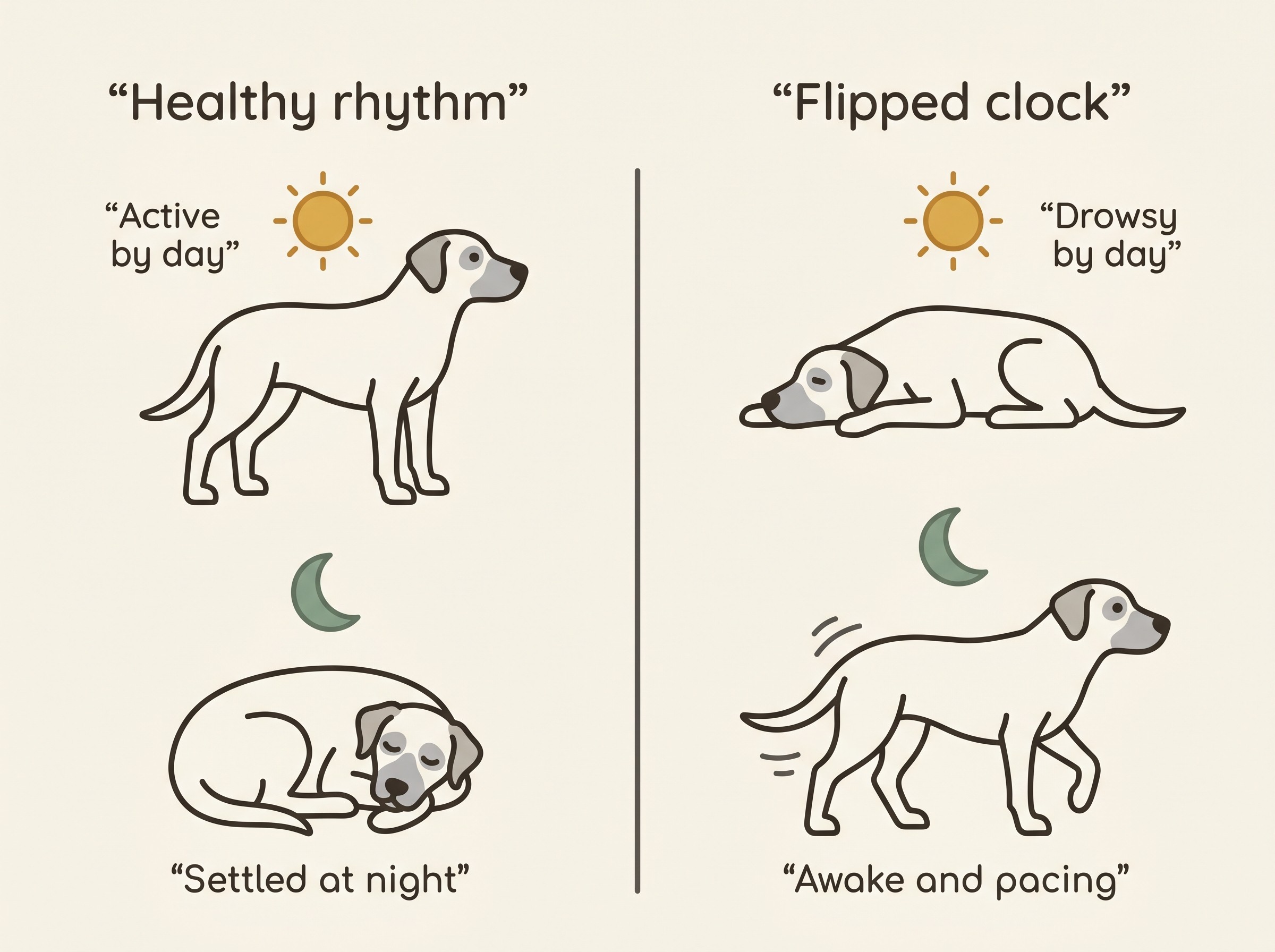
- Sleep reversal. This is the one that breaks owners, and we will come back to it. The body clock flips: he sleeps more in the day and is restless, pacing or vocalising, through the night.
- House-soiling. A reliably clean dog starts having accidents indoors, sometimes just after coming in from the garden, as though he has forgotten what the trip outside was for.
- Activity changes. Less of the old purposeful pottering and more aimless wandering, or repetitive behaviours like licking or circling. Some dogs simply do less; others do the same odd thing over and over.
- Anxiety. New worries appear, often out of proportion, and may go hand in hand with the confusion and the night-time unease.
No single one of these proves anything. We all have a doddery moment; so does an old dog. What matters is the pattern and the direction: several of these creeping in together, and getting a little more frequent month on month rather than staying flat. The instruments vets use to track this, such as the seventeen-item Canine Dementia Scale, work exactly this way, scoring signs across these domains and watching how they progress over time rather than judging a single bad day (Madari et al., 2015).
Before you call it his mind, please see your vet
This is the part the internet usually skips. An ageing mind is what doctors call a diagnosis of exclusion (Today's Veterinary Practice). That phrase means it is the answer you arrive at only after you have ruled out the other things that look just like it, and there is a long list of those other things, several of which we can actually fix. The 2025 expert guidelines say the same: a vet should reach this diagnosis only after ruling out other ailments through a physical and neurological exam, with brain imaging where possible (Olby, Gruen et al., 2025; NC State).
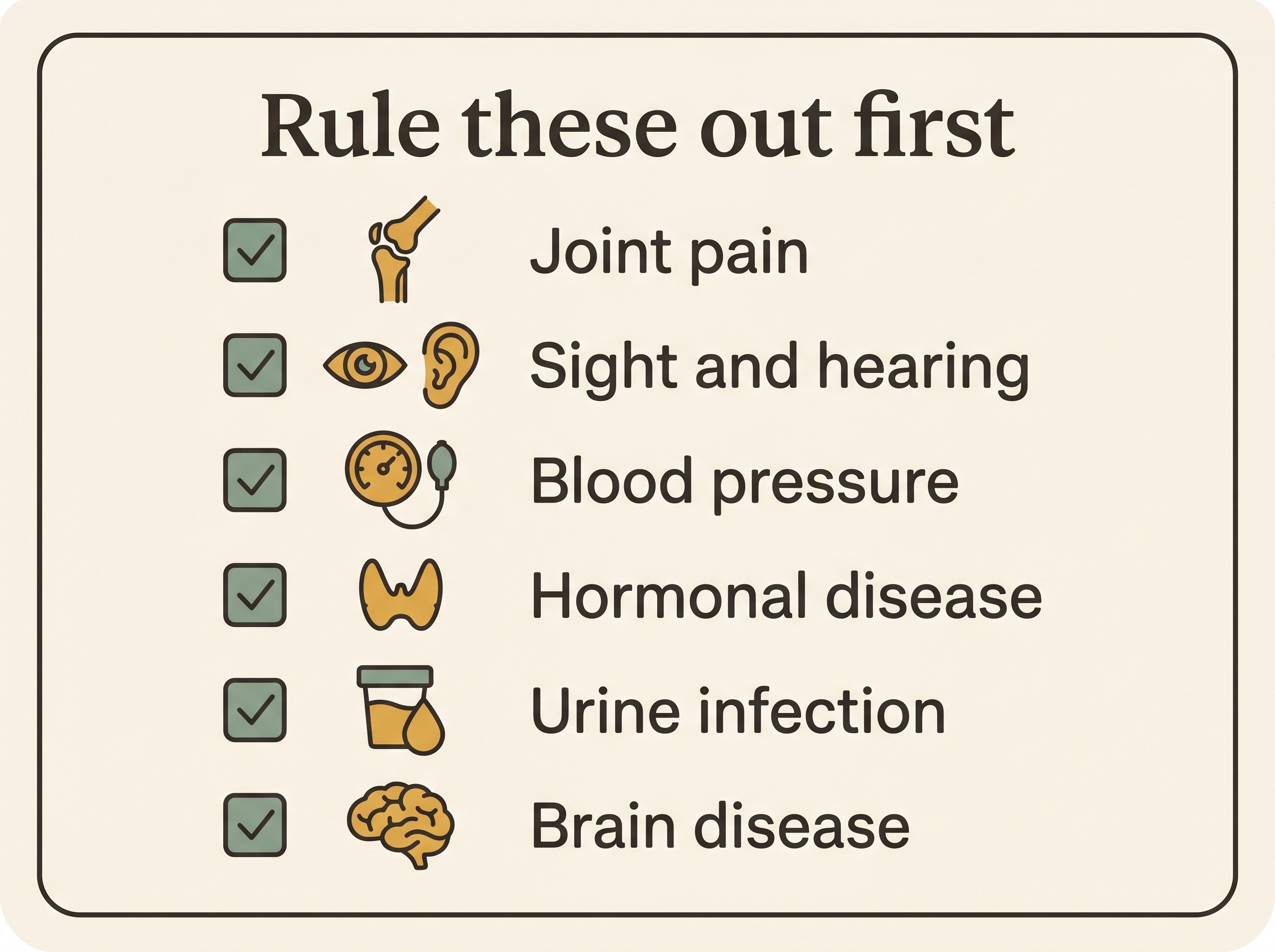
Think about how each of these could wear the same costume:
- Pain, very often arthritis. A dog who is sore is reluctant to settle, paces to get comfortable at night, becomes grumpy when touched, and stops greeting you at the door because getting up hurts. That looks a great deal like an ageing mind, and arthritis is both extremely common in older dogs and very treatable. It is worth ruling firmly in or out; the whole Arthritis space is there to help you do it.
- Fading sight and hearing. A dog who cannot see well bumps into things and seems lost; a deaf dog ignores you, startles when touched, and barks into the night because he cannot hear that the house is calm. Both can masquerade as confusion. You can read about helping fading senses in the Vision and Eye Health space.
- High blood pressure (hypertension). This is a quiet but important one, because untreated high blood pressure can affect the brain and, separately, can damage the eyes and cause sudden sight loss. It is exactly the sort of thing a senior check is designed to catch.
- Hormonal and other internal disease. An underactive thyroid in a dog, kidney disease, diabetes and liver problems can all dull a dog, change his behaviour, or send him drinking and toileting more. The Kidney space and the Hormone Health space cover the usual suspects. (In older cats, an overactive thyroid is a classic mimic of a fading mind, which is why a feline version of this story always sends owners to the vet first too.)
- A urinary tract infection. A simple, treatable infection can be the entire reason a clean old dog has suddenly started having accidents.
- Disease inside the brain itself. Less commonly, a brain tumour or other intracranial problem can produce confusion, circling or behaviour change, and needs a vet to assess.
There is one line in that list I want to pull out and underline. A sudden change, confusion that comes on over hours or a day or two, a collapse, a seizure, a dog who is abruptly disoriented, is not the slow story of an ageing mind. That is a reason to ring your vet today, not to read on. An ageing mind comes on over months. Anything faster needs a quicker look.
The good news folded inside all of this is that the trip to the vet is not bad news in disguise. It is the route to the treatable explanations. When you do go, your vet will examine your dog and very likely recommend the senior screening tests, a blood panel and complete blood count, a urine sample, a thyroid check and a blood-pressure reading, because so many of the mimics show up there (Today's Veterinary Practice). This is exactly the senior work-up covered in the senior wellness check and senior blood tests explained. It is also worth knowing that the same large studies show why the painful, stiff, inactive dog and the confused dog so often turn out to be the same dog: in the Dog Aging Project, the odds of cognitive signs were several times higher in dogs who had become inactive, very likely because the conditions that slow a body down and the changes in an ageing brain travel together (Yam et al., 2022). Treat the sore hips, and sometimes the dog you thought you were losing comes a little way back.
Is this just getting old, or is it not?
So where does that leave you, standing in the kitchen at 3am with a dog who seems somewhere else? With a clearer question, I hope, than the one you started with.
Some changes really are the gentle, ordinary furniture of age and do not need a phone call on their own: a greyer muzzle, more sleep, a slower warm-up on a cold morning, being a beat slower to learn a new trick. The senior years are mostly a long, good plateau, and you can read about what is normal in when is a dog "senior"?.
But the moment "a bit slower" tips into the things on the DISHA list, getting lost in the house, the flipped day-and-night, new accidents, a personality that is quietly rearranging itself, you have crossed from ordinary ageing into a change worth investigating. The single most useful instinct to build is this: an older dog earns the benefit of the doubt that a change is worth a look, because at this age the harmless and the serious can look identical from the sofa. We unpack that judgement in detail in is it pain, age, or disease?, which is the companion piece to this one.
This is also where keeping a record quietly changes everything, because the cruel thing about a slow decline is that you adjust to it. The dog who is "a bit confused sometimes" this month becomes your normal, and you genuinely forget how much sharper he was six months ago, which means you can walk into the consulting room and badly undersell what is happening. A simple log fixes that. The Senior Wellness Check lets you track his Mind and Sharpness alongside his energy and mobility in a couple of minutes, so that instead of relying on a memory that is busy adapting, you can see the actual direction of travel and show your vet a clear picture rather than a vague worry. If you do just one practical thing today, alongside booking the visit, make it the first entry: a couple of plain notes about what you are seeing, dated, so that next month and the month after have something to be measured against.
It is not your fault, and you are not on your own
If you have reached this point feeling a quiet guilt, that you should have noticed sooner, that you are somehow failing him, I want to meet that head on. You are not. The whole reason this condition is so under-diagnosed is that its early signs are designed to be mistaken for ordinary ageing; missing them for a while is not negligence, it is the norm, and you are here now.
I also want to be candid with you about the road, because pretending it is easy helps no one. When researchers asked owners living with this what they found hardest, the answer was consistent and it was the night. Night-time disturbance was rated the single most challenging behaviour to live with, ahead of barking, accidents indoors and everything else (Taylor et al., 2024). If your worst hours are the small ones, that is not weakness on your part. It is the most documented hardship of this whole experience, and the same study found owners were too often left to face it with very little guidance. There is a name, too, for the particular ache of watching the dog you know slip while his body is still here and his tail still wags: anticipatory grief, mourning a companion who has not gone yet, and it is now recognised in the veterinary literature as a normal part of caring for a dog with a fading mind, not a sign you are giving up on him (Taylor et al., 2025).
So please do not carry this alone. Our senior community is full of people awake at the same hours, walking the same road, and there is a particular relief in talking to someone who simply gets it.
And take some real heart from this: there are things that help. Once your vet has done the workup and an ageing mind is genuinely the answer, it is not a dead end. There are prescription options, such as selegiline (sold as Anipryl), and in the UK propentofylline (Vivitonin), which is licensed to perk up dullness and demeanour in older dogs (VMD), alongside special brain-supporting diets, supplements, and changes to the home and the daily routine that genuinely soften the signs. I will be straight with you about all of it: these slow and ease the condition, they do not cure it, and the medicines in particular have real interactions to respect, which is why every dose belongs to your vet and not to a website (selegiline, for instance, is a type of drug called an MAO-B inhibitor and must not be mixed with several common medications, including certain antidepressants and the painkiller tramadol, because the combination risks a dangerous reaction, Today's Veterinary Practice). One small but important warning while supplements are on your mind: if you also share your home with a cat, never give a cat a supplement made for dogs, because some canine brain formulas contain alpha-lipoic acid, which is toxic to cats. The full, practical plan for living with this, day and night, is laid out in living with canine cognitive dysfunction: a day-and-night plan, with a dedicated guide to surviving the 3am hours and a clear-eyed, money-saving look at which treatments and supplements actually help.
The question underneath all of this, the one nobody says out loud at the start, is usually "how will I know when it's time?" That question deserves respect rather than a brisk answer, and it is too big and too tender to belong in an article about first signs. It lives, when you are ready and not a moment before, in the gentle Rainbow Bridge space we keep for exactly that. For now you are nowhere near it. For now there is a vet visit to book and a good while of life still to enjoy.
This week, if your dog is starting to seem confused or different:
- Film him. Get a thirty-second phone clip of the behaviour that worries you, ideally one in the day and one of the night-time restlessness. A vet can tell far more from ten seconds of footage than from a paragraph of description, and the night signs are never there in the consulting room.
- Note when it started and how often. "A few weeks, two or three nights a week, getting more frequent" is exactly the kind of detail that helps. Make it the first entry in his Mind and Sharpness record.
- Book a vet visit, and say the word. Ask specifically for him to be checked for the treatable things that mimic confusion, his joints, eyes, ears, blood pressure, bloods and urine, and tell your vet plainly that you are worried about his memory and sharpness. Naming it gets it taken seriously.
- Be kind to yourself, and find your people. Read is it pain, age, or disease? for the next layer of the decision, and join the senior community if the nights are getting long. You noticed early. That is the best thing you could have done for him.
Free downloads
Companion worksheets to put what you've read into practice. Free PDFs, print at home.
Sister tool · Sightline
Track quality of life over time
Sightline, a separate ConciergeVet tool, runs a short adaptive weekly assessment with a quality-of-life focus mode built around exactly these frameworks, tracks a single composite score over time so you can see the trend rather than judge a single bad day, and produces a Sightline Report PDF you can bring to your vet.
A written log, or our printable quality-of-life sheet, does much the same job.
See how Sightline tracks quality of lifeKeep track of how your pet is doing
The owners who cope best are the ones who notice changes early. A simple health log shows you what is working, and what is not, before the next vet visit.
Start tracking, freeYou're not doing this alone
Compare treatment journeys and talk to owners managing senior pets. Free to join.
Join PetsLikeMine