

When is a dog "senior"? Ageing by breed and size
Alastair Greenway
BVM&S MRCVS
There is no birthday for it. A grey hair or two appears on the muzzle that you are fairly sure were not there last summer. A pause arrives at the bottom of the stairs that did not used to happen. The lie-ins get longer, the greeting at the door a touch slower, and the question lands: when did my dog get old? The honest answer is the one nobody puts on a poster. "Senior" is not a switch that flips on a particular morning, and a dog who is officially "senior" on paper can still be sprinting after a ball with their tongue flapping. So let me give you something more useful than a single number: a sense of roughly when the years start to count for a dog of your dog's size, why size matters so much, and the one small thing worth doing now that pays you back for years.
Bigger dogs get the shorter go of it
The bigger the dog, the sooner they reach their senior years, and it is a much bigger difference than most owners expect. The veterinary profession does not pin "senior" to a fixed age precisely because of this; the 2023 AAHA Senior Care Guidelines for Dogs and Cats define a senior dog simply as one in the last quarter of their expected lifespan, which lands at a very different age for a Chihuahua than for a Great Dane.
As a rough, owner-friendly guide, vets tend to use bands like these:
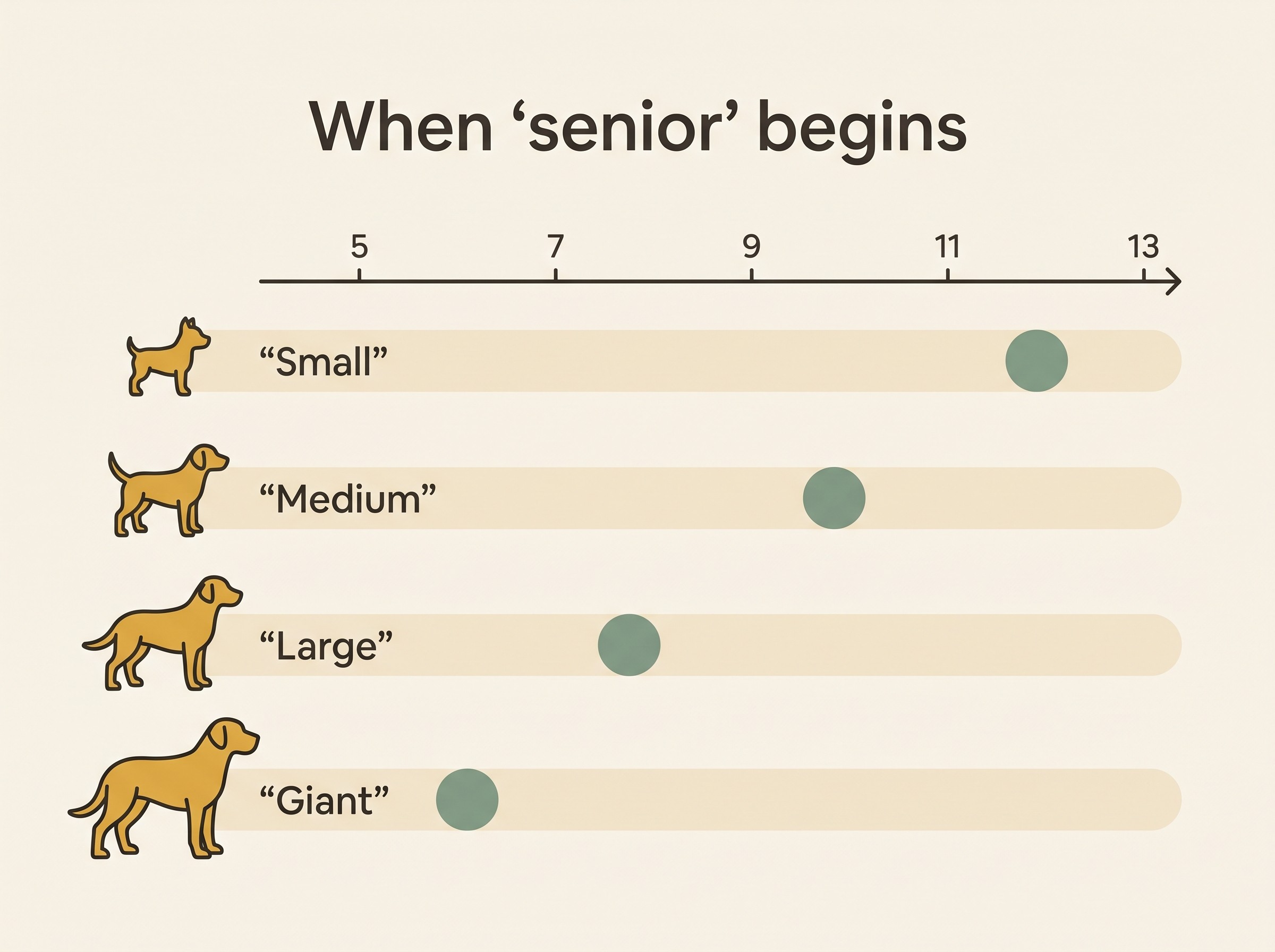
- Small breeds (terriers, toy breeds, that sort of size): senior from around 11 to 12 years, and often going strong well beyond.
- Medium breeds (spaniels, collies, the average mongrel): senior from around 9 to 10 years.
- Large breeds (Labradors, German Shepherds, Boxers): senior from around 7 to 8 years.
- Giant breeds (Great Danes, Bernese Mountain Dogs, Mastiffs): senior from around 6 years, and sometimes as early as 5.
You can see this in everyday clinic life. A small, well-kept terrier might not feel "old" to me until they are twelve or thirteen, while a Bernese Mountain Dog can be easing into their senior years around four to five (Falls Road Animal Hospital). It is genuinely jarring the first time you realise your three-year-old giant-breed puppy is closer to middle age than you thought.
The UK numbers behind this are sobering and worth knowing. In the largest study of its kind, drawing on real veterinary records through the Royal Veterinary College's VetCompass programme, the average life expectancy of a dog in the UK came out at 11.23 years, but the spread by breed was enormous: Jack Russell Terriers topped the table at 12.7 years while French Bulldogs sat at the bottom at just 4.53 years (Teng et al., 2022). Flat-faced (brachycephalic) breeds and the heavier working types tended to have the shortest lives of all. So when we say a giant breed is "senior" at six, it is not pessimism, it is arithmetic: if the whole life is shorter, the last quarter of it arrives sooner.
Why do big dogs age faster?
This catches everyone off guard, because in almost every other animal, bigger means longer-lived: an elephant outlasts a mouse many times over. Within a single species, dogs flip the rule on its head, and it is one of the genuinely fascinating puzzles in canine biology.
The clearest explanation comes from a large study that took apart the size-and-lifespan link in 74 breeds and more than 50,000 dogs. The conclusion was that big dogs do not simply start from a lower baseline; they actually age at a faster pace, with the risk of death climbing more steeply through adult life than it does in small dogs (Kraus et al., 2013). The same work put a rough price on bulk: for every extra two kilograms or so of body mass, a dog tends to lose in the region of a month of life expectancy. It is a striking way to picture it, that every stone of dog is, in a sense, time borrowed against.
Why this happens is still debated, but the leading idea points back to those fast-growing puppy months. A large-breed puppy has to build an enormous body at speed, and that rapid growth seems to carry a hidden cost: more cell division, more of the wear-and-tear that comes with it, including the gradual fraying of the protective caps on our chromosomes (telomeres) and a heavier load of the reactive molecules that damage cells over time (National Geographic). Larger dogs also tend to meet age-related illness, including some cancers, earlier than their smaller cousins. None of this is a reason to panic if you share your life with a big dog; it is simply a reason to start paying attention a little sooner than you would for a Jack Russell.
Forget "times seven"
Here is a myth worth retiring: the old "one dog year equals seven human years." It was never accurate, and the truth is more interesting and rather kinder. Dogs do not age at a steady clip. They race through the equivalent of human childhood and adolescence in the first couple of years, then the pace of ageing slows down.
When scientists read ageing directly from chemical marks on a dog's DNA (an "epigenetic clock", a far more biological measure than counting calendars), the relationship turned out to be a curve, not a straight line. By that measure a one-year-old dog is biologically closer to a human of about thirty than to a seven-year-old, and a four-year-old dog lines up with a human of around fifty (Wang et al., 2020, in Cell Systems). The takeaway for you is not the exact conversion, which varies by size and breed anyway, but the shape of it: the early years fly, the middle years settle, and "senior" is a long plateau rather than a cliff edge.
It also explains why two dogs of the same age can be worlds apart. Chronological age is just the number of candles on the cake. What actually matters is biological age, the real condition of the body and mind, and that is shaped by size, breed, weight, dental health, exercise and luck. This is why the most helpful question is rarely "how old is my dog?" and almost always "how is my dog doing, really?" That shift, from the calendar to the condition, is the whole idea behind tracking your dog's Vitality over time, which I will come back to at the end.
What changes, and what deserves a second look
So your dog is drifting into their senior band. What should you expect, and just as importantly, what should you not simply wave away?
The gentle, ordinary changes of getting older are real, and most of them are nothing to grieve. You may notice the muzzle frosting with grey, a little more sleep, a slightly slower warm-up on a cold morning, a fraction less spring in the jump into the car. The lenses of the eyes often take on a faint bluish haze with age (a harmless change called nuclear sclerosis that is easily confused with cataract; your vet can tell them apart, so a genuinely cloudy eye is always worth a look rather than a guess, and you can read more in the Vision and Eye Health space). Muscle can soften and waste a little, especially over the hips and spine, which we call sarcopenia. Hearing and eyesight may dull. And some older dogs grow a little less sharp: slower to learn a new thing, occasionally caught looking faintly puzzled in a familiar room.
Slowing down is a symptom, not a diagnosis. It is the most natural thing in the world to look at a stiff, quieter older dog and think, well, he is just getting old, and leave it there. But "old age" is not in itself a disease, and far more often than owners realise, what looks like simple ageing is treatable pain or treatable illness wearing an old dog's coat. The reluctance on the stairs is very often arthritis, which we can do a great deal about; it is one of the most common and most under-treated conditions in older dogs, and the whole Arthritis space exists to help you tackle it rather than tolerate it. Dogs are stoical and they hide pain by going quiet and still, so a dog who has simply "calmed down with age" deserves at least the question: is he comfortable, or is he sore?
And a short list deserves to jump the queue entirely. These are not "just old age", and they are worth a vet's attention sooner rather than later:
- Weight loss in an older dog, even if appetite seems fine. This is never something to file under ageing; it can be an early flag for several treatable conditions.
- Drinking noticeably more and asking to go out more, which can point toward the kidneys or hormones rather than the weather (the Kidney space and the Hormone Health space cover the usual suspects).
- A clear change in appetite, up or down.
- New restlessness at night, pacing or waking, or seeming briefly lost in the house.
- Any new or changing lump. You genuinely cannot tell a harmless lump from a worrying one by look or feel, so the rule is simply to get new ones checked rather than to watch and worry.
If any of those describe your dog, that is your cue to book in, not to read on. We unpack exactly how to tell ordinary ageing from something that needs a vet in Is it pain, age, or disease?, and the early shifts in memory and sharpness in the first signs of canine cognitive dysfunction. The thread running through all of it is the same: an older dog earns the benefit of the doubt that a change is worth investigating, because at this age the treatable and the untreatable can look identical from the sofa.
Do this the moment the years start to show
The single most valuable move you can make for a newly senior dog is not a supplement or a special bed. It is to switch from a yearly check-up to one every six months, and to capture a baseline now.
The reason is straightforward once you see it. Because dogs age several times faster than we do (a single year of an older dog's life is in the order of five to seven of ours), a year is simply too long to leave between looks under the bonnet (Zoetis Petcare). A condition that is invisible in January can be advanced by the following January. Twice-yearly visits, with a hands-on exam and the senior blood, urine and blood-pressure checks your vet will recommend, catch problems while they are still small and cheap and gentle to treat. That is exactly why the AAHA guidelines moved the goalposts for older pets from annual to twice-yearly care; it is the closest thing senior medicine has to a free lunch. The full picture of what should happen at those visits, and which tests are worth doing, lives in the senior wellness check and senior blood tests explained.
The baseline matters just as much, and here is why. The real power of those tests is not any single result but the trend: a kidney value or a body weight that is creeping in the wrong direction tells your vet a far clearer story than one snapshot ever could. But you can only see a trend if you wrote down where you started. So while your dog is well, get the numbers down: a current weight, a body condition score, this season's bloods, and a few plain notes about how they are in themselves. Setting a senior baseline walks you through exactly what is worth recording.
This is precisely what the Senior Wellness Check is built for. Rather than asking you to remember whether your dog seems slower than they were "a while ago", it lets you log their Vitality (energy, appetite, mobility, muscle and how sociable they are being) in a couple of minutes, and then shows you the direction of travel over months and years. Those five everyday things are not chosen at random: they come from a recently validated veterinary tool that found this exact cluster could flag the dogs most in need of attention, independently of their age (Russell et al., 2024). Tracking them turns a vague worry into something you can actually see, and hand to your vet. And if a particular area starts to slide, whether it is a stiff back end or a foggier mind, the check points you toward the right next step rather than leaving you to guess.
A word to put your mind at rest before you go. "Senior" sounds heavier than it should. It is not a diagnosis, and it is certainly not a countdown. For most dogs it marks the start of a long, good plateau, often the most companionable years of all, with a bit more attention paid and a few more naps taken. Worried about a single specific change, or facing several things at once down the line? You are not on your own with it: our senior community is full of owners walking the same road, and the rest of this space is here for each stage of it, all the way to the end, gently and only when you are ready. For today, though, the job is small and hopeful.
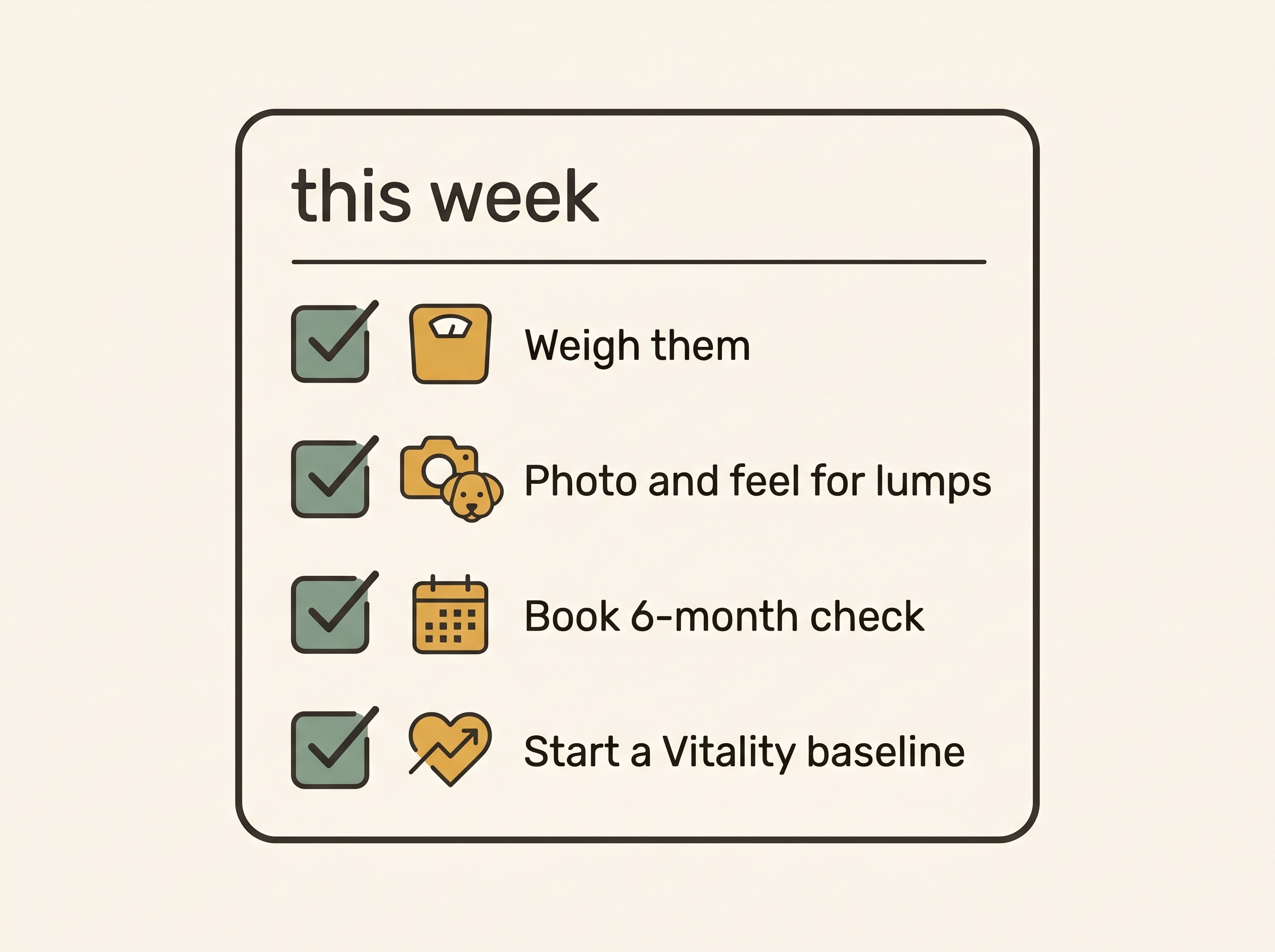
This week, if your dog has just crossed into their senior band:
- Weigh them and write it down. A vet weigh-in is ideal; a "lift them and stand on the bathroom scales" estimate beats nothing. This is the first line of your baseline.
- Photograph the muzzle, and run your hands over the whole body. A dated photo makes greying and any new lumps obvious next time, and a slow head-to-tail feel finds lumps you would otherwise miss.
- Book the six-monthly senior check (and ask whether now is the right time for baseline bloods, urine and a blood-pressure reading).
- Start tracking their Vitality, so that next time you wonder "is she slowing down?", you will not be guessing. You will know.
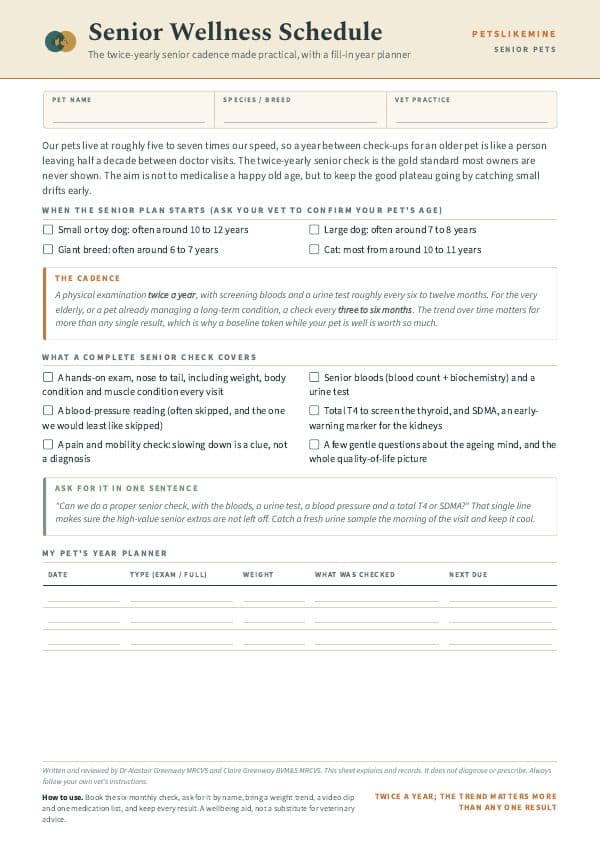
Free downloads
Companion worksheets to put what you've read into practice. Free PDFs, print at home.
Sister tool · Sightline
Track quality of life over time
Sightline, a separate ConciergeVet tool, runs a short adaptive weekly assessment with a quality-of-life focus mode built around exactly these frameworks, tracks a single composite score over time so you can see the trend rather than judge a single bad day, and produces a Sightline Report PDF you can bring to your vet.
A written log, or our printable quality-of-life sheet, does much the same job.
See how Sightline tracks quality of lifeKeep track of how your pet is doing
The owners who cope best are the ones who notice changes early. A simple health log shows you what is working, and what is not, before the next vet visit.
Start tracking, freeYou're not doing this alone
Compare treatment journeys and talk to owners managing senior pets. Free to join.
Join PetsLikeMine