

Setting a senior baseline: the numbers and notes worth having now
Alastair Greenway
BVM&S MRCVS
One quiet afternoon you notice the grey has crept further up the muzzle than you remembered. Your dog is asleep in the low light, and the years have shown up all at once. Or your cat takes the long way down off the bed instead of her old flying leap, and lands a little softer than she means to. Nothing is wrong. They are just, suddenly, a bit older than they were.
That noticing is worth keeping, and this article is about how. The most useful thing you can do for an ageing pet is not to wait for a problem and react to it, but to capture a clear picture of them now, while they are well, so that if something does begin to shift you can see it as a shift rather than a vague feeling that they are "not quite themselves." A few numbers and a few notes, taken today, become the reference point you measure everything against for the rest of their life. Vets call that a baseline, and it is one of the quietest, kindest things you can set up for an older animal. It costs almost nothing.
A baseline beats a "normal range"
When your vet runs blood tests, every result comes with a reference range, the band of values considered normal for the population. That band is wide, because dogs and cats vary enormously, so a result can sit comfortably inside the "normal" band and still be abnormal for your particular pet. What matters far more than a single number on a single day is the trend: where that number is heading over time.
Take a simple example. Imagine your dog's kidney value reads 15 one year and 22 the next. Both might sit inside the normal range, so a one-off test would shrug and call them fine. But that upward drift is exactly the kind of early signal a baseline is built to catch, often months or years before the figure crosses into clearly abnormal (The Pet Vet). It is the same logic behind newer kidney markers like SDMA, which can flag failing kidneys once around a quarter to 40% of function is lost, where the older marker creatinine often waits until roughly three quarters is gone (IDEXX).
So a "normal" result on a healthy older pet is never a wasted test. It is the ruler: without it, your vet is reading a single frame and guessing at the film. And the point of a baseline, at the clinic or at home, is not to collect numbers for their own sake, but to know your pet's own normal well enough that the small drift, the kind that hides so easily in a busy life, shows up early.
The vet's half: the senior baseline visit
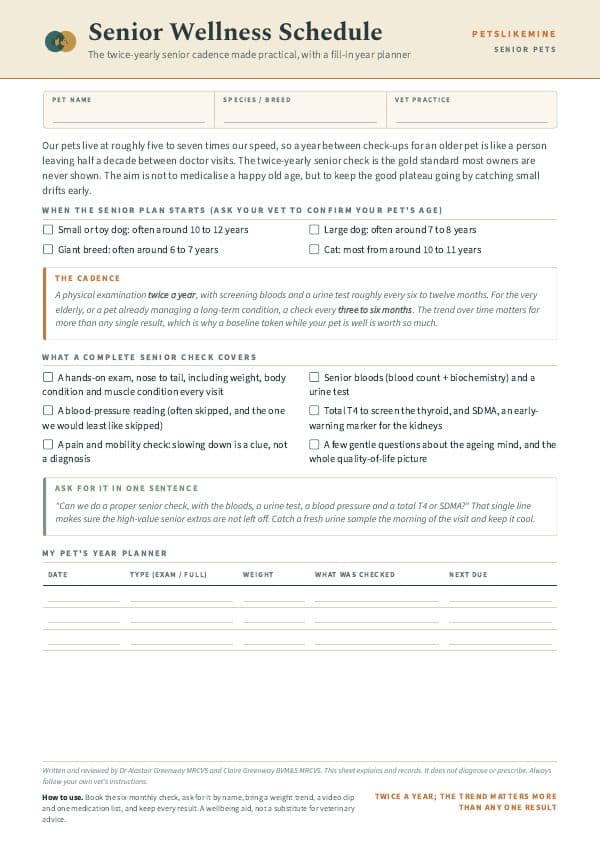
The professional half of the baseline is a wellness visit with some screening tests, done while your pet is well. The headline recommendation from the veterinary bodies is that older pets are seen twice a year rather than once. The reasoning is humane arithmetic: a year is a small slice of your life but a large chunk of an old animal's, and a lot can change inside it. The 2023 senior care guidelines build the whole approach around the principle that old age is not a disease, but a stage that benefits from a systematic plan and closer monitoring (2023 AAHA Senior Care Guidelines, Dhaliwal et al.). As one Cornell summary put it, for a healthy senior a twice-yearly exam with screening bloodwork every six to twelve months "is the best way to catch a change in health" (Catwatch).
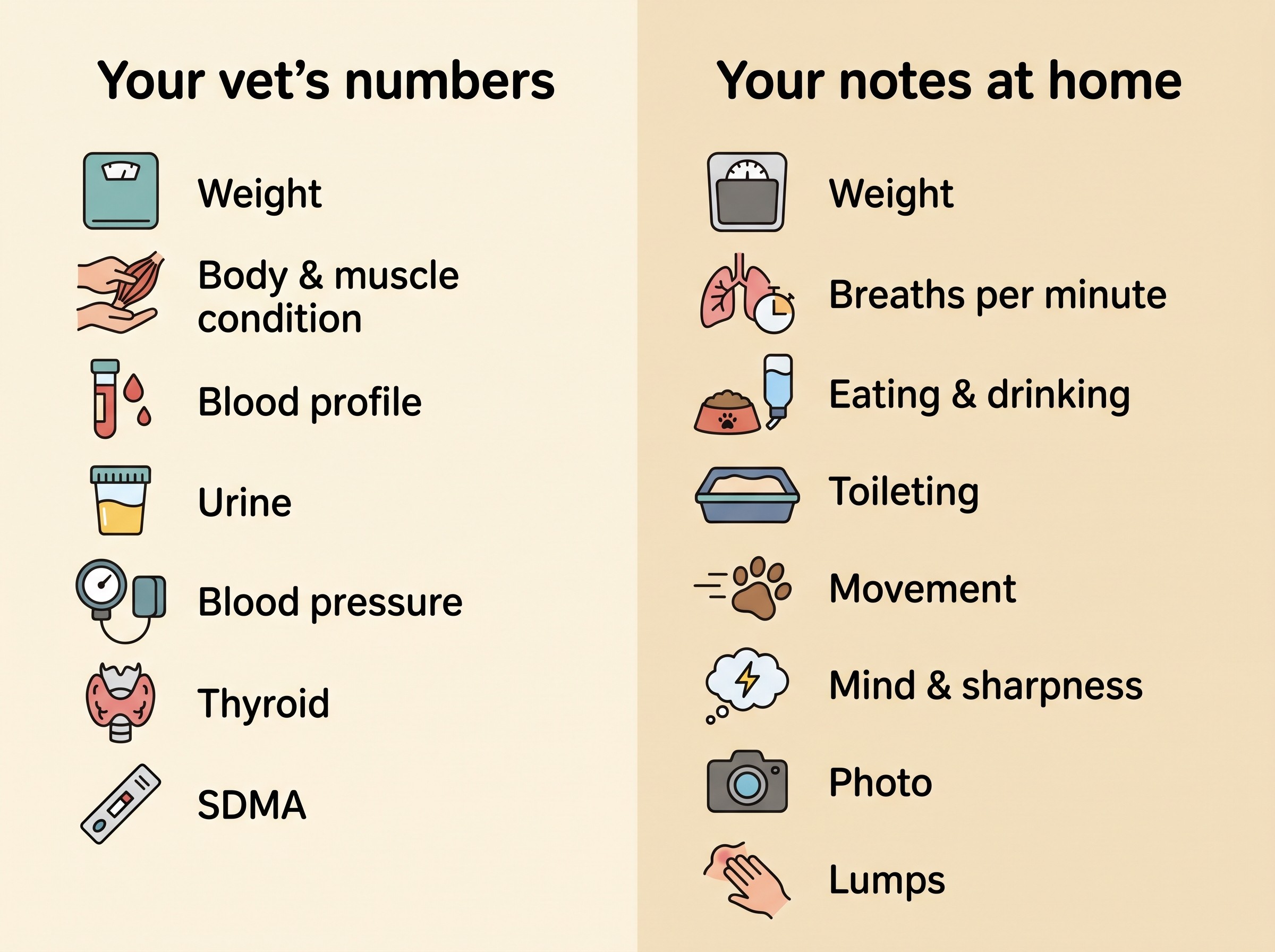
A senior baseline workup gathers a core set of information. You do not need to memorise it, but it helps to know what a thorough check looks like so you can ask for it:
- Weight, in kilograms, on the same set of scales each time so the trend is reliable.
- Body condition score (a 1 to 9 scale of how lean or heavy they are, with 4 to 5 ideal) and muscle condition score (normal, mild, moderate or marked muscle loss). These two are scored separately on purpose, and that matters a great deal, as we will see.
- A blood profile (typically a complete blood count and a biochemistry panel) plus a urine sample, surveying the kidneys, liver, blood sugar, proteins and blood cells.
- Blood pressure, recommended as a routine part of the senior workup in cats whether they seem well or unwell (2021 AAFP Feline Senior Care Guidelines, Ray et al.), and increasingly checked in older dogs too.
- A thyroid test (total T4), especially in cats, where an overactive thyroid is a common, treatable cause of weight loss; and SDMA, the early kidney marker above.
For cats, that blood pressure and thyroid check are not optional extras: the feline guidelines build them into the minimum picture and note that, because cats age faster than we do, the sensible gaps between checks shorten as they get older (Ray et al., 2021). For dogs, the same philosophy applies, scaled to size and breed.
You do not need the deep detail of every test to set a baseline. If you want to understand what each value means, we cover it properly in senior blood tests explained, and the whole twice-yearly visit, what your vet should do and how to arrive prepared, has its own guide in the senior wellness check. One thing is worth saying here, because it stops so many owners booking: if your pet is older and has never had a baseline, do not assume they are now "too old" to bother. A baseline is most valuable precisely when there are more years behind a pet than ahead, because that is when change accelerates. The sooner you start the record, the more useful it becomes.
Your half: the numbers and notes worth keeping at home
The other half of the baseline is yours, and it catches things first, because you see your pet every day. None of it needs equipment you do not already own: a set of scales, your phone and a couple of minutes here and there.
Weight. Weigh a small dog or cat by stepping on the bathroom scales holding them and subtracting your own weight, or pop them on the kitchen scales in a basket; bigger dogs are easiest to weigh at the practice between visits. You are building a line on a graph, not a single number, so the same scales at roughly the same time of day matter more than precision to the gram.
Resting breathing rate. This is the single best number you can track at home, and almost nobody knows to do it. When your dog or cat is asleep or lying quietly (not purring), watch the chest and count one breath for each full rise-and-fall over a minute. A normal resting or sleeping rate for both dogs and cats sits between about 15 and 30 breaths a minute, and one consistently above 30 is a reason to ring your vet (VCA Animal Hospitals). The power is in the baseline: once you know your pet's usual number, a creeping rise above it can be an early sign of heart or lung trouble long before they ever look breathless. Count it over a few quiet evenings and write down their normal.
Eating, drinking and toileting. Roughly how much do they eat, and how keenly? How often is the water bowl refilled? For a cat, how many wet clumps and stools in the tray? These sound mundane, and that is exactly why they are useful: increased thirst, a change in appetite or a shift in what comes out the other end are among the earliest whispers of kidney disease, diabetes and thyroid trouble, and they are invisible unless you have a rough sense of the baseline. You do not need to weigh the kibble; you need to know what ordinary looks like.
Movement. Which stairs do they take and which do they avoid? Does your dog still rise easily from the floor, or push up front-end first and pause? Does your cat still reach the windowsill in one go, or take it in two now? Stiffness, hesitation and a slower turn of speed are easy to file under "just getting old," the single most important trap in senior care, so note where they are now, while they are comfortable.
Their mind and sharpness. This is the gentlest note, and one of the most valuable. Write down who they are right now: how they greet you, whether they settle and sleep through the night, how they find their way around the house and garden, the routines that make them them. You are not diagnosing anything, just recording the personality, so that if their memory and sharpness change later you have something real to compare against rather than a fading sense of "how they used to be." It matters because these changes are so easily missed: in older dogs, the great majority show at least one sign of cognitive change, yet only a small fraction of owners ever mention it, because the early signs look so much like ordinary ageing (Today's Veterinary Practice). A baseline note is how you avoid being one of them.
A current photo, and a note of any lumps. Photograph your pet now, in good light. It is a lovely thing to have, and a record of their coat, posture and condition. While you are at it, run your hands over them and note any lump you find, where it is and how big (a coin beside it in a photo gives instant scale). Crucially, do not try to judge whether a lump is harmless from how it looks or feels: even a cancer specialist cannot reliably tell a benign lump from a serious one by touch alone, which is why any new or changing mass deserves a vet's eyes and often a quick needle sample (Today's Veterinary Practice, tumour detection). A dated photo and a measurement turn "I think it might be a bit bigger?" into something your vet can act on.
One medication list. Finally, if your pet takes anything at all, including supplements and joint chews, keep it on one current list. It is the foundation of safe care once an older pet is on more than one thing.
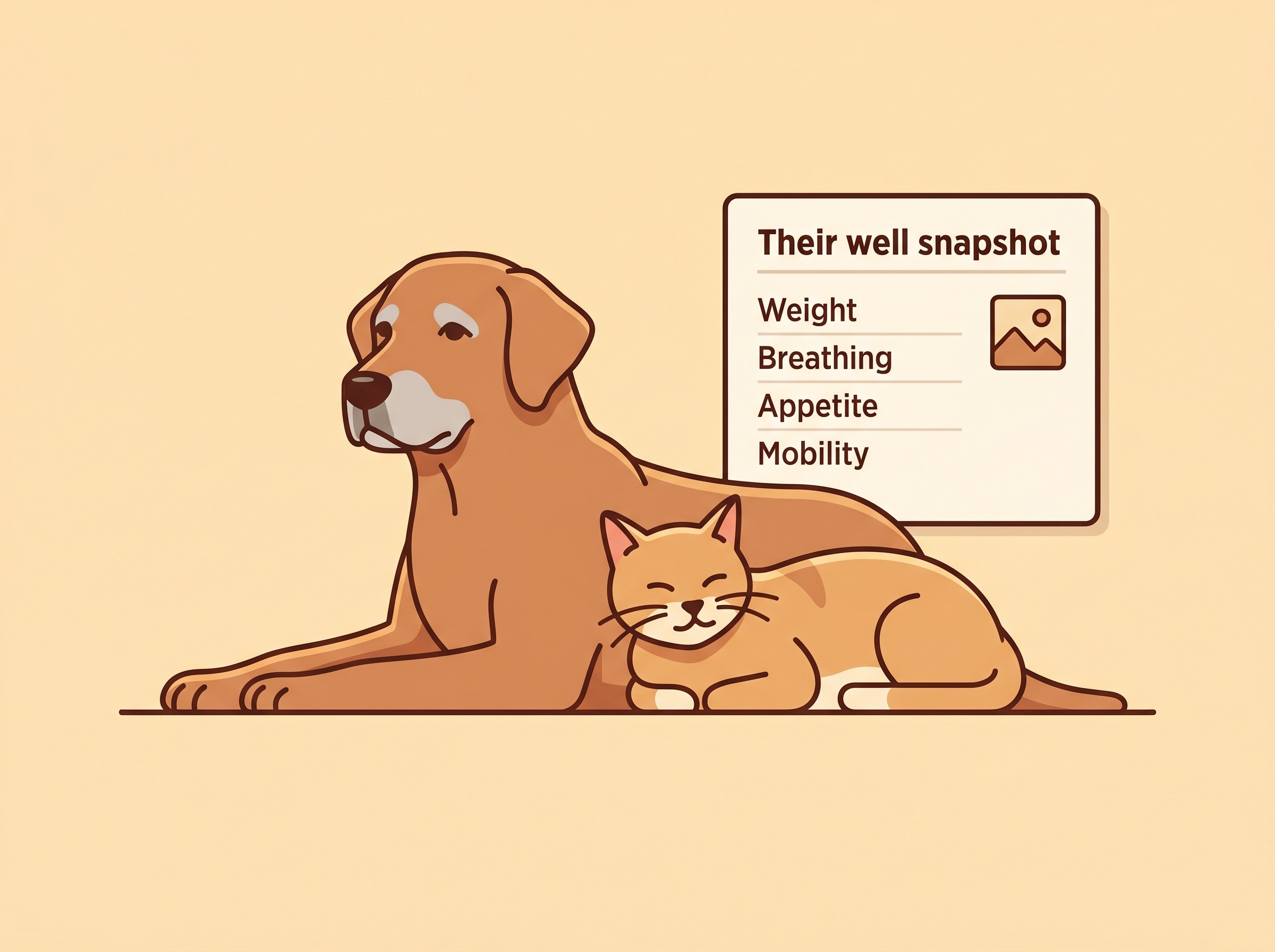
Most of these home notes map neatly onto the in-app Senior Wellness Check, which is built to hold exactly this record over time. It gathers your pet's Vitality (energy, body condition, muscle, mobility and how much they still engage with you) and their Mind and Sharpness, then keeps the trend, so that "what's changed since last time" is a question with an answer rather than a worry. That, in the end, is what a baseline is for.
When the surface lies: the muscle that goes quietly
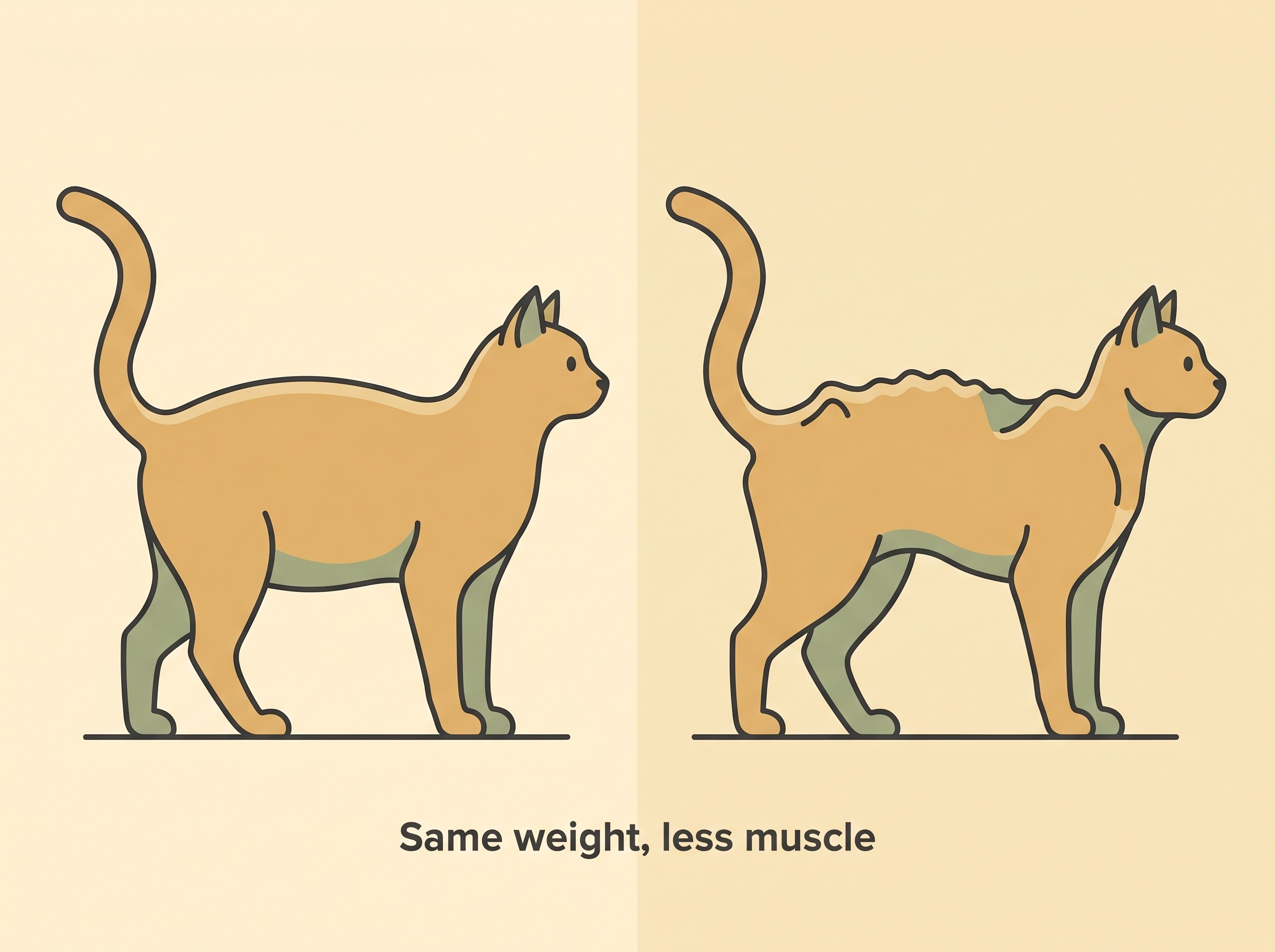
There is one place where weight alone will mislead you, and it explains why your vet scores muscle separately. As animals age, many lose lean muscle through a process called sarcopenia, the gradual, age-related loss of muscle that happens even without disease. The catch is that the lost muscle is often quietly replaced by fat, so the number on the scales barely moves while the body underneath is changing, and a pet can even be a touch overweight by body condition and be losing muscle at the same time (Preventive Vet). Weight, on its own, cannot see this. That is why muscle condition is scored on its own scale, feeling the muscle over the spine, shoulder blades, skull and hips and grading it from normal through mild, moderate and marked loss, independently of how heavy the animal is (dvm360). It is a particularly important note for cats, in whom this loss tends to be both common and clinically significant. Your hands, run over the same places every few weeks, make a good early-warning system once you know what their normal feels like.
What it is really for: spotting the drift that matters
A baseline earns its keep on the day something starts to move. Three kinds of drift, in particular, are the reason to bother, because they are the ones a baseline makes obvious and resignation makes invisible.
The first is weight loss, and it deserves a flag of its own: in an older pet, weight coming off should never be filed under "just getting old." It is one of the clearest warning signs in senior medicine, pointing to a list of things far better caught early, including dental pain, gut disease, kidney disease, an overactive thyroid in cats, diabetes and cancer. A cat can keep eating heartily, or eat more than ever, and still lose weight, the classic pattern of an overactive thyroid or diabetes (Bowman Veterinary Hospital). Many of these have their own space here: kidney disease in the Chronic Kidney Disease space, thyroid trouble in Hormone Health, and sustained thirst or appetite change leading toward Diabetes; we cover the red flag itself in why weight loss in an older pet is never just old age. The point of the baseline is simply that you will know the weight has dropped, and know it early.
The second is the slowdown that is actually discomfort. The reluctant stairs, the softer landing, the dog gone quiet, the cat who has stopped jumping to her favourite spot are very often not the years catching up but treatable pain, most commonly from arthritic joints. Pain in dogs and cats hides as a change in personality and routine far more than as an obvious limp, which is why it is mistaken for ageing and left alone. If your notes show a real change in how they move, that is a conversation to have, not a thing to accept: the 2-Minute Mobility Check and the Arthritis space are the next step, and we untangle it all in is it pain, age or disease?.
The third is a change in the mind: a dog who seems lost in a familiar room, paces at night, or forgets a house-trained habit; a cat who yowls in the small hours or seems disoriented. These changes in memory and sharpness can be the first signs of what vets call cognitive dysfunction, but that is a diagnosis reached only after other causes are ruled out, because pain, fading sight or hearing, high blood pressure and thyroid or kidney disease can all look identical from the outside (Today's Veterinary Practice). Your baseline note of "who they were" is what helps your vet tell a genuine change from a memory playing tricks. If this is where you are, the first signs of canine cognitive dysfunction is the gentle next read, and you will find others on the same road in the senior community, where the night-time worry in particular is a great deal lighter shared.
None of this is about watching your pet anxiously for decline. It is the opposite: a good baseline lets you relax into the long, good plateau of an older animal thriving, because it answers the background hum of "should I be worried?" rather than leaving it to run.
Start the well snapshot this week
You can set the whole thing up in a single, unhurried week:
- Weigh them, and write the number down with today's date. That is your first data point.
- Count their resting breathing rate over three or four quiet evenings while they sleep, and note their normal (most pets sit comfortably under 30 breaths a minute).
- Run your hands over them properly, head to tail, and note any lump with a photo and a coin for scale, then book a vet check for anything new or changing.
- Write a paragraph about who they are right now: how they move, sleep, eat and greet you. You are recording the personality before anything can quietly edit it.
- Book the baseline bloods if they are older and have never had them, and from here on aim for that twice-yearly check rather than once.
- Start the Senior Wellness Check and pour these notes in, so the record keeps itself and the trend is there waiting next time.
Keep the habit and re-take the same handful of notes each season. The record grows with your pet: the snapshot you start today as a simple "are they well?" baseline becomes, much later and only if you ever need it, the clear ledger of good days that helps you see the bigger picture clearly. That is a long way off, and a story for another day. For now it is enough to know your pet's own normal, written down, so that whatever the years bring you will see it coming gently and in good time. Today, the only job is the first number on the page.
Free downloads
Companion worksheets to put what you've read into practice. Free PDFs, print at home.
Sister tool · Sightline
Track quality of life over time
Sightline, a separate ConciergeVet tool, runs a short adaptive weekly assessment with a quality-of-life focus mode built around exactly these frameworks, tracks a single composite score over time so you can see the trend rather than judge a single bad day, and produces a Sightline Report PDF you can bring to your vet.
A written log, or our printable quality-of-life sheet, does much the same job.
See how Sightline tracks quality of lifeKeep track of how your pet is doing
The owners who cope best are the ones who notice changes early. A simple health log shows you what is working, and what is not, before the next vet visit.
Start tracking, freeYou're not doing this alone
Compare treatment journeys and talk to owners managing senior pets. Free to join.
Join PetsLikeMine