

Weight loss in an older pet: why it is never just old age
Alastair Greenway
BVM&S MRCVS
The thought usually creeps in sideways. You rest a hand on your dog's back and there's more spine under your palm than there used to be, or you lift your cat and she weighs almost nothing in your arms. The food bowl is emptying, more or less, so the comforting explanation suggests itself: she's just getting on a bit, this is what old animals look like, it's nothing. I know exactly why that sentence is so tempting, and I want to be gentle but completely straight with you, because this is the one piece of senior care I won't soften. An older pet who is losing weight is almost never "just old age." Weight loss is a symptom, not a stage of life, and behind it there is very often something we can treat, especially if you catch it now rather than in three months' time.
So this isn't an article that ends in "don't worry." It's the opposite, in the kindest way I can manage. The reassurance here is that most of the things that quietly slim down an old dog or cat are findable and, in many cases, very manageable, but only if the weight is read as a clue rather than waved away. Let me show you what your pet's body is trying to tell you, what it might mean, and exactly what to do with it.
An old body should hold its weight
Here is the principle the whole profession now builds senior care around, and it's worth saying plainly: getting old is not, in itself, a disease. The 2023 AAHA Senior Care Guidelines are built on exactly that idea, that ageing is something to support and enjoy rather than a diagnosis to shrug at (Today's Veterinary Practice). A healthy older animal, eating normally, should stay roughly the same weight from one season to the next. Yes, the muzzle frosts, the naps get longer and the morning warm-up takes a moment more. But the number on the scales drifting steadily downward is not on that list of gentle, ordinary changes. When weight is going, the body is spending more than it's taking in, and in an old pet that almost always means there's a reason worth finding.
This is why your vet now wants to see older pets twice a year rather than once, and why they weigh your pet, score the fat layer (body condition) and feel the muscle (muscle condition) at every single visit. They are not box-ticking. They are watching the trend, because in an older animal a falling weight is one of the earliest and most reliable signals that something has changed under the bonnet, often long before anything else looks wrong.
The trap that fools almost everyone
Before we get to the causes, I have to show you the trap, because it catches devoted, attentive owners every day, and even catches vets who only ever reach for the scales.
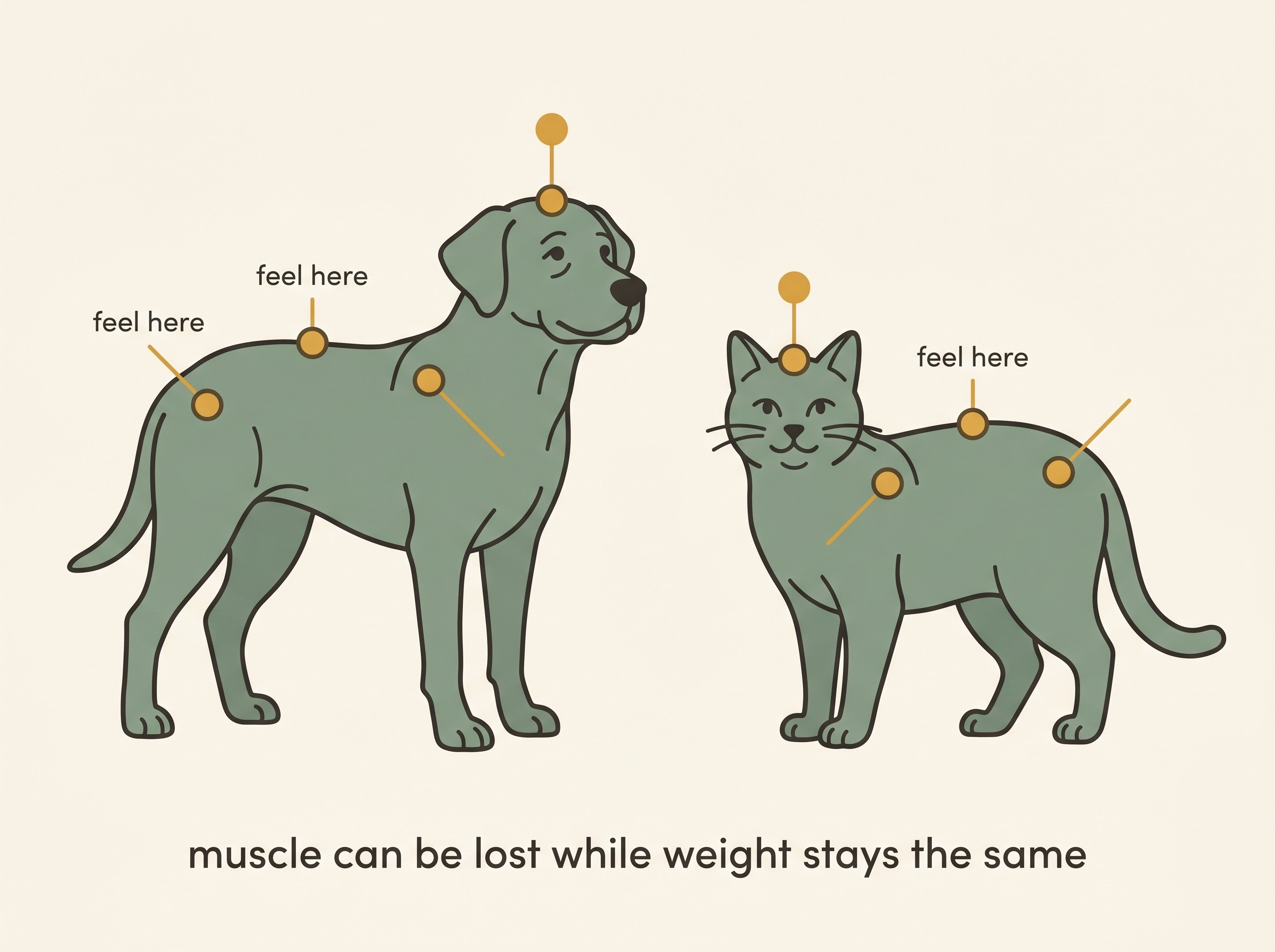
You can lose a great deal of muscle while your body weight barely moves.
Body weight is fat plus muscle plus everything else, all added together. An ageing animal can be quietly swapping lean muscle for fat, so the scales read the same while the body underneath is genuinely wasting. A pet can even be carrying a bit too much weight and be losing significant muscle at the same time (Tufts Petfoodology). That's why your vet assesses muscle separately, with a muscle condition score, by running their hands over the places muscle goes first: along the spine (the earliest to show it), and over the skull, the shoulder blades and the hips. The lesson for you at home is simple and important. Don't just weigh your pet. Feel them. Greet your dog or cat with your hands as well as your eyes, regularly, in the same way, so that you'd notice the bony ridge of a spine that used to be padded, or hollows opening up above the eyes.
How much does this matter? In one study of cats with cancer, muscle wasting was present in the great majority, and a striking number of them were wasting visibly even though their overall body condition still looked acceptable (Hloben et al. / Baez et al., reported 2024). The cats in poorer condition lived markedly shorter lives than those who had held onto their condition. Muscle is not cosmetic: losing it makes an animal weaker, dampens the immune system and slows recovery from illness, surgery or injury (Tufts Petfoodology). Catching the wasting early is part of why catching the cause early matters so much.
A quick word on what is and is not benign here, because the language gets confusing. Some gentle, age-related muscle softening (the clinical word is sarcopenia) does happen in old animals without any disease behind it. But muscle melting because of an illness (the word is cachexia, the kind seen with kidney disease, cancer or heart failure) is a different beast entirely, and you cannot reliably tell the two apart from the sofa (Purina Institute). That uncertainty is precisely the argument for a vet visit rather than a guess.
How much loss counts, and why the line matters more than the number
Owners often ask me how much weight loss is "enough" to bother the vet about, hoping for a tidy threshold. The honest answer is that the direction of travel matters far more than any single figure. A steady, unexplained downward slope is the signal, and you don't need to wait for it to become dramatic. As a rough guide, an unexplained loss of around five per cent or more of body weight in an older pet is worth a phone call, and for a small cat that can be a frighteningly small amount in absolute terms: losing half a kilo off a four-kilo cat is more than a tenth of her.
Why the trend beats the snapshot is captured beautifully by a large study of cats who went on to be diagnosed with kidney disease. Looking back through their records, the researchers could see weight slipping away as much as three years before the kidney disease was formally diagnosed, with a median loss of nearly nine per cent of body weight in the single year before the diagnosis, and the decline then sped up afterwards (Freeman et al., 2016). In other words, the scales were sounding the alarm years before the blood tests did. The cats who were already lighter at the point of diagnosis also tended to have shorter lives, which tells you that noticing early genuinely changes the story.
This is the single most useful habit you can build for an older pet: write the weight down, the same way each time, so that you and your vet are reading a line on a graph rather than trying to remember whether she felt lighter "a while ago." A trend is something you can act on. A vague memory is not.
What weight loss is usually trying to tell you
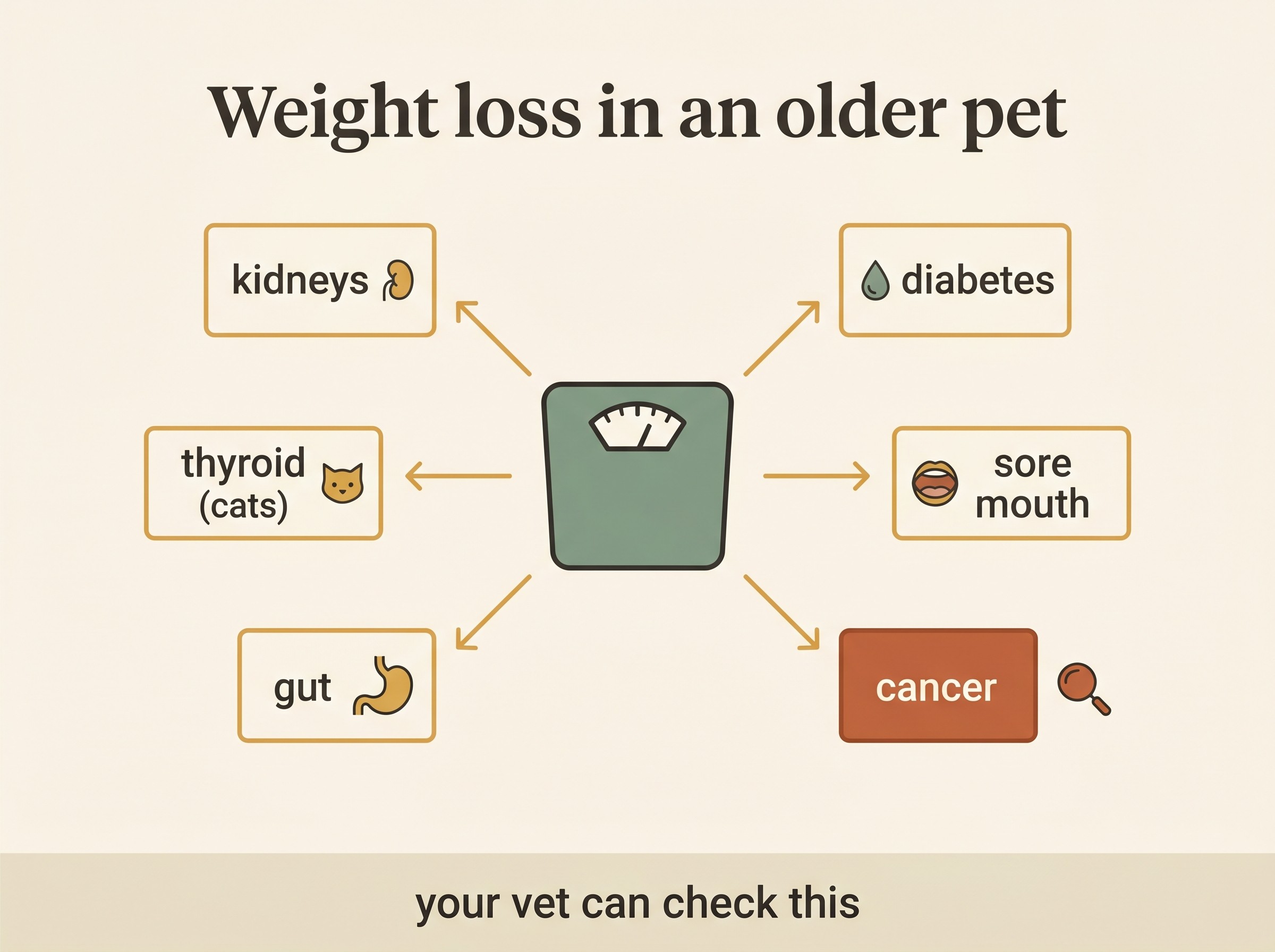
Now to the part that matters most: what's actually behind it. The list below is not meant to frighten you, and it's certainly not a diagnosis you can make from your armchair. It's a map of the usual suspects in older dogs and cats, so that you can recognise the picture and, just as importantly, see that each of these has somewhere to go and something to be done about it. For an older dog, the well-worn differentials include tumours inside and outside the gut, dental disease, chronic gut disease, pancreatitis, diabetes, kidney disease and heart failure (Royal Canin clinical library). Here's how those tend to show themselves.
The kidneys. Chronic kidney disease is one of the most common reasons an older pet, and especially an older cat, loses condition. The classic early picture is drinking and weeing more than usual, sometimes with a drifting appetite, occasional nausea and that quiet muscle wastage we talked about. As we saw above, the weight often starts sliding well before the diagnosis is made. If your pet is losing weight and drinking more, the kidneys are near the top of the list, and you can read what to look for and what your vet will check in the Kidney space.
An overactive thyroid (cats especially). This one is worth flagging loudly for cat owners because it produces the most deceptive picture of all. A cat with an overactive thyroid gland (the clinical name is hyperthyroidism) is running their engine too hot, so they lose weight steadily while often eating more, not less. The bowl empties, you think all is well, and meanwhile the cat is fading. Alongside the weight loss you may see a ravenous or restless cat, more drinking and weeing, sometimes vomiting or loose motions, and a coat that has gone scruffy and unkempt (Cornell Feline Health Center). It's common, it's very treatable, and it lives in the Hormone Health space. The crucial thing to take from it is this: a good appetite does not mean your old cat is fine.
Diabetes. In both dogs and cats, diabetes can strip weight away even while the appetite holds up, because the body cannot get sugar into its cells and starts breaking down muscle and fat for fuel instead. The tell-tale trio is weight loss, increased thirst and increased urination. Dogs more often stay hungry while they lose weight; cats are a little more likely to go off their food as things progress (Merck Veterinary Manual). Either way, a losing-weight, drinking-more older pet should be tested, and the whole picture is covered in the Diabetes space.
A sore mouth. This is one of the most missed causes, and one of the most fixable. Dental and gum disease is genuinely painful, and more than half of cats over the age of three already have some degree of it (VCA). A pet with a sore mouth may drop food, chew gingerly on one side, suddenly snub their dry food in favour of anything soft, or simply eat a little less each day, and there's often nothing to see but bad breath. The intake quietly falls, the weight quietly follows, and it gets filed under "fussy in his old age." It's none of those things, and "too old for a dental" is a myth I'll happily bust another day. If your pet has gone off their kibble or developed a whiff to their breath, the mouth is well worth a look (we cover this in detail in dental care for senior pets).
The gut. Sometimes the food goes in and simply doesn't get used. Chronic gut conditions (your vet may use the term chronic enteropathy), problems with the pancreas, or trouble absorbing nutrients can all show as weight loss, often with vomiting, loose or changeable stools, or a normal-looking appetite that just isn't translating into condition. If weight loss comes with any tummy upset, the Digestive Health space is the place to start.
Cancer. I won't skirt the one most owners are quietly dreading, because pretending it isn't on the list helps nobody. Cancer becomes more common with age, and unexplained weight loss is one of its more frequent early signs; according to the Veterinary Cancer Society, cancer is the leading cause of death in senior dogs, affecting almost half of all dogs over the age of ten (AKC). I tell you that not to alarm you but to make the point firmly: this is exactly why weight loss earns a proper look rather than a wait-and-see. And it cuts both ways. A new lump is not a death sentence and a reassuring-looking one is not a guarantee, because you genuinely cannot tell a harmless lump from a worrying one by sight or feel. The answer is never to stare at it and worry, but to have it checked, which often means a quick, simple needle sample. We talk through that whole conversation, calmly, in lumps, bumps and the cancer conversation.
A special word about the old cat
Cats deserve their own paragraph here, because they are quietly the higher-risk group and the harder one to read. Cats are masters at hiding illness; it's wired deep into a small predator who is also prey, and it means a cat can be unwell for a long time while still washing, purring and curling up on your lap. A thin old cat is one of the most reliable warning signs in feline medicine, and it should always earn a vet visit, full stop. The two big culprits, kidney disease and an overactive thyroid, are both common in cats past about ten, and there's a real subtlety worth knowing.
These two conditions frequently turn up in the same cat, and they have a habit of masking each other. An overactive thyroid speeds up blood flow through the kidneys and can flatter the kidney values on a blood test, so that hidden kidney disease only shows its true face once the thyroid is treated. Studies suggest that roughly a quarter of cats with an overactive thyroid have underlying kidney disease that was masked until the thyroid came under control, and that overall an overactive thyroid affects around one in ten older cats while kidney disease affects more than a third (Vet Times). None of that is something to manage at home, and it's certainly not a reason to delay. It's a reason to get your thin older cat seen, and then to trust your vet to monitor both systems together, because treating one can change the other. If you want the full picture of how those two are juggled, the senior cat with kidney disease and an overactive thyroid is written for exactly that situation.
Don't be reassured by a clean bowl, or by an old dog "slowing down"
Two reassurances trip owners up, so let me dismantle both.
The first is the empty bowl. It feels logical that a pet who is eating cannot be seriously ill, but two of the conditions above, an overactive thyroid and diabetes, classically cause weight loss while the appetite is up. A clean bowl is genuinely good news in some contexts and no comfort at all in others, which is why the weight itself, not the appetite, is the thing to watch. The flip side matters too: a quietly reduced appetite from a sore mouth or low-grade nausea can be just as telling, and is easy to miss in a pet who never made a fuss about food anyway.
The second is the phrase "he's just slowing down." Slowing down is itself a symptom, not a diagnosis, and when an older pet is both losing weight and losing get-up-and-go, that combination is the very opposite of reassuring. It's two clues pointing the same way. Far more often than owners expect, what reads as a gentle, dignified decline is treatable pain or treatable disease wearing the costume of old age. If you find yourself weighing up whether a change is ordinary ageing or something more, that is exactly the question we work through in is it pain, age, or disease?.
What to do this week
If you've noticed your older pet looking lighter, here is the plan. None of it is hard, and the first half of it you can do today.
-
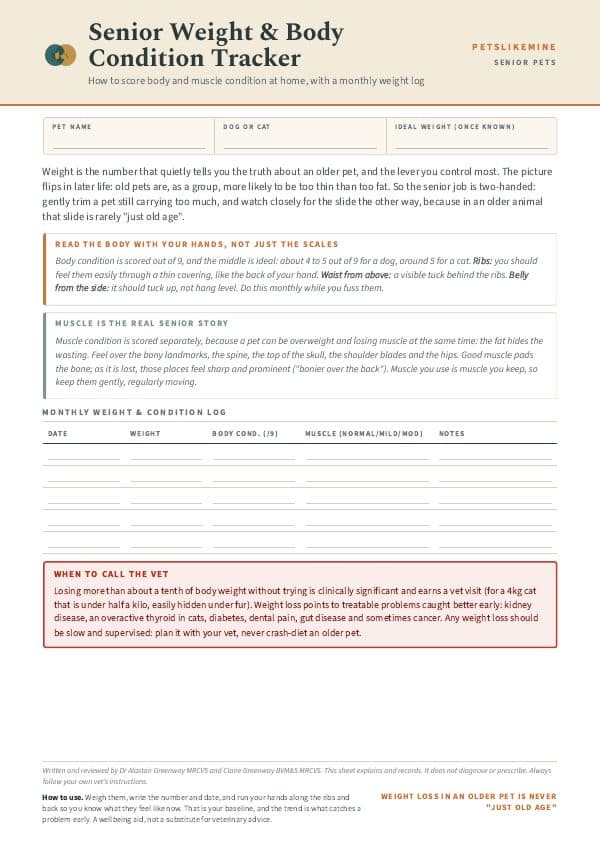
Weigh them, and write it down. A weigh-in on the vet's scales is the gold standard, and most practices are perfectly happy for you to pop in and use them between appointments. At home, weigh a small dog or a cat by stepping on the bathroom scales holding them, then subtracting your own weight, or use luggage or baby scales for a more accurate read. Use the same scales each time. This single number is the start of the trend that tells the real story.
-
Greet them with your hands. Run your palms slowly along the spine, over the shoulder blades, the skull and the hips, and get to know what your pet feels like now, so that thinning muscle would stand out to you next month. A dated photo from above and from the side helps too; changes that are invisible day to day jump out across a few weeks.
-
Note what is going in and coming out. Jot down whether the appetite is up, down or unchanged, whether they are drinking more, and whether the stools or any vomiting have changed. These small observations are exactly what point your vet toward the right test first.
-
Log it in the Senior Wellness Check. Rather than trusting your memory, record the weight and your pet's Vitality (their appetite, energy, mobility, muscle and how sociable they are being) in a couple of minutes, and the check will show you the direction of travel and let you hand your vet a clear trend instead of a hunch. The whole point is to turn "I think she's lighter" into a line you can both see.
-
Book the appointment, and bring the numbers. If the weight is already sliding, don't wait for the next routine check; ring now. Take your weights, your notes and your photos, because you will have done half your vet's detective work for them, and that often means getting to the answer faster and more cheaply.
If you'd value the company of other people walking the senior road, including those navigating a new diagnosis, our senior community is full of owners who have been exactly where you are, and the rest of this space is here for whatever the vet finds and whatever comes next, gently and at your pace.
For today, hold on to this. A thin old pet is not a stage to accept. It's a question with an answer, and the sooner you ask it, the more often that answer is something you can do something about.
Ring your vet this week if your older dog or cat:
- Is losing weight, or feels bonier along the spine or over the hips, even if they are still eating well.
- Is drinking or weeing noticeably more, with or without the weight change.
- Has gone off their food, started dropping it, or developed bad breath.
- Is losing condition alongside any vomiting, loose stools, or a clear drop in energy.
- Has any new or changing lump, however small or harmless it looks.
Free downloads
Companion worksheets to put what you've read into practice. Free PDFs, print at home.
Sister tool · Sightline
Track quality of life over time
Sightline, a separate ConciergeVet tool, runs a short adaptive weekly assessment with a quality-of-life focus mode built around exactly these frameworks, tracks a single composite score over time so you can see the trend rather than judge a single bad day, and produces a Sightline Report PDF you can bring to your vet.
A written log, or our printable quality-of-life sheet, does much the same job.
See how Sightline tracks quality of lifeKeep track of how your pet is doing
The owners who cope best are the ones who notice changes early. A simple health log shows you what is working, and what is not, before the next vet visit.
Start tracking, freeYou're not doing this alone
Compare treatment journeys and talk to owners managing senior pets. Free to join.
Join PetsLikeMine