

Dental care for senior pets: why "too old for a dental" is a myth
Alastair Greenway
BVM&S MRCVS
Somewhere in an older pet's life, a quiet decision often gets made on their behalf. The vet mentions that the teeth need attention, perhaps a dental under anaesthetic, and a single thought arrives almost before they have finished the sentence: but he's old now. It feels like the responsible call, the loving one even. Why put an old dog or a frail cat through an anaesthetic for something as ordinary as teeth? So the leaflet goes in a drawer, the breath is filed under "old-dog smell," and the mouth carries on quietly hurting.
I want to gently take that instinct apart, because it is one of the most common and most costly misunderstandings in senior care. "Too old for a dental" is a myth. So is "too old for anaesthesia." Not in a hand-wavy, everything-will-be-fine way, but for solid reasons that are worth understanding, especially because the thing being avoided is, more often than not, ongoing pain in a part of the body you almost never see.
A mouth most owners never look inside
Start with how common this is. Dental disease is not an occasional problem of neglected pets; it is close to universal in older animals. Most dogs already show some degree of periodontal disease (disease of the gums and the structures that hold the teeth) by the age of three, and the picture only deepens with age (Cornell Riney Canine Health Center).
Cats are right there alongside them, and the numbers climb steeply with the years. A large UK study following cats in ordinary first-opinion practice found that, compared with cats under three, cats aged nine to twelve had nearly seven times the odds of being diagnosed with periodontal disease, rising to almost eight times in cats over fifteen (O'Neill et al., 2023). The same study found that affected cats were typically around nine and a half years old. So if you have a senior cat, a sore mouth is not a remote possibility. It is one of the likeliest things going on.
The reason it stays hidden is the gum line. The trouble that matters happens below it, where plaque (a living film of bacteria) creeps under the gum, inflames it, and slowly destroys the attachment and bone around the tooth. The yellow-brown tartar you can see on the visible crown is almost the least of it. As the WSAVA's global dental guidelines put it, controlling the plaque on the visible surface alone is "ineffective" once disease has taken hold beneath the gum, because the damage is being done by the part you cannot reach (Niemiec et al., WSAVA Global Dental Guidelines). That single fact, that the disease lives under the gum, explains nearly everything that follows.
Pain that hides in plain sight
Here is the belief I most want to dismantle: "if his mouth really hurt, he'd stop eating." Pets, and older pets especially, are quietly heroic about oral pain. The WSAVA guidelines are blunt about it: dental and oral diseases "create significant pain," and the human dental literature, where people can actually tell us, describes that pain as severe. Animals simply do not have the option of complaining, so they keep eating because they are hungry and they carry on (Niemiec et al., WSAVA Global Dental Guidelines).
What you tend to see instead is small and easy to misread as "just getting old." A dog who has started chewing on one side, dropping kibble, or going off hard food in favour of anything soft. A cat who approaches the bowl, then backs away, paws at the mouth, or grooms less because grooming has become unpleasant. Bad breath that you had stopped noticing. A little less play, a slightly shorter fuse, a pet who would rather not have their face touched. None of this looks like agony. All of it can be a mouth quietly asking for help.
This connects to a thread that runs through everything in these years: a change in how your pet eats or behaves is a symptom, not a personality update. A pet "going fussy in old age" deserves a look in the mouth, not a shrug, and weight that starts to fall because eating has become a chore is never something to wave away as ageing (we make that case in full in why weight loss is never "just old age"). If you track how your pet is doing, the appetite and comfort notes in the Senior Wellness Check are exactly the kind of slow drift that is far easier to spot on a chart than in the blur of daily life, and exactly the thing worth showing your vet.
More than a mouth problem
There is a second reason to take this seriously, though I want to keep it in proportion rather than use it to frighten you. A mouth full of infected gum is not sealed off from the rest of the body. The chronic inflammation and bacteria have measurable effects elsewhere: a classic study of 45 dogs found a statistical association between the severity of periodontal disease and microscopic changes in the kidney, the heart muscle and the liver (DeBowes et al., 1996), and later work found that the greater the burden of gum disease, the greater the likelihood of changes in those same organs (Pavlica et al., 2008).
These are associations rather than proof that the mouth single-handedly damages the kidneys, and a clean mouth is not a cure for organ disease. But for an older pet who may already be managing something in the heart or kidneys, it makes no sense to leave a reservoir of infection sitting in the mouth. The whole-pet thinking that runs through senior care applies here too: the mouth is one more part of the same animal (the whole-pet view).
Taking the myth apart properly
So why does "too old for a dental" persist, and where exactly is it wrong?
The heart of it is this: age is not a disease. An anaesthesia specialist put it plainly in a recent review, writing that "there is no chronological age limit for anesthesia. Age is not a disease," and that anaesthetic risk is "based on health, not age" (Grubb, 2026). A birthday tells your vet almost nothing on its own. What matters is your pet's actual state: heart, kidneys, liver, blood pressure, hydration, and the general robustness the wellness check thinks of as Vitality. A bright, well-managed thirteen-year-old can be a far safer anaesthetic candidate than a sick five-year-old.
That does not mean anaesthesia carries no risk, and you deserve the real number rather than blanket reassurance. The largest UK study of anaesthetic safety found the risk of an anaesthetic-related death to be around 0.17% in dogs and 0.24% in cats, so roughly one or two in a thousand across all patients, including the very sick and the emergencies (Brodbelt et al., 2008). It is low, it is not zero, and a planned dental in an otherwise stable older pet sits at the safer end of that range, not the riskier one.
The reason your vet treats an older patient more carefully is not that age is dangerous in itself, but that age makes hidden illness more likely, and that is precisely what the workup is for. Before a senior dental you should expect a proper assessment: a thorough examination, blood and urine tests to check organ function, and often blood pressure, with the anaesthetic plan then tailored to what those results show. As the same review notes, no anaesthetic drugs are ruled out by age alone, but "underlying disease processes will affect choices" (Grubb, 2026). This is the same pre-anaesthetic picture your vet builds from the senior bloods, and it matters most for a pet juggling several conditions or several medications, where doses are reduced and monitoring is closer. Modern dental anaesthesia for an older pet means intravenous fluids, warming, dedicated monitoring and pain relief, by a team trained for exactly this.
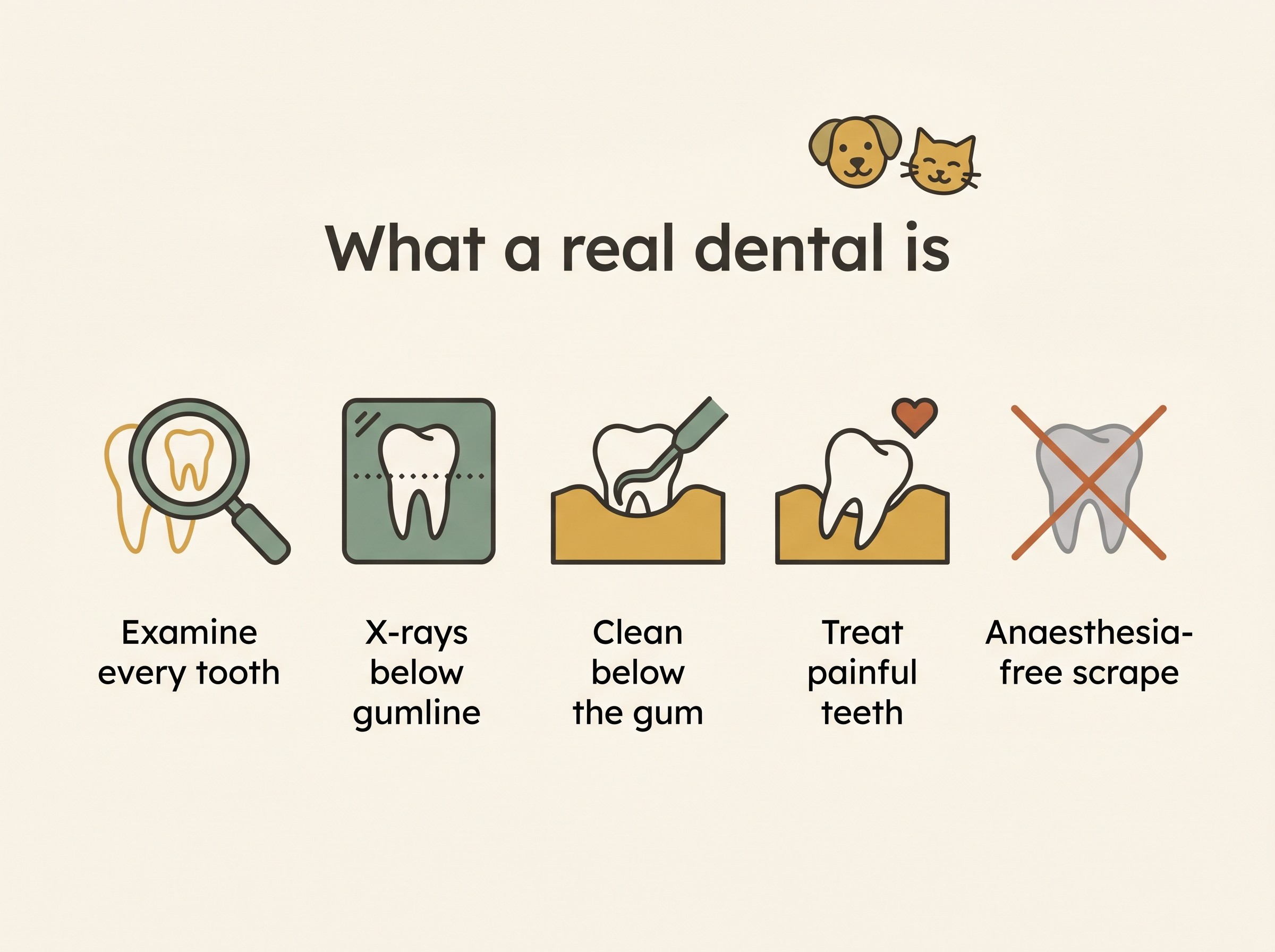
It also helps to know what "a dental" actually is, because the word undersells it. A proper procedure is not a quick scrape. Under anaesthetic your vet can examine and probe every tooth, take dental x-rays to see the two-thirds of each tooth that lives below the gum, clean thoroughly above and beneath the gum line, and treat or remove the teeth that are diseased or painful. Removing a rotten, abscessed tooth is not a loss; it is the moment the pain stops. The thing that genuinely harms an old animal is not the anaesthetic. It is leaving an infected, painful mouth untreated for the rest of their life because of a fear of the clock.
"But there's a no-anaesthetic version, isn't there?"
This is the part where many worried owners reach for what feels like the safe compromise: anaesthesia-free dental cleaning, where someone scales the visible teeth on a conscious pet. It looks like the best of both worlds, the clean teeth without the anaesthetic, and it is one of the few things where I would ask you to be genuinely wary.
The WSAVA guidelines do not mince words, describing anaesthesia-free dentistry as "ineffective at best and damaging at worst" (Niemiec et al., WSAVA Global Dental Guidelines). The reason goes back to the gum line. As the American Veterinary Dental College explains, an awake animal cannot have the area beneath the gum cleaned or even examined, "nor are they able to look beneath the gum-line to identify problems before they become painful," and you certainly cannot take x-rays on a conscious pet (AVDC). All it can reach is the visible crown, which is the one part that was never the real problem. A study published in 2026 put the matter to the test and concluded, in its title, that anaesthesia-free dentistry "does not provide any demonstrable medical benefit for the control of periodontal disease in dogs" (JAVMA).
Worse, it can do harm. The teeth come out looking whiter, which gives a "false sense of security" while the disease carries on hidden underneath; the scaling instruments leave roughened grooves that plaque sticks to even faster; and scraping an infected mouth pushes bacteria into the bloodstream, all without any pain relief for the animal being held still (AVDC). For a senior pet, the cosmetic reassurance is exactly the trap: the mouth looks better, so the real dental gets delayed, and the painful disease wins time.
Where home care comes in, starting today
None of this means the work is all your vet's. The single most powerful thing you can do between procedures is also the simplest, and it is genuinely never too late to begin. The gold standard for keeping plaque under control is brushing the teeth, ideally daily, because plaque starts re-forming on a clean tooth within about a day (WSAVA). Daily sounds daunting; even a few times a week meaningfully helps.
The trick with an older pet, especially one who already finds their mouth tender, is to go slowly and kindly. Start by letting them lick a little pet toothpaste off your finger so the experience begins as a treat, not an ambush. Over days, progress to a fingertip rub along the outer surfaces of the teeth, then to a soft brush, always working with the mouth closed and aiming at the gum line where it counts. Stop while it is still going well. If your pet is in obvious discomfort, do not push through it; that is a sign the mouth needs your vet first, and brushing can come afterwards.
If brushing is genuinely not possible, you are not out of options, but choose well rather than by the marketing on the packet. The Veterinary Oral Health Council awards its seal only to chews, gels, diets and water additives that have been shown in trials to reduce plaque or tartar by a meaningful margin, so look for that seal rather than vague "dental" claims (VOHC). And one safety habit worth keeping for any older cat: never give a cat a product made for dogs without checking, because some ingredients that are fine for dogs are not safe for cats. When in doubt, ask your vet which specific products suit your pet.
One last reassurance for the owner reading this with a guilty pang: a long-neglected mouth is not a verdict on you, and it is not too late. The dog who comes home a few teeth lighter after a proper dental is so often, within days, brighter, hungrier and more themselves than they have been in months, because a pain they had learned to live with has simply gone.
So here is the concrete next step. At your pet's next visit, ask three questions and let the answers, not the calendar, guide you: Is there dental disease, and is it likely hurting? What would the pre-anaesthetic checks involve for a pet his age and health? And what can I do at home in the meantime? If you would value hearing from others who have weighed exactly this decision for an old dog or cat, the senior pets community is full of owners who hesitated over a dental and were glad they went ahead. The mouth is one of the easiest places in an ageing body to take real pain away. Old age is the reason to look more closely, not the reason to look away.
Sister tool · Sightline
Track quality of life over time
Sightline, a separate ConciergeVet tool, runs a short adaptive weekly assessment with a quality-of-life focus mode built around exactly these frameworks, tracks a single composite score over time so you can see the trend rather than judge a single bad day, and produces a Sightline Report PDF you can bring to your vet.
A written log, or our printable quality-of-life sheet, does much the same job.
See how Sightline tracks quality of lifeKeep track of how your pet is doing
The owners who cope best are the ones who notice changes early. A simple health log shows you what is working, and what is not, before the next vet visit.
Start tracking, freeYou're not doing this alone
Compare treatment journeys and talk to owners managing senior pets. Free to join.
Join PetsLikeMine