

The senior wellness check: what your vet should do twice a year
Alastair Greenway
BVM&S MRCVS
When an older dog or cat seems perfectly well, the yearly check-up and booster can feel like plenty, and a second visit can look like fuss, or like a practice drumming up business. I want to argue the opposite, because the twice-yearly senior check is one of the genuinely high-value things you can do for an ageing pet, and most owners have simply never been shown what a good one contains. It is not a longer cuddle and a weigh-in. There is a proper, structured examination that the veterinary profession has agreed on, written down in the 2023 AAHA Senior Care Guidelines for dogs and cats and the 2021 AAFP Feline Senior Care Guidelines for cats, and it lives almost entirely inside clinician documents that no owner ever reads. This article hands you that plan in plain English, so you know what to ask for, what your vet's hands and tests are actually checking, and how to arrive with the half of the picture only you can give.
Why twice a year, not once
Our dogs and cats live their whole lives at roughly five to seven times our speed, so a single year of theirs is the rough equivalent of five to seven of ours. Leave a full year between check-ups for an older pet and, in their terms, you have left it the way a person might leave it half a decade or more between seeing a doctor. In a fit thirty-year-old, that gap is survivable. In an ageing body, where things genuinely do change month to month, it is a long time to be looking away.
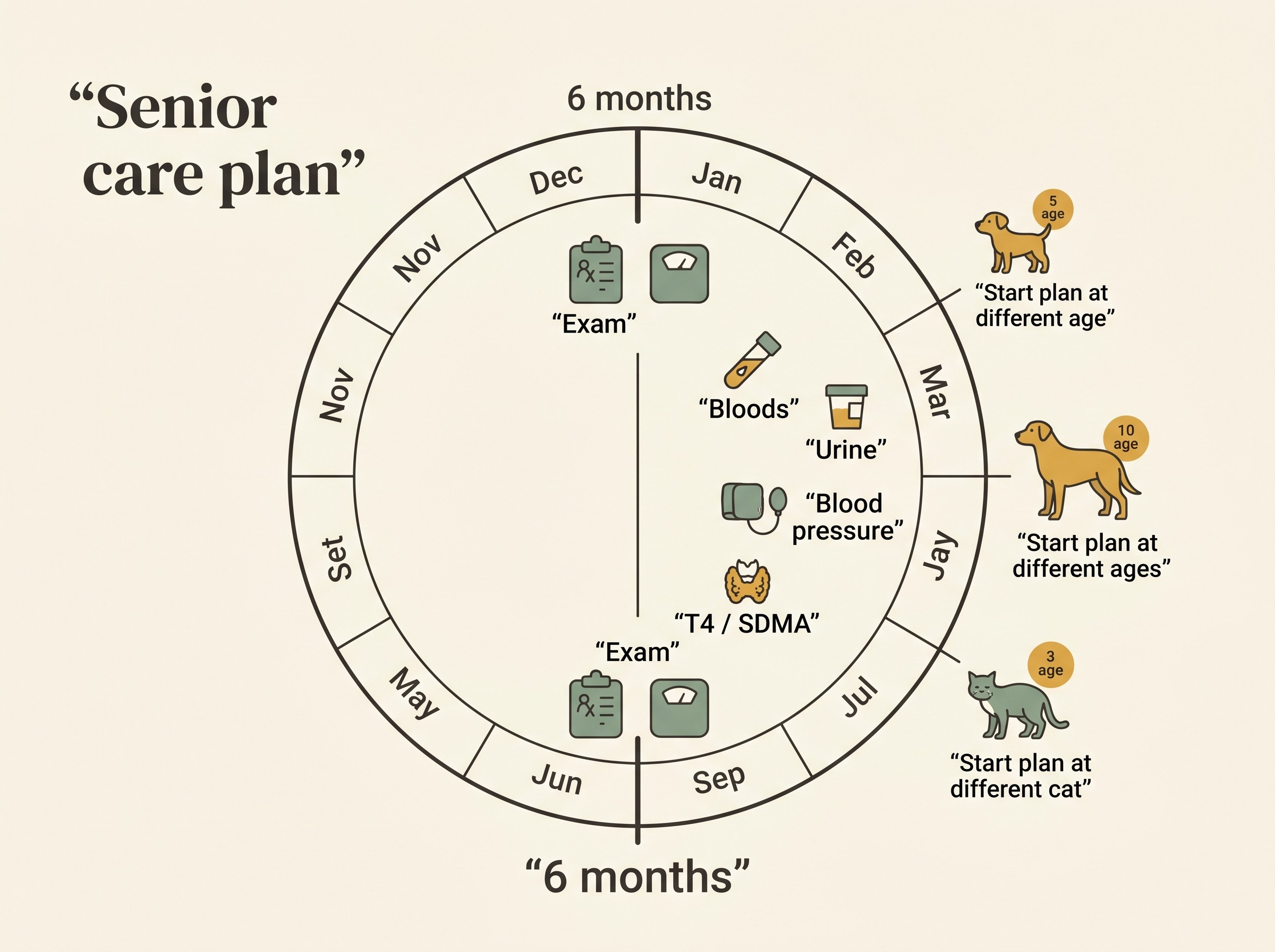
That is the whole logic behind the shift the profession has made. For a healthy senior, both the canine and feline guidelines now ask for a physical examination twice a year rather than once, with screening bloodwork roughly every six to twelve months (AAHA, 2023). The feline guidance goes further for the very oldest cats, suggesting a check every three to six months once a cat is into its very elderly years or already managing a long-term condition (AAFP, 2021). The aim is not to medicalise a happy old age. If anything it is the reverse: to keep that good, long plateau going by catching the small drifts early, while they are still small and gentle to put right, instead of meeting them later as a crisis. Twice a year is simply how often you have to look to keep up with a life moving at this speed.
When the senior plan should start
"Senior" arrives on a sliding scale, and the cadence above starts whenever your individual pet crosses into it, which is part of why a personalised plan beats a one-size rule. The guidelines define a senior dog as one in roughly the last quarter of its expected lifespan (AAHA, 2023), and because big dogs run through their lives faster than small ones, that milestone lands at very different ages: often around six to seven in a giant breed, seven to eight in a large dog, and not until ten to twelve in a small or toy breed. Cats are simpler: most are considered senior from around ten or eleven, though some are worth treating as senior a little earlier (AAFP, 2021). If you are not sure where your own pet sits, when is a dog "senior"? walks through the size bands in detail. The short version: ask your vet to name the age at which your particular animal should switch onto the twice-yearly plan, and then actually book it.
With the why and the when settled, here is the what. A complete senior wellness check has six parts, and knowing them lets you tell a thorough visit from a quick once-over, and ask for anything that gets missed.
1. Hands-on, nose to tail
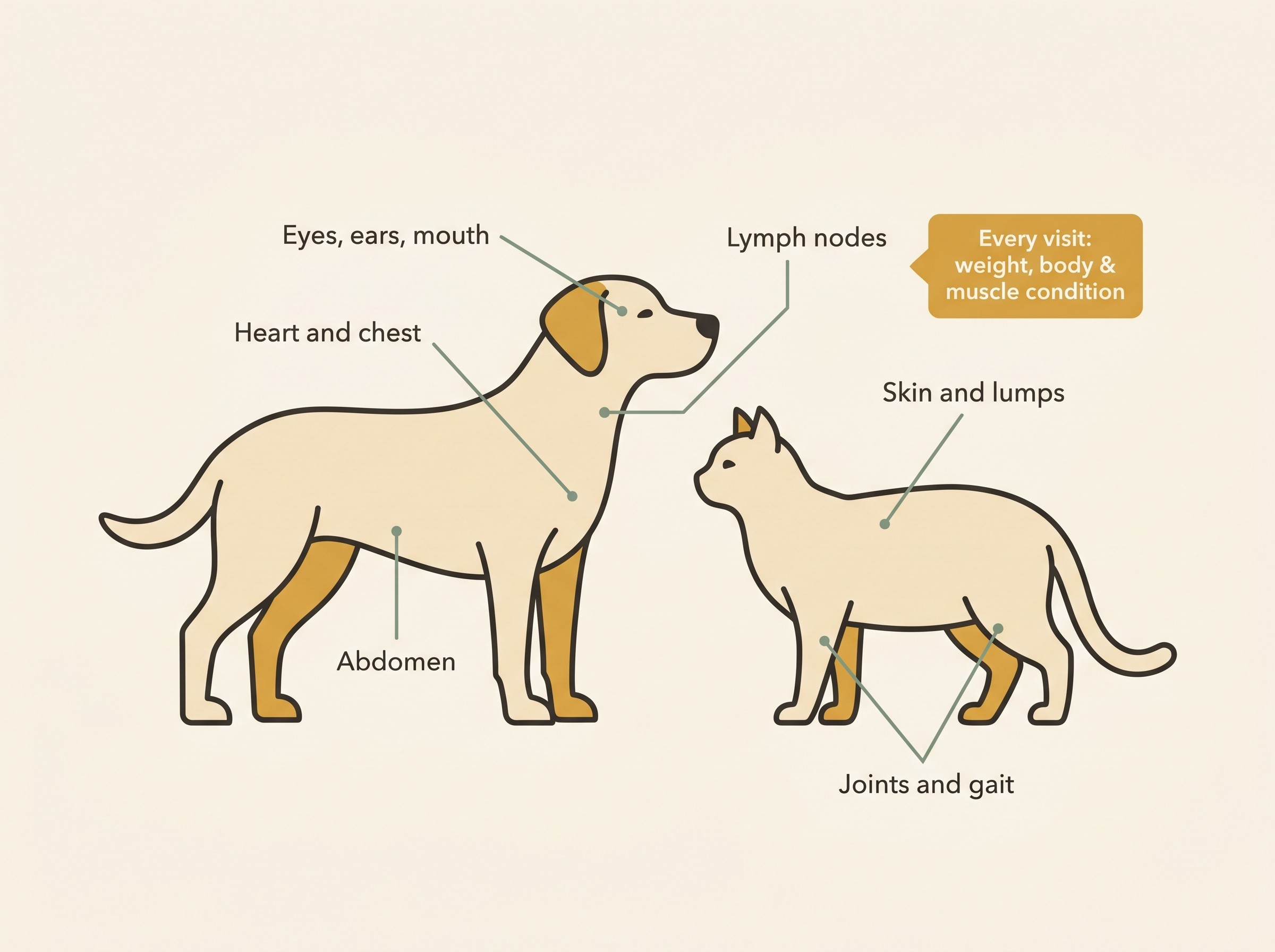
The foundation is still a proper physical examination, and an experienced pair of hands gathers a remarkable amount in a few minutes. Your vet is weighing your pet and reading their body condition and muscle condition; looking in the eyes, ears and mouth; listening to the heart and chest; feeling over the abdomen; checking the lymph nodes, the skin and any lumps; and watching how your pet stands, turns and moves.
Two of those deserve a closer look, because they are where the ageing body shows its hand first.
The first is weight, read properly. A good senior check does not just note the number on the scales; it scores two separate things. Body condition is how much fat your pet is carrying, judged on a nine-point scale where four to five out of nine is ideal for a dog and around five for a cat (WSAVA Global Nutrition Committee). Muscle condition is a different measurement entirely, a judgement of how much actual muscle sits over the spine, skull, shoulders and hips, and an older pet can quietly lose muscle while their fat, and so their weight, stays much the same, which is exactly why the feline guidelines insist that weight, body condition and muscle condition all be assessed at every single visit (AAFP, 2021). That slow wasting of muscle has a name, sarcopenia, but you do not need the label to act on it; you need someone laying a knowing hand along the backbone twice a year and noticing the change.
Weight loss in an older pet is not "just getting old". It is one of the most reliable early flags we have, and it points toward real, often very treatable, problems, kidney disease, an overactive thyroid in cats, diabetes, dental pain, gut disease and, yes, sometimes cancer. It earns a vet's attention every time, never a shrug. We give it a whole article, why weight loss is never "just old age", because it is that important.
The second is any lump or bump. New or changing masses are common in older pets, and the single most useful thing to know about them is that you cannot tell a harmless one from a worrying one by look or feel alone, not as an owner and not as a vet. The answer is neither panic nor "leave it and see", but to get any new or changing lump checked, which often means your vet taking a few cells with a fine needle to look at under the microscope. That short, undramatic step is how a benign lump gets the all-clear and a serious one gets caught early, and it is covered properly in lumps, bumps and the cancer conversation.
2. Senior bloods, urine and the screening panel
The examination tells your vet how your pet looks on the outside. Bloods and a urine test show what is happening on the inside, where a stoical dog on kidneys doing half their old work, or a cat hiding her discomfort with great skill, will give nothing away from the surface. This is why the guidelines pair the twice-yearly exam with a screening panel roughly once or twice a year (AAHA, 2023).
A good senior database usually gathers, in one go: a blood count (for things like anaemia and signs of infection or inflammation), a biochemistry panel (the organ report card, covering kidney and liver values, blood sugar, proteins and minerals), a urine test, a blood-pressure reading, and two senior-specific extras worth knowing by name, a total T4 to screen the thyroid and SDMA, an early-warning marker for the kidneys. Your vet may add a heart marker (NT-proBNP) or an inflammation marker (CRP) where there is reason to (AAHA, 2023). I will not unpack each test here, because that is its own article: senior blood tests explained takes you line by line through what each one looks for. Two things are worth carrying away now, though.
The first is that the trend matters more than any single result. One value on one day is a snapshot; the same value tracked over a couple of years, drifting up or holding steady, is the actual story, which is the whole argument for starting a baseline while your pet is well and looking again at a regular cadence. The second is the route the bloods open up: if your older pet has begun drinking more, weeing more, losing weight or eating differently, this panel is where the search for the reason begins, and it leads naturally toward whichever space fits, the Kidney space, the Diabetes space or the Hormone Health space for thyroid and adrenal conditions, each built to help you manage that condition rather than fear it.
3. Why blood pressure earns its own line
Blood pressure is part of the screening panel, but it is the test most owners are surprised by and the one I would least like to see skipped. High blood pressure is almost entirely silent until the day it is not, and what it quietly damages, the eyes, kidneys, heart and brain, does not all come back (AAFP, 2021).
This is especially a feline story. In cats over about ten, raised pressure is not rare, and it very often travels alongside kidney disease or an overactive thyroid, which is one more reason those checks belong together. Its cruellest presentation is sudden blindness: a cat whose pressure has crept up unnoticed can be brought in having lost her sight overnight, the retina detached behind a wide, fixed pupil. Caught and treated fast that sight can occasionally be saved, but often it is already gone, which is exactly why the feline guidelines ask for a pressure reading at the senior check, and why catching it before the eye is the kind of save that pays for the whole appointment. The thread between pressure and sight is one the Vision and Eye Health space follows in detail. Dogs are not exempt either: canine high blood pressure usually rides on the back of another condition such as kidney disease, so it earns a cuff too. The reading itself is painless, a small cuff on a leg or the tail and a few quiet measurements once your pet has settled.
4. Pain and mobility: the slowing-down that is really a symptom
Now we reach the screens that owners most often do not know to ask for, and the first is the careful read of pain and movement. A pet who has slowed down, gone stiff, stopped jumping or grown quieter is very easily filed under "just old", when far more often that slowing is a symptom of something treatable, and the commonest culprit is the wear-and-tear joint disease vets call osteoarthritis. Slowing down is not a diagnosis. It is a clue, and it deserves to be chased rather than accepted.
The way it hides differs by species, so the way we look for it differs too. In dogs, the signs are usually about reluctance and effort: hesitating at the bottom of the stairs, taking the step into the car in two goes, slowing on walks, stiffness after a rest that eases as they warm up, sometimes a shortness of temper that is really a shortness of comfort. In cats, the picture is sneakier still, because a sore cat rarely limps; she simply stops doing things. The most useful questions a vet can ask an owner of an older cat are about height and edges: is she still jumping up onto the windowsill or the bed in one go, or has she started taking the journey in stages, or going around? A simple six-question owner checklist built around exactly these everyday feats (jumping up, jumping down, going up and down stairs, running and chasing) has been shown to flag the great majority of cats with confirmed joint disease (Enomoto, Lascelles & Gruen, 2020). The reason that checklist works, and the reason your half of the appointment is so valuable, is that cats hide their pain at home and put on a brave, frozen face at the clinic, so the vet often cannot see at the consult what you see every day on the stairs.
This is precisely where what you bring changes the outcome. A short phone clip of your dog getting up from lying down, or your cat hopping (or not quite hopping) onto her favourite perch, can tell your vet more than any amount of poking in a strange room. If mobility is your pet's headline change, the Mobility Check helps you grade and track it over time, and the deeper decode of what slowing down is really telling you lives in is it pain, age, or disease?. The message to hold onto is simply this: do not accept stiffness as the price of age. Bring it up, and let it be looked at.
5. The ageing mind: memory, sharpness and mood
The second easily-missed screen is a few quiet questions about your pet's mind. As dogs and cats age, some develop changes in memory and sharpness, in how they sleep, how they interact and how settled they feel, and the clinical name for the more pronounced version is cognitive dysfunction. But please do not let that label frighten you off the topic, because the single most important fact about it is how badly under-recognised it is. In one survey of dogs over eight, the signs of an ageing mind were picked up by a screening questionnaire in around 14% of dogs, yet only about 2% had ever actually been diagnosed by a vet (Salvin et al., 2010). The gap is almost entirely because owners, very understandably, write the early changes off as "just getting old" and never mention them. A gentle screen at the senior check is how those changes get noticed while there is most to be gained from acting.
Vets often organise the signs with the reminder word DISHA: Disorientation (getting briefly lost in familiar rooms or standing on the hinge side of a door), changes in social Interaction (a dog clingier or more aloof, a cat less keen on a lap), disturbed Sleep (the day-night clock flipping, so they pace or call at 3am), lapses in House-training, and shifts in Activity (aimless wandering, or doing less). In older cats the same picture often shows as loud night-time yowling, becoming withdrawn, or having accidents outside the tray (AAFP, 2021). And there is a real reason to keep an old mind busy and an old body moving: in a study of more than fifteen thousand dogs, the odds of cognitive decline rose sharply with age and were several times higher in dogs who had become inactive (Yarborough et al., Dog Aging Project, 2022).
One crucial caveat your vet will hold in mind, and you should too: changes in the mind are a diagnosis of exclusion. Before any of this is put down to an ageing brain, the other things that mimic it have to be ruled out first, which is yet another reason the screen sits inside the full exam and bloods. Pain, failing sight or hearing, high blood pressure, an overactive thyroid and other conditions can all produce confusion, restlessness or night-waking, and several are very treatable (Today's Veterinary Practice). So the conversation is never "it is just old age", and never a leap straight to the diagnosis either; it is a careful sorting. If you have started to notice changes in your dog's memory and sharpness, the first signs of canine cognitive dysfunction is the gentle place to begin, and the senior community is where owners living with night-waking and a changing personality find others who truly understand it.
6. Quality of life, and the whole-pet conversation
The last part of a good senior check steps back from any single organ and asks the bigger question: taken all together, how is your pet's life? This is partly because older pets so rarely have just one thing going on, so the visit needs a moment to hold the whole animal, the joints and the kidneys and the mind and the mood at once, rather than chasing each in isolation. And it is partly to start, gently and early, the conversation about quality of life that every loving owner has somewhere in the back of their mind.
I want to be careful and reassuring here, because this is tender ground. A quality-of-life check is a reflective aid, never a verdict. The point of it, and of jotting down good days and bad days on a calendar over time, is simply to see the genuine pattern rather than trusting a tired memory, because on a hard morning it is easy to forget how many good days there really were, and on a good afternoon easy to forget the run of poor ones (AAHA, 2023). That tracked picture is a kindness to your future self and a gift to the frank conversation with your vet. It is emphatically not a countdown, and the harder questions it can eventually raise, the "is it time?" of it, are not for this stage and not for this space; when that time is genuinely near, the gentle, unhurried end-of-life space is there to help you with it. For now, here in the thriving years, quality of life is just one more thing you and your vet keep a kind and watchful eye on.
How to arrive prepared (and make the visit worth it)
A senior check is a two-handed thing. Your vet brings the examination, the bloods and the trained eye; you bring the half they can never see, which is how your pet actually is across the ordinary days at home. The single best way to give them that half is to walk in with it written down rather than half-remembered, and that is exactly what the Senior Wellness Check is for. It lets you log a quick, gentle read of your pet's Vitality (their energy, appetite, mobility, muscle and how sociable they are) and their Mind (memory, sharpness and sleep), and it draws those out as a line over months and years so you can hand your vet a trend, not a guess. The Vitality side is built on a proper, validated picture of these five domains in older dogs (Russell et al., 2024), so it is asking the same questions your vet would, in words that are not frightening.
So before the next appointment, gather three things:
- A current weight and the recent trend, plus your Vitality and Mind read from the Senior Wellness Check. This is the early-warning data that turns "she seems about the same" into something your vet can actually see.
- A short phone clip or two of anything you have wondered about: your dog rising from a rest or doing the stairs, your cat jumping (or hesitating) onto her usual perch, any pacing or night-time restlessness. Behaviour seen at home beats behaviour performed at the clinic.
- One up-to-date list of every medicine and supplement your pet is on, including the things that do not feel like "real" medicine. Older pets often end up on several, and one clear list is the foundation of giving them safely, a thread we pick up properly in when your old pet has several things wrong at once.
What to do with this, this week
The twice-yearly senior check is the gold standard hiding in plain sight, and the practical version of it is short:
- Book the six-monthly check if your pet is into their senior years and only being seen once a year. If you are unsure whether they have crossed that line yet, check the age bands or simply ask your vet to tell you.
- When you book, ask one sentence: "Can we do a proper senior check, with the bloods, a urine test, a blood pressure and a total T4 or SDMA?" That one line makes sure the high-value senior extras are not left off.
- Catch a fresh urine sample the morning of the visit if bloods are due, kept cool, the easiest thing you can personally do to make the appointment more useful (there is a how-to in senior blood tests explained).
- Bring your three things: the Vitality and Mind trend from the Senior Wellness Check, a clip or two, and the one medication list.
- Keep the results and the weight. They are the start of the trend that makes every future check sharper.
Do that, and you turn an appointment most owners stumble through into the single most useful half-hour your older pet gets all year, twice. That is the whole point of the thriving years: not waiting for something to go wrong, but looking often and kindly enough to keep the good plateau going for as long as it possibly can.
Free downloads
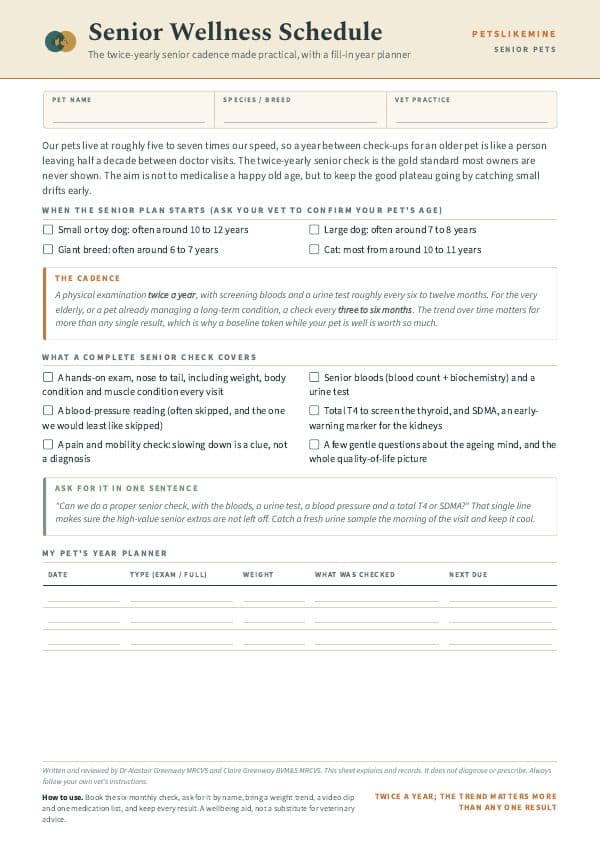
Companion worksheets to put what you've read into practice. Free PDFs, print at home.
Sister tool · Sightline
Track quality of life over time
Sightline, a separate ConciergeVet tool, runs a short adaptive weekly assessment with a quality-of-life focus mode built around exactly these frameworks, tracks a single composite score over time so you can see the trend rather than judge a single bad day, and produces a Sightline Report PDF you can bring to your vet.
A written log, or our printable quality-of-life sheet, does much the same job.
See how Sightline tracks quality of lifeKeep track of how your pet is doing
The owners who cope best are the ones who notice changes early. A simple health log shows you what is working, and what is not, before the next vet visit.
Start tracking, freeYou're not doing this alone
Compare treatment journeys and talk to owners managing senior pets. Free to join.
Join PetsLikeMine