

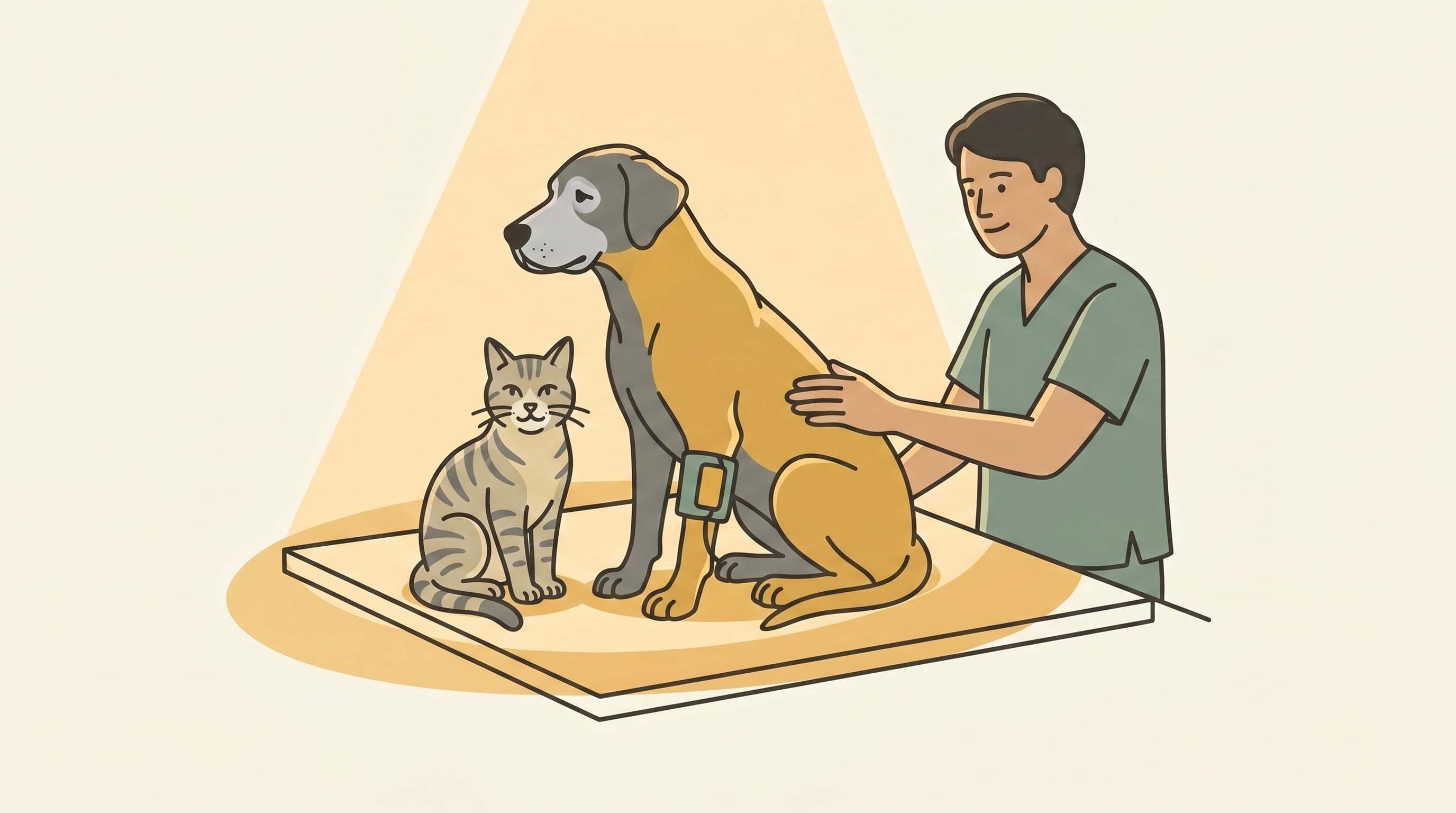
Senior blood tests explained: bloods, urine, blood pressure, SDMA, T4
Alastair Greenway
BVM&S MRCVS
"Senior bloods", your vet says, maybe a urine test and a blood-pressure check alongside, and you go home with a sheet of numbers you cannot quite read and a knot in your stomach. Is something wrong? Why now, when she seems perfectly well? Take the reassuring part first. In a well older pet, these tests are not a hunt for bad news. They are how we look under the bonnet while everything is still running smoothly, so that if a value has begun to drift, we catch it early, while the problem is small and gentle to put right, rather than meeting it later as a crisis. This article walks you through what each test looks for, in plain language, for dogs and for cats, and what to do with the results.
The reason this matters is the line the whole profession keeps repeating: ageing is not a disease. The 2023 AAHA Senior Care Guidelines set out a systematic approach to an older pet precisely because old age is not itself an illness, even though it is the easiest thing in the world to see a slower, quieter pet and assume decline is just the way of things now. It very often is not. And our pets are no help: a dog will trot about cheerfully on kidneys doing half their old job, and a cat is a small furred genius at hiding how she really feels. A blood test does not care how stoical they are being. That is the point of it.
One idea to carry through all of this: the trend is the story
Before we open the lab sheet, one principle, because it changes how you read everything below. A result on a single day is a snapshot. The direction of travel over time is the story. A kidney value sitting at the very top of the normal range tells your vet little on its own. The same value, where last year it sat comfortably in the middle, tells them a great deal. Drift is the signal, and you can only see drift if you know where you started.
This is why a healthy baseline, taken while your pet is well, is worth so much, and why we keep nudging you toward setting one now. It is also what the Senior Wellness Check is for: rather than trying to remember whether last year's weight was "about the same", you log the headline numbers and a quick read of your pet's Vitality (energy, appetite, mobility, muscle, sociability), and the tool draws the line over months and years. So as you read each test below, picture not one figure in a box but a little graph you are slowly building.
Counting the red and white cells
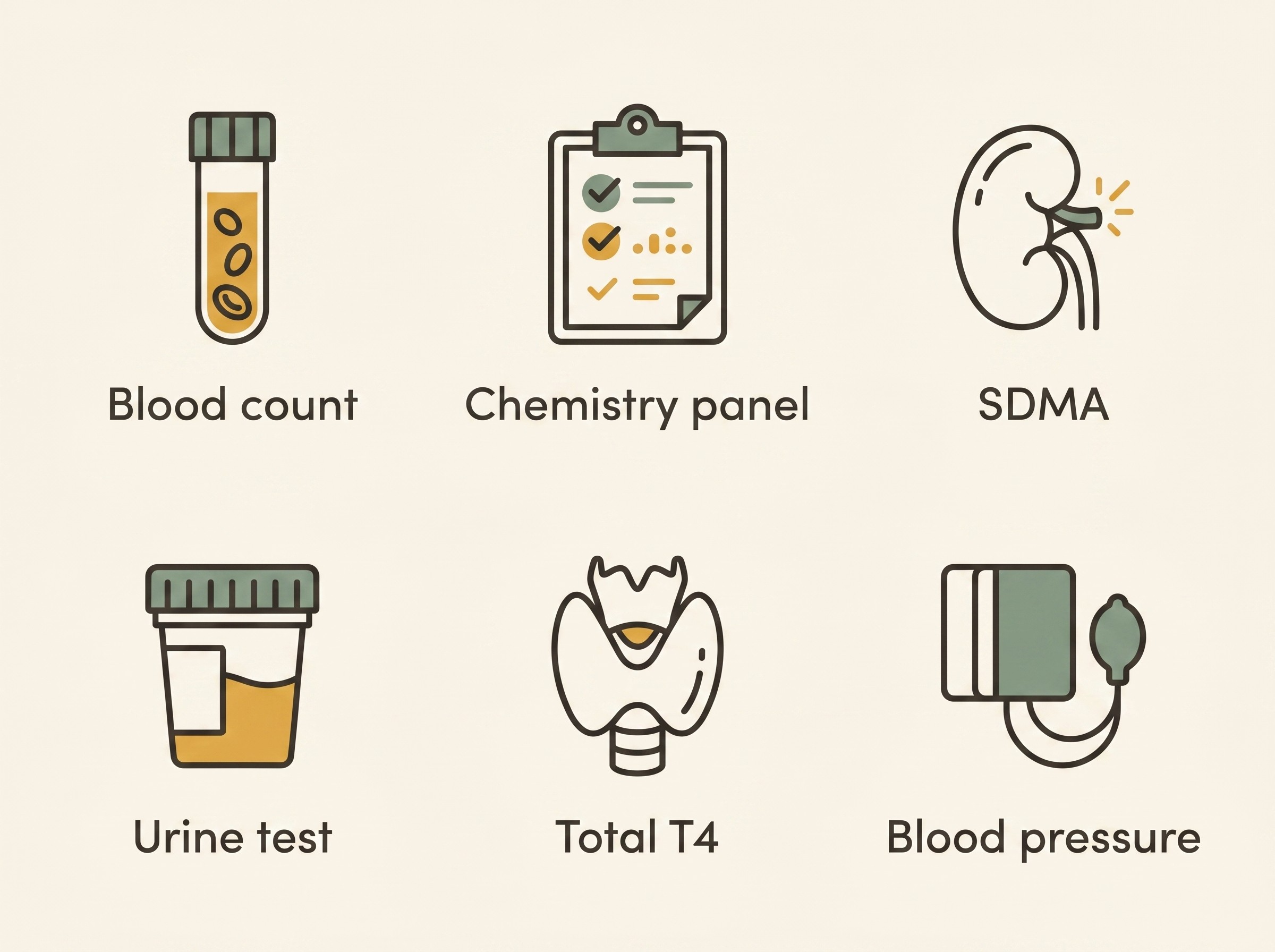
The first part of a blood panel is the complete blood count (your vet may call it haematology or a CBC). It counts the cells in the blood and answers a few quiet but useful questions (VCA Hospitals). The red cells carry oxygen, and if they are low your pet is anaemic, a common travelling companion of chronic kidney disease and other long-running illnesses, so a gently falling red-cell count is a thread a vet follows back to its source. The white cells are the immune army, and their number and mix hint at infection or inflammation. Platelets, the tiny cells that plug leaks, matter if your pet ever needs a procedure. None of this is dramatic on most senior panels, but taken with the rest it helps your vet see the whole animal rather than one organ at a time.
Chemistry: the organ report card
This is the part most owners mean when they say "bloods". A biochemistry panel measures substances in the blood that report on how the internal organs are doing, and the 2023 AAHA database recommends it every six to twelve months for an older pet (AAHA, 2023). Roughly what the main entries mean:
- Kidney values (urea, often written BUN, and creatinine, plus phosphate): waste products the kidneys clear, so when they rise it can mean the kidneys are not filtering as well as they were. These old standbys have a real blind spot in the early stages, which is where SDMA comes in.
- Liver enzymes (ALT, ALP and friends): a flag, not a diagnosis. They can reflect liver disease but also things going on elsewhere, so they point the way rather than give the answer.
- Proteins (albumin and globulin): these shift with hydration, gut and liver health, inflammation and the immune system.
- Glucose, the blood sugar. A persistently high glucose is the headline clue for diabetes, more under the urine test. One cat-specific trap: a stressed, frightened cat can push her own glucose right into the diabetic-looking range, as high as 16 to 22 mmol/L, purely from the upset of the visit (hospital-stress study), so a single high glucose in a cat is not a diagnosis. Your vet may confirm with a test called fructosamine, which averages the blood sugar over the previous two weeks and so cannot be fooled by a bad morning (MSD Animal Health).
- Electrolytes (sodium, potassium) and calcium, which can wander in several hormonal and kidney conditions and, when they do, often need attention in their own right.
The everyday job of this panel is to flag the big treatable diseases of older age while they are still quiet. If your dog or cat has started drinking more, asking out or using the tray more, losing weight, or has an appetite that has changed, this is the panel (with the urine test alongside) that begins to sort out why. And those signs genuinely matter: weight loss in an older pet is never something to file under "just getting old". It is one of the most reliable early flags we have, and it earns a vet's attention, not a shrug. We dig into that in why weight loss is never "just old age".
SDMA: the early warning light for the kidneys
Here is the one extra test owners most often ask about by name, and it is genuinely one of the better things to happen to senior medicine in the last decade.
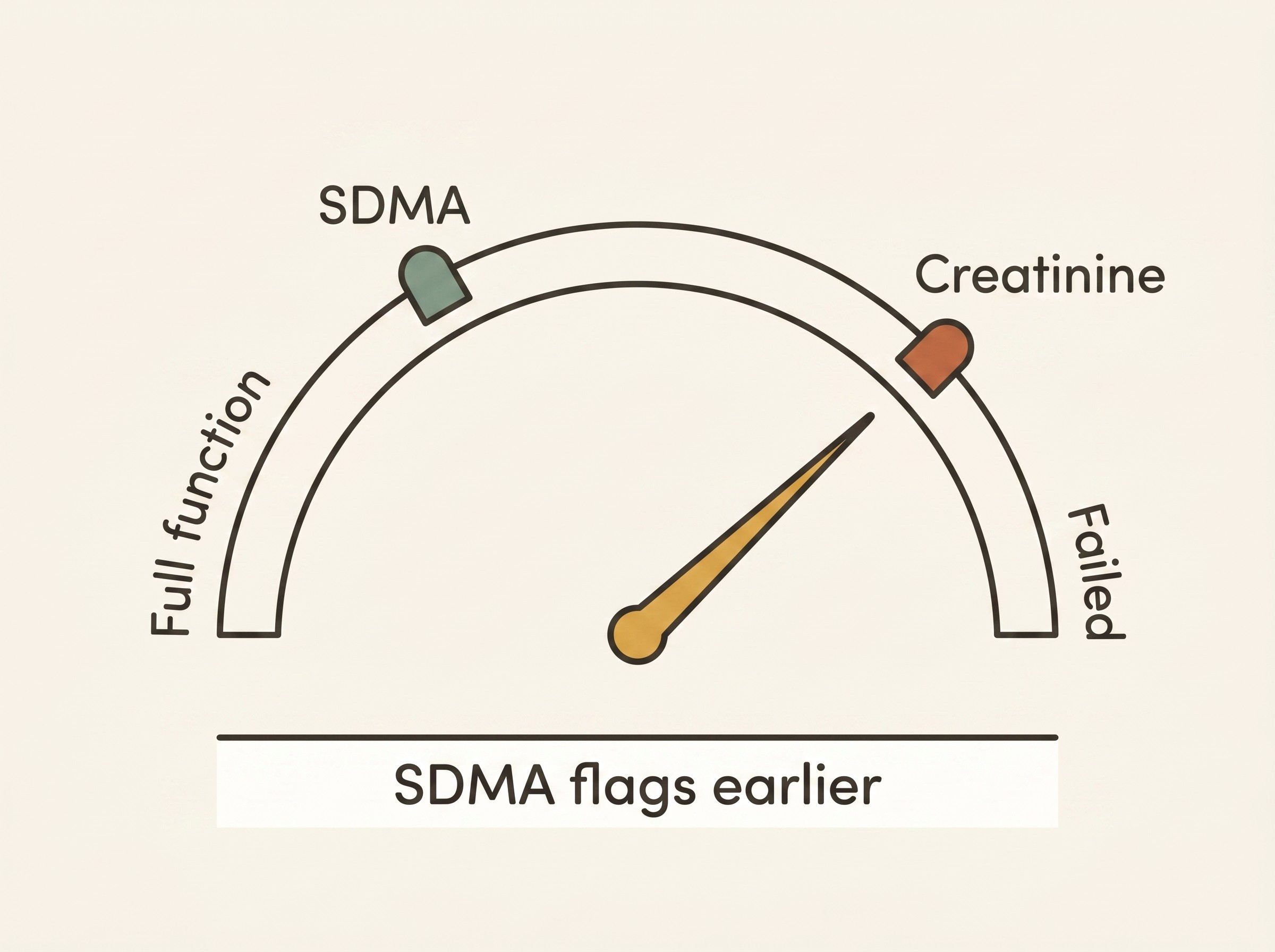
The trouble with creatinine, the traditional kidney value, is that it is a late reporter. By the time creatinine climbs above the normal range, roughly three-quarters of working kidney function has typically already been lost (IDEXX). That is a lot of ground gone before the alarm sounds. Worse, creatinine is a by-product of muscle, so a thin, muscle-light older pet, exactly the pet whose kidneys you are most worried about, can have a deceptively low creatinine that flatters the result.
SDMA (symmetric dimethylarginine) sidesteps both flaws. It begins to rise much earlier, when as little as a quarter, and on average around 40%, of kidney function has been lost, and crucially it is not pulled about by muscle mass, diet or sex (IDEXX). In one study group it rose above normal a mean of 17 months before creatinine in cats (17 of 21 cats), and on average around 9.8 months before it in dogs (Today's Veterinary Practice). That head start is why it has been folded into the international (IRIS) staging system for kidney disease: a persistently raised SDMA, even with a still-normal creatinine, can be the first solid sign that the kidneys need watching.
If SDMA is the test that finds early kidney disease, the place to manage it well is the Kidney space, which exists to help you slow it and live alongside it rather than fear it. Catching it at this stage, not the crisis stage, is the whole prize.
Urine: the kidney's homework you cannot fake
It is tempting to think a urine test is an afterthought to the bloods. It is not: for the kidneys especially, urine answers a question blood simply cannot.
That question is concentration. Healthy kidneys conserve water by producing concentrated urine; failing kidneys lose that knack and put out a watery, dilute stream. So a urine specific gravity (the measure of how concentrated the urine is) that has gone persistently dilute can reveal kidney disease still hiding under a normal creatinine. The urine also picks up protein leaking through tired kidney filters, and that dipstick protein only makes sense read against the concentration: a trace of protein in very dilute urine means something quite different from the same trace in concentrated urine (Today's Veterinary Practice), so vets often follow up with a precise measurement, the UPC ratio. Protein loss matters: it is linked to faster decline in kidney disease, and turns up in roughly one in ten apparently healthy older dogs, which is exactly why it is worth screening for before anything looks wrong.
Urine carries another headline too: sugar. Glucose should not appear in urine, so when it does, it points hard toward diabetes, the condition that has the Diabetes space built around managing it. (It also settles that stress-glucose trap in cats: it takes sustained high sugar for glucose to spill into the urine, so a normal urine sugar alongside a high blood glucose tells your vet it was just nerves.) And the dilution itself is a clue: very dilute urine raises the question of an overactive adrenal gland, which we will come to, while moderately dilute, fixed-concentration urine pushes kidney disease up the list.
A small practical thing here saves a return trip. The most useful sample is a fresh one caught at home the morning of the visit, ideally first thing. For dogs, a clean tray slid under mid-flow, or a soup ladle, does the job; for cats, non-absorbent litter (your vet can supply special granules, or a few clean aquarium pebbles work) lets you tip a sample off. Pop it in a clean tub in the fridge and bring it in: the least glamorous part of senior screening, and one of the most informative.
Total T4: one thyroid test, two opposite stories
This is the test where dogs and cats genuinely part ways, because the same blood test is looking for the opposite problem in each.
In cats, total T4 screens for an overactive thyroid, the condition called hyperthyroidism, and it is one of the signature diseases of the older cat: it affects around one in ten cats over the age of ten, and it is very treatable, often even curable, when caught early (AAFP, 2021). A cat with a racing thyroid burns through herself: the classic picture is a cat eating heartily, even ravenously, yet steadily losing weight, sometimes with a touch of restlessness, a louder voice or a scruffier coat. Because the signs creep in slowly and the cat often seems "full of beans", it is easy to miss, which is exactly why the feline guidelines recommend measuring T4 in all cats from about eight years of age (VCA Hospitals) and stress that the trend in T4 is what catches it early (AAFP, 2021). One catch: a single normal T4 does not always fully clear a cat, because an early or borderline case can still read in the normal range, so if the clinical story fits but the number does not, your vet may repeat it rather than rule it out.
In dogs, the same total T4 is usually looking for the reverse, an underactive thyroid, or hypothyroidism. The thyroid sets the metabolic rate of the whole body, so when it slows, the dog does too (VCA Hospitals): a near mirror image of the cat, a dog who has gained weight without eating more, slowed down, seems flat or cold-seeking, perhaps with a thinning coat and recurrent skin or ear trouble. A low T4 supports the diagnosis, but with an important caveat your vet keeps in mind: other illnesses, and even some medications, can drag a dog's T4 down without the thyroid itself being the problem, so a single low value is interpreted in context and sometimes confirmed with further thyroid tests rather than taken at face value.
Both of these, the racy feline thyroid and the sluggish canine one, sit within the Hormone Health space, along with the other big endocrine player of older dogs: an overactive adrenal gland (Cushing's disease), a common reason behind a dog who has started drinking and weeing far more than usual, often with a pot belly and a thinning coat. If your older dog's headline change is sudden thirst, that trio, kidney disease, diabetes and Cushing's, is the usual shortlist the bloods and urine work through. None of these is a sentence; all are far kinder to manage when found early.
The blood-pressure cuff: the quiet one
Of everything on the senior list, blood pressure is the test most owners are surprised by and the one I would least want skipped, because high blood pressure (hypertension) is almost completely silent until the day it is not.
The danger is what persistently high pressure does to the small, delicate organs downstream of it. Left unchecked it damages the eyes, kidneys, heart and brain, and, as the feline guidelines put it plainly, that target-organ damage "may not be reversible" (AAFP, 2021). In cats it is most common after about ten years of age and very often travels with kidney disease or an overactive thyroid, which is one more reason those tests belong together. The cruellest presentation is the eyes: a cat whose high pressure has gone unnoticed can be brought in suddenly blind, the retina detached or bleeding behind a wide, fixed pupil. Caught and treated very fast, that sight can occasionally be saved; more often, sadly, it is already lost. That is precisely why the feline guidelines ask for a reading at every check in cats over ten, and the wider consensus suggests routine screening in any cat or dog from about nine years of age (ACVIM consensus, 2018). The link between pressure and sight is exactly the kind of thread the Vision and Eye Health space follows, and catching the pressure before the eye pays for the whole appointment.
Dogs are not exempt. Canine hypertension tends to ride on the back of another condition, often kidney disease or Cushing's, so it earns a cuff too. The reading itself is painless: a little cuff on a leg or the tail, a few quiet measurements. One thing worth understanding is the "white-coat" effect, the way a nervous animal's pressure climbs simply from being at the vet's (this is called situational hypertension). A good practice works hard to take it off the table with a quiet room, a few minutes to settle, you kept close by and gentle handling, so the number reflects your pet and not the waiting room (ACVIM consensus, 2018).
For cat owners: why two problems can hide each other
One tangle is so particular to older cats it is worth naming on its own, because it explains why your vet may seem cautious about declaring victory. Kidney disease and an overactive thyroid often arrive together in the same senior cat, and each can partly mask the other. A racing thyroid speeds blood flow through the kidneys and burns off muscle, both of which flatter the kidney values and make creatinine read lower than the kidneys' true state (EveryCat Health Foundation). So when the thyroid is brought back under control, the real state of the kidneys can surface for the first time: roughly one in eight cats turns out to have had quieter kidney disease underneath all along (Clinician's Brief). This is not a setback; it is why your vet will want to monitor both the thyroid and the kidneys for several months after starting treatment, rather than testing once and walking away. It is the clearest example of why, in an older pet, the whole picture matters more than any single result.
Reading the results sheet without the dread
When the results land, you may see a value or two flagged outside the reference range, and your stomach may drop. Two things to hold on to.
First, "out of range" is not "doomed". Reference ranges are built from large populations, and healthy individuals sit just outside them all the time; a mild flag often means "worth an eye on" or "let's repeat that", not catastrophe. Your vet reads the whole sheet together, against your pet's age, breed, history and how they actually are, not one box in isolation. Second, and this is your part: ask. Nobody is better placed to walk you through your own pet's results than the vet who ran them. Ask which values they are watching, what would change the plan, and when they want to look again.
Then bring the sheet home and do the one thing that turns a stack of paper into a trend: write the headline numbers down. Because older pets so rarely have just one thing going on, several tests can flag at once, and holding the whole picture rather than chasing each value separately is its own skill. We cover that in when your old pet has several things wrong at once, and if a results sheet has left you overwhelmed, the senior community is full of owners who have sat exactly where you are sitting. (These same bloods do a second job, too: if your pet ever faces an anaesthetic, they are the pre-anaesthetic homework that lets your vet tailor a safe protocol, which is why "too old for anaesthesia" is far more often a myth than a verdict.)
What to do with this, this week
Senior bloods, a urine test and a blood-pressure check are not a verdict on your pet. They are a torch, shone early, into the corners stoicism keeps hidden, and their real value is not any single number but the line you build over time. The practical version:
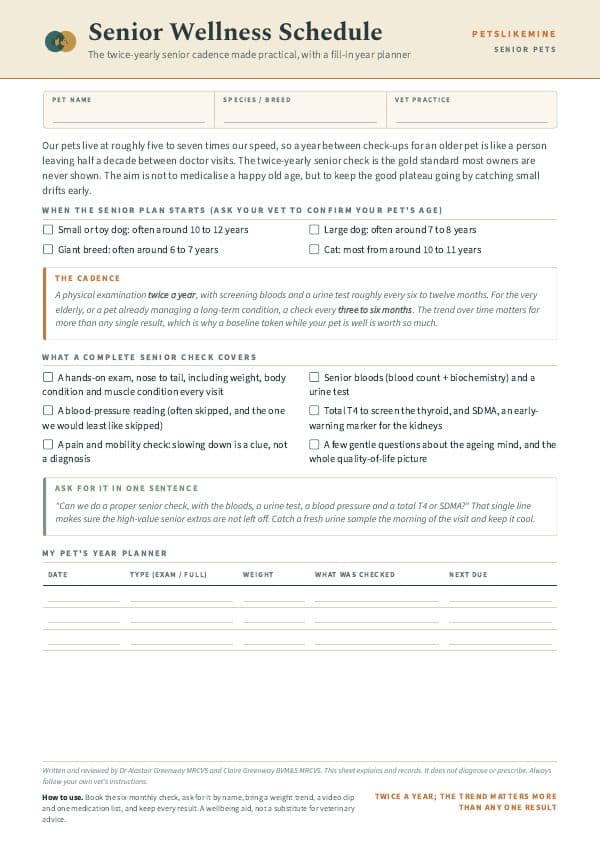
- Ask which senior panel they run, and what is in it. A quick "does that include SDMA, a total T4 and a blood pressure?" makes sure the three high-value senior extras are not left off.
- Collect a fresh urine sample the morning of the visit. First thing if you can, kept cool: the easiest thing you can personally do to make the appointment more useful.
- Get a copy of the results, and the weight. Keep them. This is the raw material of every future trend.
- Log the headline numbers and your pet's Vitality in the Senior Wellness Check. Next time, instead of "is she slower than last year?", you will see the answer and hand your vet a line, not a guess.
- Book the six-monthly re-check. A year is a long time in an older pet's life, and the whole point is to look again while there is still everything to play for. The bigger picture of that twice-yearly visit lives in the senior wellness check.
Free downloads
Companion worksheets to put what you've read into practice. Free PDFs, print at home.
Sister tool · Sightline
Track quality of life over time
Sightline, a separate ConciergeVet tool, runs a short adaptive weekly assessment with a quality-of-life focus mode built around exactly these frameworks, tracks a single composite score over time so you can see the trend rather than judge a single bad day, and produces a Sightline Report PDF you can bring to your vet.
A written log, or our printable quality-of-life sheet, does much the same job.
See how Sightline tracks quality of lifeKeep track of how your pet is doing
The owners who cope best are the ones who notice changes early. A simple health log shows you what is working, and what is not, before the next vet visit.
Start tracking, freeYou're not doing this alone
Compare treatment journeys and talk to owners managing senior pets. Free to join.
Join PetsLikeMine