

When your old pet has several things wrong at once: the whole-pet view
Alastair Greenway
BVM&S MRCVS
There is a particular kind of tired that comes with an old animal. You stand at the kitchen counter with three or four bottles in front of you, a folded printout from the last visit, and a feeling you cannot quite name. One tablet is for the stiff back legs. One is for the kidneys. There is a sachet for the thyroid, or the heart, or the tummy that has not been right for weeks. Somewhere in all of it your dog or your cat is asleep in their bed, greyer round the muzzle than you remember, and you realise you can no longer tell what is the arthritis, what is the kidneys, and what is just the years catching up.
If that is you, take a breath. You are not failing them. An old pet with several things going on at once is not a sign that you did something wrong or waited too long. It is, in truth, the normal shape of a long life. The goal here is to lift you out of the bottle-counting and hand you a calmer way to hold all of it: not as a list of diseases to chase one by one, but as one whole pet you are caring for, with one medication list, one tracked timeline, and one set of priorities you have agreed with your vet.
Several at once is the rule, not your bad luck
It helps, first, to know that this is genuinely the rule and not your particular bad luck. When researchers in the Dog Aging Project mapped the health records of 26,614 dogs, they found 71.6 per cent of them living with three or more conditions at the same time. More striking still, the older the dog, the more tangled those conditions became: the links between different problems grew denser with age, so that in the oldest dogs, problems that look unrelated in a young one (high blood pressure and kidney disease, for instance) started turning up together. The clinical word for several conditions at once is multimorbidity, and once you have read it you can put it away again. The plain truth underneath it is simpler: bodies that have run for a decade or more tend to wear in more than one place.
Cats are no different, and anyone who calls a cat "low maintenance" in old age has not met a fifteen-year-old. The veterinary profession's own feline senior care guidelines put it plainly: "Comorbidities are common in gerontology, and cats are much like humans in this tendency." The classic older-cat stack is kidney disease, arthritis that almost nobody notices because cats hide it so well, an overactive thyroid, dental pain and high blood pressure, often in some combination, often quietly. The same guidelines note something that matters for how you should feel about all this: as the number of conditions a cat carries goes up, their quality of life tends to come down. That is not said to frighten you. It is exactly the reason the whole-pet view is worth the effort. The conditions interact, so the care has to as well.
One more piece of research is worth holding onto, because it reframes the problem usefully. Rather than ask "how many diseases does this pet have," vets increasingly ask "how robust is this animal overall," a quality they call frailty. (Gentler words for the same idea are vitality, strength and stamina, the reserve a pet has to bounce back.) A 2024 study built an owner-completable frailty check for ageing dogs across five everyday domains: body condition, energy, muscle, how sociable they still are, and how they move. Dogs that scored frail were nearly five times more likely to die within six months, whatever their age. A 2025 pilot version for cats found the same pattern, and tellingly, one of the things it counts towards frailty is simply the number of chronic conditions a cat is carrying. So the running total in your kitchen is not just a list of nuisances. It is, in a real sense, a measure of how much your pet has on their plate, which is exactly why no single bottle tells the whole story.
Where treating each thing on its own quietly fails them
When a pet has one problem, you take it to the vet, you get a plan, you follow it. Simple. The trouble with several problems is that the simple approach, repeated, stops working, and it stops working in three specific ways that are worth recognising so you can sidestep them.
The first is the silo. A different appointment, or a different person, ends up owning each problem: the kidney is somebody's project, the joints are somebody else's, the heart is a referral letter from last spring. Each plan is sensible on its own. But nobody is holding the whole animal, and the gaps between the plans are exactly where an old pet falls. The antidote is the thing the same feline guidelines recommend: one clinician who agrees to "look at the whole patient and view trends in context." Your general-practice vet is usually best placed to be that person, because, as the guidelines put it, they are the one who "sees the whole picture." Your job is to make sure that whole picture actually reaches them.
The second is the tug-of-war. This is the one that frightens owners most, and it deserves candour rather than reassurance. Sometimes the very treatment that helps one problem pulls against another. An anti-inflammatory (an NSAID) that eases an arthritic dog's stiffness has to be used with real care if the kidneys are struggling, because these drugs can reduce blood flow to the kidney; the international kidney-medicine consensus is firm that they are not for use in a patient with acute kidney injury. A steroid that calms an itchy skin or an immune problem can nudge a diabetic pet's blood sugar the wrong way and lean on the heart. And there is a well-known three-way combination in human medicine, a water tablet plus a blood-pressure drug plus an anti-inflammatory, sometimes nicknamed the "triple whammy," that together can stress the kidney more than any one of them alone.
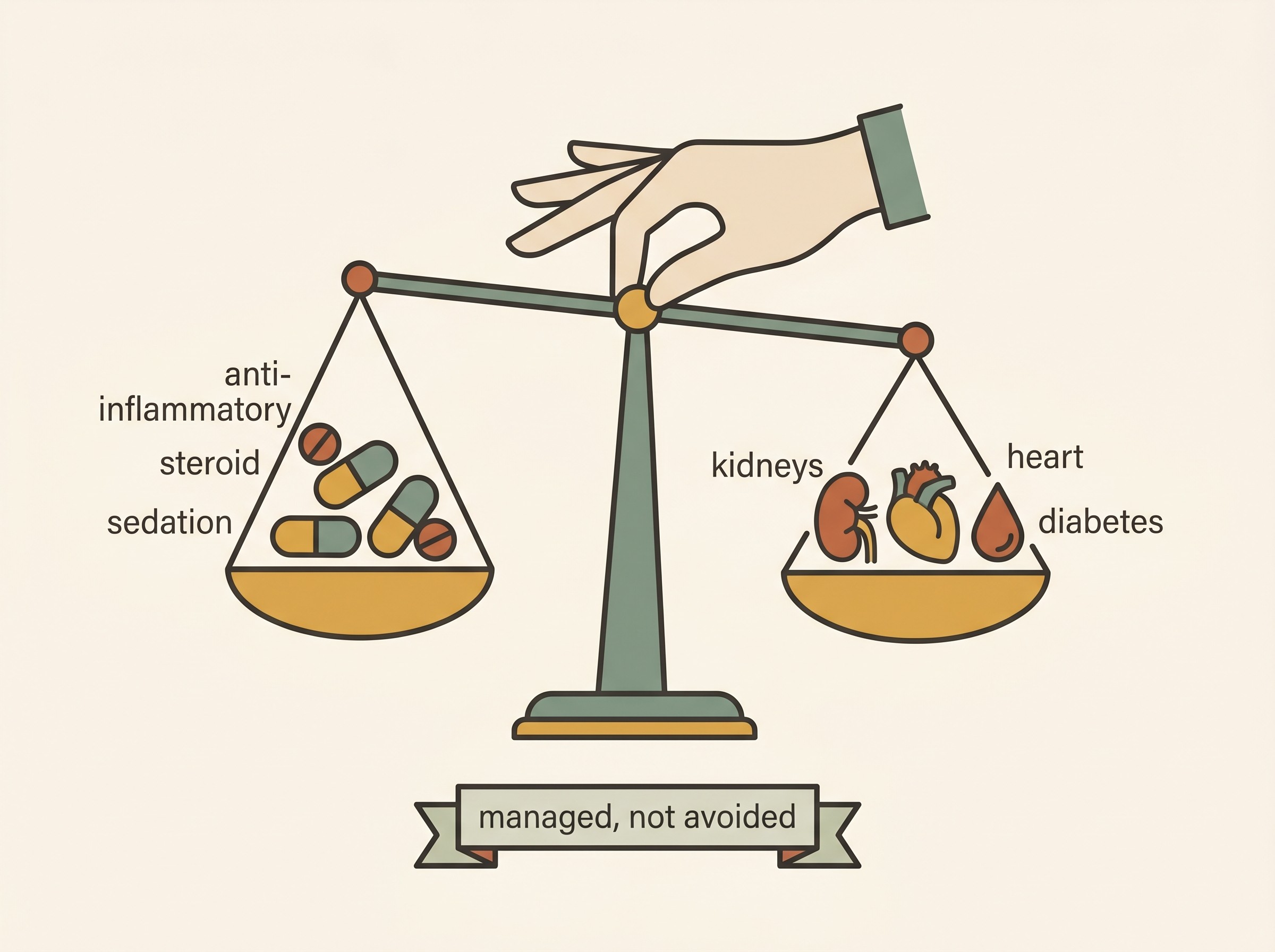
None of this means the treatments are dangerous or that your pet should go without relief. It means the choices need a person who can see every drug at once and weigh them together, which is, again, your vet. We have given this balancing act its own article, the treatment tug-of-war, because it is the heart of senior multimorbidity. For now, take only this from it: when one treatment affects another, that is not a mistake, it is the expected texture of caring for an old body, and the way through it is information, not avoidance.
There is a feline version of the tug-of-war so important it has its own guardrail. In cats, kidney disease and an overactive thyroid each hide the other. An overactive thyroid revs the body up, which props up the kidney's blood flow and burns off muscle, and both effects make a routine kidney blood test look better than the kidney really is. Treat the thyroid successfully, as you should, and in roughly 15 to 25 per cent of cats the kidney numbers that were being flattered drift upward over the following weeks, revealing kidney disease that was there all along. This is not a treatment failure, and not a reason to leave the thyroid untreated. It is simply why a good vet treating one of these keeps a close eye on the other, and why you may hear "let's recheck in a few weeks" more than you expect. (We go deeper into this pairing in the senior cat with kidney disease and an overactive thyroid.)
The third trap is the blur. When several things are happening at once, and one of them may be the ageing mind, you lose the ability to tell what is what. Is the slower walk the arthritis, the heart, or just tiredness? Is the new habit of standing in corners at night confusion, pain, or a full bladder from drinking more because of the kidneys? You cannot untangle this by staring harder at home, and you should not try, because "slowing down" is a symptom, not a diagnosis, and a great deal of what owners write off as old age turns out to be treatable. Working out which thread is which is exactly what our article on reading the slowdown, is it pain, age, or disease? is for.
Three habits that change everything
Here is the good news. You do not need a veterinary degree to care well for a pet with several conditions. You need three simple habits, and between them they do most of the heavy lifting.
One medication list
Keep a single, current list of everything your pet takes. Every tablet, every sachet, every spot-on, every supplement, even the ones that feel too minor to mention. For each one, write down four things: what it is, the dose, what it is for, and who prescribed it. Put it on the fridge, in your phone, wherever you will actually keep it up to date, and bring it to every appointment, including the out-of-hours visit you did not plan for.
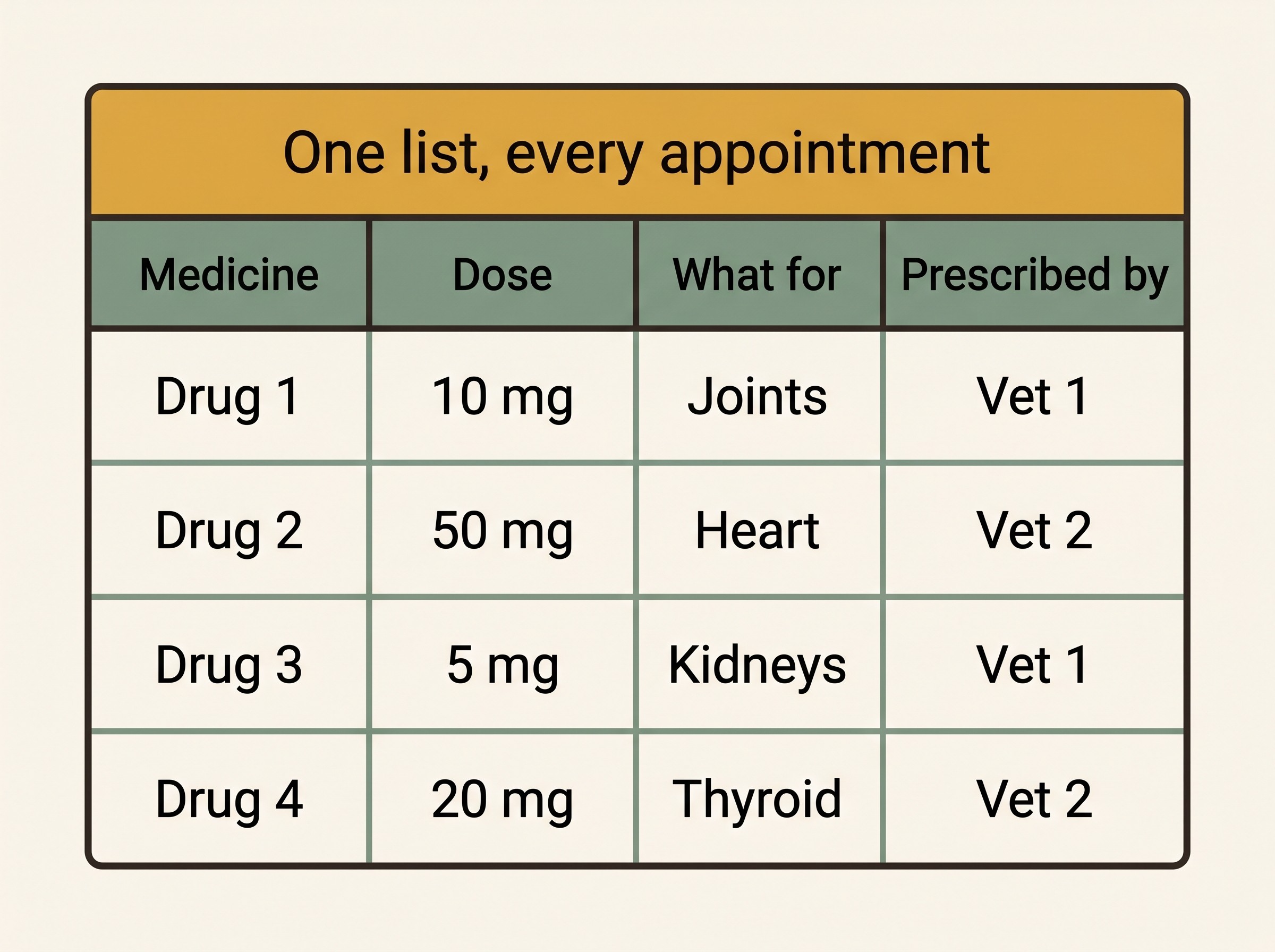
Why this matters so much: as the feline guidelines note, an older body clears drugs more slowly, so doses sometimes need to come down, and the more medicines there are, the more chances they have to interfere with one another. (The catch-all term is polypharmacy, and you can forget it as soon as you have read it.) This is where owners sometimes try to help by quietly adjusting a dose, or adding a supplement they read about. Never change, stop or add a medicine without checking, and never give a cat a product made for a dog without asking, because some are harmful to cats even though they are fine for dogs. Your job is not to manage the interactions. It is to make sure the whole list is in front of the one person who can, and to ask the single most useful question there is: "do any of these work against each other, and is there anything I should watch for?" We have written a full, gentle guide in juggling medications for a senior pet.
One tracked timeline
The second habit is to gather what is happening into one place over time, rather than carrying it in your head from visit to visit. Memory is a poor witness here. By the time you are at the appointment, you genuinely cannot remember whether the limping was better or worse this month, how much they are actually drinking, or whether the appetite has slipped or you only notice it on bad days. A tracked record remembers for you, and just as importantly, it shows your vet the trend rather than the single snapshot of a pet who is often, frustratingly, on their best behaviour in the consulting room.
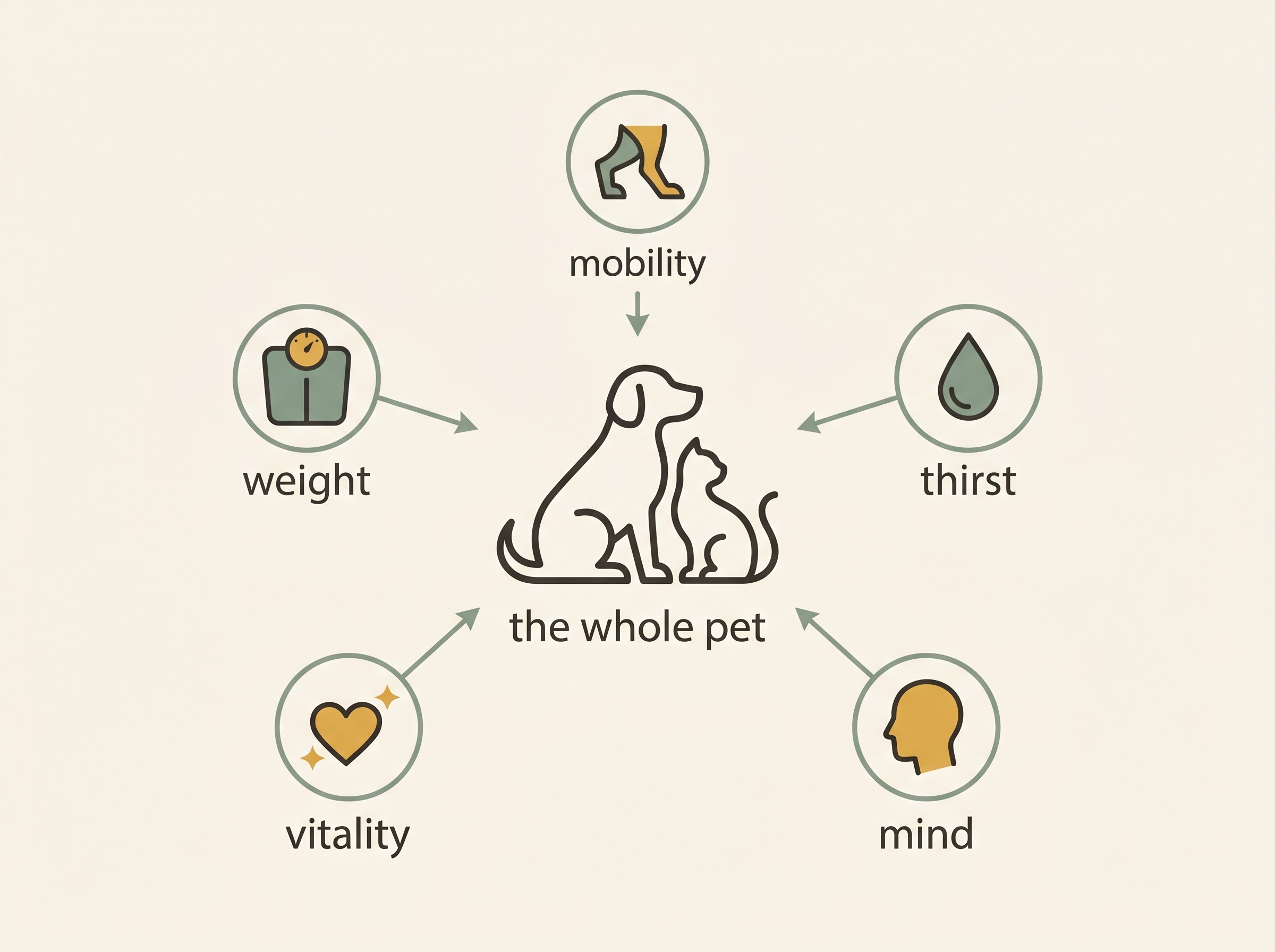
This is what the Senior Wellness Check is built for. It gathers the everyday signals that matter most in an older pet (weight, appetite, thirst, mobility, and the two big-picture scores we call Vitality and Mind / Sharpness) into one running picture, so that "something has changed since last time" becomes a thing you can see rather than half-suspect. Where one of those signals points at a specific organ, you can layer on the matching tracker: the Mobility Check for stiff or sore movement, the thirst-and-wee tracker when drinking and weeing change, the glucose companion for a diabetic pet. The point is not to turn yourself into a data clerk. It is that when you sit down with your vet, you can hand them a real record of the whole animal over weeks and months, worth more than any single test, and exactly the "view trends in context" that good senior care is built on.
One set of priorities, agreed with your vet
The third habit finally lets you put the bottle-counting down, and it is more a change of mind than a task. When a pet has several conditions, you cannot keep every number perfect at once. The diet that is best for the kidneys may not be the one that holds weight on a thin old cat. The strict blood-sugar target may matter less than the fact that your dog is comfortable and still wags. So instead of trying to win every battle, you and your vet decide together what matters most for this particular animal, and you let the other things be "good enough."
For most owners of an old pet, the real priority is comfort and the number of good days, not the perfect lab result, and a thoughtful vet will be relieved to hear you say so. It is worth asking out loud: "Given everything he has going on, what should we be aiming for, and what can we stop worrying about?" One signal, though, always earns its place near the top of the list and should never be filed under "just old age," and that is weight. A pet quietly losing weight is telling you something, and it is rarely benign: kidney disease, an overactive thyroid in cats, diabetes, dental pain, gut disease and cancer can all show up first on the scales. So weigh them regularly, put it in the timeline, and treat any steady drop as a reason to ring the vet, not to wait and see. We say more in weight loss in an older pet: why it's never just old age.
You are allowed to be tired
There is a part of this nobody prints on the medication label: caring for a pet with several things going on is genuinely hard, and the exhaustion you feel is real, not a character flaw. The research is unusually clear on this for one condition in particular. Owners of dogs whose ageing minds are changing, what vets call canine cognitive dysfunction, report measurably higher levels of caregiver burden than other owners, and when researchers asked them about it, the broken nights, the sense of grieving a pet who is still here, and the feeling that nobody had warned them came up again and again. Many had assumed the early signs were "just ageing" and felt left without guidance. If that is landing close to home, know two things. First, the mind changing is one of the "several things" too: it is common, under-recognised, and worth raising with your vet, who will want to rule out pain, blood pressure, the thyroid and other causes before settling on it. Second, you are not alone in the tiredness, and you do not have to carry it silently. Our senior community exists precisely for the owners doing this work, at 3am and otherwise, and there is real relief in finding the people who already understand.
Choosing what you can sustain is not giving up on your pet. It is part of caring for them well, because a carer who is running on empty cannot give what an old animal needs. We wrote a whole piece for exactly this, you're not a bad owner: caring for the carer, and it is worth your time on a hard day.
Five things to bring to your next appointment
If you take nothing else from this, take the shape of the whole-pet view into your next visit. Caring for a pet with several conditions is not about chasing each disease harder. It is about holding the one animal steady. So before the appointment, get these five things ready:
- The complete medication list, four columns: what, how much, what for, who prescribed it. Nothing left off.
- The tracked timeline, an export or summary from the Senior Wellness Check showing weight, appetite, thirst, mobility, Vitality and Mind / Sharpness over recent weeks.
- The one question: "Do any of these treatments work against each other, and what should I watch for at home?"
- The one worry that is keeping you up, named plainly, even if it is "I don't think I can keep doing the nights."
- The one thing that matters most for this pet right now, so you and your vet can aim the whole plan at it together.
When the day comes that comfort and good days are the only goals left, that is not a failure of any of this, it is the natural last chapter, and you do not have to judge it alone. The gentle work of weighing good days against hard ones lives in our guide to tracking quality of life, built around the long-used, owner-validated questions of hurt, hunger, hydration, hygiene, happiness, mobility and whether the good days still outnumber the bad. And when you are ready to think about what comes after, our Rainbow Bridge space is there to hold that part, so that this space can stay where it belongs: alongside you and your old friend, for the long good plateau you still have, one whole pet at a time.
Sister tool · Sightline
Track quality of life over time
Sightline, a separate ConciergeVet tool, runs a short adaptive weekly assessment with a quality-of-life focus mode built around exactly these frameworks, tracks a single composite score over time so you can see the trend rather than judge a single bad day, and produces a Sightline Report PDF you can bring to your vet.
A written log, or our printable quality-of-life sheet, does much the same job.
See how Sightline tracks quality of lifeKeep track of how your pet is doing
The owners who cope best are the ones who notice changes early. A simple health log shows you what is working, and what is not, before the next vet visit.
Start tracking, freeYou're not doing this alone
Compare treatment journeys and talk to owners managing senior pets. Free to join.
Join PetsLikeMine