

The treatment tug-of-war: when managing one condition affects another
Alastair Greenway
BVM&S MRCVS
By the senior years, a lot of pets are running more than one problem at once. You are managing the sore joints and the kidneys and, since the spring, the heart as well. There is a tablet at breakfast and two at teatime and a syrup that has to go down somehow. And then your vet says the sentence that makes your stomach drop: "We need to be careful, because the painkiller that helps his joints can be hard on his kidneys." It can feel as though you are being asked to choose which of his problems matters more.
You are not. What you are seeing is something vets manage every day, and it has a quiet name in our heads: the treatment tug-of-war. In an older animal with several things going on at once, the treatment that helps one part of the body can pull against another, and the whole art of looking after them is holding those forces in balance. This article is about why that happens, why "treat one thing, keep an eye on another" is not carelessness but the standard of careful medicine, and the one job that is genuinely yours. A gentle promise first: nothing here is a list of doses or a reason to change, stop or second-guess anything your vet has prescribed. The point is the opposite.
Why the tug-of-war happens at all
Old age, on its own, is not a disease. But an older body has less to spare. A young animal has reserve: kidneys, liver, heart and gut all have spare capacity, so a medicine that leans on one of them a little is comfortably absorbed. By the senior years, much of that capacity has quietly been spent, often on the very conditions you are already treating, so a drug that is fine in a young dog with one problem can tip an older one running three. The profession's own guidance is built around exactly this: older pets often have several conditions at once and need to be treated as a whole animal, not as separate problems handed between separate prescriptions (2023 AAHA Senior Care Guidelines for Dogs and Cats). Cats are no exception, and the rule may be sharper in them: the feline guidelines name directly "the effect of polypharmacy and risk of drug interactions," noting that "reduced renal or hepatic clearance can require reduced dosing or increased intervals of medications" (2021 AAFP Feline Senior Care Guidelines). Polypharmacy is just the word for being on several medicines at once. So when your vet hesitates over a painkiller or starts a new drug at a cautious dose, they are not being indecisive: they are weighing one part of your pet against another so the whole animal does better. And the conflicts are not random. There is a short list of classic senior tug-of-wars that recur, and it genuinely helps to recognise them.
Joint painkillers, the kidneys, and the heart
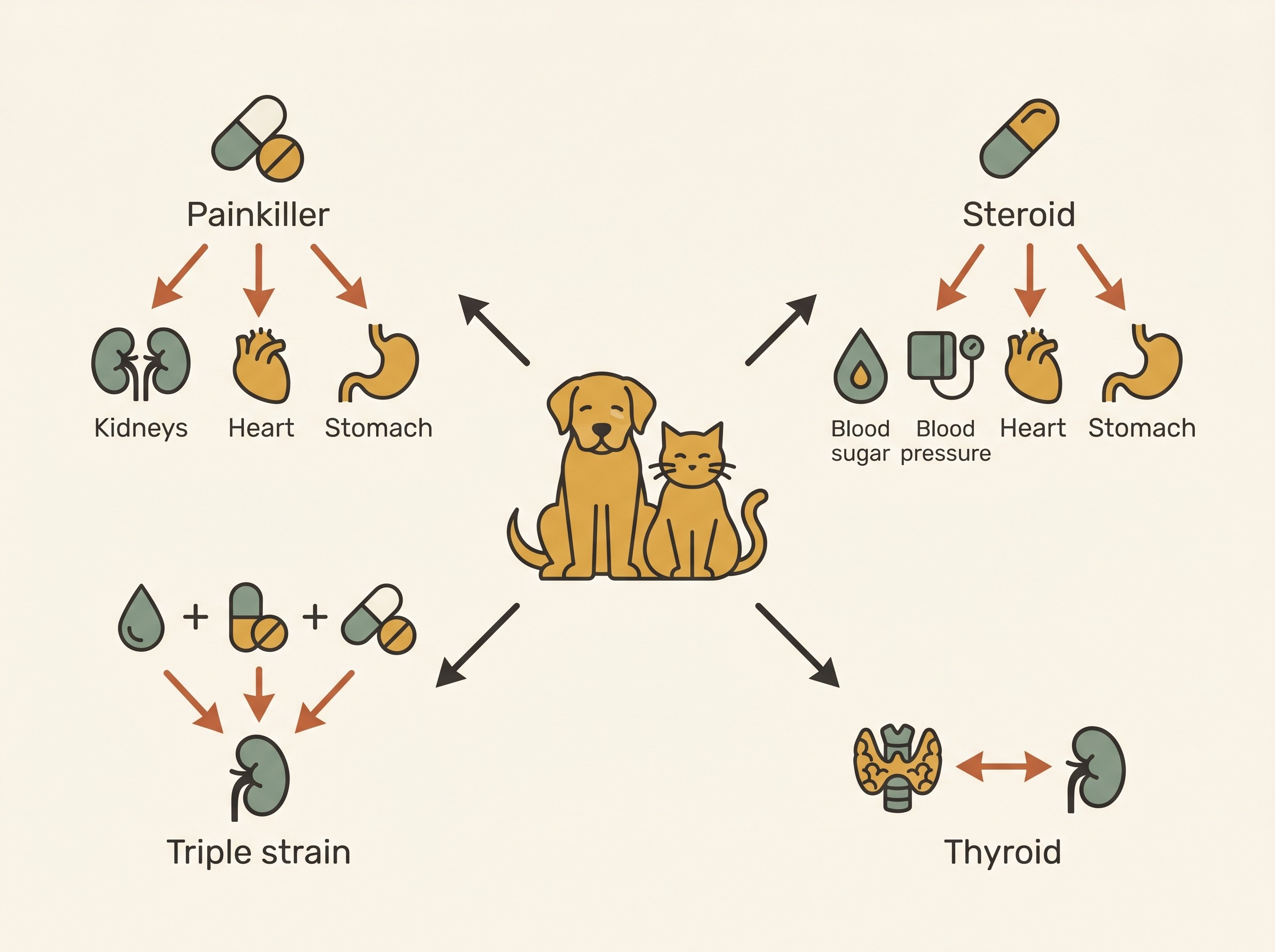
This is the most common tug-of-war of all, because the two conditions involved are two of the most common in old age. Sore, stiff joints, which your vet may call osteoarthritis, affect a great many older dogs and, less visibly, a great many older cats. And the kidneys not working as well as they used to, the clinical name being chronic kidney disease, is one of the defining conditions of the senior years, especially in cats. Plenty of old animals have both, so the painkiller that would transform a stiff dog's day is the very drug we think hardest about when the kidneys are already struggling.
The painkillers in question are the anti-inflammatory ones, the class vets call NSAIDs (the same family as ibuprofen, though pets must only ever have the versions licensed for them). They are brilliant for joint pain. The catch is in how the kidney supplies itself with blood: under strain from age, dehydration, low blood pressure or existing disease, it leans on natural chemicals called prostaglandins to keep its blood flow up, and these painkillers work by turning prostaglandins down. In a healthy pet that barely matters; in a kidney relying on them, it can be the push that tips it over. This is why the guidance is so consistent: these painkillers should be avoided in any pet who is dehydrated, has low blood pressure, or already has reduced kidney function (Cave Veterinary Specialists; De Santis et al., 2022). But "be careful with" is not "never." For many older dogs with mild, stable kidney changes a vet will still reach for them, because being in pain is its own serious harm, using the lowest dose that works with good hydration and a kidney recheck soon after starting. You don't win the tug-of-war by surrendering one side. You win it by holding both, treating the pain and watching the kidney.
Cats differ, and the stakes are high. Older cats get sore joints extremely commonly, but their kidneys are also especially prone to trouble. At the high doses some cats received in the past, used long-term, these painkillers were linked to real kidney harm, yet the more recent evidence is kinder than that reputation: at low daily doses, with monitoring, they can be used in cats with stable, early kidney disease without obvious deterioration (KuKanich et al., 2021). So if your cat is on a small daily dose and your vet keeps asking to recheck the bloods, that is the tug-of-war managed as it should be, not twitchiness.
Now add a third rope, and you get the conflict vets are most wary of. Picture an old dog with sore joints and a heart that is not pumping as well as it was. The heart is often managed with a water tablet (a diuretic) to shift fluid and a heart-support drug from the group called ACE inhibitors, each of which changes how the kidney manages its blood supply. Add the painkiller on top, and you have what doctors and vets call the "triple whammy": three drugs that each nudge the kidney, combining to risk a sudden drop in function. In human medicine, studied in large numbers, adding the painkiller to the other two has been associated with roughly a 31% higher risk of acute kidney injury (bpacnz, 2018), and the principle carries straight across to our patients. It is why your vet weighs that painkiller so carefully in a dog also on heart medication. No single one of those drugs is the villain. It is the three, pulling together, that can be too much for an old kidney to hold.
Painkillers and steroids: the one combination to avoid
This is the closest thing to an absolute in the senior medicine cabinet. The anti-inflammatory joint painkillers and the steroids (drugs like prednisolone, from the group called corticosteroids) must not be given at the same time.
Both, by different routes, strip away the prostaglandins that protect the lining of the stomach and gut. On its own, each carries some risk of irritation or, occasionally, an ulcer; together that risk climbs steeply, and an old pet can develop a serious, sometimes silent, bleed in the gut. This is why the teaching is unambiguous: combining these painkillers with steroids "is therefore contraindicated," and why, if your pet needs to move off a course of steroids and on to a joint painkiller, your vet will build in a gap, a washout of around a week, often with a stomach-protecting medicine to cover the changeover (KuKanich, WSAVA proceedings).
This is the rule most likely to catch a loving, organised owner out, precisely because you are trying to help: your dog is sore, you have some anti-inflammatory left from last time, and he is also on a short steroid course for an itchy flare-up, so giving both feels like common sense. It is one of the genuinely dangerous things you can do at home with an old pet, and it is alarmingly easy for the two to meet in the same animal on the same day unless someone is holding the whole list. Which brings us to whose job that is.
How steroids nudge the blood sugar and the blood pressure
Steroids earn their own tug-of-war, because they are wonderfully useful drugs (for itchy skin, immune problems and inflammation of all kinds) and they reach far beyond the part you are aiming at. The clearest conflict is with diabetes, the condition where the body cannot control its blood sugar. Steroids cause insulin resistance: they make the body's own insulin work less well, pushing blood sugar up. In a pet who is already diabetic, a course of steroids can throw careful control right off; in a pet on the edge, they can occasionally tip them into diabetes in the first place (Clinician's Brief: Corticosteroid Therapy). This is true for cats and dogs both, with a hopeful flip side: where steroids helped trigger the diabetes, stopping them sometimes lets it settle again. So if your diabetic pet needs a steroid for something else, expect your vet to watch the blood sugar closely and adjust the diabetes treatment around it.
Steroids also encourage the body to hold on to salt and water, which in a pet whose heart is already struggling, or who has high blood pressure, is the last thing you want: it adds to the very load the heart is failing to cope with. And by dampening the immune system, they can quietly mask the early signs of an infection, such as a fever. None of this makes steroids "bad." It makes them powerful drugs to place carefully in a pet who has other things going on, at the least dose and duration that does the job, with the other conditions watched while they are on board.
Sedation and procedures in an older body
The tug-of-war is not only about daily tablets. It shows up sharply whenever an older pet needs sedation or an anaesthetic, for a dental, a scan or a lump removal. There is a stubborn myth that old pets are "too old" to be put under, worth retiring gently because it costs them things they need, dental treatment in particular: age in itself is not a disease and not a reason to refuse a procedure (Cañón Pérez et al., 2025). What is true is that an older body handles these drugs differently. With less organ reserve, and the liver and kidneys often clearing drugs more slowly, an old pet usually needs lower, carefully judged doses titrated to effect, which is why a good vet will want a pre-anaesthetic assessment first, an examination, a look at every medicine the pet is on and very often blood work, to find and stabilise any concurrent disease before the pet is asleep, because doing so measurably lowers the risk of the anaesthetic itself (Irish Veterinary Journal, 2008). So the answer to "is she too old?" is almost always "no, but she will be assessed and her protocol tailored to her." That is the tug-of-war handled well, not avoided.
The cat's own see-saw: the kidneys and the thyroid
Cats have a tug-of-war so specific that it deserves naming on its own: the see-saw between the kidneys and an overactive thyroid (which vets call hyperthyroidism), each common in older cats. The cruel twist is that the two hide each other. An overactive thyroid revs the whole body up, driving more blood through the kidneys and, by wasting away muscle, lowering the very blood marker (creatinine) we use to judge kidney health, so a cat's kidney results can look reassuringly normal while kidney disease sits quietly underneath, masked (Geddes and Aguiar, 2022, summarised in Vet Times). Treat the thyroid, which of course you must, and the see-saw tips: as it settles, that artificial boost disappears and the hidden kidney disease can show itself, in a proportion of cats who looked fine beforehand. This is not a treatment failure and not your fault. It is a well-recognised, expected unmasking, and it is why your vet rechecks the kidney values in the weeks after starting treatment and aims for a sensible thyroid level rather than over-correcting, because pushing it too low has its own cost to the kidneys. The watchword is "monitor both," because in some cats you cannot have a perfect thyroid number and a perfect kidney number at once. The article on the senior cat with kidney disease and an overactive thyroid walks through it in full.
Your job in all of this
Reading those sections, it would be easy to feel more overwhelmed, not less. Please do the opposite, because here is the reassuring part: your vet carries the prescribing, the dosing and the balancing. Not one decision about how much of anything to give is yours, and you should never adjust, stop, start, double-up or skip a medicine on your own judgement, however sensible it seems in the moment: getting that wrong is one of the main ways an old pet comes to harm. What is your job is smaller, and you can do all of it. It comes down to three things.
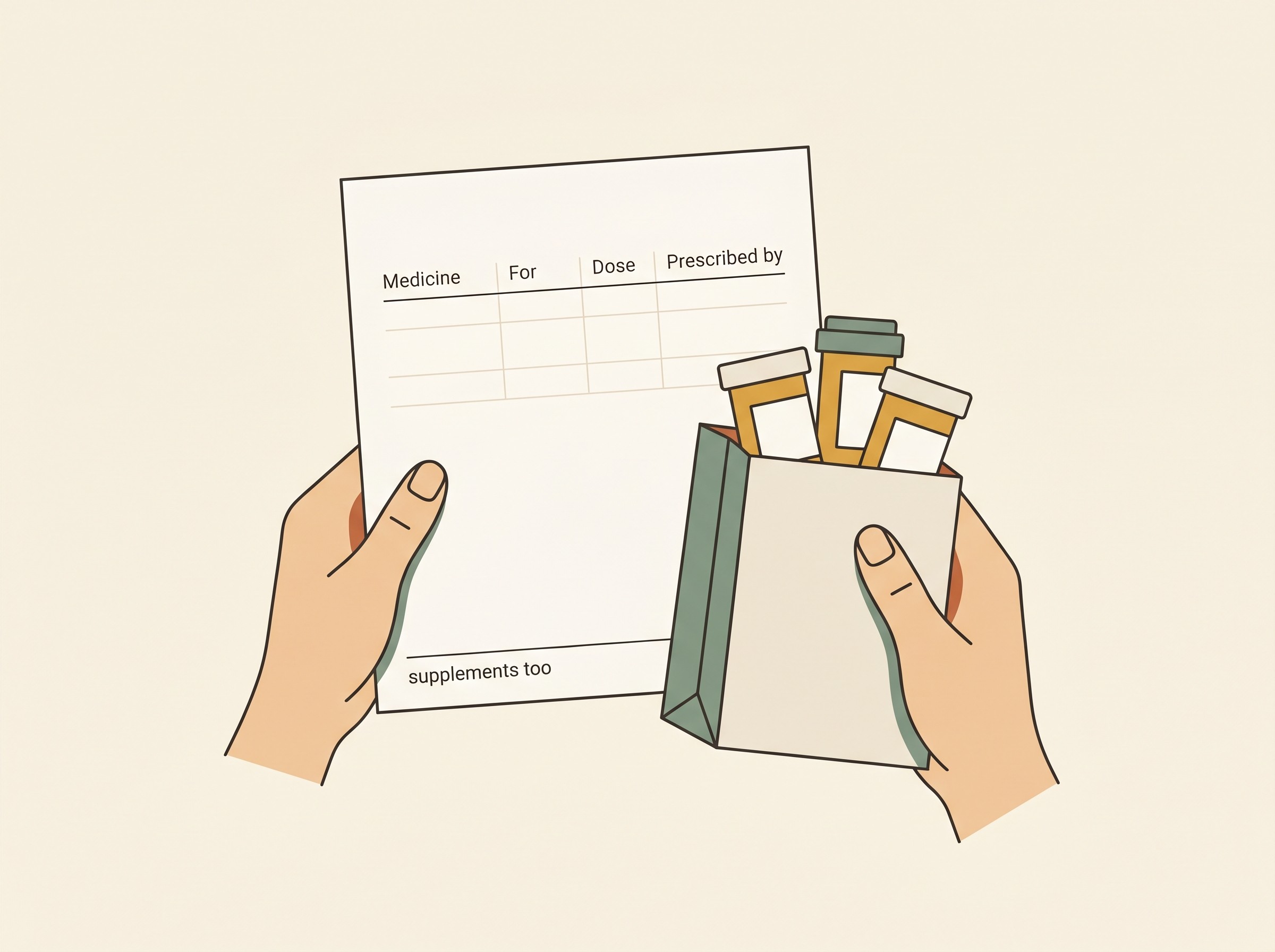
Keep one medication list, and make it the truth. Everything your pet takes, in one place: the prescription drugs, the flea and worm preventives, and, crucially, every supplement, oil, paste and "natural" remedy, with doses where you have them and which vet or shop each came from. This is the single most useful thing an owner of a multi-medicine pet can do, because the tug-of-wars above only become dangerous when nobody can see the whole picture at once. Always check with your vet before adding a supplement, as they can interact with medicines or conditions, and a cat in particular must never be given a product meant for dogs without checking, because some are unsafe for cats. Veterinary bodies now explicitly ask owners to bring this list, or even the bag of bottles itself, to every senior visit (AAHA: Supporting Your Senior Pet).
Ask the interaction question, out loud, whenever something changes. When a new medicine is suggested, a new vet sees your pet, or you are tempted by a supplement, ask the one question that protects them: "Does this pull against any of her other conditions or medicines, and if so, what should I watch for at home?" Good vets welcome it, and it prompts a useful conversation about which warning signs matter for your individual pet. It also helps to have one practice, ideally one familiar vet, keeping the whole animal in view even when a specialist is involved for the heart or the eyes: share the list with anyone new, and tell your usual practice when an emergency vet treats your pet out of hours.
Watch, and write it down. You are with your pet every day, which makes you the early-warning system no blood test can replace, and what your vet most wants is clear information about which side is wobbling: is the dog stiffer since the kidney-friendly dose drop, is the diabetic cat drinking more since the steroid started, is the thyroid cat brighter but off her food. Logging how your pet is doing, week to week, in the Senior Wellness Check, with the matching condition trackers where they fit (the Mobility Check for the joints, thirst-and-wee and glucose tracking for the kidneys and diabetes), turns daily impressions into a clear picture, so you and your vet adjust the balance from real data rather than a vague sense that "he's not been quite right." Catching the dipping side early is how a tug-of-war stays a balancing act instead of becoming a crisis. And if the size of all this is weighing on you, you are not failing and you are not alone: the senior community is full of people doing exactly what you are doing.
When the goal gently shifts to comfort
One more thing, gently, because some readers will be further along the road. Sometimes, in a much older pet with several advanced conditions, the balancing act changes character: the aim stops being to optimise every number on every blood test and becomes, instead, to give your pet the most good days. You and your vet may then deliberately accept a little more risk to one condition, perhaps allowing a painkiller the kidney bloods would rather you did not, because a comfortable, mobile old dog enjoying his garden is worth more to him than a perfect kidney result he cannot feel. That is not giving up. It is the tug-of-war re-weighted, with love and clear eyes, toward quality of life. At that stage tracking quality of life over time keeps the bigger pattern visible, as a reflective aid never a verdict, and when the questions grow into ones about the road ahead itself, the Rainbow Bridge space is there to hold them with you. It prepares you for that conversation; it never rushes you toward it.
What to do this week
You do not need to absorb every conflict above. Just three small, concrete things, starting today: get every medicine and supplement onto one page (and photograph it on your phone); ask your practice for a senior medication review, an appointment whose whole purpose is to look at the entire list together; and start logging the condition you are most worried about in the Senior Wellness Check, so next time something shifts you can show your vet what is really happening rather than trying to remember it.
The dosing and the weighing belong to your vet; the whole picture, kept accurate and visible, belongs to you, and it is the most valuable thing you can bring to a pet carrying more than one thing at once. For the wider view, when your old pet has several things wrong at once and juggling medications for a senior pet sit either side of this one, and the Arthritis, Kidney, Diabetes and Hormone Health spaces each hold the detail on one rope of the tug-of-war, while your vet holds them all at once, alongside you.
Sister tool · Sightline
Track quality of life over time
Sightline, a separate ConciergeVet tool, runs a short adaptive weekly assessment with a quality-of-life focus mode built around exactly these frameworks, tracks a single composite score over time so you can see the trend rather than judge a single bad day, and produces a Sightline Report PDF you can bring to your vet.
A written log, or our printable quality-of-life sheet, does much the same job.
See how Sightline tracks quality of lifeKeep track of how your pet is doing
The owners who cope best are the ones who notice changes early. A simple health log shows you what is working, and what is not, before the next vet visit.
Start tracking, freeYou're not doing this alone
Compare treatment journeys and talk to owners managing senior pets. Free to join.
Join PetsLikeMine