

The senior cat with kidney disease and an overactive thyroid
Alastair Greenway
BVM&S MRCVS
Two diagnoses for one small, ageing cat is a surprisingly ordinary place to end up. Perhaps the vet found an overactive thyroid first, started treating it, and a few weeks later the kidney numbers had crept the wrong way. Perhaps it ran the other way round. Either way you may now be holding a tablet to give twice a day, a special food she is sniffing at suspiciously, and the uneasy sense that fixing one problem somehow made another one worse.
None of that is a mistake, and it is almost certainly not anything you did. Chronic kidney disease and an overactive thyroid are the two headline illnesses of older cats, they turn up together all the time, and they have a genuinely confusing habit of masking each other. This article is about that tangle: why these two arrive as a pair, why treating one can seem to "cause" the other, why your vet treats the thyroid anyway, and the handful of things that, watched over time, keep your cat comfortable.
Why these two, and why so often together
These are not rare, exotic diagnoses. Chronic kidney disease is the single most common internal illness of older cats, thought to affect more than a third of cats in their senior years, and hyperthyroidism (an overactive thyroid gland, usually from a benign growth that makes too much thyroid hormone) affects roughly one older cat in ten (RCVS Knowledge / AAFP, 2021). When two conditions are each common in the same group of patients, plenty of cats will have both. By the time a cat is into her senior years (vets count cats as senior from around 11, and super-senior from 15), having more than one thing going on is closer to the norm than the exception.
So the first thing to know is that you are in very ordinary, very well-trodden territory. Vets manage this combination routinely. It is fiddly, but it is familiar.
How they hide each other
This next part catches a lot of owners out, and it is worth understanding once, plainly, because it explains almost everything that follows.
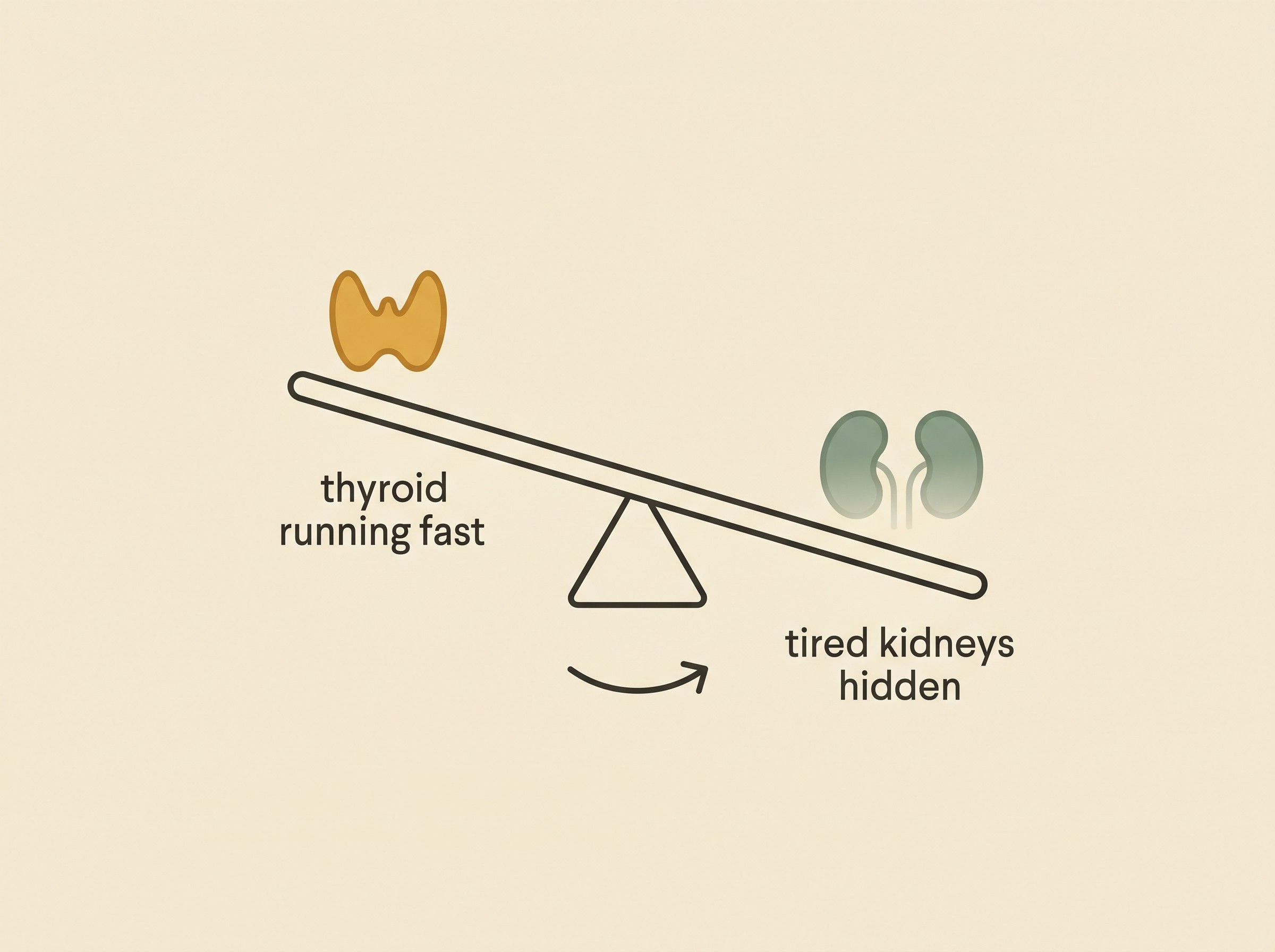
An overactive thyroid revs the whole body up. Among many other things, it pushes more blood through the kidneys and makes them filter harder, and it burns through muscle so a hyperthyroid cat is often thin and wasted. Both of those things make the kidneys look better than they really are on a blood test. The standard kidney marker, creatinine, comes from muscle, so a thin cat with little muscle produces less of it, and the reading comes back "misleadingly low" even when the kidneys are struggling (Caney, Vet Times, 2018). The fast-running thyroid is, in effect, propping the kidney numbers up.
Then you treat the thyroid. The body stops running hot, blood flow through the kidneys settles back to normal, muscle slowly returns, and the prop is removed. Now the kidney trouble that was there all along becomes visible on the test. Around one cat in ten to one in four who looked fine before treatment turns out to have kidney disease once the thyroid is controlled, and some studies put it higher still (Geddes and Aguiar, Journal of Feline Medicine and Surgery, 2022; Vaske et al., Journal of Feline Medicine and Surgery, 2016).
It works the other way too. The early signs of kidney disease, drinking more, weeing more, losing weight, going off food, are almost the same signs an overactive thyroid produces. From the outside you often cannot tell which is doing what, which is exactly why this needs blood and urine tests, not guesswork.
"We treated the thyroid and the kidneys got worse"
Owners say this sentence with real guilt, so let it land clearly: treating the thyroid did not break the kidneys. The kidney disease was already there. Treatment simply stopped hiding it (Geddes and Aguiar, 2022). Think of a torch shone at a wall. It reveals a crack that was there all along in the dark; it does not carve a new one.
That distinction matters for more than your conscience. It is the reason the answer is not to stop treating the thyroid.
Why you still treat the thyroid
It is tempting to think: if controlling the thyroid reveals kidney disease, why not leave the thyroid a little overactive to keep the kidneys flattered? That used to be a school of thought. It has fallen out of favour, for good reasons.
An untreated overactive thyroid is not kind to the kidneys, or to anything else. The hyperthyroid state itself damages the kidneys over time, strains the heart and drives up blood pressure (Caney, 2018). Cats whose thyroid is left unchecked do worse. So leaving the gland to run hot to make a blood test look prettier trades a number on a page for real harm to the cat. Your vet treats the thyroid because, on balance, a settled thyroid is better for the kidneys and everything else, even when it means the kidney disease becomes visible and needs managing in its own right.
Aiming for the comfortable middle
The aim, then, is not to crush the thyroid as hard as possible. It is to get it into a comfortable middle. Vets generally aim to bring the thyroid hormone (total T4) down into the lower half of the normal range, controlled but not over-suppressed (Geddes and Aguiar, 2022).
Going too far matters as much as not going far enough. If treatment pushes the thyroid all the way into underactive (an over-corrected, iatrogenic hypothyroidism), the kidneys suffer for it. In one well-known study, cats that ended up underactive were markedly more likely to develop kidney trouble, and those that became both underactive and azotaemic (with raised kidney markers) lived a median of 456 days, against 905 days for those that stayed off the kidney slide (Williams et al., Journal of Veterinary Internal Medicine, 2010). That is roughly half the time. It is the clearest possible argument for "controlled, not crushed," and it is why your vet rechecks the levels rather than setting a dose and forgetting it.
This is also why dose and product are your vet's call, never something to tinker with at home. The whole game is precision, and precision needs the blood tests.
Start with what you can undo
Because the kidneys can only be properly judged after the thyroid is settled, most vets start with a treatment they can adjust or undo. The reversible options are a daily anti-thyroid medication (you may hear the names thiamazole or methimazole, or carbimazole, given as a tablet or a gel rubbed inside the ear) or, in suitable cats, a special iodine-restricted food that starves the gland of the raw material it needs (Caney, 2018).
The logic is sensible: get the thyroid under control with something you can dial back, recheck the kidneys once she is settled, and only then decide whether to move to a permanent fix. The permanent options, radioactive iodine treatment (which cures most cats) or surgery to remove the gland, are excellent, but they cannot be reversed. If a cat has hidden kidney disease, you want to know that before committing to a one-way door, so the kidneys are not stranded by a thyroid that has been permanently switched off. None of this is decided alone or in a hurry. It is a conversation with your vet, shaped by your individual cat.
The dinner-bowl dilemma
Food is where this gets genuinely awkward, and where owners often feel they are failing. The textbook diet for kidney disease and the iodine-restricted diet for the thyroid are two different products with two different jobs, and you usually cannot serve both perfectly at once. On top of that, the cat in front of you is often thin, picky, and quietly unimpressed by prescription food.
There is no clean answer here, and anyone who gives you one is overselling it. The right compromise depends on which condition is currently the bigger threat, how advanced each is, and, crucially, what your cat will actually eat, because in a thin old cat, calories on board often matter more than the perfect formula on the label. This is exactly the kind of trade-off your vet weighs case by case. Your job is not to crack the diet puzzle yourself; it is to report plainly what she is and is not eating, and how much, so the plan can be matched to the real cat rather than the ideal one.
The third passenger: blood pressure
A quieter third problem rides along with both of these conditions, and it is the one that can do sudden, visible harm: high blood pressure. Both kidney disease and an overactive thyroid push blood pressure up. At least 60% of cats with high blood pressure have kidney disease, and around one in five hyperthyroid cats is hypertensive (Cornell Feline Health Center).
The reason this matters so much is the eyes. The commonest damage from feline high blood pressure is to the back of the eye, where it can cause the retina to detach and the cat to go suddenly, often permanently, blind (Cornell Feline Health Center). It can come on overnight: a cat who is bumping into things, has suddenly wide, staring pupils, or seems lost in her own home, needs to be seen quickly. That is why a blood pressure check belongs on the list for any older cat with either of these conditions, not as an optional extra. There is more on protecting fading sight in our Vision and Eye Health space.
The pain you might be missing
One last whole-cat point. A great many of these same elderly cats also have arthritis, which they hide brilliantly: less jumping, stiffer movement, a coat that has gone unkempt because grooming hurts. It is tempting to write all of that off as "she's just old," but stiffness and slowing down are symptoms to investigate, not an age to accept (AAHA, 2023).
The catch is that the usual joint painkillers, anti-inflammatories, are exactly the drugs that have to be used with great care in a cat with kidney disease, because they can stress the kidneys further. That is not a reason to leave a cat in pain. It is a reason this is, again, a vet's judgement: there are safer ways to manage feline arthritis pain alongside kidney disease, but the choice has to account for the whole cat. The principle to carry away is the one that runs through every multimorbidity story: keep a single, up-to-date list of everything your cat takes, and whenever anything new is added, ask the simple question "does this clash with anything she's already on?" You can read the fuller version of that in the treatment tug-of-war and juggling medications for a senior pet.
Your job between the visits
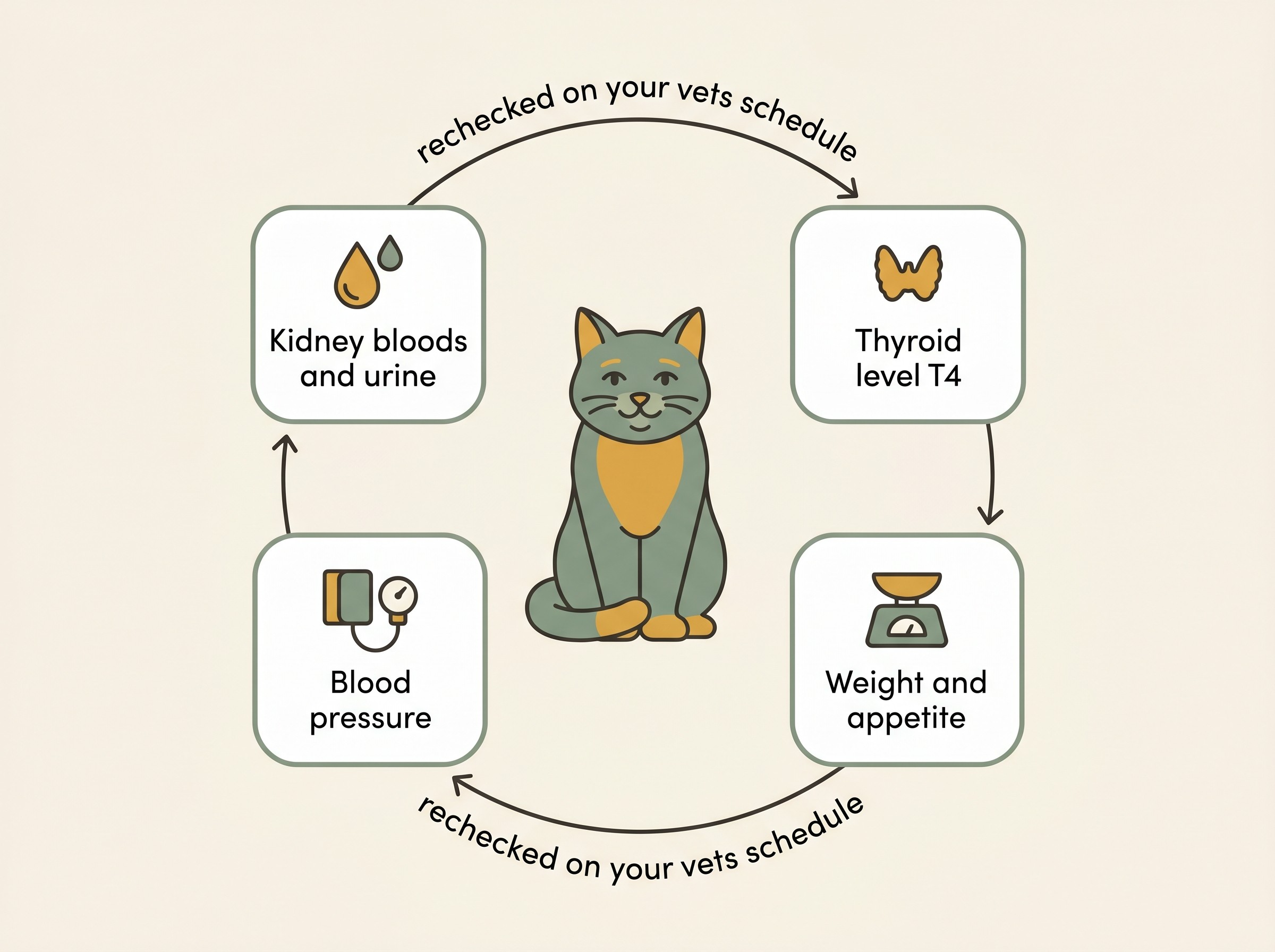
Rechecking, monitoring, watching the numbers over time: that is not your vet being cautious for the sake of it. With these two conditions, the monitoring genuinely is the management. The four things worth keeping an eye on are the kidney markers (on blood and urine tests), the thyroid level (total T4), and the blood pressure, rechecked on whatever schedule your vet sets, which is usually frequent at first and then settling down once things are stable (Geddes and Aguiar, 2022).
Between those vet visits, you are the eyes on the ground, and what you notice is genuinely useful clinical information. Two things are worth logging in particular. The first is weight and appetite: weight loss in an older cat is never just old age, it is one of the most important early warnings there is, and a slow downward drift you might not feel by stroking her will show up plainly if you note it down. The second is how much she is drinking and weeing, because both of these conditions drive thirst, and a change there is often the first sign something has shifted. Our Senior Wellness Check is built for exactly this: it tracks her Vitality, weight and appetite over time and turns it into a vet-ready summary, and the thirst-and-wee tracker lets you show your vet just how much the drinking has changed rather than trying to remember.
You can also dig deeper into either condition on its own terms: the Kidney space covers what kidney disease is and how it is staged and supported, and the Hormone Health space covers the overactive thyroid in full.
A last, candid word
Caring for an old cat with two conditions, two sets of numbers and possibly a daily tablet she would rather you didn't, is tiring. It is allowed to be tiring. If you are worn down by the pilling and the appointments and the worry, you are not doing it wrong, and you are not alone: our senior community is full of people doing this exact balancing act, and they understand it in a way few others can.
And hold onto the realistic, hopeful truth here. Plenty of cats live well for a long time with both of these conditions managed together. Concurrent kidney disease and thyroid disease is a balance to keep, watched and adjusted over months and years, not a countdown. The job in front of you is not to fix everything at once. It is to keep the thyroid in its comfortable middle, keep an eye on the kidneys and the blood pressure, keep her eating and comfortable, and let your vet fine-tune as you go. If a day comes, much further down the road, when the question becomes a gentler one about comfort and time, the Rainbow Bridge space is there for that. For now, this is about good days, well managed, one recheck at a time.
Sister tool · Sightline
Track quality of life over time
Sightline, a separate ConciergeVet tool, runs a short adaptive weekly assessment with a quality-of-life focus mode built around exactly these frameworks, tracks a single composite score over time so you can see the trend rather than judge a single bad day, and produces a Sightline Report PDF you can bring to your vet.
A written log, or our printable quality-of-life sheet, does much the same job.
See how Sightline tracks quality of lifeKeep track of how your pet is doing
The owners who cope best are the ones who notice changes early. A simple health log shows you what is working, and what is not, before the next vet visit.
Start tracking, freeYou're not doing this alone
Compare treatment journeys and talk to owners managing senior pets. Free to join.
Join PetsLikeMine