

Juggling medications for a senior pet: the safe-polypharmacy guide
Alastair Greenway
BVM&S MRCVS
Somewhere in the senior years, the cupboard quietly becomes a small pharmacy. A tablet for the joints, a capsule for the kidneys, something for the heart that has to be split, a sachet stirred into food, drops, and a supplement a friend swore by. Some go with food, some on an empty stomach, some morning and some night. You are keeping the whole thing in your head, and you are quietly terrified of getting it wrong.
If that is you, take a breath. You are not disorganised and you are not failing. You are caring for an older animal whose body now needs more than one kind of help at once, and that is genuinely hard to hold. This article is not about pharmacology. It is about a system: one list, a safe way to give each kind of medicine, the single question to ask your vet whenever anything changes, and the warning signs that mean "phone the practice" rather than "wait and see."
One rule runs through all of it: no doses or timings here are ever yours to change. Every "how much" and "when" and "should I stop" belongs to your vet. Your job is the list, the giving, and the watching, and you can do all three brilliantly.
Why old age means more bottles (and why that is not a failure)
Older pets rarely have just one thing going on. As dogs and cats age, conditions tend to accumulate rather than arrive one at a time, and that pattern of several diagnoses at once rises steadily with age (BMC Veterinary Research, 2022; the Dog Aging Project, 2025 found the same accumulation predicts how an old dog fares). A thirteen-year-old terrier might be managing stiff joints, an early heart murmur and a grumbling kidney all together. An old cat might have an overactive thyroid and quietly declining kidneys at the same time. We explore why this happens, and how to hold the whole animal rather than a pile of separate problems, in the companion piece on the whole-pet view. Here we are downstream of that: you already have the diagnoses, and now you have the bottles.
Why a system matters comes down to one thing. The more medicines an animal is on, the more chances there are for two of them to pull against each other, and that risk climbs with every drug added (Plumb's). You do not need to memorise the chemistry. You need a way to make sure the right people see the whole picture, and a way to give each dose without stress or error.
Pillar one: keep one medication list (and bring it everywhere)
This is the single most useful thing you will do, and it costs nothing. Write down, in one place, everything your pet takes. Not just the prescription drugs. The 2023 senior care guidelines are explicit that a critical part of looking after an older pet is knowing "what pharmaceuticals, supplements, nutraceuticals, creams, oils, or other therapeutics are currently being given," precisely so the team can "evaluate the need for additional therapeutics and minimize drug interactions" (AAHA, 2023). The herbal calming chew counts. The fish oil counts. The joint supplement counts.
For each item, jot the name, the strength, how much, what time, whether it goes with food or without, and who prescribed or recommended it. Then take that list to every appointment, including the ones at a different clinic, the out-of-hours visit, and the specialist. Vets do try to obtain a complete, updated drug history at each visit (Clinician's Brief), but on a busy day with a frightened animal, the owner who hands over a clear list is doing real safety work. It is the difference between a vet guessing and a vet knowing.
Your tracking earns its keep here too. The in-app Senior Wellness Check lets you hold the medication list alongside your pet's Vitality and Mind scores and their weight, so it is not a scrap of paper that gets lost but part of the record you bring to the vet. When a new tablet starts, you can watch on the same screen whether their energy, appetite or sharpness shifts, which is exactly the "what changed since last time" picture a vet wants to see.
Pillar two: getting it in, safely
A medicine that ends up spat behind the sofa is not a medicine. Difficulty giving pills is one of the leading reasons treatment quietly fails (PetMD), so the practical craft of getting each dose in matters as much as the prescription itself. It varies by form.
Tablets and capsules. A pill pocket, a treat designed with a hollow for the tablet, or a small blob of something irresistible will get most dogs over the line, and there are commercial pill-hiding treats made for exactly this (PetMD). Before you crush or split anything into food, check with your vet or the pharmacist, because some tablets must never be broken: enteric-coated and modified or extended-release tablets are built to release slowly or to survive the stomach, and crushing one can dump the whole dose at once or destroy it (PetMD). If your dog is wise to the pill-in-cheese trick, ask whether a flavoured liquid or a compounded version exists.
Pilling a cat. Cats deserve their own paragraph, because giving a cat a tablet is a genuine skill and a genuine hazard if done carelessly. The gentle technique is to place the pill as far back on the tongue as you can, close the mouth and stroke the throat downward to trigger a swallow (VCA). The part owners most often miss is the chaser: if you dry-pill a cat, follow it with a little water or food, because a tablet that lodges in the cat's oesophagus can cause irritation and even a stricture (a narrowing that is hard to treat, classically linked to certain antibiotics like doxycycline) (VCA). A few millilitres of water from a syringe into the cheek, or a tasty morsel straight after, moves the pill safely down. End every session with something lovely, and even a cross cat learns to tolerate the routine.
Liquids, ear gels and injections. Liquids are often easier for a reluctant cat or small dog, and many drugs come in palatable suspensions worth asking about. Some medicines, such as the cat thyroid drug methimazole, can be made as a gel you rub inside the ear; wear a glove so you are not dosing yourself. If your pet is on insulin or another injection, your vet will have shown you the technique, and the amount is never something to adjust at home.
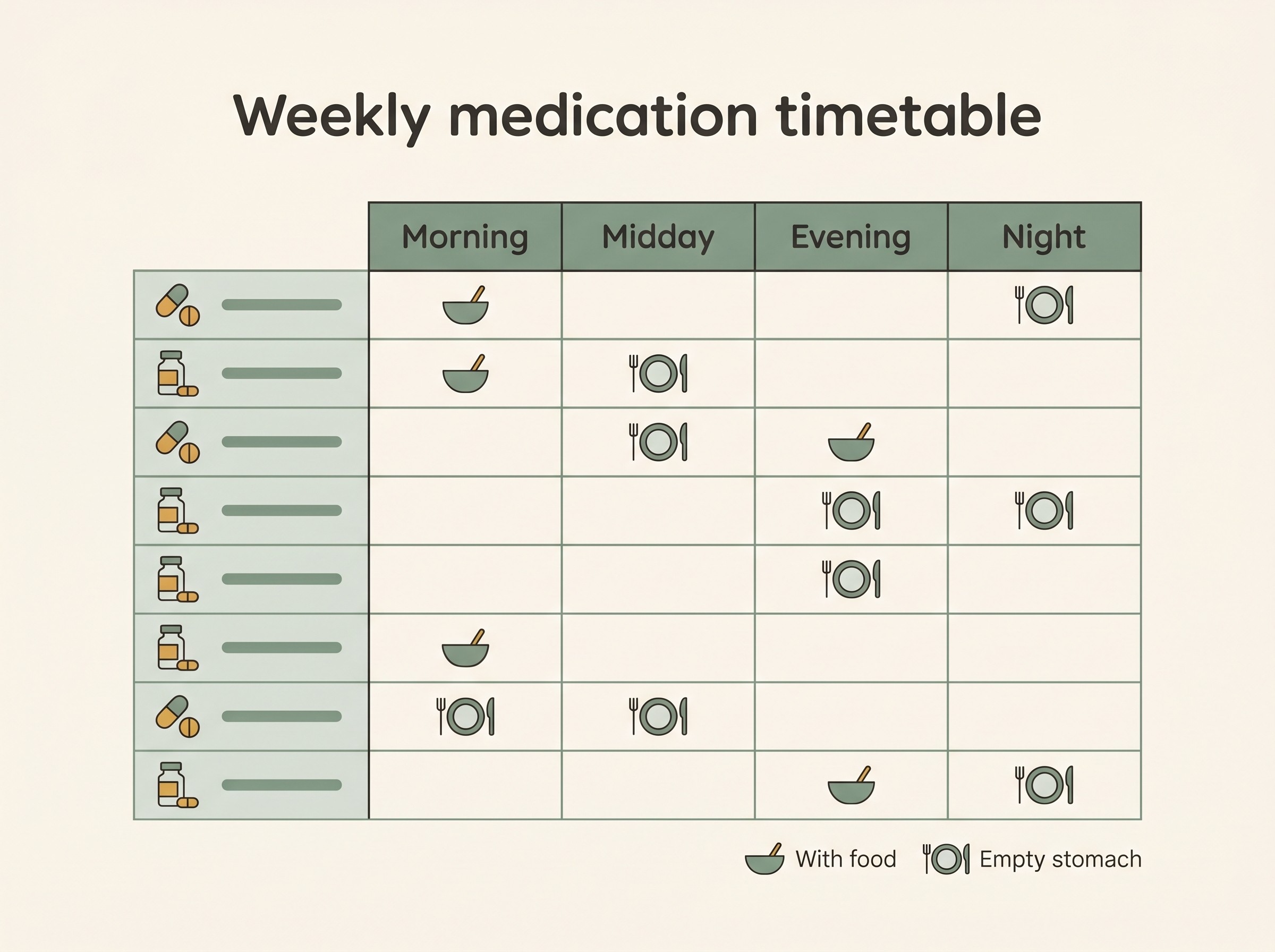
The timing grid. This is where most muddles happen. Make a simple grid of what goes when, marking which doses need food, which need an empty stomach, and which two should be spaced apart, and stick it inside the cupboard door. If you miss a dose or fear you double-dosed, the rule is the same: ring the practice and ask, rather than guessing and adding an extra. A missed tablet is rarely a crisis; an improvised correction sometimes is.
Pillar three: the one question that prevents most clashes
You do not need to learn which drug fights which. You need to build one habit: before anything new goes into your pet, a prescription, a pharmacy remedy, a supplement, even a herbal chew, ask your vet, "does this clash with anything she is already on?" Drug interactions in older pets are real and can cause "serious toxicities" or quietly cancel a medicine out (AAHA, 2023). A few of the classic senior clashes are worth recognising, so you understand why your vet is careful. We map these in full in the treatment tug-of-war; here is the short version.
- Anti-inflammatory painkillers (NSAIDs) and the kidneys, gut and steroids. The NSAIDs that ease arthritis are some of the most useful drugs in an old dog's life, but they ask a lot of the kidneys and stomach. They are avoided or used with great care in a pet with kidney disease, dehydration or gut problems, and never given at the same time as a steroid, because the combination markedly raises the risk of serious stomach ulceration (Today's Veterinary Practice; JAVMA, 2025). It is why your vet builds in a gap of several days when switching between the two, and why you should never reach for your own ibuprofen for a limping pet.
- The "triple whammy." An ACE inhibitor for the heart, a water tablet (diuretic) and an NSAID are each reasonable drugs, but together they can tip an older animal's kidneys into acute injury, because all three lean on kidney blood flow (bpacnz; the human evidence is reviewed in Calvo et al., 2025). A heart patient is exactly the pet who might also have sore joints, which is why this combination needs a vet weighing it up, not an owner adding a painkiller on a bad day.
- Steroids and the metabolic conditions. Steroids are sometimes unavoidable, but they can worsen diabetes, raise blood pressure and strain a failing heart, so in a pet with those conditions they are used thoughtfully and monitored, never casually stacked on.
One more clash is worth naming because it surprises people. If your dog (or, less often, your cat) is given selegiline for the ageing mind, a prescription medicine for confusion and memory changes that we will come back to, it must not be combined with a long list of other drugs. Selegiline is a type of medicine called an MAO-B inhibitor, and mixing it with certain antidepressants, with the painkiller tramadol or some opioids, with the anti-sickness drug metoclopramide, with the calming drug trazodone, or even with some supplements can trigger a dangerous reaction called serotonin syndrome (VCA; Veterinary Partner). The senior care guidelines specifically warn that even nutraceuticals like St John's Wort, melatonin and tryptophan can combine this way, and your vet may need a washout gap of a couple of weeks or longer before adding another medicine (AAHA, 2023). None of that is for you to manage. It is simply the clearest example of why the question, "does this clash?", is worth asking every single time.
Species safety rules you must never break
Some safety lines are absolute, and they differ between cats and dogs. Keep these somewhere you will see them.
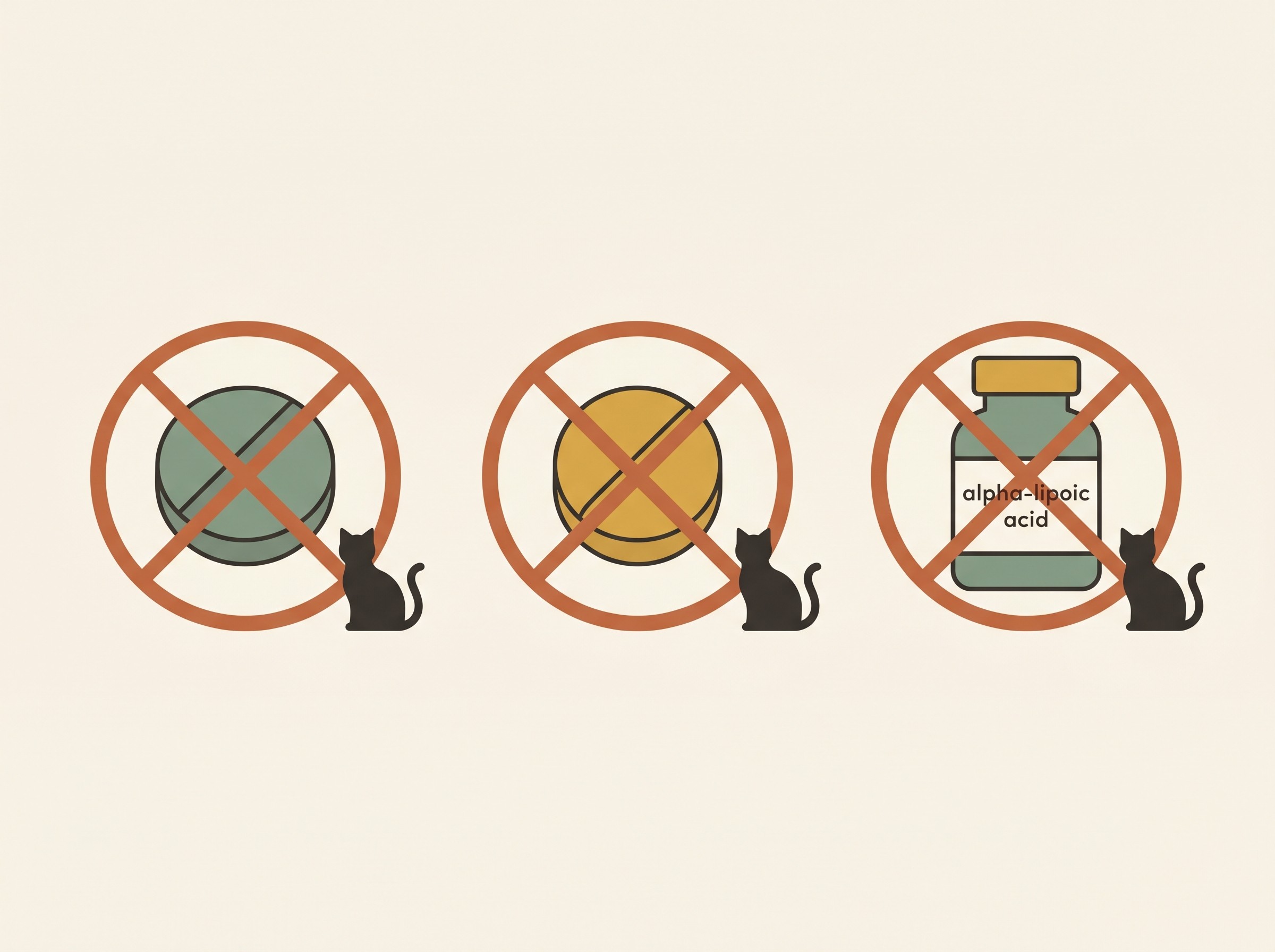
For cats: never give a cat a medicine made for a dog or a person without your vet's say-so. Cats process drugs differently, and the consequences can be fatal. The clearest example sits right inside this topic: the popular ageing-mind supplement Aktivait is sold in two versions because the dog formulation contains alpha-lipoic acid, which is toxic to cats. Cats are roughly ten times more sensitive to it than dogs, so only the feline-specific formulation is safe (Pet Poison Helpline; PetfoodIndustry). Likewise, paracetamol is never safe for a cat in any amount: even part of a tablet can be deadly, because cats cannot detoxify it (VCA; International Cat Care). If your cat is on thyroid medication and also has kidney changes, you may notice the doses being adjusted carefully over time. That is normal: an overactive thyroid and kidney disease each hide the other, and treating the thyroid can unmask the kidneys, so your vet will monitor both together (Geddes and Aguiar, 2022). There is a whole guide to that particular balancing act in the senior cat with kidney disease and an overactive thyroid.
For dogs: doses are usually worked out on lean body weight, so an overweight dog is not given more just because the scales say so (Today's Veterinary Practice). Watch what you hide pills in: grapes, raisins, onions and the sweetener xylitol (in some peanut butters) are all poisonous, so check a food is dog-safe before it becomes a pill wrapper. And keep your own medicine cabinet shut, as many dog poisonings are simply human painkillers given with good intentions or hoovered off the floor.
When a medicine is the problem, not old age
Here is a trap that catches loving owners. A new medicine causes a side effect, the pet goes a little flat or off their food, and because they are old, everyone shrugs and calls it "the years catching up." It might be the drug. Slowing down is a symptom to investigate, not a verdict to accept, and that goes double when a new tablet has just started. The same is true for weight: a drop in appetite or weight in an older pet is never just old age and always deserves a call, because it can flag both a medicine problem and an underlying disease (AAHA, 2023). For the wider question of telling treatable trouble from normal ageing, is it pain, age, or disease? is the place to start.
Ring your practice, rather than waiting, if you notice any of these after a medicine starts or changes:
- going off food, or refusing the meal the medicine is hidden in
- vomiting, diarrhoea, or very dark or tarry stools (a possible sign of stomach bleeding, especially on an NSAID; the standard advice is to stop the NSAID and call if your dog goes off food, Today's Veterinary Practice)
- new lethargy, wobbliness, tremors or a dazed look
- a jump in thirst or in how often they pass urine
- any sudden change in behaviour or mood
A new lump, by the way, belongs on the same "ring them" list rather than a "watch and see" one, because you genuinely cannot tell a harmless lump from a serious one by feel, and the wait-and-see approach is risky (AAHA, 2023). There is more on that in lumps, bumps and the cancer conversation. Logging these signs in the Senior Wellness Check as they happen, with the date, turns a vague "he's been a bit off lately" into a clear timeline your vet can act on, and the appropriate condition tracker (the Mobility Check for the joints, a glucose or thirst-and-wee log where those apply) sharpens it further.
When the regime itself is wearing you down
Sometimes the real problem is not any single drug but the sheer weight of the routine: the early alarms, the cat who fights every tablet, the worry that you forgot the lunchtime one. That fatigue is real and it is allowed. You are doing the work of a nurse, often alone, often grieving the easier version of your pet you remember. You are not a bad owner for finding it exhausting, and you are not alone in it; many owners in our senior community are running the same kitchen-cupboard pharmacy and trade the tricks that make it survivable.
Tell your vet when the regime is too much, because there is often room to simplify. Visits can sometimes be combined, a twice-daily drug swapped for a longer-acting once-daily one, a tablet changed to a liquid, and any medicine that is no longer earning its place can be reviewed and stopped. A shorter list is safer as well as kinder, and asking for one is good care, not giving up.
And if you are starting to wonder whether the pills themselves have become part of the question, whether the daily struggle is taking more from your pet's days than it gives back, that is a tender and important thought, not a disloyal one. Tracking quality of life over time, in the good-days ledger, can help you see the pattern clearly rather than from inside one hard morning. That reflection is a gentle aid, never a verdict, and the bigger conversation about what comes next is held with great care in the Rainbow Bridge space, whenever you are ready.
Start here, today
You do not have to fix everything at once. Do one thing: open the Senior Wellness Check and build your one list now, every drug, supplement, cream and chew, with its dose, its time and its food rule. Then, at your next appointment, ask three questions:
- Does everything on this list still need to be here, or can anything be simplified or stopped?
- Is there any clash between these, and is there anything I should never add without checking first?
- What exactly should make me phone you between visits?
Three answers, one list, and a timetable on the cupboard door. That is the whole system, and it turns the small pharmacy back into something you are quietly, capably on top of.
Sister tool · Sightline
Track quality of life over time
Sightline, a separate ConciergeVet tool, runs a short adaptive weekly assessment with a quality-of-life focus mode built around exactly these frameworks, tracks a single composite score over time so you can see the trend rather than judge a single bad day, and produces a Sightline Report PDF you can bring to your vet.
A written log, or our printable quality-of-life sheet, does much the same job.
See how Sightline tracks quality of lifeKeep track of how your pet is doing
The owners who cope best are the ones who notice changes early. A simple health log shows you what is working, and what is not, before the next vet visit.
Start tracking, freeYou're not doing this alone
Compare treatment journeys and talk to owners managing senior pets. Free to join.
Join PetsLikeMine