

Lumps, bumps and the cancer conversation in senior pets
Alastair Greenway
BVM&S MRCVS
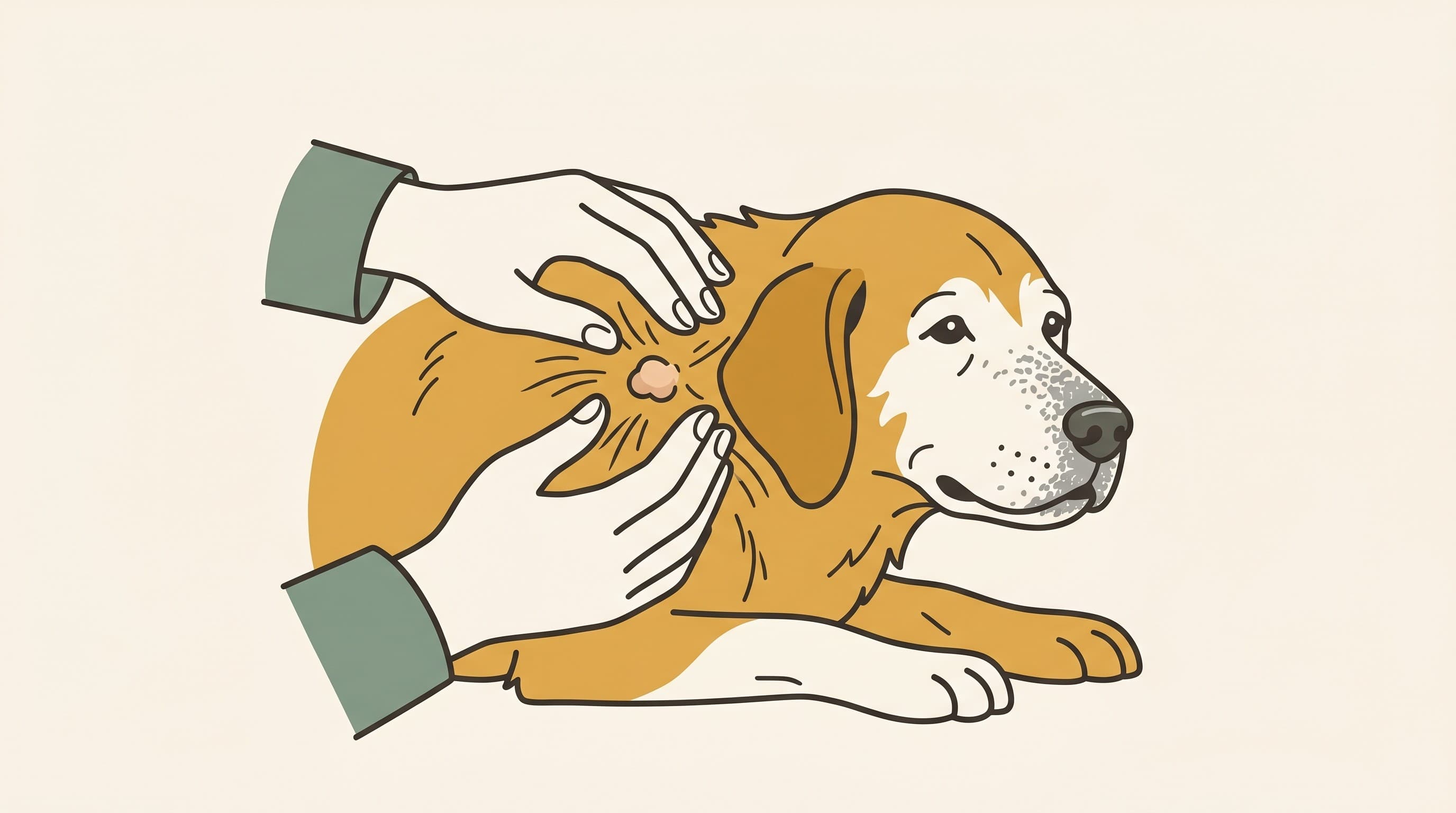
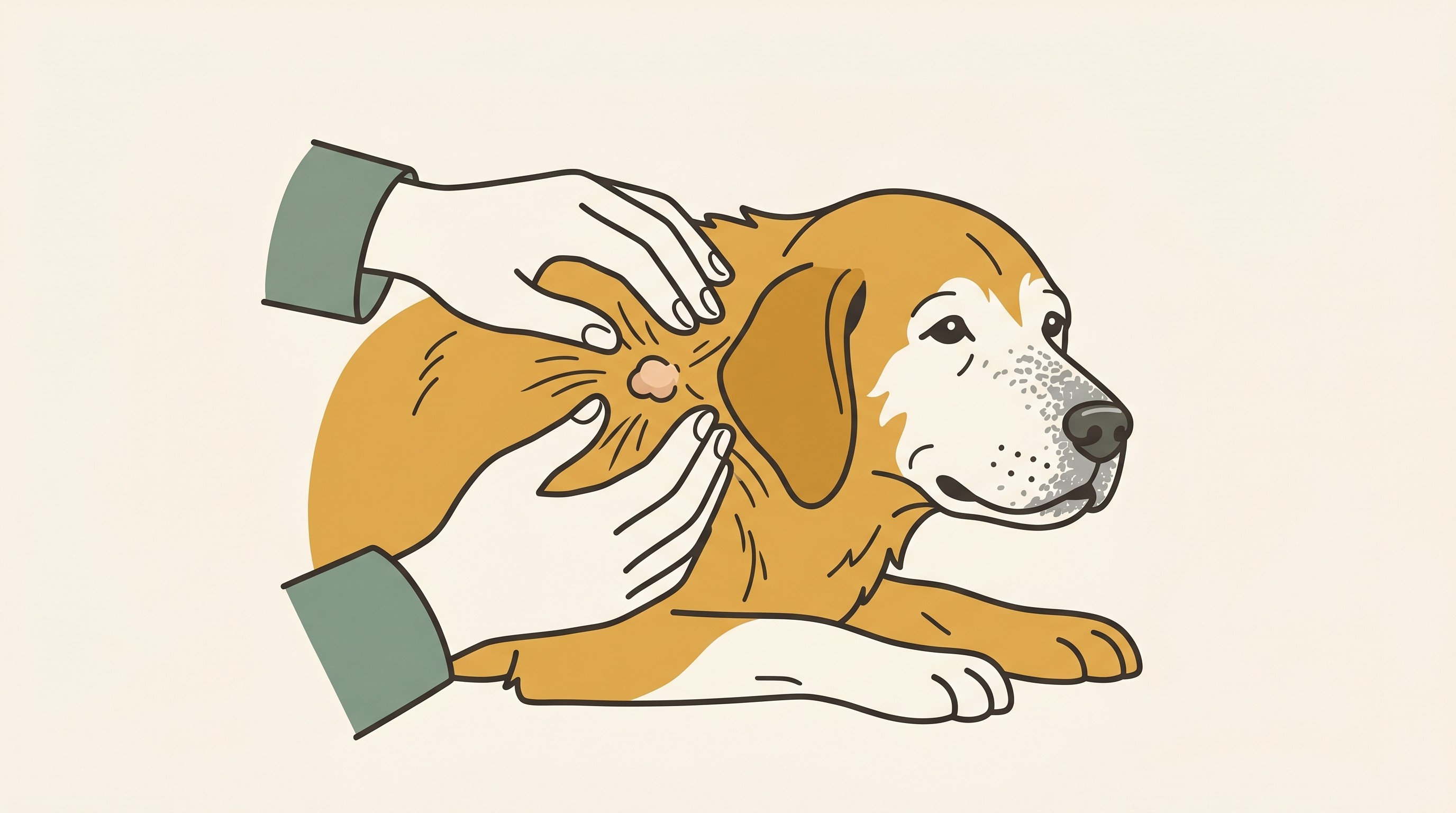
New lumps tend to turn up during an ordinary moment. Your hand is moving through your dog's coat on the sofa, or you're rubbing an old cat's chin the way you have a thousand times, and your fingers stop on something that wasn't there before. A small, soft swelling. A firmer pea under the skin. A crusty patch you took for a scab that has now sat there for weeks. The evening goes quiet, because the word neither of us wants to think arrives anyway.
So here's the single most useful fact in this whole subject, and one almost nobody tells worried owners early enough. No one can tell whether a lump is harmless or serious just by looking at it or feeling it. Not you, not me, not a specialist cancer vet. As the veterinary oncologist Dr Sue Ettinger puts it, "even the most experienced veterinarian or oncologist cannot look at or palpate a mass and know whether it is malignant or not", because "cancer is a cellular diagnosis" (WSAVA 2017, A Practical Approach to Lumps and Bumps).
That one fact is kind. It takes the lump out of dread and guesswork and turns it into a simple, answerable question, and the same question whether the news is good or not. This article is about asking it calmly, for dogs and for cats.
Why older pets grow more lumps
If you're noticing more lumps than you used to, you're not imagining it. Skin lumps really are a feature of middle and older age. In dogs the commonest is the lipoma, a soft, benign fatty swelling. A large UK study of everyday first-opinion practice found lipomas diagnosed in around 1.94% of dogs in a single year, and dogs aged nine to twelve had roughly seventeen times the odds of one compared with dogs aged three to six (O'Neill et al., 2018, Canine Genetics and Epidemiology). Lumpiness really does come with the grey muzzle.
The reassuring half is this: in dogs, the majority of skin lumps are not cancer. When masses are sampled and sent to a lab, somewhere between 20% and 40% turn out to be malignant (Today's Veterinary Practice). Most are lipomas, cysts and warts.
Cats ask for a little more respect on this point. In cats the odds flip: studies put the proportion of skin tumours that are malignant at roughly 50% to 65%, higher still if you set aside one common benign type (Today's Veterinary Practice). Cats also have far fewer plain lipomas than dogs. The upshot is worth holding onto: a new lump on a cat earns a vet visit a little sooner than the same lump on a dog, not because every feline lump is sinister, but because the base rates differ and cats are masters at looking fine until they aren't.
None of this calls for alarm. Lumps are a normal part of the ageing landscape, and the sensible response to a new one is curiosity rather than catastrophe.
The fact that disarms both panic and false comfort
Why does "you can't tell by feel" matter so much? Because it cuts down the two opposite mistakes loving owners make, and with the same blade. The first is panic: assuming every new bump is cancer and lying awake over a lump that turns out to be fat. The second, quietly more dangerous, is false comfort: deciding a lump is "just a fatty lump" because it's soft and looks like the last one.
The trouble is that some of the cancers we most want to catch early are brilliant mimics. The mast cell tumour, one of the most common skin cancers in dogs, is nicknamed "the great pretender" precisely because it can look and feel like almost anything: an insect bite, a wart, an allergic lump, or a perfectly innocent lipoma (VCA Animal Hospitals). A soft swelling on an old Labrador might be the most ordinary fatty lump in the world. Or it might not, and you can't win that bet by squeezing it.
Dr Ettinger built her whole campaign around a cautionary tale. Over years she had sampled lump after lump on one dog, and every one had been a harmless fatty tumour, so when a new lump appeared everyone relaxed and took their time. When it was finally tested, it was a soft-tissue sarcoma, a malignant cancer (DogCancer.com). The lesson isn't that fatty lumps are secretly dangerous. It's that a history of benign lumps does not vouch for the next one. Each new lump is its own question.
So resist the temptation, mine included, to diagnose a lump by description. A lump can't be "graded" by how it feels under your fingers or looks in a photo. Happily, finding out is genuinely easy.
So what do you actually do? Meet the fine-needle aspirate
The test that answers nearly all of this is the fine-needle aspirate, usually shortened to FNA. Your vet puts a small needle, often no bigger than the one used for a vaccination, into the lump, draws back a few cells, and spreads them on a glass slide to be examined under a microscope.
For most lumps it's genuinely undramatic, usually done with your pet awake, during a normal consultation, often in a couple of minutes. Ettinger sums up its appeal as a "low risk, low cost procedure, and results are available more quickly than biopsy results" (WSAVA 2017). For a worried owner, that speed is a mercy.
It does have limits. Sometimes an aspirate comes back "non-diagnostic", meaning too few or too-fragile cells came out for the pathologist to be sure (WSAVA 2017). And even when one confirms cancer, it can't always give the full picture alone. To know exactly which cancer it is and how it's likely to behave, your vet may need a biopsy, where a piece of the lump, or the whole lump, is removed for histopathology. To put it simply, an aspirate (cytology) reads loose cells and is the fast first step, while a biopsy reads the tissue's architecture for the definitive answer. One leads sensibly to the other.
Which lumps are worth testing? There's a clean rule of thumb from Ettinger's "See Something, Do Something: Why Wait? Aspirate" campaign, now widely taught: any skin or under-skin mass bigger than a centimetre (about a large pea), or present for a month, should be aspirated (Today's Veterinary Practice). The thinking behind it is hopeful. Most skin and subcutaneous tumours can be cured by surgery if caught while small, so the goal is to find out while a lump is little, not after it's had a year to grow. "Wait and see if it goes away" is the one approach that quietly works against you.
A way to watch without panicking
Between feeling a lump and getting to the vet, you can be genuinely useful, as long as you remember the golden rule: you are gathering information for your vet, not diagnosing it yourself. Nothing below tells you whether a lump is benign or malignant. It just gives your vet a head start.
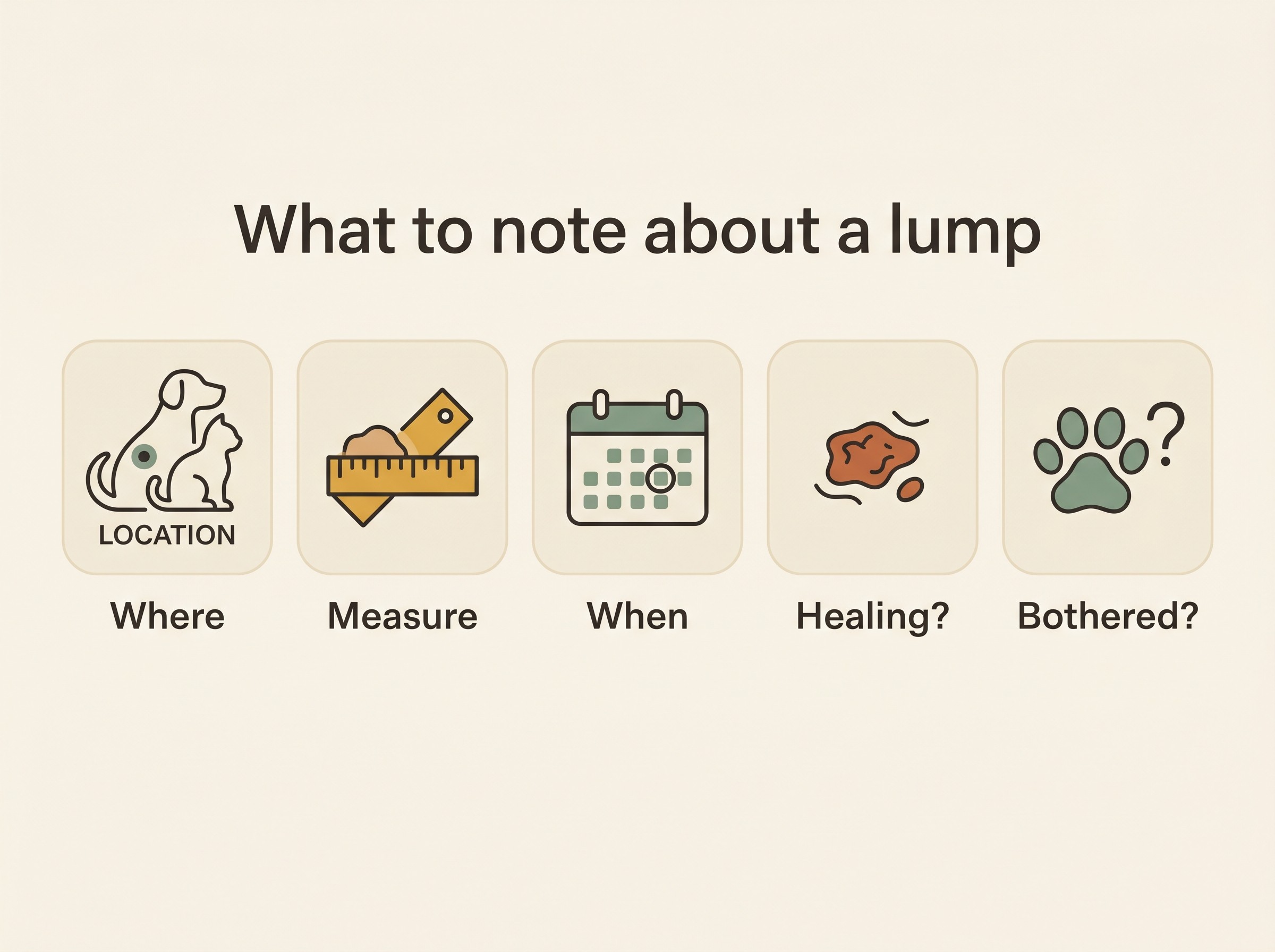
- Where it is. Lumps near eyes, mouth, paws and bottom, or anywhere that will make surgery tricky later, are worth showing sooner.
- How big it is, measured not guessed. Hold a ruler against it and write down the millimetres. Memory and worry both inflate lumps; a number does not. This is the single most useful thing you can do.
- When you first found it, with an actual date. "A while ago" is hard to act on; "the 3rd" is not.
- How fast it is changing. A lump visibly bigger week to week is more pressing than one unchanged for a year.
- Whether it is ulcerated, weeping, or refuses to heal, and whether your pet is licking, scratching or bothered by it.
The neat way to keep this in one place is the Senior Wellness Check. Logging the lump with its measurement, the date and a photo lets you show your vet exactly how it has changed rather than relying on "I think it's a bit bigger?". Tracking turns a vague worry into something your vet can act on.
What's different about cats
A few lumps and changes are worth knowing about specifically because they're feline.
The first is a lump where your cat has had injections, including vaccinations. Very rarely, cats develop a tumour called an injection-site sarcoma at such a site. The risk is genuinely small, well below one in ten thousand vaccine doses (ABCD, European Advisory Board on Cat Diseases), so this is not a reason to skip the vaccines that protect your cat. But because these tumours behave badly if missed, vets use a memory aid called the 3-2-1 rule: get any post-injection lump checked if it is still there three months afterwards, grows larger than two centimetres, or is still getting bigger one month afterwards (AVMA). A small swelling that appears after a jab and fades within weeks is usually a normal reaction. One that lingers or grows is one to show your vet.
The second is the patch that isn't a lump at all, but a sore that won't heal. In white-faced and light-coloured cats especially, years of sun exposure can lead to a skin cancer called squamous cell carcinoma on the least-furry, most sun-catching places: the ear tips, the nose and the eyelids (VCA Animal Hospitals). It begins as something easy to dismiss, a crusty, scabby area that looks like a minor scratch but never quite heals and slowly creeps larger (Cornell Feline Health Center). Caught while tiny, it's often curable with surgery, so a persistent crusty ear tip on a white cat deserves the same attention as a lump, even though it doesn't feel like one.
The third feline truth is the quiet one. Because cats carry on as normal so well, the cancers that matter most in older cats are often the ones you cannot feel at all, showing up not as a lump but as weight loss or a fading appetite.
The lumps you can't put your finger on
Not all cancer is something you can feel, and the most important early signs of internal disease are deliberately vague. In older dogs especially, the classic warning signs worth a vet's eyes include a non-healing sore, unexplained weight loss or a dropping appetite, abnormal discharge or a new bad smell, reduced stamina, new lameness, and any difficulty breathing or toileting (American Kennel Club, citing the Veterinary Cancer Society).
Every one of those signs can be caused by cancer, and every one is far more often caused by something else, much of it very treatable. Weight loss in an older pet is never "just old age", but the list behind it includes an overactive thyroid in cats, kidney disease, diabetes, dental pain and gut trouble long before you reach cancer. So the right response is neither "it's nothing" nor "it's the worst". It's "this needs a vet to look properly." We walk through that judgement in is it pain, age, or disease? and the red flag itself in weight loss in an older pet, and depending on what your vet finds, the road may lead into the Chronic Kidney Disease, Diabetes or Hormone Health spaces rather than towards cancer at all. Catching these whispers early, while a problem is small, is the whole point of the twice-yearly senior wellness exam.
Is a diagnosis the end of the road?
This is the part that frightens people most, so let me be straight and gentle in equal measure. Cancer is common in older animals: in dogs it's the leading cause of death in the senior years, and close to half of dogs over the age of ten will develop some form of it (American Kennel Club). There's no kind way to shrink that statistic.
But "cancer" is an umbrella word covering wildly different things, and a diagnosis is the start of a conversation, not an automatic ending. Some growths the lab calls tumours behave benignly and need only watching. Many malignant ones, caught while small, can be removed completely with surgery and never trouble your pet again. Others need more. The only way to know which conversation you're in is to find out what the lump actually is, which loops right back to that quick, kind aspirate.
And set aside the assumption that an old pet is automatically "too old" to do anything about it. Veterinary oncologists are clear that age is not, by itself, a disease, and that an older animal who's otherwise well often tolerates treatment perfectly fine (Dr Joanne Intile, DVM DACVIM (Oncology), PetMD). Where intensive treatment isn't right, modern care offers gentler, comfort-led options that keep good days good rather than chase a cure at any cost. What matters is not your pet's birthday but their quality of life, and those decisions are always yours, with your vet, at your own pace.
Holding the whole pet, and the question underneath
If the pet you've just found a lump on is also juggling stiff joints, a kidney that needs watching or a foggy old mind, a new diagnosis can feel like one weight too many. Caring for an old animal with several things going on is genuinely tiring. The way through is to hold the whole pet rather than each problem in isolation, keeping one medication list and one set of priorities agreed with your vet, which is what the whole-pet view is about. You're allowed to be tired, and other owners walking the same road gather in the senior pets community.
Underneath all of this sits the question that brings so many people to a page like this, even unspoken: how will I know when it's time? That deserves more care than a lump article can give it, so we hold the answer somewhere gentler. Tracking good days and bad days helps you see the real pattern rather than the worst day or the fear, and when the time comes to think about the goodbye itself, the Rainbow Bridge space is there to walk you through it with care. For today, though, you're not there. Today there's just a lump, and a question with an answer.
If you found a lump this week, here is the whole plan
Measure it with a ruler and write the number down. Note today's date. Take a quick photo, and log all three in the Senior Wellness Check so you can track whether it changes. Then book your vet and ask, in plain words, for a fine-needle aspirate, especially if the lump is bigger than a pea, has been there a month, or sits on a cat. Don't wait to see if it goes away, and don't lie awake assuming the worst either. The lump is not asking you to be brave or to be a vet. It's just asking a question, and the answer is a quick test you can arrange tomorrow morning.
Sister tool · Sightline
Track quality of life over time
Sightline, a separate ConciergeVet tool, runs a short adaptive weekly assessment with a quality-of-life focus mode built around exactly these frameworks, tracks a single composite score over time so you can see the trend rather than judge a single bad day, and produces a Sightline Report PDF you can bring to your vet.
A written log, or our printable quality-of-life sheet, does much the same job.
See how Sightline tracks quality of lifeKeep track of how your pet is doing
The owners who cope best are the ones who notice changes early. A simple health log shows you what is working, and what is not, before the next vet visit.
Start tracking, freeYou're not doing this alone
Compare treatment journeys and talk to owners managing senior pets. Free to join.
Join PetsLikeMine