

You are not a bad owner: caring for the carer of a senior pet
Alastair Greenway
BVM&S MRCVS
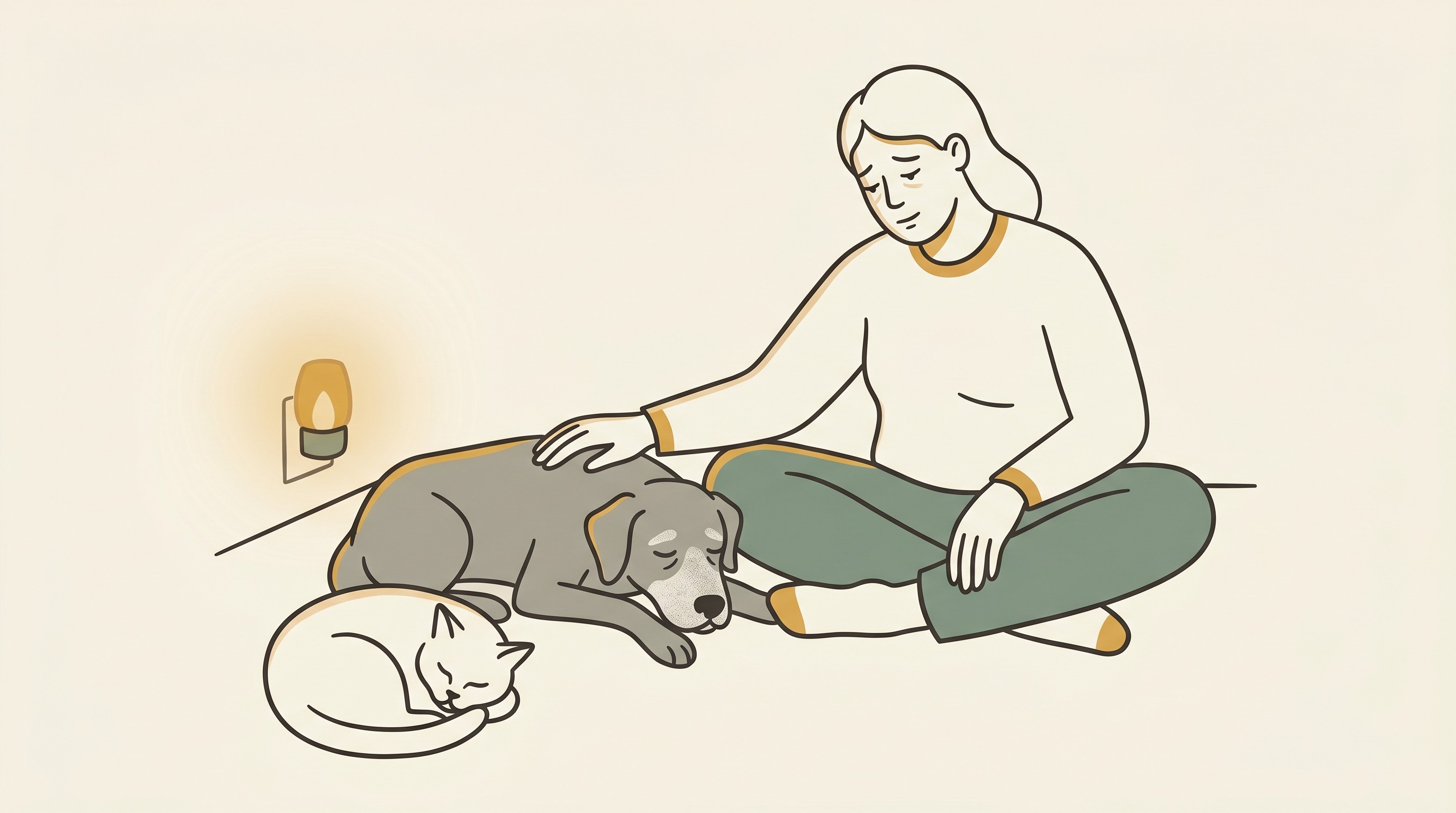
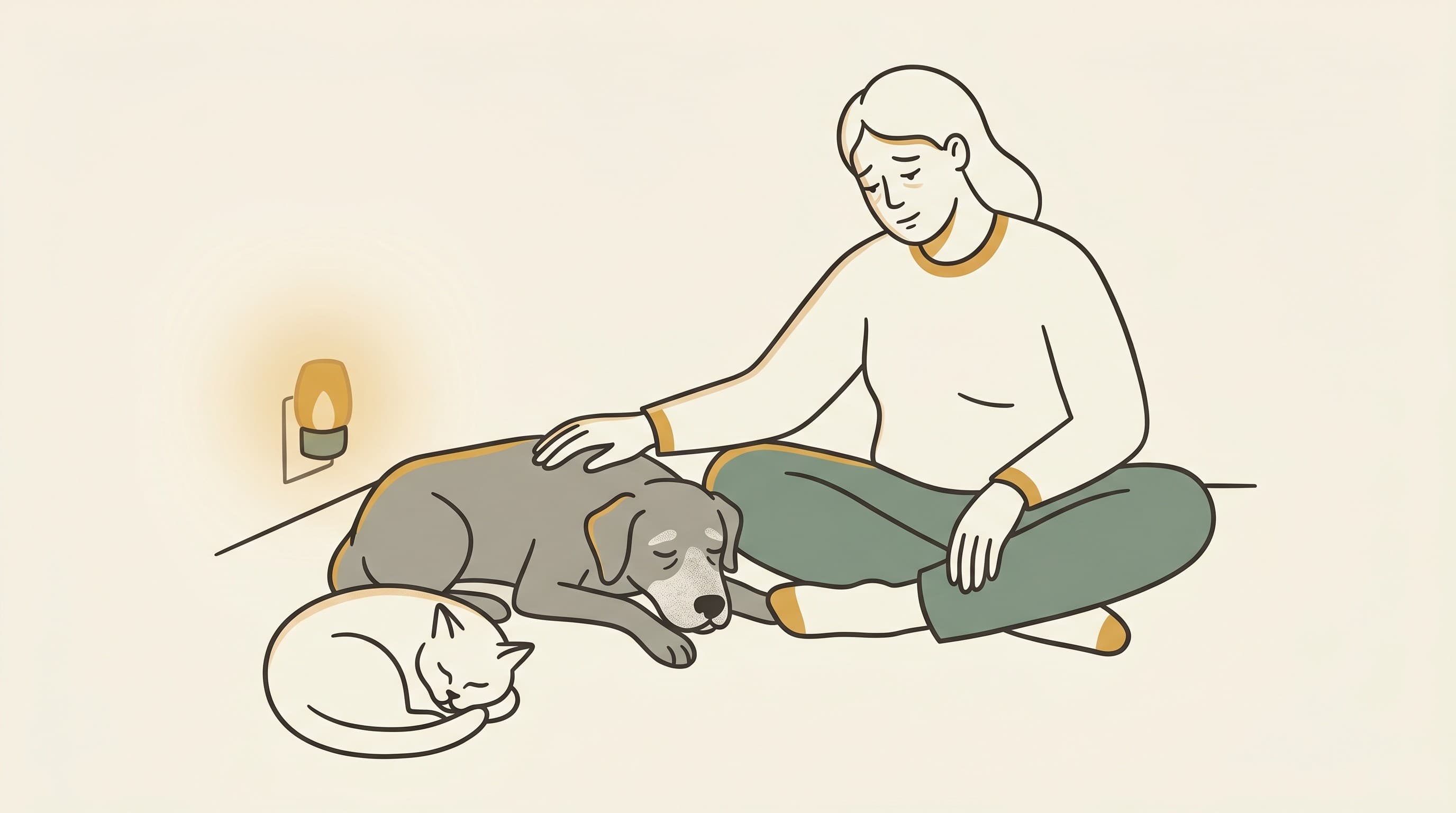
You have been up three times in the night: once to help her find her way back from the corner she got stuck in, once because she was pacing and panting, once to change bedding. And somewhere in the dark, a thought arrives that frightens you more than the tiredness does. Just for a second, you wish this was over. Then comes the guilt, hot and immediate, because how could you think that about the animal who has slept at your feet for years.
If any of that is familiar, please read the next sentence slowly. You are not a bad owner. You are a tired one. What you are carrying has a name, it has been measured, and there is a way through it that does not ask you to love your pet any less.
What you are feeling has a name
The thing that is wearing you down is called caregiver burden: the strain, practical and emotional, that builds up when you are responsible for the day-to-day care of someone who is ageing or unwell. In human medicine it has been studied for decades in the families of people with dementia. In veterinary medicine it is newer, but the picture is now clear.
When researchers compared 238 pet owners, half caring for a dog or cat with a chronic or terminal illness and half with healthy pets, the carers of the sick animals carried significantly more burden, more stress, and more clinically meaningful symptoms of depression and anxiety, alongside a lower quality of life (Spitznagel and colleagues, Veterinary Record, 2017). This is not a soft finding from a wellbeing blog. It is a measurable effect, with a validated questionnaire behind it, and the strain it tracks rises with stress and falls with your quality of life in lockstep.
It matters that this is now recognised by the people who set the standards. The 2023 senior care guidelines from the American Animal Hospital Association name it outright: caring for a senior pet "takes time, patience, money, and emotional and often physical stamina," and "can take an emotional and physical toll on the caregivers and lead to caregiver burden" (AAHA, 2023). The toll is written into the gold-standard guidance. It is expected, not a sign you are doing it wrong.
Why ageing is the hard kind of caring
Plenty of people care for a pet through a short, sharp illness and come out the other side. The senior years are different, and naming why is the first relief.
There is no timeline. A broken leg has a cast-off date. An ageing body does not. You are caring without an end in sight, riding good days and bad ones with no calendar to plan around, and that open-endedness is its own kind of exhausting.
It is rarely just one thing. Old animals tend to collect problems: stiff joints and a grumbling kidney and fading hearing and a mind that is not quite as sharp as it was, often all at once. Each is manageable alone. Together they become a daily act of juggling that nobody trained you for. If that is your reality, the whole-pet view is written for exactly this, and the guide to juggling several medications safely takes the choreography of pills and timings off your shoulders a little.
The nights break you fastest. When guardians of dogs with an ageing, struggling mind were asked which behaviour they found hardest to live with, the answer was not the confusion or the accidents. It was the night-time disturbance, ahead of the barking, the house-soiling, the irritability and the clinginess (Taylor and colleagues, Veterinary Record, 2024). Broken sleep, night after night with no prospect of catching up, is the part that hollows people out. If your nights have gone like this, the 3am pet guide to night-waking is the practical companion to this one.
The mind changes are the heaviest load of all. When an old dog's memory and sharpness start to slip, into what a vet will call cognitive dysfunction, the owners carry more burden than owners of dogs whose minds are still bright (Belshaw and colleagues, Veterinary Record, 2024). And the part that makes those carers feel so alone is that it is barely diagnosed. In a study of more than 15,000 dogs, only around 1.9% had a formal diagnosis, even though closer to one in seven showed the signs, the odds rising about 52% for every extra year of age (Yam and colleagues, Scientific Reports, 2022). So if you feel like you are doing this in the dark, with no name for what is happening and nobody to ask, that is not your imagination: the recognition has not caught up with the reality. There is more on what these changes are, and what helps, in the living-with-cognitive-changes day-and-night plan.
If you share your home with an older cat, none of this is a dog story you are reading from the outside. Cats carry their decline quietly: the load on you looks like the 4am yowling at a wall, the litter tray missed by inches, the once-fastidious coat that now needs grooming, the cat who used to greet you and now stares through you. Feline minds slow in much the same way, and the old cat who yowls and forgets speaks to that directly. The work is no lighter for being done in silence.
The guilt, the resentment, and why neither makes you bad
The flash of resentment you felt at 3am is not a character flaw. It is a symptom of burden, the same way a fever is a symptom of infection: it tells you the load is too heavy, not that your heart is too small. The person who never once felt that flash is the person who is not actually doing the caring.
And the guilt that follows it is so common that it has its own name in the research. One study found that pet owners' guilt and the sense of being torn between their pet and the rest of their life ran at levels comparable to human family caregiving studies, and the authors called it "disenfranchised" guilt (Kogan and colleagues, Animals, 2022). Disenfranchised means a feeling the world does not give you permission to have. Nobody sends a card when your dog stops recognising you. Nobody offers you compassionate leave because your cat needs medicating four times a day. So you carry it privately, and the privacy convinces you that you are the only one, and that you must be failing.
You are not the only one, and you are not failing. As the psychologist who has studied this most closely puts it, owners "need to know that it is okay to feel stressed out by the situation," and crucially that "acknowledging the stress doesn't mean they love their pet any less" (Spitznagel, Kent State University). You can be devoted and depleted. You can adore this animal and dread the alarm clock. Holding both does not cancel the love. It is the love, under strain.
Grieving a pet who is still here
There is one more feeling worth naming, because it surprises people and then convinces them something is wrong with them: you may find yourself grieving an animal who is still asleep on the sofa beside you.
That is anticipatory grief, and it is real and recognised. In the families of people with dementia it is well established and closely tied to caregiver burden, and that same grief has now been described in the guardians of senior dogs whose minds are fading, in a survey of 347 owners aptly titled "With great love comes great grief" (Taylor and colleagues, Veterinary Record, 2025). You are mourning the dog who used to bound up the stairs while the dog who takes them one at a time is right in front of you. You are missing the cat who slept on your chest while the cat who now sleeps alone in the spare room is just down the hall.
This grief is exhausting precisely because there is no moment to mark it, and society barely acknowledges that grieving the living is even a thing, a quiet loneliness grief researchers have long called disenfranchised. None of it means you are giving up or loving them less. It means you love them so much that part of you has started to ache for them already. That is allowed.
We hold the goodbye itself gently, and somewhere else. When you are ready to think about that road, the anticipatory grief guide and the wider Rainbow Bridge space are there, with no pressure and no clock. You do not have to go there today. This article is about keeping you standing now.
What actually helps
None of the above changes if all it does is make you feel seen. So here is what the people who study this, and the vets who do hospice work, actually recommend. None of it is heroic, and that is the point.
Name it, out loud, to someone. The single most repeated piece of advice is also the smallest: recognise that this is taking a toll, and say so to another human. Saying "I am exhausted and I feel guilty about it" to your partner, a friend, or your vet breaks the privacy that makes burden so corrosive. You are not complaining about your pet. You are telling the truth about caring.
Share the load, deliberately. Take stock of who else could help, and ask them to (Spitznagel, Kent State University). Could someone else do the morning medication, take the night shift on a Friday so you sleep once a week, sit with the cat so you can leave the house? In hospice settings this is sometimes formal respite care; at home it is usually just a rota you were too frazzled to ask for. The primary carer should not be the only carer.
Protect your sleep like it is medicine, because it is. If the nights are the thing breaking you, treat that as a problem to solve rather than a sentence to serve. Some night-time restlessness in an ageing pet can be eased with routine and environmental changes, and sometimes with pet-side options for pain, anxiety or broken sleep that a vet can prescribe and tailor. Whether any of those suit your animal is a conversation for your vet, not a decision from a forum. Start with the night-waking plan, then take it to your appointment.
Lower the bar to good enough. A slightly shorter walk, a meal that is a bit late, a coat that is not quite brushed: none of these is neglect. Burden grows fastest in the gap between the care you think you should give and the care that is humanly possible. Closing that gap by forgiving yourself a little is legitimate medicine.
Keep the good moments on purpose. Caring can shrink your whole relationship down to tasks, until the pet becomes a list of things to manage rather than a creature you love. Hospice teams suggest the opposite reflex: take the photos, sit in the sun together on a good afternoon, let memory-making happen even when health is imperfect (Lap of Love). And schedule something for you, as ordinary as a coffee with a friend. The well does not refill on its own.
Use your vet as a partner, not just a prescriber. The senior guidelines explicitly ask the veterinary team to build a care plan that "recognizes and works within" your limitations, and to point you towards support, including mental-health resources, when the caring gets heavy (AAHA, 2023). So tell them the truth at the next visit: that you are not sleeping, and about the 3am thoughts. A good vet would far rather hear it than have you struggle silently, and can adjust the plan around a real human being rather than an ideal one.
Look after your own mind. If the low mood, anxiety or exhaustion is starting to interfere with your daily life, that is the point to speak to your own GP or a mental-health professional (Spitznagel, Kent State University). Getting help for yourself is part of caring for them, not a betrayal of it.
You are not alone in a room full of people who get it. The loneliness is half the harm. The owners doing exactly what you are doing, awake at the same impossible hours, are in the senior pets community, and there is no audience anywhere that understands "I love him and I am so tired" more completely. Sometimes the most useful thing is simply to read someone else say it first.
Keeping your exhaustion separate from their suffering
There is one trap to name before you go, because tired carers fall into it gently and it is unfair to everyone.
Your exhaustion is not a verdict on your pet's quality of life. They are two different questions, and burden has a way of blurring them, to the point where research has found caregiver burden linked with owners starting to consider whether it is time (discussed in the RCVS Knowledge collection). That link is human and understandable, and it is exactly why it helps to hold the two apart rather than judge from the fog of a bad week.
How your pet is actually doing is something you can look at clearly, over time, rather than from the worst night. The good-days ledger and quality-of-life tracking exist for this: to show you the real pattern of good days against hard ones, so the picture comes from the weeks and not from your fatigue. It is a reflective aid, never a verdict, and the decision it might one day inform is held gently in the Rainbow Bridge space, with all the time and support that decision deserves. Not here, and not from a place of being worn out.
One more thing belongs in this same drawer. If your pet is genuinely deteriorating, losing weight, going off food, declining faster than the slow drift of age, that is a medical question for your vet, separate from how tired you are. Carer fatigue is never the reason to write off a treatable change as "just old age." The two truths sit side by side: your pet may need a vet, and you may need a rest, and neither one cancels the other.
Tonight, and this week
- Tonight: say one true sentence out loud to someone who loves you. "I am exhausted, and I feel guilty about it." That is the sentence that breaks the spell.
- This week: name one task you can hand to someone else, and actually hand it over. One night of sleep, one medication round, one afternoon off.
- This week: log how things really are in the Senior Wellness Check, the bad nights, the missed meals, your pet's Vitality and Mind as well as the bare facts. It turns a blur of hard days into a record your vet can act on, and it makes the load visible to the one person whose job it is to help you carry it.
- Whenever you need it: the senior pets community is full of people awake at the same hour, who will never once think you are a bad owner.
Because you are not. You are someone who loves an old animal enough to be worn thin by it, and that is not a failing to fix. It is a kindness to be supported through.
Sister tool · Sightline
Track quality of life over time
Sightline, a separate ConciergeVet tool, runs a short adaptive weekly assessment with a quality-of-life focus mode built around exactly these frameworks, tracks a single composite score over time so you can see the trend rather than judge a single bad day, and produces a Sightline Report PDF you can bring to your vet.
A written log, or our printable quality-of-life sheet, does much the same job.
See how Sightline tracks quality of lifeKeep track of how your pet is doing
The owners who cope best are the ones who notice changes early. A simple health log shows you what is working, and what is not, before the next vet visit.
Start tracking, freeYou're not doing this alone
Compare treatment journeys and talk to owners managing senior pets. Free to join.
Join PetsLikeMine