Anticipatory Grief: Mourning a Pet Who Is Still Here
Alastair Greenway
BVM&S MRCVS
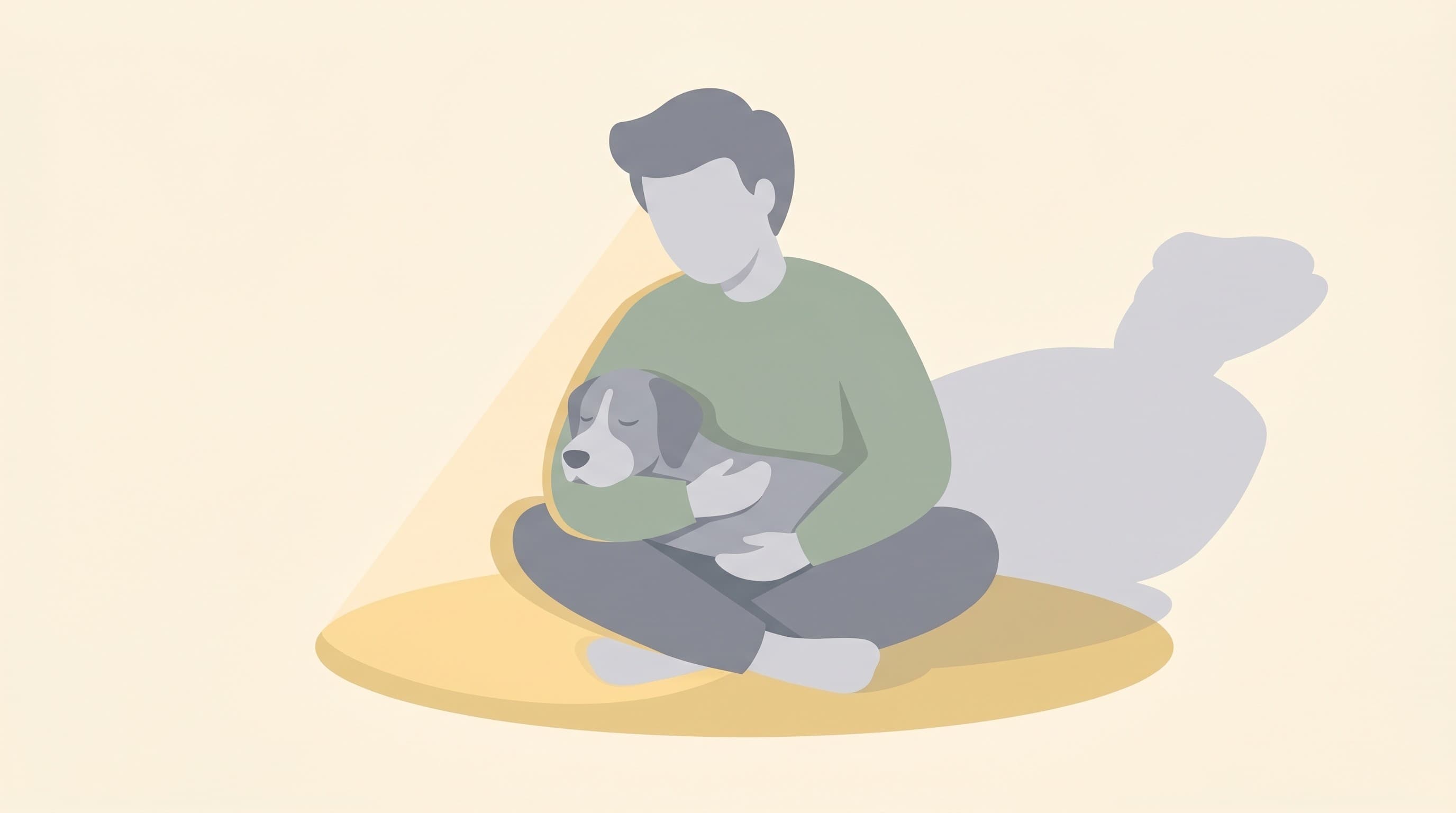
Crying over a pet who is still here, still eating their dinner, still pleased to see you when you walk through the door, is not a sign you have done anything wrong. You have not given up on them. You are not wishing them away, or being morbid, or loving them any less for letting the thought of losing them into the room. You are grieving a loss that has not happened yet, and that is one of the most ordinary, most human things a person who loves an animal can do.
It has a name, and it is older than you might think. In 1944 the psychiatrist Erich Lindemann described people who began to mourn in advance of a death or separation they could see coming, and he called it anticipatory grief (Lindemann, 1944). The phrase has been with us ever since, used for the husband watching a wife fade, the family living alongside a terminal diagnosis, and, just as truly, the owner sitting up at midnight listening to an old dog breathe. So if no one has given you the word before, here it is. What you are feeling is real, it is named, and you are in a great deal of company.
This page is not going to hand you a to-do list. It is about why this happens, and why the guilt that comes with it is misplaced.
One thing first, because grief and the small hours so often arrive together. If you are reading this in the middle of the night and the dread has tipped into a thought that you cannot go on, please pause here and ring the Samaritans on 116 123. It is free, from any phone, at any hour, and you do not have to be in crisis or "bad enough" to call (Samaritans, n.d.). Loving an animal this much, and dreading their loss, is a real and worthy reason to reach out. The rest of this page will keep.
Where the feeling comes from
Anticipatory grief is the sorrow, dread, worry and love that arrive when you know, or fear, that a loss is on its way. In pets it tends to begin at a grave or terminal diagnosis, or more gradually, as an owner watches a once-bouncy dog or a fastidious cat slowly become something frailer (Lap of Love, n.d.; APLB, n.d.). It is not a sign of weakness or a failure to "stay positive". It is, at its root, the mind doing what minds do with something too large to absorb all at once: beginning to take it in a little at a time, ahead of the day itself (Lindemann, 1944).
The first thing to understand about it is that it does not behave in a straight line. It comes in waves. The Association for Pet Loss and Bereavement, which runs support specifically for owners in exactly your position, describes anticipatory grief as an emotional rollercoaster, a tide of sorrow, dread, worry, anger, guilt and confusion that can wash in and out many times in a single day (APLB, n.d.). You can be perfectly steady making a cup of tea and undone by the sight of the lead on its hook. None of that is you handling it badly. That is simply what this kind of grief is shaped like, and knowing that can take some of the fright out of your own feelings when they refuse to settle.
Hope makes it more confusing, not less. A good day, when your pet eats well and seems brighter, can lift you up and then leave you strangely disoriented when you remember that the prognosis has not actually changed (APLB, n.d.). People sometimes feel guilty for being happy on those days, as though hope were a betrayal of the seriousness of things, or for the small drop that follows, as though they had wished the good day away. Neither is true. Hope and grief are not opposites here. They are two things that live, uneasily but truly, in the same week.
Grieving someone who is still alive
Of all the feelings that come with this, the one I most want to take off your shoulders is the guilt. Many owners feel that by grieving early they are somehow betraying their pet: giving up on them, "writing them off", even hastening the loss by daring to think about it. Some feel almost superstitious about it, as if mourning in advance might summon the very thing they dread.
Let me dismantle that as gently and as firmly as I can. Grieving in advance is not abandonment. It is the opposite. You grieve in advance precisely because the bond is so strong that your mind has already started reaching for the shape of life without them (Lindemann, 1944; APLB, n.d.). It does not mean you love them less, that you want them gone, or that you have stopped fighting for them. It certainly does not bring the loss any closer. The tears that catch you while your pet is curled warm against you are not a sign you have one foot out of the door. They are love, doing its difficult work early.
It can help to separate two kinds of guilt, because they often get tangled and they belong in different places. There is the guilt of grieving while they are still alive, which is the one this page is about, and which is misplaced. And there is the quite different weight some owners carry about a decision that may be coming, the "am I thinking about this too soon, or leaving it too late" guilt. That second one is its own hard thing, and it has a piece written just for it in the guilt is normal. If your mind keeps circling a looming decision, that may be where your guilt really lives, and you are allowed to go and read about it. But the simple act of grieving a pet who is still here needs no forgiveness at all.
A tiredness that sleep does not fix
If you are bone-tired in a way that sleep does not fix, I want you to know that this is not you being feeble. There is a particular exhaustion that comes from caring for a seriously ill animal and "waiting for the other shoe to drop", and it is not just a feeling. It is measurable.
A UK study looked at 238 owners and compared those caring for a dog or cat with a chronic or terminal illness against matched owners of healthy pets. The carers had significantly greater caregiver burden, more stress, more symptoms of depression and anxiety, and poorer quality of life, and the heavier the burden, the worse their psychological functioning tended to be (Spitznagel et al., 2017). The depletion you are feeling is something researchers can see in the numbers. You are not weak, and you are not failing to cope with something everyone else would breeze through. You are carrying a genuine, documented load, the watching and the worrying and the medicating and the bracing, and it is heavy because it is heavy, not because you are not strong enough.
This matters for a practical reason, which I will come to: if the load is real, then rest is not an indulgence, and asking for help is not giving up. But first I need to level with you about something, because there is a comforting idea attached to anticipatory grief that I think does more harm than good.
No quota of grief to fill in advance
There is a tempting reassurance that gets offered to people in your position, and I am not going to offer it to you, because the evidence does not support it and because, when you look at it closely, it is just a kinder-sounding way of telling you to suffer now. The idea goes: at least you are preparing yourself, so it will hurt less later. Grieve hard enough in advance, the thinking runs, and you will have done some of the work, banked some of the pain, softened the blow.
The truth is plainer and, I think, far kinder. There is no fixed quantity of grief that you have to get through before the day comes, no quota to fill in advance to spare yourself afterwards. The most rigorous look at this question, a systematic review of caregivers facing the loss of a loved one, set out to test exactly that comforting assumption and did not find it. High levels of grief during the caregiving period, together with feeling unprepared, actually predicted worse outcomes after the loss, including complicated grief, not better ones. The review concluded outright that the long-held idea that grief work before a loss eases grief afterwards "was not confirmed" (Nielsen et al., 2016).
I want to be careful here, because this could land as a rebuke and it is meant as a relief. I am not telling you that your grief is wrong, or harmful, or that you should be stopping it. You could not stop it if you tried, and you should not try. What I am telling you is that you can put down the extra burden of grieving on purpose, of grinding through the dread in the belief that it is a task you must complete to protect your future self. It is not. You do not owe anyone, least of all the version of you who will be standing here on the hardest day, a certain amount of suffering paid in advance.
It is only fair to say that not everyone in the research agrees, and I would rather show you the genuine tension than pretend the matter is settled. A 2023 study of bereaved dog owners reflected the older, traditional view, suggesting that anticipatory grief can leave people feeling better prepared and might reduce how long and how hard they grieve afterwards (Testoni et al., 2023). That sits in real tension with the larger review above, and reasonable people can hold both findings in view. The defensible reading, the one I would stake my name on, is this: anticipatory grief is normal and not harmful in itself, but whether it helps you later seems to depend far less on how much you grieve now and far more on whether you feel prepared and supported (Nielsen et al., 2016; Testoni et al., 2023). The goal was never to grieve "correctly" or thoroughly enough in advance. The goal is to feel less alone, and more ready, and those are won by support, not by suffering.
Turning the feeling toward the time you have
So if grinding through dread is not the work, what is? The answer is not sentiment, it is what the people who sit with dying animals and their owners actually advise.
Anticipatory grief, left to its own devices, pulls you forward into the loss, so that you end up living the worst day over and over while the real days slip by half-noticed. The alternative is not to stop feeling, but to let the feeling point you back towards the animal in front of you. The practical wisdom from pet-loss services is to spend the time you have on presence and on small joys that suit a frail body, and on preparing gently, talking openly to your vet, thinking ahead about practicalities, rather than rehearsing the loss in dread before it arrives (Lap of Love, n.d.). Grief, turned outward, becomes attention. The same heightened awareness that makes the lead on the hook unbearable can also make this evening, this sun, this ordinary nap together, land more deeply than it would have a year ago.
I will leave the specific ideas to a piece that does them justice, because there is a real art to making a good last stretch of time, and it belongs to its own page in making memories, a good last week. I would only flag one thing here, because it matters for your peace of mind: anything you do should serve your pet's comfort, not your own guilt. A frail animal does not need a packed itinerary or a grand farewell tour. They need you, calm and present, and the small familiar pleasures they can still enjoy. The point is not a checklist. It is the permission to let the time be tender rather than only frightening.
Rest, and let people help, while they are still here
This is where the exhaustion we named earlier meets the rest of it, and becomes something you can act on. Because the load is genuinely heavy (Spitznagel et al., 2017), resting, sharing the caring, and leaning on the people around you are not luxuries you have to earn. They are part of how you keep going, and part of how you stay well enough to be present for the pet you are trying to be present for.
Tell someone how hard this is. Let them take a night shift, or sit with your pet so you can sleep, or simply listen while you say the frightening things out loud. You do not have to keep the watch alone, and you were never meant to. The same research that questions pre-suffering points to what genuinely helps instead, and it is not grief endured in private. It is preparedness, and it is support (Nielsen et al., 2016). Those are the two things worth reaching for, and both of them are easier the moment another person is in it with you.
When it tips into not coping
I need to draw a line here, clearly, because there is a difference between the ordinary heaviness of anticipatory grief and a distress that is swallowing your life, and the second one is a reason to reach for help now, not to push on alone.
If the dread is taking your sleep, your appetite and your ability to get through the day, or if you find yourself thinking that you cannot go on, please do not wait, and please do not decide you have to carry it by yourself. Ring the Samaritans on 116 123. It is free, from any phone, at any hour of any day, and you do not have to be in crisis, or "bad enough", or suicidal to call them. You can ring them about anything that is too much to hold (Samaritans, n.d.). The grief of an animal who is still here is a real and worthy reason to pick up that phone, and a person who loves their pet this much is exactly the kind of person who is allowed to. This page will still be here afterwards.
That is the floor, and it belongs to crisis support. Everything below it is for the very real, very heavy, but not life-threatening weight of grieving in advance, and there is more of it, and it is kinder than you might expect.
Help is allowed before the loss
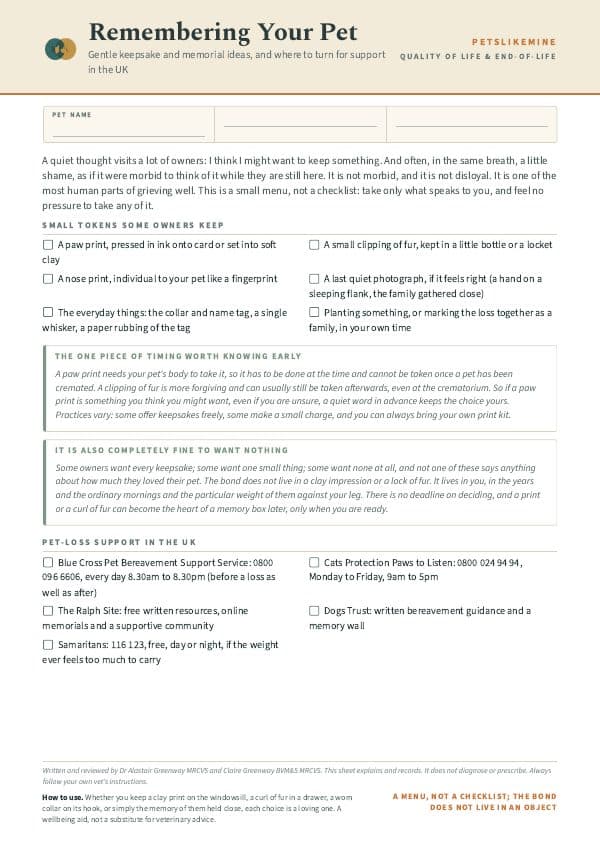
Here is something most people simply do not know: you are allowed to call a pet-bereavement line while your pet is still alive. You do not have to wait until they have gone to be permitted to grieve, or to be helped with grieving.
The Blue Cross Pet Bereavement Support Service exists for exactly this. It offers free, confidential support to anyone affected by the loss of a pet, and it says plainly that this includes people who are facing the anticipated loss of a pet who is still living, not only those who have already said goodbye (Blue Cross, n.d.). It is open every day of the year, from 8.30am to 8.30pm, by phone on 0800 096 6606 and by email, staffed by people trained specifically in pet loss (Blue Cross, n.d.). Sit with that for a moment if you need to. The thing you may have felt was too soon, too dramatic, not really allowed, is precisely what that service is for. If you want an online option that understands this particular grief, the Association for Pet Loss and Bereavement runs a chat room dedicated to anticipatory grief, where you can be among people in the same strange, in-between place (APLB, n.d.).
Reaching out now, while your pet is still breathing, is not an overreaction and it is not too soon. It is one of the wiser, gentler things you can do for yourself, and it is the kind of support the evidence actually points to as helpful (Nielsen et al., 2016).
What I want you to carry
The grief you feel for a pet who is still here is not a betrayal and not a flaw. It is the love still working, reaching ahead of itself because the bond is real. And you do not have a quota of grief to fill before the day comes, so you can stop trying to suffer your way to readiness (Nielsen et al., 2016). What you can do instead is let the feeling turn you back towards the animal in front of you, be present for the ordinary evenings while you have them, rest when you are tired, and let other people carry some of the weight. When the day does come, the grief that follows is real too, and there is a place that says the size of it is entirely normal, waiting for you in is it normal to grieve this much. If a decision is starting to take shape in your mind, that is its own hard and separate thing, with its own careful guide in how will I know when it is time. Neither is for tonight unless you want it to be.
There are people who will pick up the phone right now, while your pet is still here. The Blue Cross Pet Bereavement Support Service (0800 096 6606, 8.30am to 8.30pm every day, and yes, for anticipated loss too) is the one most owners turn to first (Blue Cross, n.d.). The Ralph Site, a free pet-loss resource founded by a vet, offers information, online memorials and a community of people who understand exactly this (The Ralph Site, n.d.). If you have a cat, Cats Protection's Paws to Listen runs a free, confidential line on 0800 024 94 94, Monday to Friday, 9am to 5pm, staffed by trained volunteers who understand the loss of a cat (Cats Protection, n.d.). And Dogs Trust offers gentle bereavement support, with the decent guiding line that you may grieve in your own way and at your own pace (Dogs Trust, n.d.). Asking any of them for help today, with your pet asleep beside you, is not too soon.
References
- APLB (Association for Pet Loss and Bereavement). (n.d.). Anticipatory Grief.
- Blue Cross. (n.d.). Pet Bereavement Support Service (PBSS).
- Cats Protection. (n.d.). Paws to Listen grief support service.
- Dogs Trust. (n.d.). Coping with the loss of your dog (bereavement support).
- Lap of Love. (n.d.). Navigating Anticipatory Grief: Coping Tips for Pet Owners.
- Lindemann, E. (1944). Symptomatology and management of acute grief. American Journal of Psychiatry, 101(2), 141-148.
- Nielsen, M. K., Neergaard, M. A., Jensen, A. B., Bro, F., & Guldin, M. B. (2016). Do we need to change our understanding of anticipatory grief in caregivers? A systematic review of caregiver studies during end-of-life caregiving and bereavement. Clinical Psychology Review, 44, 75-93.
- Samaritans. (n.d.). Contact a Samaritan.
- Spitznagel, M. B., Jacobson, D. M., Cox, M. D., & Carlson, M. D. (2017). Caregiver burden in owners of a sick companion animal: a cross-sectional observational study. Veterinary Record, 181(12), 321.
- Testoni, I., De Vincenzo, C., Campigli, M., Caregnato Manzatti, A., Ronconi, L., & Uccheddu, S. (2023). Validation of the HHHHHMM Scale in the Italian Context: Assessing Pets' Quality of Life and Qualitatively Exploring Owners' Grief. Animals, 13(6), 1049.
- The Ralph Site. (n.d.). Support for pet loss.
Free downloads
Companion worksheets to put what you've read into practice. Free PDFs, print at home.