

Is It Normal to Grieve This Much? Pet Loss Is Real Grief
Alastair Greenway
BVM&S MRCVS
People come to me weeks after a pet has died and half-apologise before they have finished the sentence, asking some version of the same question: is it normal to feel this much, this hard, for an animal? They expected sadness. They did not expect to be ambushed in the supermarket, or unable to sleep, or to feel that something has been physically taken out of them. And almost always there is a quieter fear underneath it: that something is wrong with them for hurting this badly over a dog, or a cat. If the size of this has frightened you, you are not doing anything wrong.
So let me say the most important thing first, before any of the science. What you are feeling is grief, real grief, the same grief a person feels for a person. The force of it is not a sign that you are weak or have lost your sense of proportion. It is a sign of how much you loved, and the research now says so without hedging. This page exists to sit with you in that, to show you the evidence that your grief is normal, to name the strange shapes it takes, and then to point you gently towards people who will pick up the phone. There is nothing here you need to do tonight. You only need to know you are not alone, and you are not broken.
One note before we go on, because grief and the small hours often arrive together. If you are reading this at 3am and the thought has crept in that you cannot go on, please ring Samaritans now, on 116 123. It is free from any phone, landline or mobile including pay-as-you-go, at any hour of any day, and you do not have to be in crisis or "suicidal enough" to call: it is for anyone who has "been struggling to cope" and feels they "need some extra support" (Samaritans, n.d.). Losing a beloved companion is a real and recognised reason to reach out. The rest of this page will still be here afterwards.
The research finally says what you already feel
For a long time, pet grief was treated as a lesser thing, a junior cousin of "proper" bereavement. The current evidence does not treat it that way at all, and the most striking finding is recent and from right here in the UK. In a nationally representative study of 975 British adults published in 2026, researchers measured the symptoms of prolonged grief disorder, the clinical pattern of grief that is intense and enduring, and found those symptoms "operated identically for those who experienced the death of a pet to those who experienced the death of a human" (Hyland, 2026). Their conclusion is worth quoting, because so few owners have ever been told it: "there is nothing unique or special about how PGD symptoms are experienced in relation to a human bereavement" (Hyland, 2026). When grief for an animal is severe, it is not a different, lesser kind of grief you should be able to shrug off. It is the same machinery, doing the same thing, for the same reason.
That study held one more finding I think about often. Among the people who had lived through both kinds of loss, who had buried a pet and also buried a person, 21% named the pet's death as the most distressing bereavement of their entire life (Hyland, 2026). I want to hand you that carefully, because it is not a ranking or a competition. It is permission. If losing your dog has floored you more completely than losing a relative did, you are not a monster and you are not unusual. For roughly one in five people who have known both, the animal was the harder goodbye, and there are real, human reasons why.
The UK study does not stand alone. An earlier Australian study set grief after a human death directly alongside grief after a companion-animal death and found "no significant differences between the levels of grief severity" between the two (Lavorgna & Hutton, 2019). I will be straight about that one: it was small, just fifty people, so I would not lean the whole house on it alone. But it points the same way as the much larger 2026 work, and together they make a sturdy floor to stand on. The grief you feel for an animal can match, in its raw force, the grief you would feel for a person. That is not sentiment, it is what the measurements show.
Why it can hit as hard as losing family
If the grief is real, the next fair question is why. Why would the loss of an animal reach this deep? For dogs, part of the answer is written into our biology, and it is worth a moment because it lifts the whole thing out of "you are just being soft."
When a dog and its owner simply look at one another, both of them get a rise in oxytocin, the same attachment hormone that floods through a human parent holding their newborn. It is a feedback loop, a small chemical conversation: the dog's gaze raises the owner's oxytocin, the owner's response raises the dog's, and round it goes. Tellingly, researchers found that "gazing behaviour from dogs, but not wolves, increased urinary oxytocin concentrations in owners", which suggests this loop grew up specifically in the long companionship between our two species (Nagasawa et al., 2015). So when people say the loss feels like losing family, they are not exaggerating. The bond was built, in part, on the very same neurochemistry as a human family bond. Of course it hurts like one.
I should be careful here, because that study was done in dogs, and I will not pretend the identical mechanism has been mapped in cats. But cat owners should feel no less seen, because the deepest root of this grief is not species at all. Both grief studies above point to the same thing: what predicts how hard a loss lands is the strength of the bond, the closeness and attachment, not whether the one you lost walked on two legs or four (Lavorgna & Hutton, 2019; Hyland, 2026). The size of the grief is simply the size of the love. And love between a person and a cat is built the way most love is built, in daily proximity and trust, which brings us to the thing that makes pet grief so peculiarly sharp.
A life lived in routine, and the ache of the gaps
There is a specific kind of ache pet owners describe, and it is not really about the big moments. It is about the ordinary ones. Our animals are woven into the fabric of every single day in a way that very few human relationships are: the feed at the same hour every morning, the walk at the same time every evening, the weight settling onto the end of the bed, the small face waiting at the door when you come home. A pet is not someone you see on Sundays. A pet is the texture of your daily life.
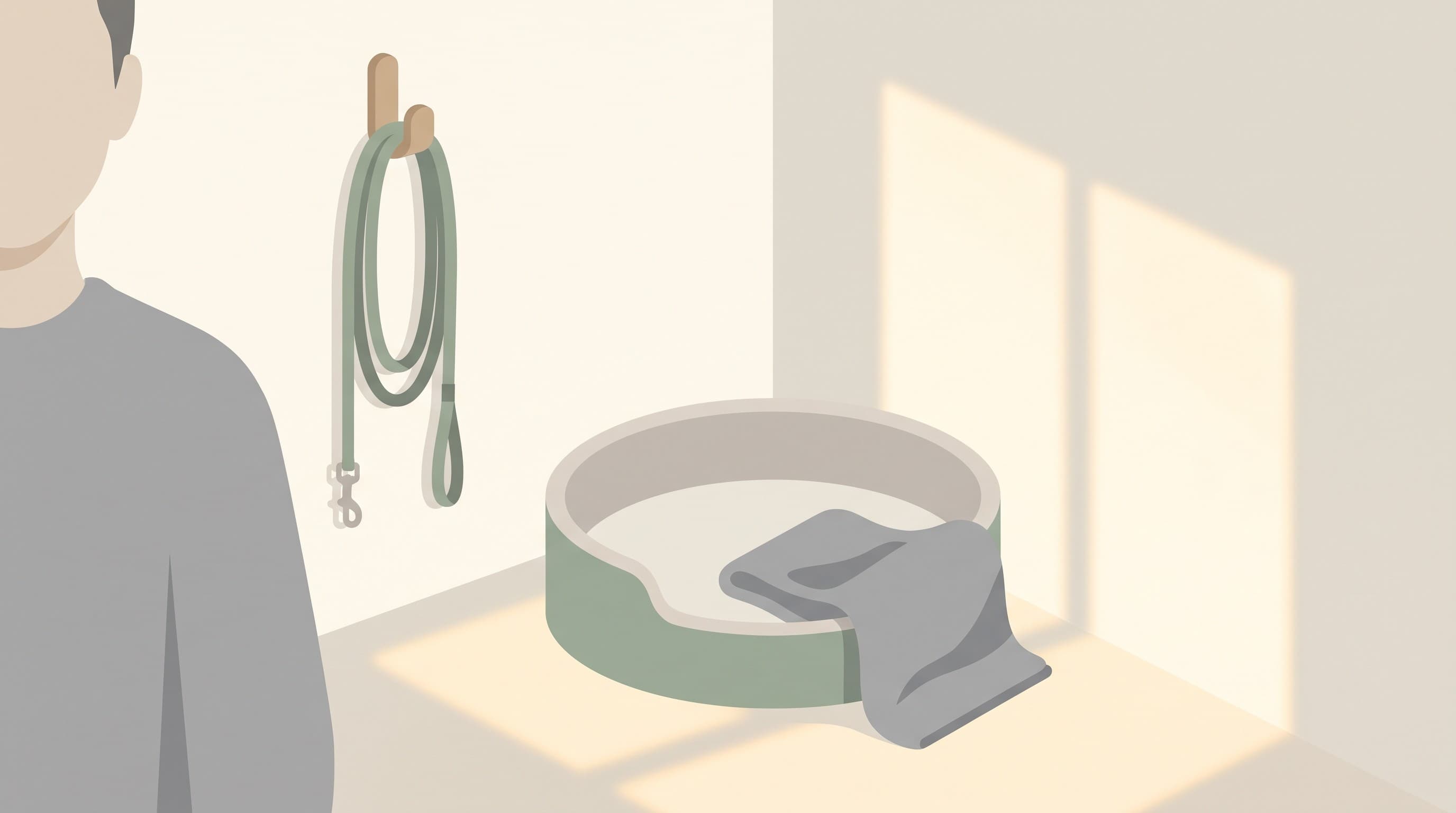
Which is exactly why the grief ambushes you in the gaps. The empty patch of floor where the bowl used to sit. The lead still hanging on its hook. Reaching down at 6am out of pure habit and finding nothing there, or coming through the front door to a silence where there used to be a greeting. The house does not feel empty so much as loud with quiet. If you have found yourself crying not over your pet's last day but over an unwashed food bowl, that is why, and it is one of the most normal things in the world. This is grief for a relationship that lived in the smallest routines, so it is in the smallest routines that you will miss them most. The practical side of those first raw days, what on earth to do with the bed and the toys and the bowl, has its own gentle companion in the first days: the empty bowl and the quiet house.
Grief shows up in the body, and that is normal too
One of the things that frightens owners most is when grief stops feeling purely emotional and starts feeling physical, because no one warned them it would. So let me reassure you plainly: bereavement is a physiological event, not only a feeling, and a long list of bodily symptoms come with it as standard.
Disrupted sleep. Appetite that vanishes, or the opposite, comfort-eating you cannot seem to stop. Bone-deep fatigue, headaches and dizziness (Salamon, 2026). A tightness or heaviness in the chest or throat, difficulty breathing, a dry mouth, oversensitivity to noise, aches and pains, and the strange foggy state where you cannot concentrate on things you would normally find easy, cannot hold a thought, walk into a room and forget why (Marie Curie, n.d.). These are not signs of a separate illness layered on top of your grief. They are the grief, expressed through the body. There is even a measurable mechanism: bereavement switches on the body's stress systems, raising the stress hormone cortisol and stirring up inflammation, which is part of why the limbs feel leaden and the mind will not clear (Seiler et al., 2020). Your body is not betraying you, it is grieving, in the only language a body has.
One physical symptom deserves its own careful sentence, not to frighten you but to validate it and to draw a clean safety line. The "broken heart" is, just occasionally, literal. A sudden, severe emotional shock such as the death of someone you love can trigger takotsubo cardiomyopathy, sometimes called broken heart syndrome, a temporary stunning of the heart muscle that produces real chest pain, a feeling of pressure or heaviness, and breathlessness, usually brought on by overwhelming emotional or physical stress. It affects up to 5,000 people in the UK each year and is most common in women and in people over 50 (British Heart Foundation, n.d.). I tell you this only so the tightness in your chest does not seem mad or shameful. But here is the line that matters, and I would be failing you to soften it: any chest pain or breathlessness that is new, severe, or will not settle should always be checked by a doctor, and the British Heart Foundation is unambiguous about the emergency version, "if you think you're having a heart attack, call 999 immediately" (British Heart Foundation, n.d.). That is not catastrophising. It is simply being as kind to your body as you would be to anyone else you loved.
Relief and guilt, sitting side by side
If your pet was ill, or old, or you carried them through a long decline, there is a feeling that catches a great many owners off guard and then shames them for it. Relief. A quiet, involuntary unclenching, that the waiting is over, that the watching for signs is over, that your pet is no longer suffering and you are no longer holding your breath. And then, hard on its heels, guilt: what kind of person feels relieved?
A normal, loving one. In a study of 672 bereaved companion-animal owners, the large majority, around 73%, experienced their grief without guilt at all, while a meaningful minority, roughly 22%, carried guilt or ambivalence alongside a decision they still believed was right (Davis et al., 2018). Relief and grief are not rivals; they live together, because you can be heartbroken that your pet is gone and relieved that their suffering has ended in the same breath. Relief is not betrayal. It does not mean you wanted them gone or loved them any less, it means you loved them enough to be glad their pain is over. If the harder, sharper guilt of the decision itself is what is gnawing at you, whether you chose the right moment, the dedicated piece on why the guilt is normal was written for exactly that. Here I only want to lift the everyday version off your shoulders: the relief you feel is allowed, and so is the guilt about the relief, and neither means you did anything wrong.
There is no "should" to any of this
Somewhere in the second or third week, a new worry tends to arrive, and it is almost the opposite of the first. Not "is it normal to feel this much" but "shouldn't I be over this by now?" People around you may have started, gently or not so gently, to expect you to be getting back to normal.
Let me take the weight of that off you too. There is no correct dose of grief, and no deadline on it. Grief does not run to a tidy schedule and does not move in a straight line, and comparing your own to anyone else's, or to how you imagine you "should" feel about an animal, is a trap that will only hurt you. The charities that support grieving owners say the same in their own words: allow yourself to "grieve in your own way and at your own pace", because "there is no right or wrong way to process your emotions" (Dogs Trust, n.d.). The way grief actually behaves over the longer term, the waves that come from nowhere, the dates that ambush you, the slow uneven settling, has its own clear guide in grief has no timetable: waves, triggers and anniversaries, and if you have reached the stage of wondering why this is taking so long, that is the piece to read next. The single thing to hold onto here is that there is no clock. You are not behind. You are exactly where grief has taken you.
You do not have to choose between healing and keeping them
I want to gently dismantle one more idea before we get you to some support, because it haunts a lot of grieving people and it is, by the best modern understanding, simply wrong. That idea is that healthy grief means "letting go", "moving on", cutting the cord and leaving them behind. Many of us absorbed that somewhere, and then feel like we are failing at grief because we cannot, and do not want to, let go.
Modern grief theory abandoned that model decades ago. The framework now is what researchers call continuing bonds: the understanding that keeping an ongoing inner connection to the one you have lost is a normal, healthy part of grieving, not a failure to recover from it (Klass, Silverman & Nickman, 1996). The bond does not have to be severed for you to heal. It changes form. It becomes memory, and habit, and the particular way you will always tell their story, and that is not you being stuck, it is grief working exactly as it is meant to. The ways people choose to tend that ongoing bond, the keepsakes and small rituals and remembering, are gathered in ways to honour and remember your pet for when you are ready, and not a moment before.
There is a line that gets passed around about all this, usually on a greetings card and usually misattributed to the Queen, and I have always slightly winced at it for being too neat. But it comes from a real source: the psychiatrist Colin Murray Parkes, one of the foundational researchers of human bereavement, who wrote that the pain of grief "is just as much a part of life as the joy of love; it is, perhaps, the price we pay for love, the cost of commitment" (Parkes, 1972). I offer it once, and only because it is true. The reason this hurts so much is not that something has gone wrong. It is that you committed yourself, fully, to loving a creature whose life was always going to be shorter than yours, and you paid the price you knew, somewhere, would come due. That is not a tragedy of your making. It is what it costs to have loved an animal well.
You do not have to carry this alone
So here is where I will leave you, not with a tidy ending, because grief does not have one, but with the names of people whose whole job is to sit with you in this. Reaching out to any of them is not an overreaction, and it is not making a fuss over an animal. It is the sensible, kind thing to do with a real grief.
In the UK, Blue Cross Pet Loss Support (also known as the Pet Bereavement Support Service, running since 1994) offers free, confidential support by phone, email or webchat, from people trained specifically in pet loss. The freephone line is 0800 096 6606, open 8.30am to 8.30pm every day (Blue Cross, n.d.). The Ralph Site is a free, not-for-profit pet-loss website founded in 2011 by a veterinary surgeon after the loss of his own cat, with information, online memorials and a supportive community of people who understand exactly what you are feeling (The Ralph Site, n.d.). If you have lost a cat, Cats Protection's Paws to Listen runs a free, confidential grief line staffed by trained volunteer listeners, a sympathetic ear rather than formal counselling, on 0800 024 94 94, Monday to Friday, 9am to 5pm, excluding bank holidays (Cats Protection, n.d.). And Dogs Trust offers its own bereavement support, with the simple and decent guiding line that you should grieve in your own way and at your own pace (Dogs Trust, n.d.). For the fuller picture, including how to know when grief might need professional help and how to support someone else who is grieving a pet, our hub on where to turn when grief is overwhelming gathers it all in one place.
And the one number to keep closest, the one from the top of this page: if at any point the grief tips into "I cannot go on", ring Samaritans on 116 123, free, day or night (Samaritans, n.d.). You do not have to be at the edge to call. You only have to be hurting.
References
- British Heart Foundation. (n.d.). Takotsubo cardiomyopathy (broken heart syndrome).
- Blue Cross. (n.d.). Pet Loss Support (Pet Bereavement Support Service).
- Cats Protection. (n.d.). Paws to Listen grief support service.
- Davis, H., Irwin, P., Richardson, M., & O'Brien-Malone, A. (2018). The euthanasia decision-making process: A qualitative exploration of bereaved companion animal owners. Bereavement Care, 37(3), 109-117.
- Dogs Trust. (n.d.). Coping with the loss of your dog (bereavement support).
- Doka, K. J. (1989). Disenfranchised Grief: Recognizing Hidden Sorrow. Lexington Books.
- Hyland, P. (2026). No pets allowed: Evidence that prolonged grief disorder can occur following the death of a pet. PLoS One, 21(1), e0339213.
- Klass, D., Silverman, P. R., & Nickman, S. L. (Eds.). (1996). Continuing Bonds: New Understandings of Grief. Taylor & Francis.
- Lavorgna, B. F., & Hutton, V. E. (2019). Grief severity: A comparison between human and companion animal death. Death Studies, 43(8), 521-526.
- Marie Curie. (n.d.). Physical symptoms of grief.
- Nagasawa, M., Mitsui, S., En, S., Ohtani, N., Ohta, M., Sakuma, Y., Onaka, T., Mogi, K., & Kikusui, T. (2015). Oxytocin-gaze positive loop and the coevolution of human-dog bonds. Science, 348(6232), 333-336.
- Parkes, C. M. (1972). Bereavement: Studies of Grief in Adult Life. Tavistock.
- Salamon, M. (2026). Losing a pet can trigger grief as intense as human loss. Harvard Health Publishing, Harvard Medical School, 18 February 2026.
- Samaritans. (n.d.). Contact a Samaritan.
- Seiler, A., von Känel, R., & Slavich, G. M. (2020). The psychobiology of bereavement and health: A conceptual review from the perspective of social signal transduction theory of depression. Frontiers in Psychiatry, 11, 565239.
- The Ralph Site. (n.d.). Support for pet loss.