Ways to Honour and Remember Your Pet
Alastair Greenway
BVM&S MRCVS
Once the first shock has eased and the house has gone quiet, many owners feel a small, insistent pull to do something. To mark that this animal was here. That they mattered. And then, almost in the same breath, a doubt arrives: is it silly to make a fuss over a dog, a cat, a rabbit? Should I be over this by now rather than wanting to plant a tree or frame a photograph?
Let me settle that doubt before we go a step further. Wanting to honour your pet is not morbid, not self-indulgent, and not a sign that you are stuck. It is one of the most normal and quietly healthy things a grieving person can do. For decades the understanding of grief has moved away from the old idea that mourners must "let go" and fully detach, towards what researchers call continuing bonds: keeping an ongoing, symbolic relationship with the one who died is now seen as a normal and often healthy part of grief, not a failure to move on (Klass, Silverman & Nickman, 1996). Reminiscing, keeping a few special possessions, marking the loss in some small way: these are classic expressions of that bond, not obstacles to recovery.
So this page is, more than anything, permission. Permission to make something, and equal permission to make nothing at all. There is no right or wrong way to grieve and no right length of time for it (PDSA, n.d.), and finding a way to honour your pet, when you want one, is recognised as an important part of healthy healing (AVMA, n.d.). What follows is a gentle menu, not a checklist to complete. Take what speaks to you, leave the rest, and please hold one thing throughout: an owner who never builds a shrine did not love their pet any less than one who does.
Why even a small gesture helps, and why it is never silly
Perhaps part of you suspects that lighting a candle or writing a letter is a bit much. If so, the evidence is on your side, not your scepticism's. Across a series of experiments, people who carried out a ritual after a loss reported lower grief afterwards, and the effect was explained by a regained sense of control, something bereavement strips away so cruelly. Strikingly, the benefit appeared even in people who did not believe rituals would work (Norton & Gino, 2014). You do not have to be a spiritual person, or even a sentimental one, for a small marked moment to help you feel a little less powerless.
There is one caveat to add. Memorialising helps many people, but not everyone in the same way. A study of 496 bereaved owners found that the relationship between continuing bonds and grief is not uniform: it depends in part on a person's attachment style, easing the grief of some more than others (Lykins et al., 2024). There is no single correct memorial, because people are not interchangeable. If an idea here lifts something in you, follow it. If it leaves you cold, that tells you it is not yours, not that you are grieving wrongly. Honouring the bond can give grief a shape to hold, and there is no standard timeline for any of it (Ohio State University Veterinary Medical Center, n.d.).
One note on overlap before the menu. This piece is about the broad, ongoing work of memory in the weeks and months after a loss. The tender, time-sensitive keepsakes you ask the practice for at or near the end, the ink or clay paw print, a lock of fur, a nose print, and how and when to request them, have their own dedicated guide in keepsakes: paw prints and fur clippings. I will mention a paw print or a tuft of fur as a starting point, but for the "what to ask the vet for, and when" detail, that is the page to read.
Keepsakes as lasting objects of memory
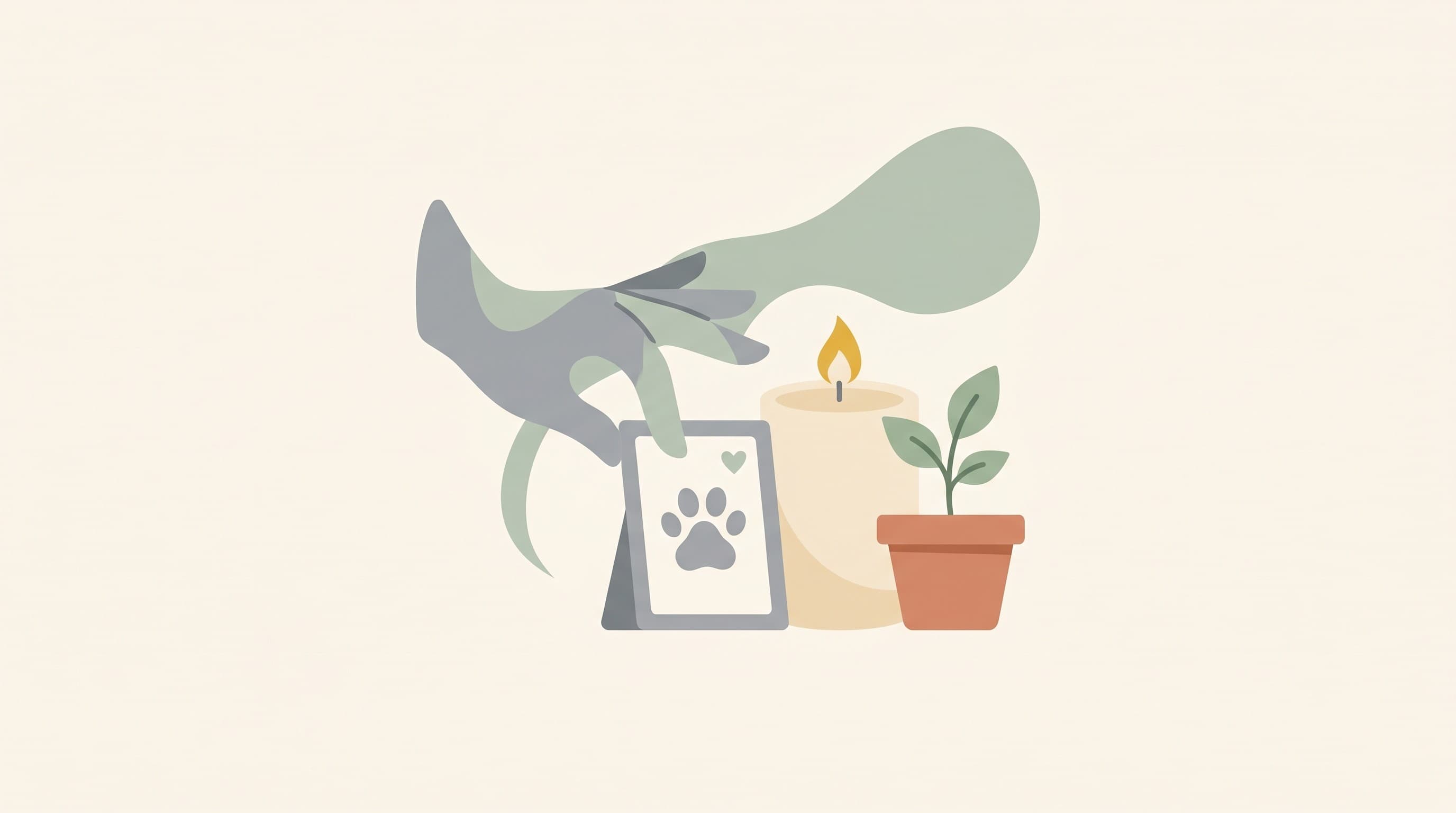
For a great many people the first instinct is simply to keep something to hold. There is good reason for that: a physical token can give grief somewhere to land, validating that the loss is real and easing the strange isolation of it. The classic is a memory box, a single place to gather the small things that were unmistakably theirs: the collar and name tag, a favourite toy, a tuft of fur, that paw print (Blue Cross, n.d.; The Ralph Site, n.d.). There is no right way to assemble one and nothing you must include. Some people fill a beautiful box over an afternoon; others add a single thing and close the lid for a year. Both are fine.
Beyond the box, the most enduring keepsakes tend to be the ones you live alongside. A favourite photograph, properly framed, or a commissioned portrait in paint, pencil or ink, turns a memory into something on the wall you greet rather than something hidden in a drawer (The Ralph Site, n.d.). If your pet was cremated and the ashes were returned to you, a small amount can be set into a piece of jewellery or sealed within glass, so that a little of them travels with you. I will not explain cremation itself here, individual versus communal, ashes returned, home burial, pet cemeteries, because that whole subject is owned by aftercare: cremation and burial options in the UK. For how ashes work and what is possible, that is your page. Here I only want you to know that ashes-based keepsakes exist and are a gentle, popular choice, never an obligation.
Rituals and marking the loss
Where keepsakes are objects, rituals are moments, and they suit people who would rather do something than keep something. The gentlest and most lasting is often a living one: planting a tree, a shrub, or some bulbs in a favourite spot in the garden, somewhere that will green and flower long after the rawness has passed (Blue Cross, n.d.; PDSA, n.d.). Others light a candle on a quiet evening, or hold a small ceremony, no more than a few words said together as a family, perhaps as a collar is buried or a little of the ashes is scattered (PDSA, n.d.). None of this needs to be formal or witnessed. The point is agency, marking the loss on your own terms, not performance.
Writing has its own place here, and I want to be candid about it rather than prescribe it. Some people find real release in writing a letter to their pet, or a thank-you for the years, or keeping a few lines in a remembrance journal, and the idea appears on most vets' and charities' lists of ways to honour a pet (AVMA, n.d.; The Ralph Site, n.d.). But the popular advice to "just write it all down" rests on shakier ground than it sounds. In bereavement specifically, structured expressive-writing exercises have repeatedly failed to show the benefit you might expect, and putting the story of a loss into words does not, by itself, reliably ease the grief (Stroebe et al., 2002). So treat a letter or a journal as something that genuinely helps some people and does nothing for others. If the pen sits heavy in your hand, put it down without a second thought. This is not homework, and there are no marks for it.
A lasting legacy: donations and sponsorships in their name
For some owners the most fitting thing is to turn the love outward, into help for other animals. Making a donation to an animal charity in your pet's memory is the very first idea the profession's own guidance lists among ways to honour a pet (AVMA, n.d.), and in the UK there are warm, well-run routes for doing exactly that. None of them carries a minimum, and a local rescue or a cause your pet would have benefited from is every bit as valid as a national charity.
For a dog, Dogs Trust offers a tribute fund, a dedicated online space where family and friends can share memories, messages, stories and photographs and, if they wish, give in your dog's memory; a Memory Wall where you can read others' stories and add your own; and a personalised memorial tag mounted on a sculpture, with a replica tag to keep (Dogs Trust, n.d.). For a cat, Cats Protection mirrors much of this: you can set up a tribute page and give in a cat's memory, add to a Cat Memory Wall, or sponsor a cat pen so that the bond becomes shelter for another animal, with an In Memory team reachable on 0800 917 2287 (Cats Protection, n.d.). Cats Protection is, naturally, cat-focused, so for a dog the Dogs Trust routes above, or any rescue close to your heart, are the better fit.
One more option is worth knowing, because it is built precisely for this. The PDSA runs a National Collection of Pet Memories, which lets you commemorate your pet's life in a way meant to leave a lasting legacy for other pets, with a freephone line on 0300 3737 226 (PDSA, n.d.). Whichever route you choose, or if you choose none, the principle is the same: there is no pressure here, only an offer. Some people find that the kindest thing they can do with their grief is to spend a little of it on an animal who is still waiting for a home.
Memory books, physical and digital
If you would like to gather the whole story rather than a single object, a memory book is a lovely middle path, and it can be as analogue or as digital as suits you. A scrapbook or photo album, assembled at your own pace, is among the most commonly suggested ways to honour a pet (AVMA, n.d.), and a remembrance journal with gentle prompts gives the same shape to those who would rather have a structure to lean on. None of this needs finishing on any timetable; a half-filled album left for a quieter month is not a failure.
Online, the options are generous and mostly free. The Ralph Site lets you create a free online memorial with photographs; you register to post, there is no time limit so you can add the story when you are ready, and for three years the memorial is featured on their Facebook page on the anniversary of your pet's passing (The Ralph Site, n.d.). The Blue Cross hosts an online dedication wall where you can honour your companion, share your memories and find comfort in the stories of others (Blue Cross, n.d.), and both Dogs Trust and Cats Protection keep memory walls of their own where you can read other owners' tributes and add yours alongside them (Dogs Trust, n.d.; Cats Protection, n.d.). There is a particular comfort in these shared spaces that a private album cannot give: the quiet proof that you are not the only one who has loved an animal this much.
Their life, in the moments you tracked: the PetsLikeMine memorial
PetsLikeMine members have one form of remembrance that is uniquely theirs, and I want to introduce it gently, because it is the opposite of a sales pitch. For months, perhaps years, you logged things. The weights and the walks. The meals and the medications. Quality-of-life scores on the harder days, photographs on the good ones, the small milestones that made up an ordinary life. At the time those entries may have felt like admin, the dutiful housekeeping of a careful owner. They were nothing of the sort. Every one of them was an act of care, and together they are a record almost nowhere else holds: the months you spent caring for them, the weights and walks and notes you logged, gathered into a remembrance, their life in the moments you tracked.
On your pet's page you will find a gentle action: Memorialise. Choosing it lets you, if you wish, add a short tribute of a few words and the date they passed, after which their profile carries a small rainbow badge and health logging quietly stops. Their posts and their place in the community remain; nothing is deleted. And here is the part I most want you to carry, because grief and irreversible buttons are a cruel pairing: the action can be undone within 90 days. There is no rush, no permanent click to dread on a hard afternoon. You can leave it for weeks, undo it and come back to it. It will wait for you.
Let me be equally clear about who this is not for. If you never logged a thing, you have lost nothing. A shoebox of photographs, a drawer of collars, a story you tell at the table does precisely the same work, and just as beautifully. The data-memorial is not a reason to wish you had tracked more, and it looks only backwards, at care already given. It is simply that, for those who happened to keep the record, that record can become a quiet and unexpected keepsake.
A place among people who understand
Of everything that reliably helps a grieving owner, one of the simplest is also among the strongest: being among people who will not say "it was just a dog." Talking with others who have lost a pet is recognised as one of the most effective supports there is, precisely because they will not minimise it (AVMA, n.d.). PetsLikeMine keeps a space for exactly this, the Rainbow Bridge community, a supportive room for those who have lost a pet, where you can share memories and find comfort. It is somewhere to be met without a stopwatch and without the well-meaning "at leasts" that wound, by people walking the same road. I mention it as an invitation, never a push. If you are not ready, or it is not for you, that is entirely fine.
A memorial can also become a quiet anchor when the harder dates come round. The waves, the triggers, the dread before an anniversary and the way grief loops back when you thought it had eased are all normal, and they have their own guide in grief has no timetable: waves, triggers and anniversaries. Some people find that a candle on the anniversary, or a visit to the tree they planted, gives a shapeless day something to hold. And in time, though only when and if it is right for you, some owners find they honour the pet they lost by opening their heart to another, a step that deserves its own careful thought in are we ready for another pet?. Neither of these is a task on a list. They are simply two of the many shapes that love can take after a loss.
The bond does not end, it changes shape
The doubt you may have arrived with, the worry that wanting to mark this is somehow a fuss: it is not. Whether you build a memory box this week, plant something next spring, give in their name, fill an album over a year, choose the in-app memorial, or do none of these and simply carry them quietly in your thoughts, you are grieving exactly as you should. There is no deadline, no wrong way, and no obligation to do any of it (PDSA, n.d.; AVMA, n.d.). Some people make something in the first few days; some, years later; some, never, and they love their pet no less for it.
What I can promise you is this. The bond you had does not have to end. It changes shape, from a relationship with a living animal into something carried in memory, and the love you are holding now does not have to go nowhere. It has somewhere to go, into a box or a tree or a tribute or a story told and retold, or simply into the rest of your life, lived a little more gently for having known them. That is not the end of something. It is the bond, continued, in a new form.
If the grief itself ever feels too heavy to carry alone, please reach for support; wanting it is not weakness, and it is never an overreaction to mourn a member of your family. In the UK, the Blue Cross Pet Bereavement Support Service offers a free, confidential listening line on 0800 096 6606, open 8.30am to 8.30pm every day, with webchat and email (plsmail@bluecross.org.uk) during the same hours. The Ralph Site (theralphsite.com) provides written resources, free online memorials and a peer-support community. If you have lost a cat, Cats Protection's Paws to Listen is a cat-focused grief line on 0800 024 94 94, Monday to Friday, 9am to 5pm. Dogs Trust offers written bereavement guidance and a memory wall, and signposts anyone wanting to talk to the Blue Cross line above. The fuller map of where to turn, including online communities and how to find pet-loss counselling, is gathered in pet loss support: where to turn. And if grief ever tips into a thought that you cannot go on, please ring the Samaritans on 116 123, free, day or night, every day of the year.
References
- American Veterinary Medical Association (AVMA). (n.d.). Coping with the loss of a pet.
- Blue Cross. (n.d.). Pet loss and bereavement support; Dedication Wall. and https://petmemorial.bluecross.org.uk/
- Cats Protection. (n.d.). Giving in memory.
- Dogs Trust. (n.d.). In memory.
- Klass, D., Silverman, P. R., & Nickman, S. L. (Eds.). (1996). Continuing Bonds: New Understandings of Grief. Taylor & Francis/Routledge.
- Lykins, A. D., McGreevy, P. D., Bennett, B., Paul, N. K., & Gotsis, N. (2024). Attachment styles, continuing bonds, and grief following companion animal death. Death Studies, 48(7), 698-705.
- Norton, M. I., & Gino, F. (2014). Rituals alleviate grieving for loved ones, lovers, and lotteries. Journal of Experimental Psychology: General, 143(1), 266-272.
- Ohio State University Veterinary Medical Center. (n.d.). Honoring the Bond: Support and resources for pet owners.
- PDSA. (n.d.). How to cope with the loss of a pet.
- Stroebe, M., Stroebe, W., Schut, H., Zech, E., & van den Bout, J. (2002). Does disclosure of emotions facilitate recovery from bereavement? Evidence from two prospective studies. Journal of Consulting and Clinical Psychology, 70(1), 169-178.
- The Ralph Site. (n.d.). Create a free online pet memorial; Pet memorials.
Free downloads
Companion worksheets to put what you've read into practice. Free PDFs, print at home.